




Access control
Entity-, role-, and permission-level data segregation (Keycloak or equivalent IDP for SSO/MFA)
Build custom platforms that connect portfolio, reporting, compliance, and client data — for firms where operations can't scale with AUM growth, alternative assets, or LP/board expectations.



Getting from login to a client's answer takes ten screens and three logins — the tool adds work instead of removing it.
When a core platform shuts down, "we'll migrate the data properly later" isn't an option — the fallback becomes manual entry under time pressure.
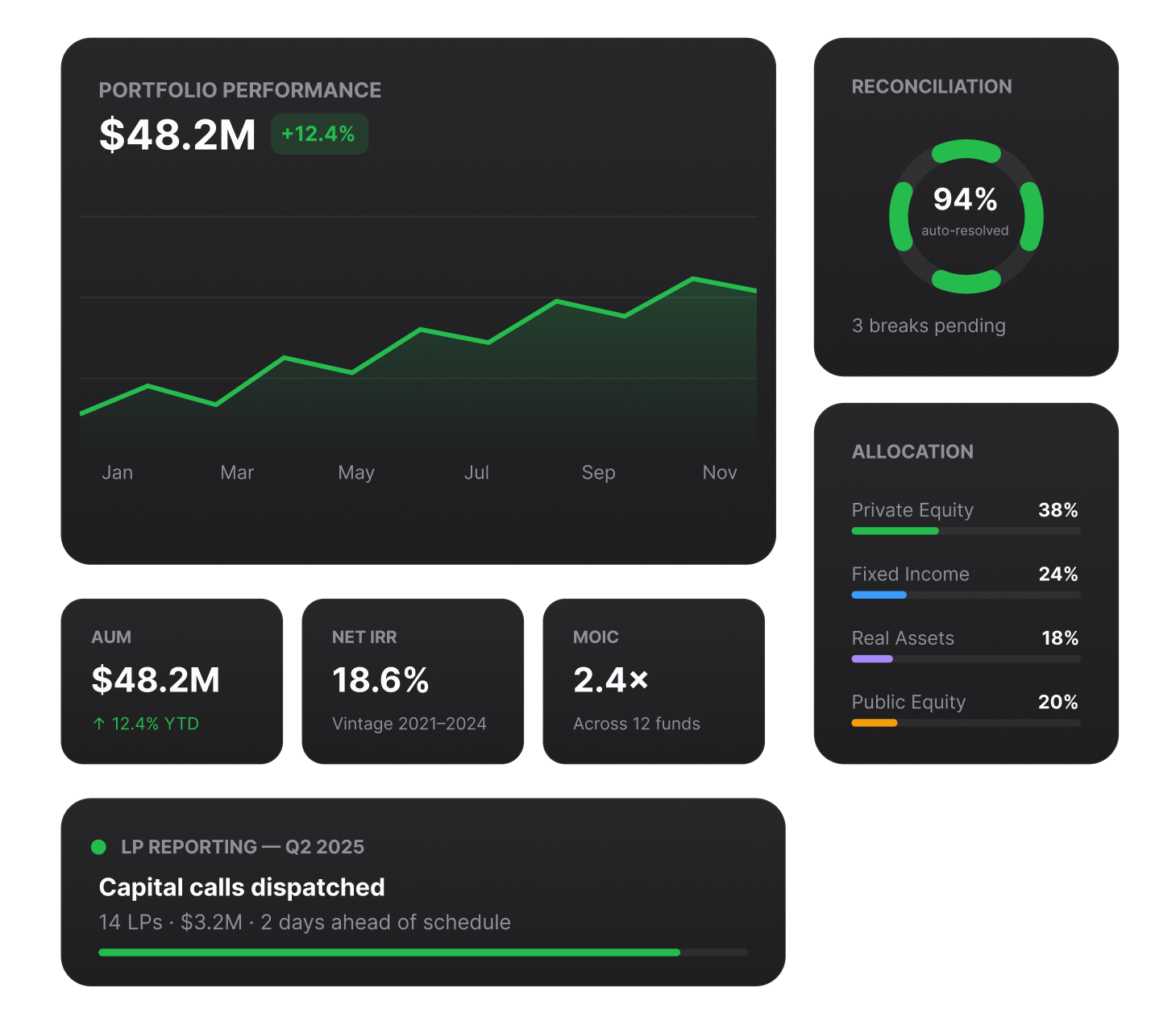
Your PMS says one NAV, your accounting system says another, and someone has to manually figure out which one is right — every day, before anyone can trust a report.
Capital calls, distributions, K-1s and portfolio metrics arrive as PDFs and portal exports. Someone assembles them into a deck — and that deck is your credibility with LPs and trustees.
Private fund NAVs lag, portfolio company KPIs come in five different formats, and unfunded commitments live in a spreadsheet no one fully trusts.
The workflow runs because someone senior knows the workarounds, the exceptions, and where the "real" numbers live. If they leave, the process leaves with them.
Trusts, SPVs, co-invest vehicles, and multi-entity ownership don't fit cleanly into standard reporting tools — so every exception becomes a manual project.
IPS ranges, mandate restrictions, and disclosure requirements get reviewed in hindsight, when a report is already out the door — instead of being enforced as the data moves.
We build for firms where domain complexity and fiduciary stakes make off-the-shelf software too rigid. Every engagement below works alongside your existing systems — we close operational gaps, not rebuild your stack.
Reconciliation breaks between trading, accounting, and reporting, usually surfaced by an ETF launch or a vendor like Aladdin or Charles River that can't flex for a new product structure.
LPs judge operating maturity, not just returns — and Excel plus DealCloud stops being enough once a new fund or fundraise puts your reporting under a microscope.
Trusts, LLCs, and SPVs need to map back to entities, beneficiaries, and tax views — but that data is trapped in PDFs and capital statements, not the portfolio system.
Every client has a custom IPS and a custom report format. The workflow behind them needs to be standardized — without making every client's report look the same.
Alternatives reporting — capital calls, K-1s, unfunded commitments — is where the process breaks first when every family needs its own format.
Basket construction, PCF accuracy, and Rule 6c‑11 disclosure need to work the same way for fund 1 and fund 50 — that consistency is where most fund admin workflows break down.
A trustee asking "what's our unfunded commitment schedule?" should get an answer from a dashboard, not a week of pulling data from consultant decks and spreadsheets.
Long questionnaires, KYC friction, and advisor exceptions are why leads stall before becoming funded, suitability-documented accounts.
Dealflow, diligence, and LP reporting scattered across Affinity, Notion, and spreadsheets — partners won't adopt anything that slows down judgment, so it has to fit how they already work.
From portfolio data and reconciliation to reporting and governance, Itexus builds the product, data, and operational layers wealth firms need to scale without adding headcount.
Itexus builds the integration layer that connects wealth platforms to the systems you already run — we close the gaps between them, we don't replace them.



























We build wealth management platforms with fiduciary-grade auditability and data protection from day one.
Entity-, role-, and permission-level data segregation (Keycloak or equivalent IDP for SSO/MFA)
PII and financial data encryption, masking, secure document handling
Decision trails, IC memo history, approval logs, source data lineage
IPS/mandate monitoring, disclosure workflows, reporting controls
SOC 2 Type II, ISO/IEC 27001, GDPR, CCPA/CPRA
Itexus builds wealth platforms with architecture that grows with your firm without a rebuild.
Modular services for portfolio, reporting, compliance, client data, and workflow modules
Documented API contracts for custodian, fund admin, market data, and CRM integrations
Event-driven workflows for capital activity, reconciliation breaks, and approval chains
Cloud and DevOps readiness for controlled releases and scaling
QA automation for reporting-critical and compliance-sensitive workflows
Digital onboarding, KYC/KYB, banking portals, back-office automation.
Payment orchestration, embedded payments, payouts, FX, reconciliation.
Loan origination, underwriting, credit decisioning, servicing, collections.
Brokerage platforms, trading analytics, risk dashboards, compliance monitoring.
Advisor tools, client portals, portfolio reporting, alternative investments.
We manage scope, timelines, risks and budget end to end.
Every release is tested, documented and audit-ready.
Clients see progress, blockers and risks before they impact delivery.
Clients see progress, blockers and risks before they impact delivery.
Our teams fit into client tools, governance and compliance workflows.
We help design scalable systems, integrations and technical roadmaps from the start.
We connect new products with legacy systems, third-party APIs, fintech platforms and internal tools.
We upgrade outdated systems step by step without disrupting critical business operations.
We understand workflows that require security, compliance, auditability and operational control.
We focus on workable solutions that can be built, integrated, maintained and scaled in production.
Rapid prototyping, agents and automation tools, production-ready RAG, LLM and AI agent architectures, secure AI implementation with guardrails and more.
AI workflow automation, LLM-powered analytics, AI copilots and assistants, RAG-based search and Q&A, monitoring, evaluation systems and more.
Fast prototyping and feature delivery, automated AI-DLC with code review, testing and security checks, legacy code analysis and modernization.
Itexus combines Agile flexibility with strict scope, budget, risk, and delivery governance required in regulated financial and enterprise projects.
Requirements, architecture, integrations, API contracts, configuration, scope, and delivery assumptions are defined upfront and updated with every release.
For the right AI-first setup — modular architecture, documented requirements, and clear guardrails — development can be accelerated dramatically with up to 100% automated test coverage.
Enterprise delivery includes manual and automated QA, regulatory scenario testing, usability testing, penetration testing, performance and load testing, and AI audit of test case coverage against requirements.
Short iterations, demos, and retrospectives are combined with controlled scope management, budget tracking, release planning, risk reporting, and dependency management.
For tightly coupled systems with incomplete documentation, Itexus applies AI-assisted analysis, refactoring, test generation, and controlled modernization with more manual engineering oversight.
From analysis and architecture to implementation, deployment, monitoring, maintenance, and knowledge transfer. Strong architecture and current documentation make fixes faster and future changes safer.








Itexus delivered the app according to the requirements. The team met all development milestones and deliverables. They were efficient, friendly, and cooperative. Itexus team was very timely with updates, a regular meeting cadence, and ad-hoc questions and answers via Slack. The team was very responsive and still is.
Itexus’ work positions the business well for an imminent launch. They excel at managing their team, presenting frequent product demos to ensure that the project is aligned with development goals. An affordable price structure coupled with remarkable technical skill makes them an attractive partner.
The assigned team was easy to work with and they are especially strong collaborators and communicators. They demonstrated flexibility, professionalism, and trust in everything they did, and completed the work on time and budget.





Tell us about your product, legacy platform, integration challenge, or AI initiative. We’ll respond within 24 hours and sign an NDA if needed.
Define scope, risks, integrations, compliance requirements, architecture, and delivery priorities with fintech analysts and software architects.
Get structured requirements, architecture documentation, UI/UX direction, technical guardrails, and a feature-by-feature estimate.
Get the first production-ready version of your product within weeks with our AI-first development approach for greenfield projects — ready for further extension and enterprise scalability.
We connect directly to your existing custodians, fund administrators, and internal systems through their native APIs and data feeds, normalizing everything into one consistent data model. There is no rip-and-replace: your source systems keep running, and the platform reconciles and unifies the data on top of them.
Document intelligence pipelines extract structured data from capital statements, PDFs, and portal exports automatically, with validation rules and human review for exceptions. The extracted figures flow into the same data model as your custodial feeds, so alternative and traditional holdings are reported side by side.
Yes. Reporting templates are configurable per client type, so the same underlying data can produce institutional-grade compliance reports and bespoke UHNW or family-office statements without duplicating the data pipeline.
Every data change, approval, and report generation is logged with a timestamp, actor, and rationale, producing an immutable audit trail that can be exported for fiduciary review, board packets, or regulatory examination.
Role- and entity-based access controls let you scope permissions down to individual accounts, entities, or client relationships, so team members, advisors, and family members see only the data appropriate to their role.
Integrations are built as an additive layer on top of your existing custodian, fund administrator, or portfolio management system — we consume their data via API or secure file feed rather than requiring you to switch providers.
A single standardized data and calculation layer feeds a flexible reporting/template engine, so each client or advisor can have a customized report layout, branding, and metric set without forking the underlying logic.
Investment policy statement rules and mandate constraints are encoded as configurable checks that run continuously against portfolio data, flagging drift or breaches in real time rather than only at quarter-end review.
Data is encrypted in transit and at rest, access is governed by role-based permissions and audit logging, and the platform is built to align with the security and compliance controls expected of regulated financial institutions.
No. Client data is never used to train third-party foundation models. AI features run against your isolated data with strict data-handling boundaries, and any model usage is scoped, logged, and configurable per your compliance requirements.
Your data remains exportable in open, documented formats at all times, and architecture decisions favor standard integrations over proprietary lock-in, so transitioning to another vendor or an in-house team is a planned migration, not a rebuild.
New capabilities are rolled out incrementally alongside existing workflows, validated against parallel-run comparisons before cutover, so reporting and reconciliation cycles continue uninterrupted while the new system is verified.
A master data management layer resolves and deduplicates client and account identities across CRM, custodian, and reporting sources, using deterministic and fuzzy matching with a clear rule for which system is the source of truth per field.
A first working version scoped to your highest-priority data sources and reports typically launches within a few weeks of discovery, with additional integrations and reporting formats layered on in subsequent phases.
ROI is typically measured in hours saved on manual reconciliation and reporting, faster client turnaround, and reduced error/compliance risk. Engagement cost depends on the number of data sources, reporting complexity, and integration scope — a detailed estimate follows an initial discovery and technical scoping session.
