
Quick Summary: A forward deployed engineer (FDE) sits inside a client’s world, wiring a company’s product into that client’s messy real-world systems and owning the outcome end to end. An ML engineer sits inside the company itself, building and productionizing the models and pipelines that power the product. FDEs trade deep model work for deep customer context; ML engineers trade customer face-time for depth in data, infrastructure, and model performance.
Two job titles have been popping up on every hiring page from Palantir clones to AI startups: forward deployed engineer and ML engineer. On paper they sound similar — both are technical, both work with data-heavy products, both get paid well. In practice, they’re almost opposite jobs wearing the same “engineer” label.
This matters more in 2026 than it did a few years ago. AI companies are shipping products that need heavy customization for every enterprise client, and that’s pulled the forward deployed model out of Palantir’s niche and into mainstream AI vendors. At the same time, “ML engineer” has splintered into several sub-roles as companies figure out what productionizing AI actually requires. Getting the distinction right matters for anyone hiring, anyone job-hunting, or any fintech leader trying to staff an AI initiative correctly.
What a Forward Deployed Engineer Actually Does
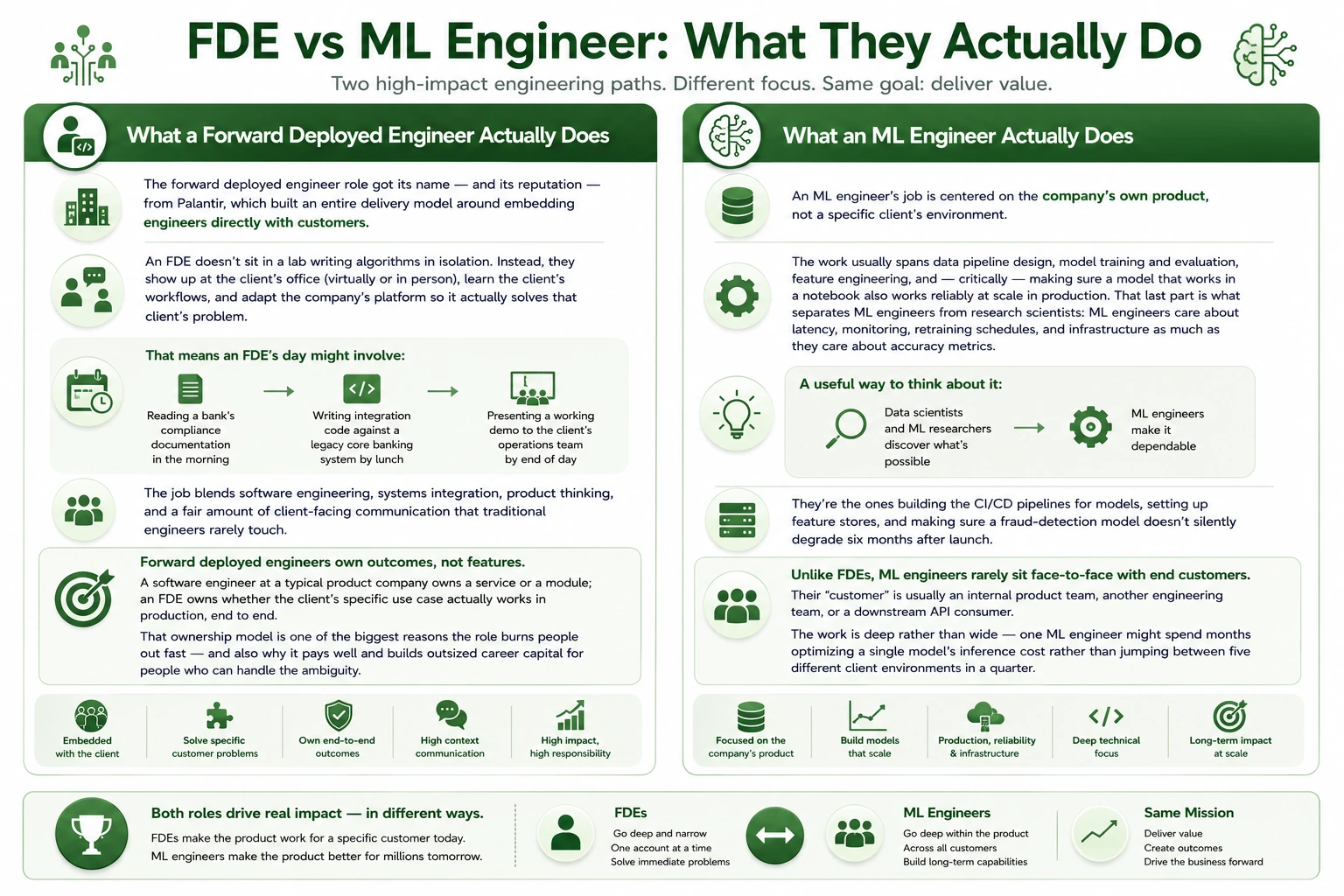
The forward deployed engineer role got its name — and its reputation — from Palantir, which built an entire delivery model around embedding engineers directly with customers. An FDE doesn’t sit in a lab writing algorithms in isolation. Instead, they show up at the client’s office (virtually or in person), learn the client’s workflows, and adapt the company’s platform so it actually solves that client’s problem. That means an FDE’s day might involve reading a bank’s compliance documentation in the morning, writing integration code against a legacy core banking system by lunch, and presenting a working demo to the client’s operations team by end of day. The job blends software engineering, systems integration, product thinking, and a fair amount of client-facing communication that traditional engineers rarely touch.
Forward deployed engineers own outcomes, not features. A software engineer at a typical product company owns a service or a module; an FDE owns whether the client’s specific use case actually works in production, end to end. That ownership model is one of the biggest reasons the role burns people out fast — and also why it pays well and builds outsized career capital for people who can handle the ambiguity.
What an ML Engineer Actually Does
An ML engineer’s job is centered on the company’s own product, not a specific client’s environment. The work usually spans data pipeline design, model training and evaluation, feature engineering, and — critically — making sure a model that works in a notebook also works reliably at scale in production. That last part is what separates ML engineers from research scientists: ML engineers care about latency, monitoring, retraining schedules, and infrastructure as much as they care about accuracy metrics. A useful way to think about it: data scientists and ML researchers discover what’s possible; ML engineers make it dependable. They’re the ones building the CI/CD pipelines for models, setting up feature stores, and making sure a fraud-detection model doesn’t silently degrade six months after launch.
Unlike FDEs, ML engineers rarely sit face-to-face with end customers. Their “customer” is usually an internal product team, another engineering team, or a downstream API consumer. The work is deep rather than wide — one ML engineer might spend months optimizing a single model’s inference cost rather than jumping between five different client environments in a quarter.
Forward Deployed Engineer vs ML Engineer: Side-by-Side
| Dimension | Forward Deployed Engineer | ML Engineer |
|---|---|---|
| Primary focus | Client-specific integration and outcomes | Model development and productionization |
| Where the work happens | Embedded with the client’s team/systems | Inside the company’s own product org |
| Core skills | Systems integration, APIs, rapid prototyping, client communication | Data pipelines, model training, MLOps, statistics |
| Success metric | Whether the client’s use case works reliably | Whether the model performs and scales reliably |
| Travel/client exposure | High — regular client meetings, sometimes on-site | Low to none — mostly internal collaboration |
| Typical background | Software engineering, solutions/sales engineering, or consulting | Computer science, applied math, or data science |
| Career ceiling | Product management, solutions architecture, founder track | ML infrastructure lead, applied science lead, MLOps |

Put AI Models Into Production With Itexus
Itexus develops and implements AI systems for banking, trading, lending, insurance, wealth management, and internal financial workflows.
Need More Than Model Development?
Itexus can help with:
- AI consulting and implementation
- machine learning and predictive analytics
- RAG systems and copilots
- fraud and anomaly detection
- AI agent workflow automation
 Contact Itexus to discuss your AI project.
Where the Two Roles Overlap — and Where They Don’t
Shared Technical Ground
Both roles sit at the intersection of engineering and a specific domain problem. They also require enough technical range to work across more than one discipline.
An FDE at an AI company may need to understand how a model behaves well enough to explain its limits to a skeptical client. An ML engineer increasingly needs to consider deployment constraints that may once have belonged to another team.
The Rise of AI Forward Deployed Engineers
This overlap helps explain why the boundaries are becoming less clear in 2026. As more AI vendors sell directly to enterprises with unique data, security, and compliance requirements, some companies have started hiring AI forward deployed engineers.
This hybrid role combines FDE-style customer embedding with a deeper AI and ML skill set than the traditional Palantir-style FDE role.
Breadth vs Technical Depth
The main difference comes down to breadth versus depth. FDEs work across customer requirements, integrations, deployment, and delivery. ML engineers usually go deeper into model development, evaluation, data pipelines, and performance.
Moving From ML Engineering to FDE Work
ML engineers who leave pure ML work often have a smoother path into applied AI engineering than into a full FDE position. FDE work requires customer-facing skills such as negotiation, expectation-setting, and workflow discovery, which most ML programs do not teach directly.
Moving From FDE Work to ML Engineering
An FDE moving toward ML engineering may need to strengthen their knowledge of statistics, model evaluation, experimentation, and other areas of ML depth. These skills can receive less attention when the immediate priority is solving integration problems and meeting delivery deadlines.
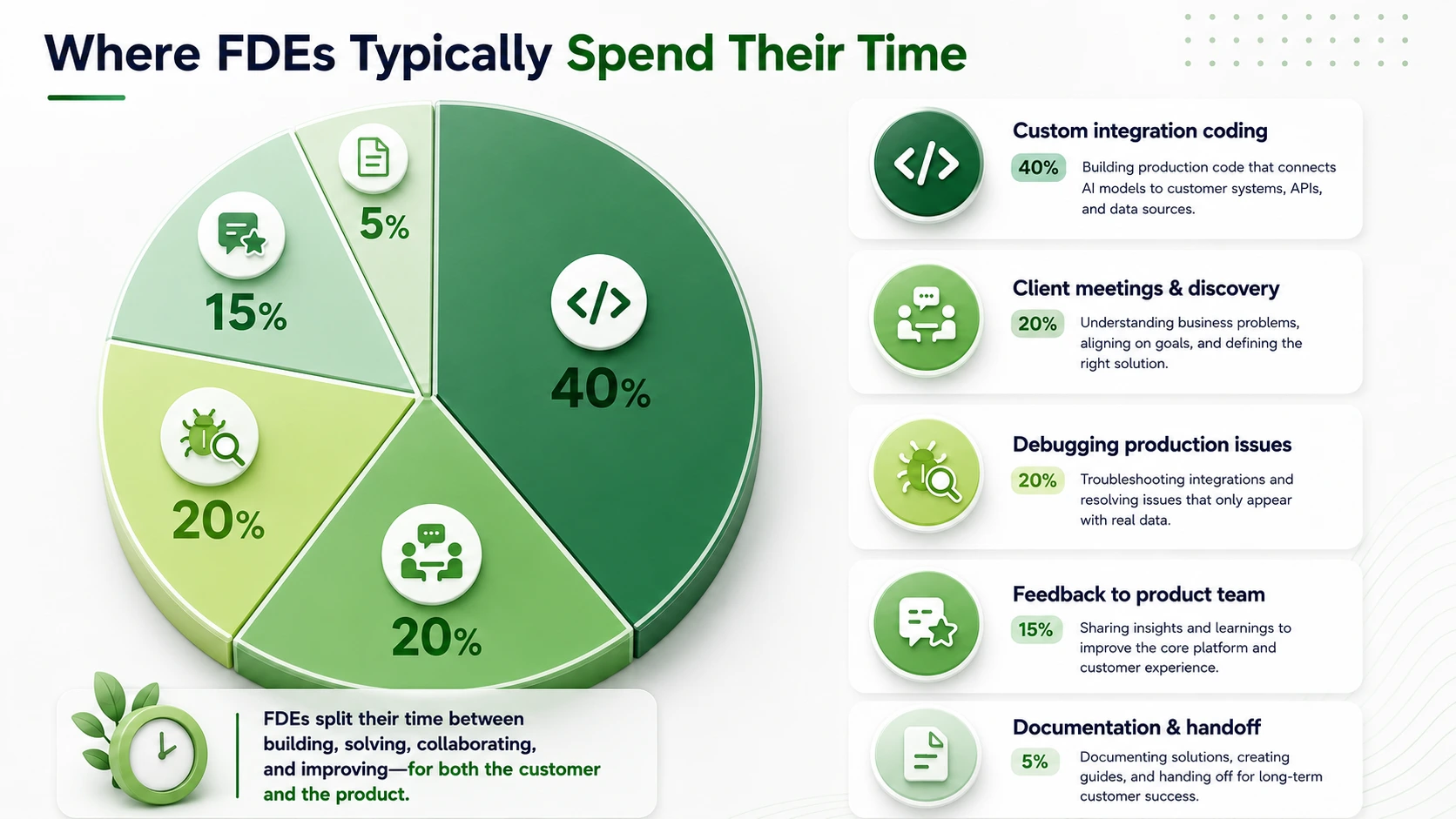
Rough weekly time breakdown for a forward deployed engineer role.
Why This Distinction Matters for Fintech and AI-Driven Products
Fintech is one of the industries where this choice actually shows up on an org chart, not just a job board. A digital bank rolling out an AI-driven underwriting engine needs ML engineers to build and monitor the model — but it also needs someone who understands each partner bank’s core system, KYC rules, and reporting requirements well enough to make the model actually usable inside that partner’s environment. That second job looks a lot like forward deployed engineering, even if the company never uses the title. This is also where a lot of financial institutions get their staffing wrong. They hire a strong ML team, ship a good model, and then discover integration with legacy banking infrastructure takes twice as long as model development did — because nobody owned that end-to-end deployment problem. Firms that build AI-driven lending or trading tools often find it faster to bring in partners who already understand both the model side and the integration side, rather than trying to grow that hybrid skill set from scratch. Teams evaluating AI software development services for a fintech product should ask upfront who on the vendor’s team plays the FDE role versus who plays the pure ML role — the answer usually predicts how smooth the rollout will be.
Hiring: Which Role Does a Company Actually Need?
The honest answer is “it depends on the bottleneck.” If a company already has a working model or product and the problem is getting enterprise clients live on it, that’s an FDE problem. If the bottleneck is model accuracy, data quality, or scaling inference, that’s an ML engineering problem. A few signals that point toward needing forward deployed engineers first:
- Every new client requires custom integration work before the product is usable.
- Sales cycles are stalling at the technical proof-of-concept stage.
- Client success teams keep escalating integration issues to engineering.
And signals that point toward ML engineering as the priority:
- Models work in testing but degrade or fail once in production.
- Data pipelines are brittle, manual, or inconsistent across environments.
- The team has research talent but no one owns deployment infrastructure.
Compensation, Career Path, and Burnout Considerations
Compensation Across Both Roles
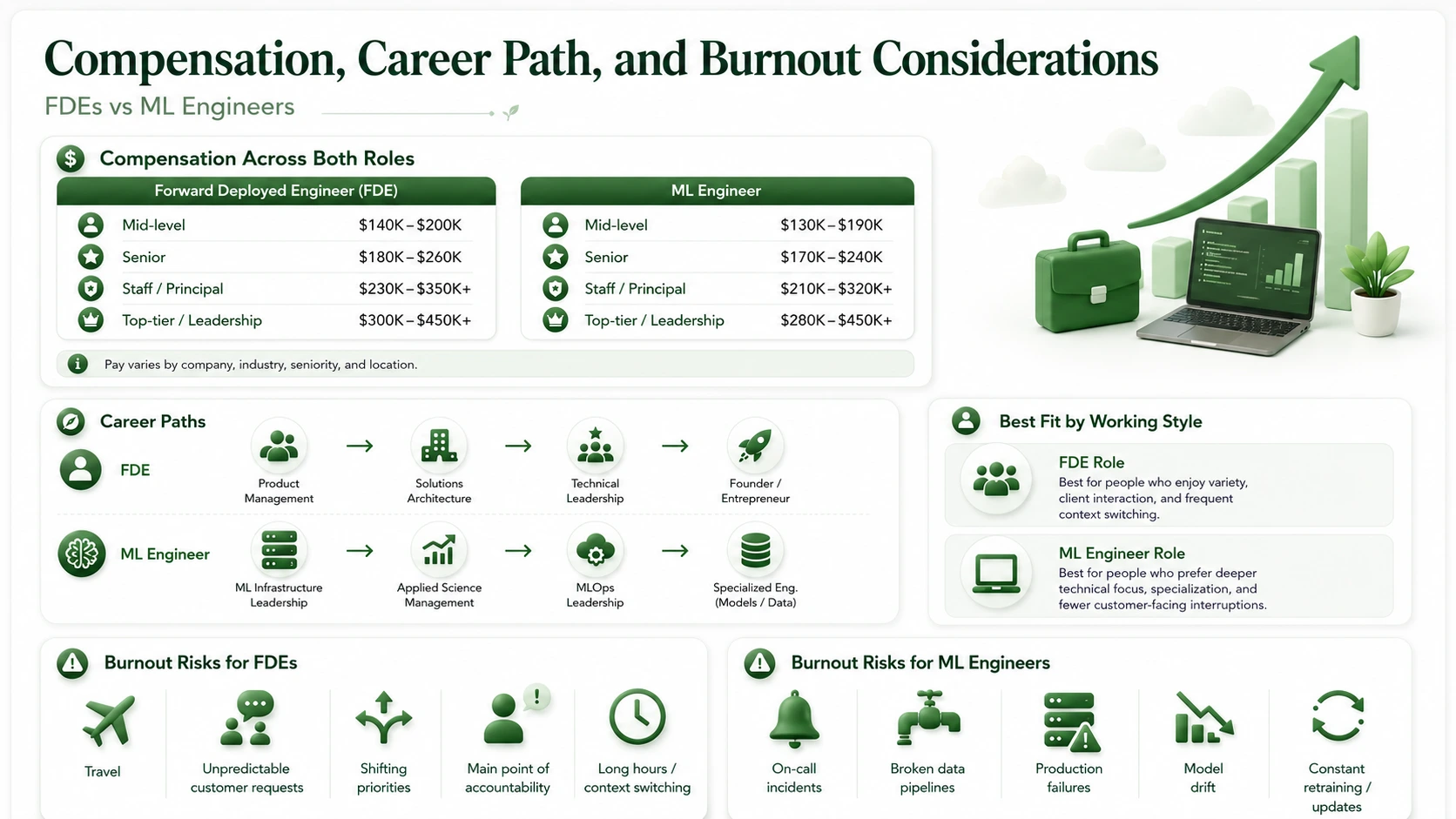
Both roles tend to be compensated well relative to general software engineering because they require combinations of skills that are difficult to hire for.
Exact pay varies considerably by company, industry, seniority, and location. Current listings on Levels.fyi or the target company’s careers page will usually provide a more useful reference than a single market-wide average.
Career Paths for Forward Deployed Engineers
FDEs often move into product management, solutions architecture, technical leadership, or founding roles. Their client exposure and end-to-end ownership prepare them for positions that combine technical work with business and product decisions.
Career Paths for ML Engineers
ML engineers more commonly move into ML infrastructure leadership, applied science management, MLOps, or other specialized engineering roles. These paths usually maintain a stronger focus on models, data systems, and production infrastructure.
Which Role Fits Which Working Style
Neither path is objectively better. People who enjoy variety, client interaction, and frequent context switching may be more comfortable in an FDE role.
Those who prefer sustained technical focus, deeper specialization, and fewer customer-facing interruptions may be better suited to ML engineering.
Burnout Risks for FDEs
FDE burnout is often linked to travel, unpredictable customer requests, shifting priorities, and the pressure of being the main point of accountability for a deployment.
Burnout Risks for ML Engineers
ML engineers face different pressures, including on-call incidents, broken data pipelines, production failures, and the ongoing work of maintaining models that gradually lose accuracy as data changes.
How Teams Building AI-Driven Financial Products Should Structure Both Roles
For a fintech company shipping something like an AI-assisted lending platform or a trading signal engine, the healthiest structure usually pairs the two roles rather than picking one. ML engineers build and maintain the model layer; a smaller forward-deployed function handles the last mile — connecting that model to a specific client’s core banking stack, adjusting workflows to match local compliance rules, and translating client feedback back into the product roadmap. Companies building white-label or embedded finance products, in particular, run into this constantly: the underlying platform is standardized, but every bank or credit union partner needs it configured differently. That’s precisely the gap forward deployed work fills. Firms evaluating a white-label banking platform or a Banking-as-a-Service setup should expect this integration layer to require dedicated engineering attention, not just a plug-and-play API key.
FAQ
Is a forward deployed engineer the same as a solutions engineer?
Do forward deployed engineers need machine learning skills?
Can an ML engineer become a forward deployed engineer?
Which role is harder to hire for?
Do forward deployed engineers write production code?
Is the forward deployed engineer role only for AI companies?
What’s the biggest mistake companies make when choosing between the two roles?
Bottom Line
Forward deployed engineers and ML engineers solve different halves of the same puzzle. One makes sure a product actually works inside a specific client’s messy reality; the other makes sure the underlying model or system is accurate, scalable, and reliable in the first place. Neither role replaces the other, and the companies getting the most out of AI-driven products — especially in fintech — tend to be the ones staffing both deliberately rather than defaulting to whichever title sounds trendier. Anyone weighing this for their own team or career should start by naming the actual bottleneck: is it getting the product live with real clients, or is it making the underlying system trustworthy at scale? That answer points straight to the right hire — or the right next move. Teams that want a partner who already blends both skill sets across model work and real-world deployment can look at how firms structure delivery in practice through a portfolio of completed fintech projects or review a development process overview before committing to an internal build.