
Quick Summary: A forward deployed engineer (FDE) embeds with a single customer to bend a company’s product around that customer’s messy, specific reality, while a product engineer builds the core product that has to work for every customer at once. FDEs trade breadth for depth on one account and often work directly on-site or in close daily contact with the client; product engineers optimize for scale, reusability, and long-term maintainability. Fintech teams typically need both — product engineers to build the lending, trading, or banking platform, and FDE-style specialists to get it live inside a specific bank or broker’s environment.
Ask five engineers what a “forward deployed engineer” actually does and expect five different answers. Some call it glorified consulting. Others say it’s the most technically demanding job in software right now. The confusion is fair — the title barely existed a decade ago, and now every AI startup wants to hire a dozen of them.
Product engineer, by contrast, sounds familiar. It’s the modern label for a software engineer who cares as much about the “why” as the “how” — someone who sits close to users and ships features, not just tickets. So where do the two roles actually split, and why does it matter for how a company builds and delivers software?
What Is a Forward Deployed Engineer?
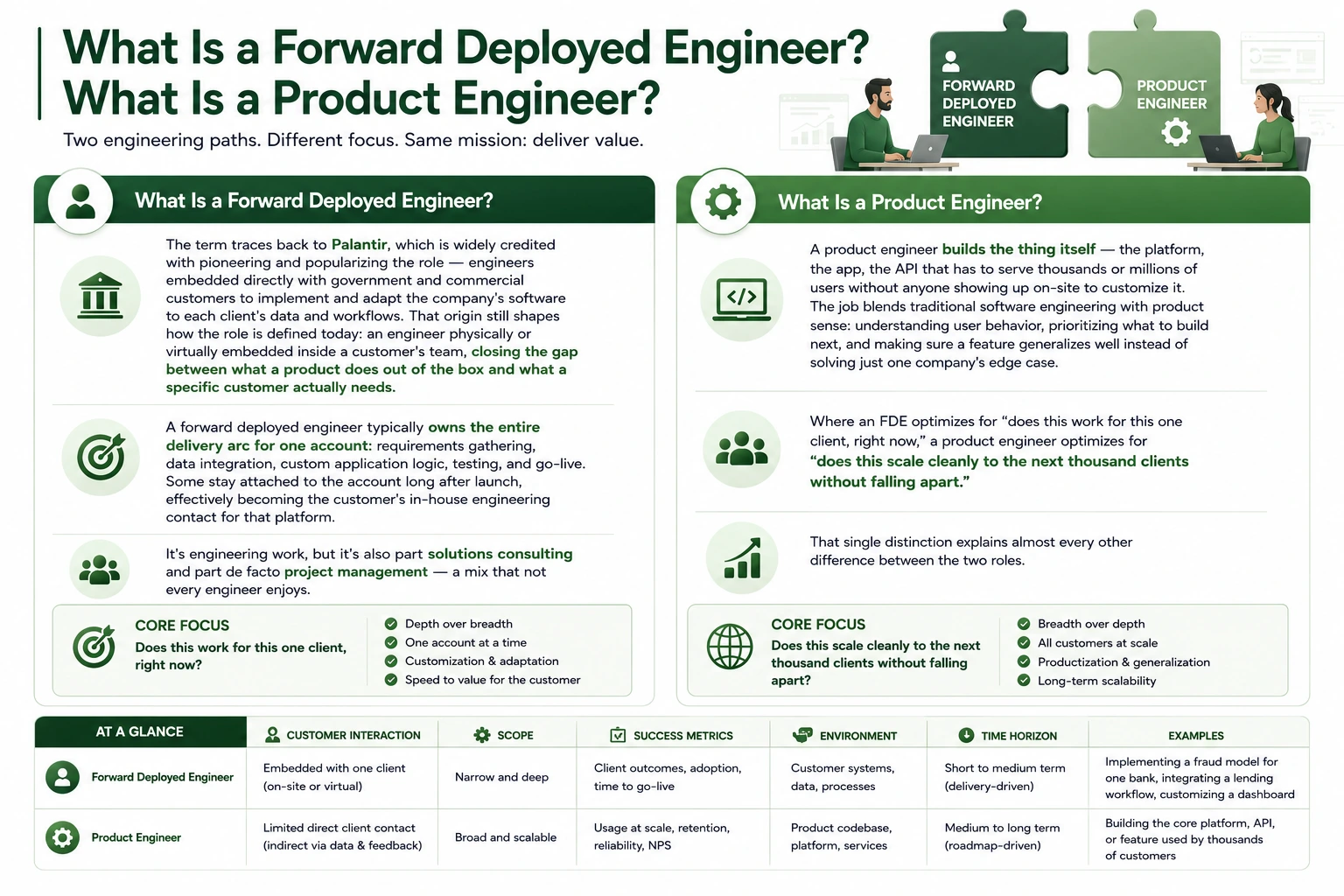
The term traces back to Palantir, which is widely credited with pioneering and popularizing the role — engineers embedded directly with government and commercial customers to implement and adapt the company’s software to each client’s data and workflows. That origin still shapes how the role is defined today: an engineer physically or virtually embedded inside a customer’s team, closing the gap between what a product does out of the box and what a specific customer actually needs.
A forward deployed engineer typically owns the entire delivery arc for one account: requirements gathering, data integration, custom application logic, testing, and go-live. Some stay attached to the account long after launch, effectively becoming the customer’s in-house engineering contact for that platform. It’s engineering work, but it’s also part solutions consulting and part de facto project management — a mix that not every engineer enjoys.
What Is a Product Engineer?
A product engineer builds the thing itself — the platform, the app, the API that has to serve thousands or millions of users without anyone showing up on-site to customize it. The job blends traditional software engineering with product sense: understanding user behavior, prioritizing what to build next, and making sure a feature generalizes well instead of solving just one company’s edge case.
Where an FDE optimizes for “does this work for this one client, right now,” a product engineer optimizes for “does this scale cleanly to the next thousand clients without falling apart.” That single distinction explains almost every other difference between the two roles.
Forward Deployed Engineer vs Product Engineer: Core Differences
Both roles write code, both deal with real production systems, and both can be highly paid specialists. But the day-to-day, the incentives, and the career path diverge sharply.
| Dimension | Forward Deployed Engineer | Product Engineer |
|---|---|---|
| Primary customer | One client at a time | All users of the product |
| Main output | Custom integration, workflow, or deployment | Reusable feature or platform capability |
| Where the work happens | Often on-site or embedded remotely with the client | Mostly with the core engineering team |
| Success metric | Client go-live, adoption, renewal | Feature usage, retention, scalability |
| Skill mix | Engineering + requirements analysis + client-facing communication | Engineering + product thinking + data-informed prioritization |
| Travel / client contact | High, especially in enterprise or public-sector deals | Low to none |
| Typical hiring companies | Palantir, applied-AI startups, enterprise software vendors | SaaS companies, fintechs, product-led startups |

Build Fintech Products With Itexus
Itexus supports financial products from discovery and architecture through development, integrations, testing, deployment, and maintenance.
Need Help Moving From Product Ideas to Working Software?
Itexus can help with:
- product discovery and prototyping
- UI/UX design
- custom web and mobile development
- API and legacy system integrations
- production support
 Contact Itexus to discuss your fintech product.
Skills and Day-to-Day Work
What Forward Deployed Engineers Actually Do All Day
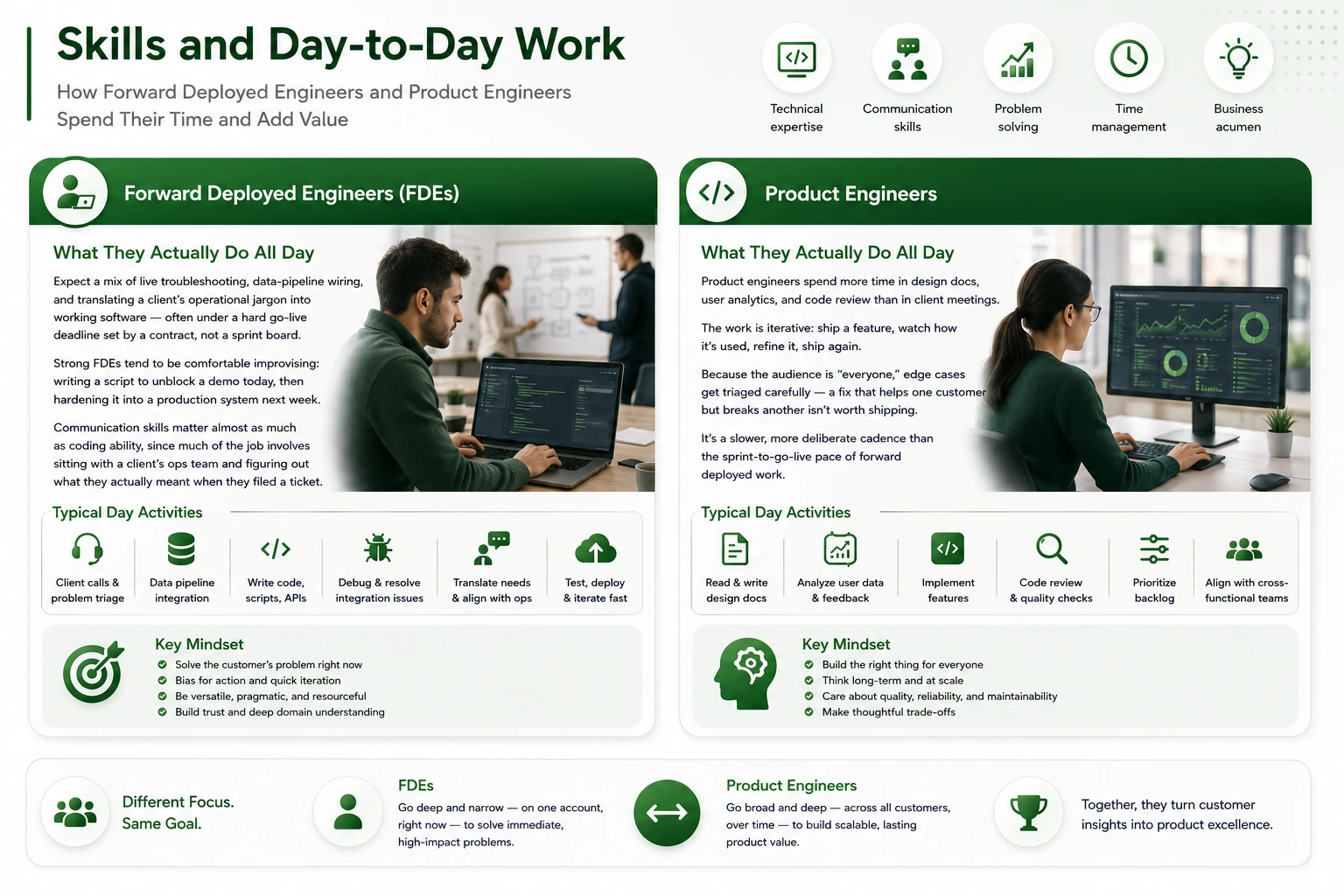
Expect a mix of live troubleshooting, data-pipeline wiring, and translating a client’s operational jargon into working software — often under a hard go-live deadline set by a contract, not a sprint board. Strong FDEs tend to be comfortable improvising: writing a script to unblock a demo today, then hardening it into a production system next week. Communication skills matter almost as much as coding ability, since much of the job involves sitting with a client’s ops team and figuring out what they actually meant when they filed a ticket.
What Product Engineers Actually Do All Day
Product engineers spend more time in design docs, user analytics, and code review than in client meetings. The work is iterative: ship a feature, watch how it’s used, refine it, ship again. Because the audience is “everyone,” edge cases get triaged carefully — a fix that helps one customer but breaks another isn’t worth shipping. It’s a slower, more deliberate cadence than the sprint-to-go-live pace of forward deployed work.
Compensation in 2026: How the Numbers Compare
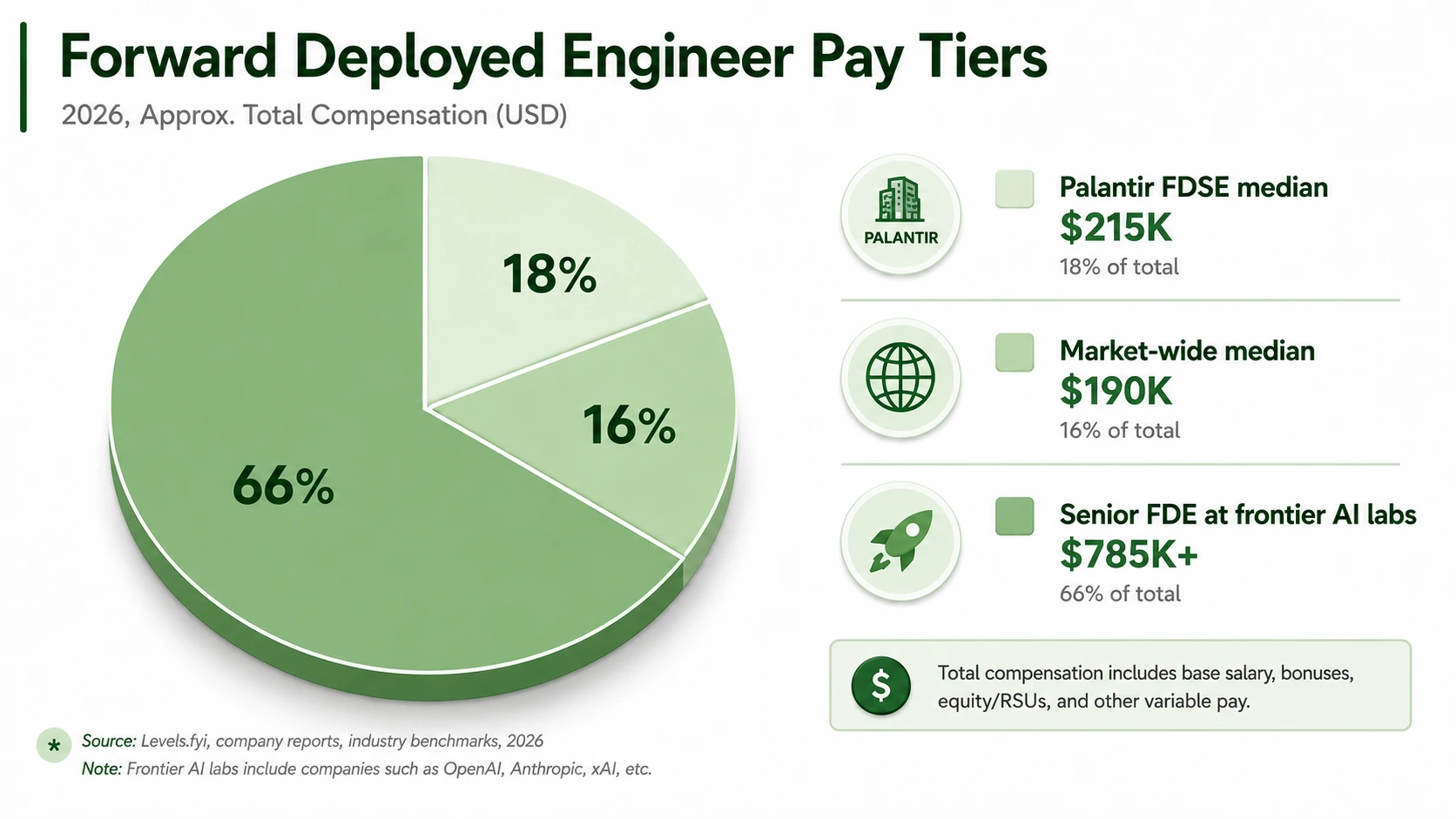
Pay for forward deployed roles varies enormously by company tier. According to Glassdoor’s 2026 data, the average forward deployed engineer salary sits around $155,932 a year, with top earners reaching roughly $243,949 at the 90th percentile. A separate analysis of job postings by Recruiting From Scratch put the 2026 median at about $190,000, ranging from $160,000 at the 25th percentile to $220,000 at the 75th. At the very top of the market, frontier AI labs pay far more: Perspective AI’s 2026 compensation report notes Palantir’s FDSE median lands near $215,000, while senior forward deployed roles at companies like Anthropic and OpenAI can climb past $785,000, with principal-level applied AI engineering compensation reportedly exceeding $1.2 million.
Product engineer pay is less tiered by client-facing pressure and more tied to company stage and seniority — generally competitive with senior software engineer bands at the same company, since the role sits inside the core engineering org rather than a specialized delivery function.
Rough comparison of reported 2026 forward deployed engineer compensation across company tiers.
Why Fintech Teams Care About This Distinction
Fintech is one of the clearest places where both models show up side by side. A digital lending platform, a trading system, or a banking-as-a-service layer needs a product engineering team to build the core rails — underwriting logic, order matching, ledger accuracy — in a way that works for every bank, broker, or lender that plugs into it. But the moment that platform lands with a specific regional bank or brokerage, someone has to wire it into that institution’s core banking system, its compliance rules, its data formats. That’s forward-deployed-style work, even if nobody on the team carries the title.
This is exactly the split that shows up in fintech software development engagements: a product-minded core team builds the platform — think a digital lending system or a trading platform — while integration specialists handle the client-specific wiring, from core banking connections to KYC workflows, that gets it live at a real institution. Vendors offering white-label banking platforms run into this constantly: the base product has to stay generic enough to resell, yet flexible enough to fit each bank’s branding, compliance stack, and existing systems without a rebuild every time.
Teams evaluating banking-as-a-service integrations often underestimate how much forward-deployed-style effort a “plug and play” API actually requires once real regulatory and legacy-system constraints show up.
How to Decide Which Model Fits a Team or Project
Neither role is inherently better — the right choice depends on what’s actually being built and for whom.
A few practical signals help make the call:
- If a contract depends on hitting one client’s specific go-live date, lean toward a forward-deployed engagement model.
- If the goal is a reusable platform sold to many customers, invest in product engineering and treat any custom client work as a controlled exception, not the default.
- Early-stage products often need a hybrid: a small product team building the core, with one or two people doing forward-deployed-style onboarding for the first anchor clients.
- As a company scales past a handful of large clients, forward-deployed work tends to justify a dedicated team rather than pulling product engineers off the roadmap.
Companies that outsource platform builds — through partners following a structured development process — often get both functions bundled: a product-focused build team plus integration support for the first live deployments. Reviewing a vendor’s portfolio of completed projects is usually the fastest way to see whether they’ve actually handled that handoff before.
FAQ
Is a forward deployed engineer a real engineering role, or mostly consulting?
Do forward deployed engineers get paid more than product engineers?
Can a product engineer become a forward deployed engineer, or vice versa?
Which companies typically hire forward deployed engineers?
Is the forward deployed engineer role just a rebrand of solutions engineering?
Does a fintech startup need forward deployed engineers from day one?
What skills should someone build to move into a forward deployed engineering role?
The Bottom Line
Forward deployed engineers and product engineers solve the same underlying problem — getting software to actually work for real users — from opposite ends. One goes deep on a single client’s mess; the other builds the clean, reusable core that has to survive contact with thousands of different messes at once. Fast-growing fintech products usually need a healthy mix of both, especially once enterprise clients start demanding integrations that no generic API can fully anticipate.
Teams trying to figure out where their own build sits on that spectrum — and whether they need a product-first build, forward-deployed-style integration support, or both — are usually better off mapping it out before writing a single line of code. Exploring how a fintech app development partner structures that split, or looking at AI-driven engineering options for automating parts of the integration work, is a reasonable next step for teams weighing the decision.