
Quick Summary: A forward deployed engineer (FDE) is a post-sale, hands-on builder who embeds inside a client’s environment to configure, integrate, and ship a working production system, while a sales engineer (SE) is a pre-sale, technical communicator who demos the product and answers technical objections to help close a deal. FDEs are judged on whether the deployed system works and gets adopted; SEs are judged on whether the deal closes. Compensation for FDEs at frontier AI labs and Palantir now regularly clears $200K-$600K+ in total pay as of 2026, reflecting how central the role has become to enterprise AI rollouts.
Ask five people what a forward deployed engineer actually does and expect five different answers. Some call it “consulting with a GitHub account.” Others call it the most important hire in enterprise AI right now. Meanwhile, sales engineering has existed for decades under names like solutions engineer, pre-sales consultant, or sales consultant — and it’s suddenly getting compared to this newer, flashier role.
The confusion is understandable. Both roles put technical people in front of customers. Both require the ability to translate engineering jargon into business outcomes. But the similarities mostly stop there. Where a forward deployed engineer sits in the customer relationship, what they build, and how their success gets measured are fundamentally different from a sales engineer’s world — and that difference matters a lot for anyone hiring, job-hunting, or trying to structure a technical go-to-market team.
What Is a Forward Deployed Engineer?
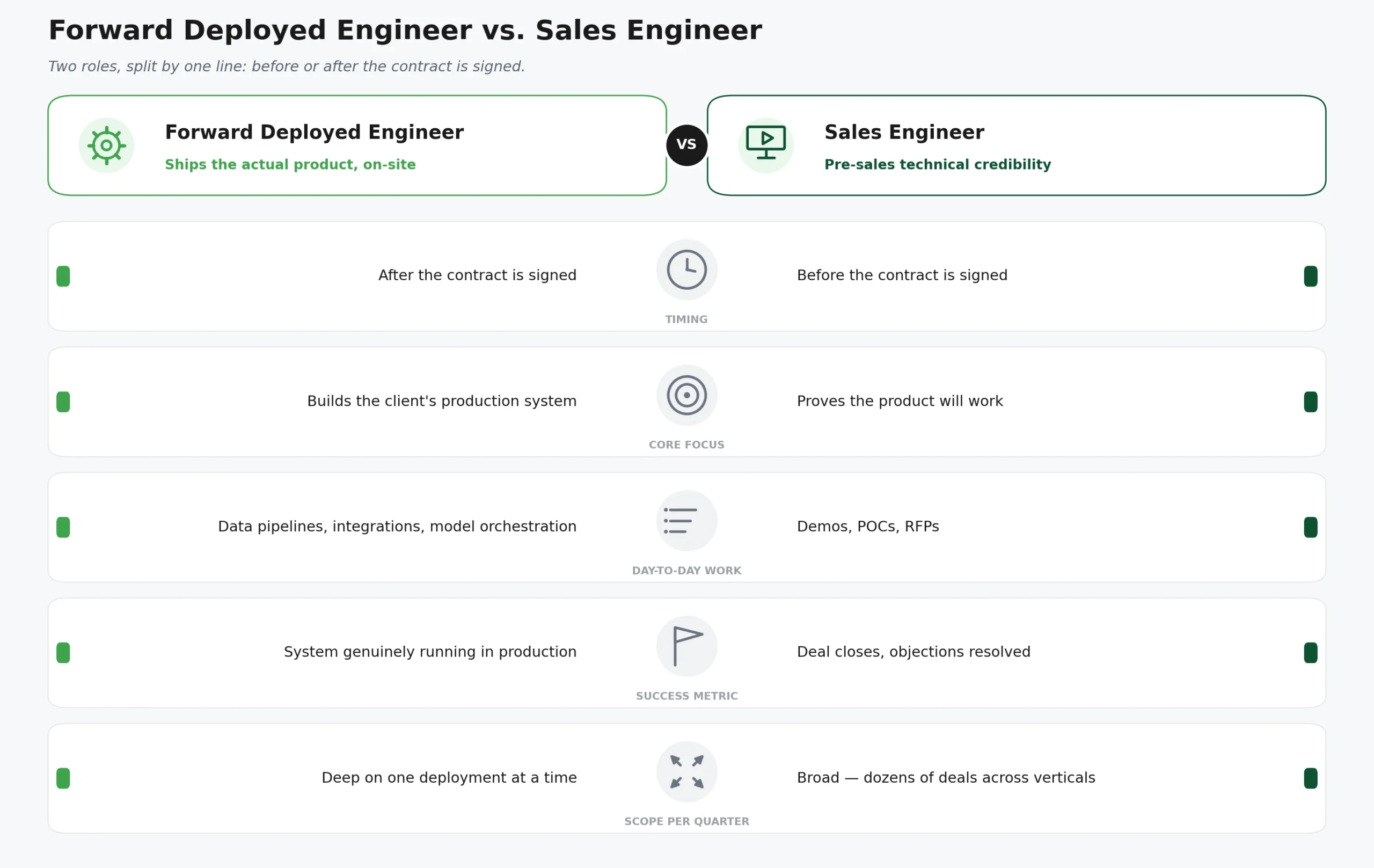
A forward deployed engineer works after the contract is signed, not before it. Palantir popularized the role — it remains the company’s “canonical engineering role,” according to compensation-tracking site CTAIO — by sending engineers to sit inside government agencies, banks, and manufacturers to build the actual software the client needed, using the company’s platform as the toolkit.
That’s the core distinction: FDEs contribute directly to the product a company sells, not just to the sale of it. A forward deployed engineer’s day looks like data pipeline work, custom integration logic, prompt engineering or model orchestration for AI-heavy deployments, and iterating with the client’s own team until a system is genuinely in production. It’s less demo, more deployment.
This is also why the role has exploded across the AI industry. Anthropic, OpenAI, and a wave of applied-AI startups now hire forward deployed engineers to embed with enterprise customers and get large language model systems actually working inside messy, real-world environments — something a generic sales cycle can’t accomplish alone.
What Is a Sales Engineer?
A sales engineer — also called a solutions engineer or pre-sales consultant depending on the company — operates before the contract is signed. Their job is to support the sales team with technical credibility: running product demos, answering “will this integrate with our stack” questions, building proof-of-concept environments, and responding to RFPs.
Sales engineers are sales-first with technical capability layered on top. Their success metric is straightforward — did the deal close, and did the technical objections that could have killed it get resolved in time? They rarely touch the client’s production environment, and they typically hand off to a separate implementation or customer success team once the ink dries.
It’s a role built for breadth: a sales engineer might support dozens of deals across different verticals in a quarter, going deep enough on the product to be credible without necessarily building anything that ships to the client’s live systems.
Forward Deployed Engineer vs Sales Engineer: Core Differences
Here’s the thing though — the titles alone hide most of the important detail. The real gap shows up in where each role sits in the customer lifecycle, what they’re accountable for, and what they actually produce.
| Dimension | Forward Deployed Engineer | Sales Engineer |
|---|---|---|
| Stage of engagement | Post-sale, embedded on-site or remotely with the client team | Pre-sale, supporting the deal before signature |
| Primary deliverable | A working production system or integration | A convincing demo, POC, or technical answer |
| Success metric | System adoption, uptime, and client outcomes | Deal closed, quota attainment |
| Reports to / aligned with | Engineering or delivery leadership, sometimes product | Sales leadership, tied to a quota-carrying rep |
| Typical background | Software/data engineer, sometimes ex-consultant | Technical generalist with strong communication skills |
| Client relationship length | Weeks to years, deep and ongoing | Days to months, ends at contract signature |
Whose Quota They Carry
Sales engineers are almost always attached to a number. Their compensation frequently includes a commission or bonus tied to the deals they support closing. Forward deployed engineers, by contrast, are usually paid on an engineering scale — base, bonus, and equity — with no direct line to a sales quota, even though a well-executed deployment often becomes the strongest case study for renewals and expansion.
What They’re Actually Building
This is the split competitors keep circling around without quite naming it: sales engineers build proof that something can work. Forward deployed engineers build the thing that does work, inside the client’s actual environment, with the client’s actual data. One is theatre for a technical audience; the other is production engineering with a customer looking over your shoulder.

Align Business and Engineering With Itexus
Itexus combines fintech consulting with software development for banking, payments, trading, lending, insurance, and wealth management products.
Need Help From Early Planning Through Implementation?
Itexus can help with:
- fintech consulting
- technical discovery
- solution design
- custom software development
- demos, testing, and release support
 Contact Itexus to discuss your business and technical requirements.
Compensation: How the Numbers Actually Compare
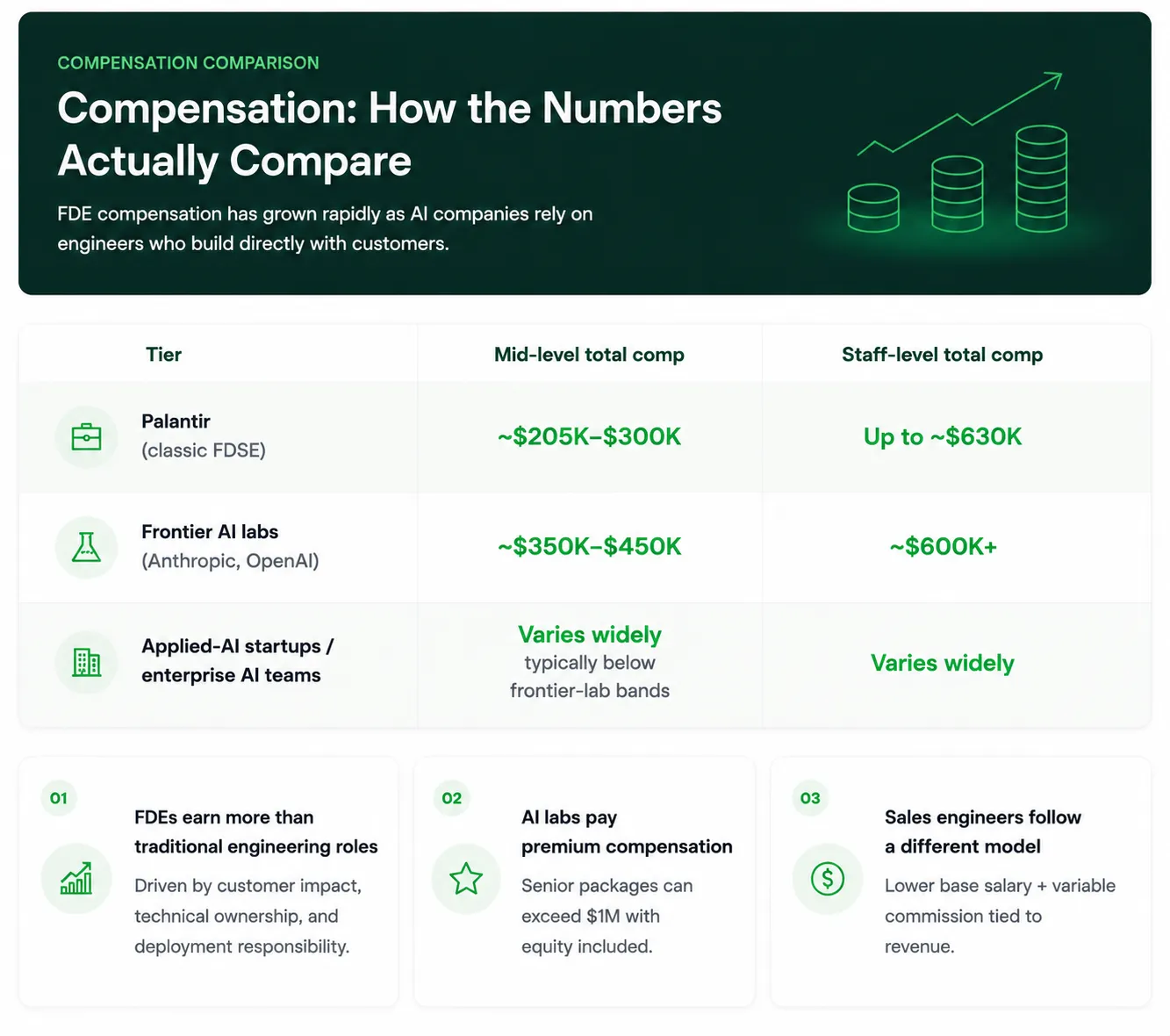
Compensation is where the gap becomes most visible, and it’s widened sharply through 2026 as forward deployed roles became central to enterprise AI rollouts. According to Levels.fyi, the median total compensation for a Forward Deployed Software Engineer at Palantir sits around $215,000 in the United States, with reported packages ranging from roughly $171,000 to $415,000. Glassdoor’s crowd-sourced figures run somewhat lower, putting the average base closer to $155,000-$177,000, which reflects the usual gap between base-only and total-comp reporting.
The bigger jump shows up at frontier AI labs. A 2026 compensation report from Perspective AI, drawing on roughly 1,200 data points across Palantir, Anthropic, OpenAI, and Scale AI, found median total compensation for forward deployed engineers at $385,000 for mid-level, $610,000 for staff-level, and north of $1,000,000 for principal-level engineers at the top labs — with equity making up 55-70% of total pay at the senior end.
| Tier | Mid-level total comp | Staff-level total comp |
|---|---|---|
| Palantir (classic FDSE) | ~$205K-$300K | Up to ~$630K |
| Frontier AI labs (Anthropic, OpenAI) | ~$350K-$450K | ~$600K+ |
| Applied-AI startups / enterprise AI teams | Varies widely; typically below frontier-lab bands | Varies widely |
Sales engineer pay follows a different structure entirely: a lower fixed base paired with variable commission tied to closed revenue, so total pay swings with deal flow and quota attainment rather than seniority alone. Because that mix varies enormously by industry, company size, and region, it’s worth checking current listings on Glassdoor, LinkedIn Salary, or the U.S. Bureau of Labor Statistics for up-to-date figures rather than relying on a single average.
Skills and Background: Who Fits Which Role
Forward deployed engineers tend to come from software or data engineering backgrounds, sometimes with a stint in management consulting or systems integration. They need to be comfortable writing production code inside someone else’s messy infrastructure, often with tight timelines and a client watching. Ambiguity tolerance matters as much as raw coding skill — nobody hands an FDE a clean spec.
Sales engineers usually come from a technical generalist path: former developers, support engineers, or product specialists who discovered they’re better at explaining a system than building the next feature of it. Strong storytelling, quick objection-handling, and stage presence during demos matter more here than deep production experience.
- Forward deployed engineer strengths: systems integration, data engineering, ML/AI implementation, project ownership under ambiguity.
- Sales engineer strengths: live demoing, discovery calls, RFP responses, translating features into business value fast.
Which Role Should a Company Hire — or Should a Candidate Pursue?
The right call depends on where a product sits in its lifecycle and what’s actually blocking growth. A product that’s mature, well-documented, and easy to self-serve mostly needs sales engineers to clear pre-sale objections. A product that’s powerful but not yet obvious — the kind that needs hands-on configuration to prove its value inside a specific customer’s environment — needs forward deployed engineers instead.
For engineers deciding between the two paths, the trade-off is fairly blunt. Forward deployed roles offer more ownership, deeper technical work, and — at the moment — considerably higher compensation ceilings, especially at AI-native companies. Sales engineering offers steadier hours, less travel-heavy embedding, and a more predictable path into sales or product leadership. Neither is objectively better; they reward different temperaments.
Why This Split Matters for Fintech and Enterprise AI Teams
Fintech is a good stress test for this whole debate, because banks, lenders, and trading firms rarely buy off-the-shelf software without heavy customization. A payments platform or lending system has to plug into legacy core banking infrastructure, satisfy compliance requirements, and handle institution-specific workflows that no generic demo ever captures.
That’s exactly the environment where forward-deployed-style engineering earns its keep — embedding with a client’s technical team to configure a Banking-as-a-Service platform or wire up an AI-driven software solution against real transaction data rather than a sandbox. Sales engineers still play a critical role earlier in that journey, proving during the sales cycle that the platform can plausibly do what the client needs before anyone commits engineering time to prove it for real.
Teams building custom fintech software often structure delivery the same way, whether or not they use the “forward deployed” label: a technical pre-sale conversation followed by an embedded build phase that mirrors the client’s actual operating environment. That pattern shows up across structured development processes and is visible in various completed fintech projects where deep, hands-on integration work — not just a sales pitch — determined whether the deployment actually stuck.
Common Misconceptions Worth Clearing Up
A few things get muddled constantly in job postings and LinkedIn debates:
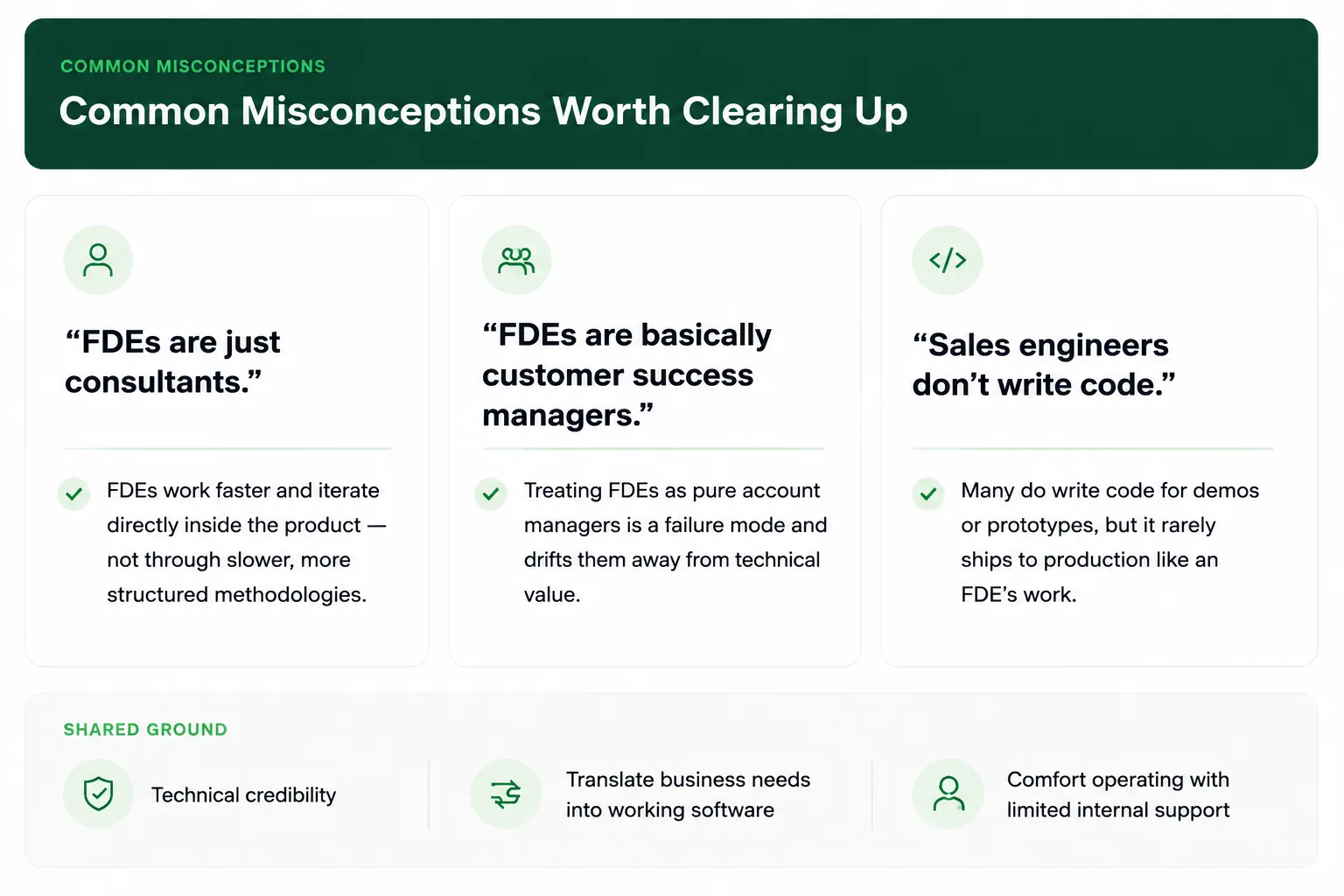
- “FDEs are just consultants.” Not quite. Traditional tech consultants often work through a slower, more structured methodology; forward deployed engineers tend to move faster and iterate directly inside the product itself, per accounts from engineers who’ve done both.
- “FDEs are basically customer success managers.” Also not quite — and treating them that way is a documented failure mode. The deeper an FDE goes into pure account management, the further they drift from the technical building that made the role valuable in the first place.
- “Sales engineers don’t write code.” Many do, particularly for building proof-of-concept demos, but the code rarely ships to production the way an FDE’s work does.
The Bottom Line
Forward deployed engineer and sales engineer both put technical talent in front of customers, but that’s where the overlap ends. One closes deals; the other makes the thing the deal was for actually work. Companies building complex, customer-specific software — fintech included — usually need both functions, just at different points in the relationship, and confusing the two when structuring a team tends to leave a gap right where the client needs the most help: turning a signed contract into a system that actually runs.
Teams evaluating how to structure technical delivery around custom platforms, from digital lending systems to trading platforms, tend to benefit from mapping out exactly where pre-sale technical support ends and hands-on, embedded engineering begins — before the hiring plan gets written, not after.