
Quick Summary: Preparing for a forward deployed engineer role means sharpening full-stack coding skills, practicing customer-facing problem solving with frameworks like STAR, and building projects that show you can turn messy business requirements into working software fast. Strong Python fluency, comfort with ambiguity, and genuine curiosity about a client’s industry matter more than deep specialization in any single framework. The best candidates treat every technical exercise as a mini consulting engagement, not just a coding test.
Forward deployed engineering sits at an odd intersection. Half the job looks like software engineering, the other half looks like consulting, and the interview process reflects that split. Candidates who prepare only for LeetCode-style questions tend to stall out, while those who over-index on soft skills get exposed the moment a live coding round starts.
So what actually moves the needle? Here’s a practical breakdown of what to study, build, and practice before stepping into a forward deployed engineer (FDE) interview or the job itself.
What a Forward Deployed Engineer Actually Does
A forward deployed engineer embeds directly with a client’s team, often onsite, to translate business problems into deployed software — usually fast, and usually without a perfectly defined spec. Palantir popularized the title, and it’s since spread to AI-native companies like OpenAI and Anthropic, plus a growing number of fintech and enterprise software vendors who need technical staff who can sit inside a bank’s operations team and ship something useful within weeks.
That’s different from a typical backend or platform engineering role. Career growth still depends on writing solid code, but it depends just as much on reading a room, managing client expectations, and knowing when to push back on a request versus when to just build it.
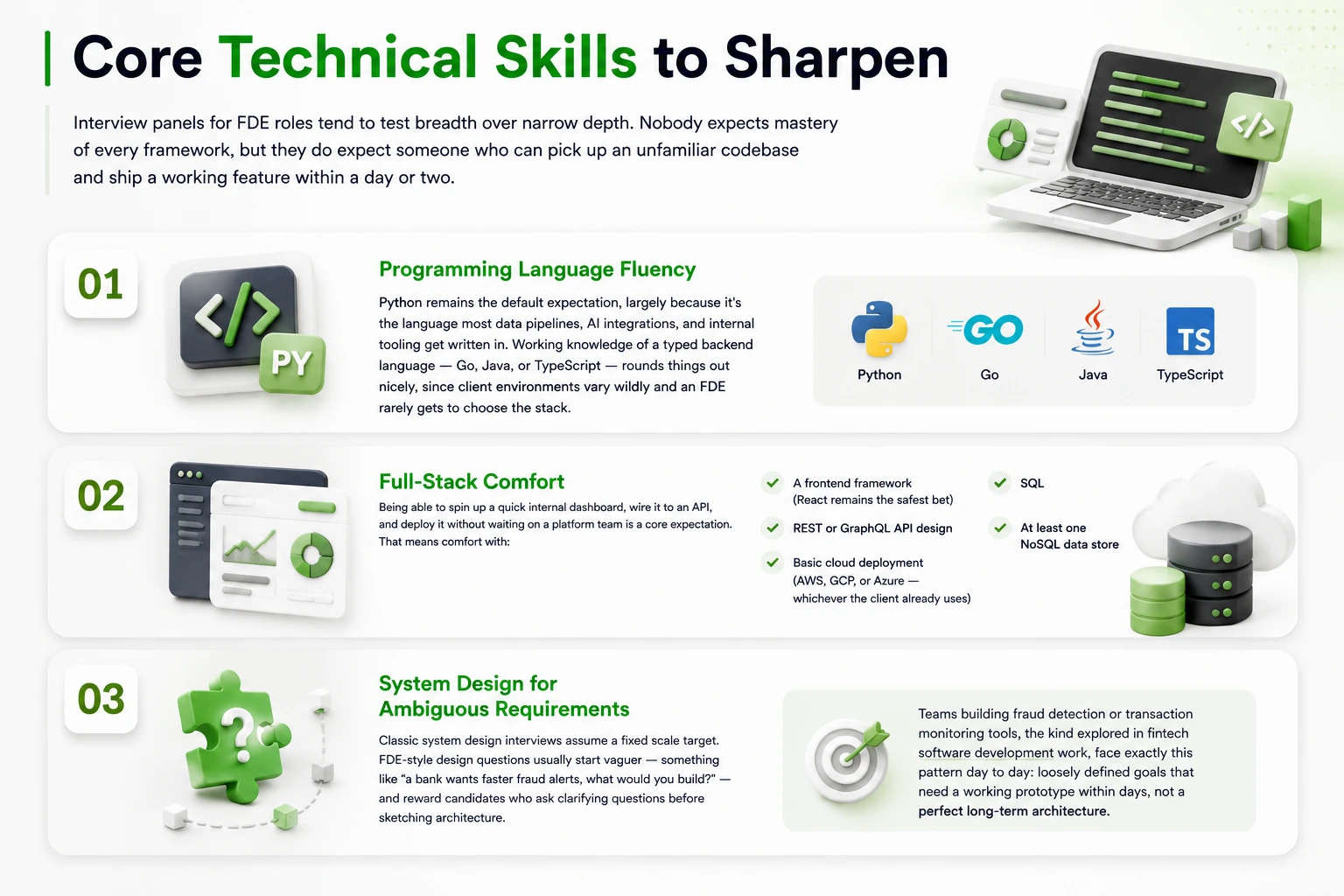
Core Technical Skills to Sharpen
Interview panels for FDE roles tend to test breadth over narrow depth. Nobody expects mastery of every framework, but they do expect someone who can pick up an unfamiliar codebase and ship a working feature within a day or two.
Programming Language Fluency
Python remains the default expectation, largely because it’s the language most data pipelines, AI integrations, and internal tooling get written in. Working knowledge of a typed backend language — Go, Java, or TypeScript — rounds things out nicely, since client environments vary wildly and an FDE rarely gets to choose the stack.
Full-Stack Comfort
Being able to spin up a quick internal dashboard, wire it to an API, and deploy it without waiting on a platform team is a core expectation. That means comfort with:
- A frontend framework (React remains the safest bet)
- REST or GraphQL API design
- Basic cloud deployment (AWS, GCP, or Azure — whichever the client already uses)
- SQL and at least one NoSQL data store
System Design for Ambiguous Requirements
Classic system design interviews assume a fixed scale target. FDE-style design questions usually start vaguer — something like “a bank wants faster fraud alerts, what would you build?” — and reward candidates who ask clarifying questions before sketching architecture. Teams building fraud detection or transaction monitoring tools, the kind explored in fintech software development work, face exactly this pattern day to day: loosely defined goals that need a working prototype within days, not a perfect long-term architecture.
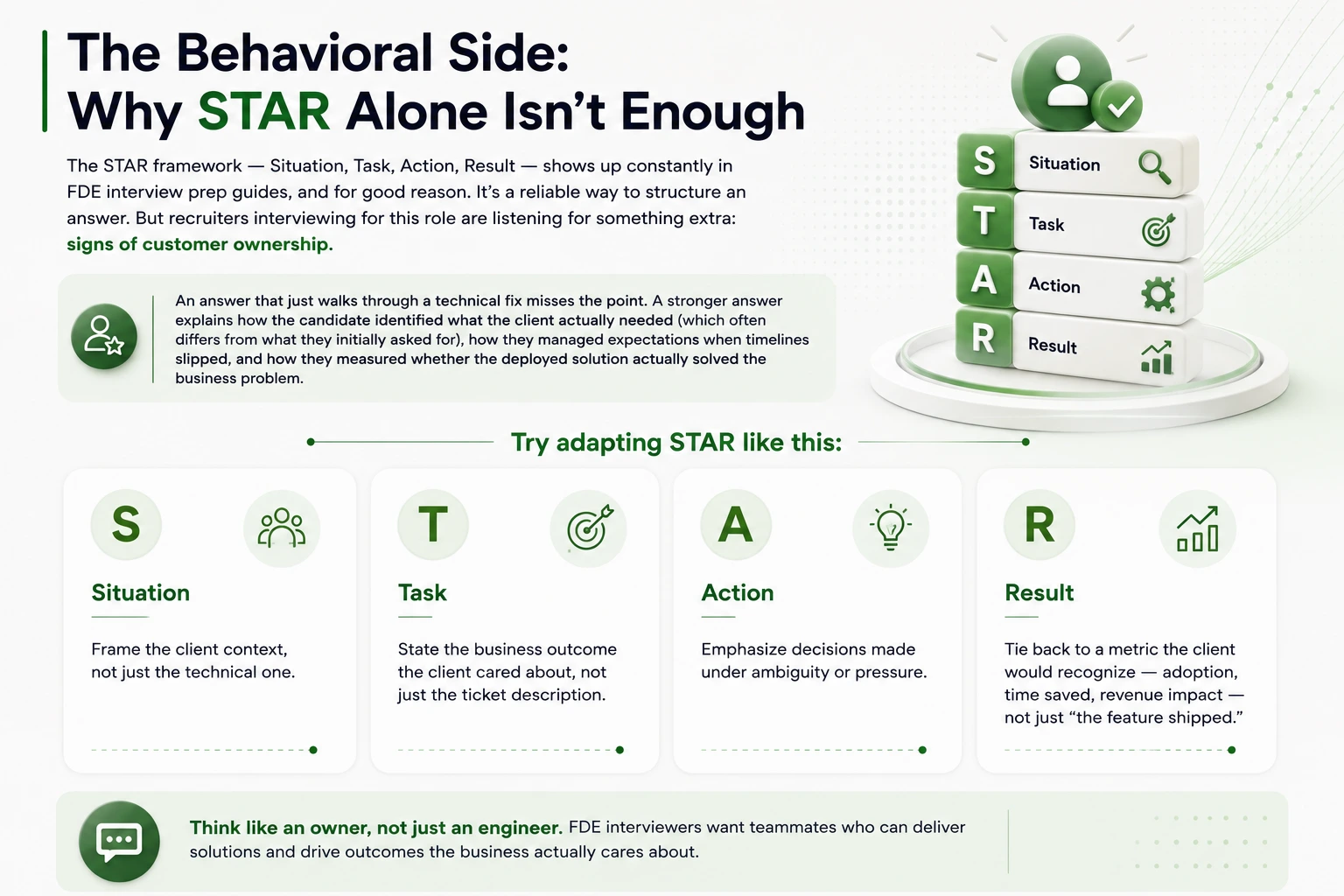
The Behavioral Side: Why STAR Alone Isn’t Enough
The STAR framework — Situation, Task, Action, Result — shows up constantly in FDE interview prep guides, and for good reason. It’s a reliable way to structure an answer. But recruiters interviewing for this role are listening for something extra: signs of customer ownership.
An answer that just walks through a technical fix misses the point. A stronger answer explains how the candidate identified what the client actually needed (which often differs from what they initially asked for), how they managed expectations when timelines slipped, and how they measured whether the deployed solution actually solved the business problem.
Try adapting STAR like this:
- Situation: Frame the client context, not just the technical one.
- Task: State the business outcome the client cared about, not just the ticket description.
- Action: Emphasize decisions made under ambiguity or pressure.
- Result: Tie back to a metric the client would recognize — adoption, time saved, revenue impact — not just “the feature shipped.”
Projects That Actually Demonstrate FDE Readiness
Generic portfolio projects rarely impress FDE hiring panels. What tends to land better are projects that mimic the actual job: taking a fuzzy problem, scoping it down, and shipping something a non-technical stakeholder could use.
| Project Type | What It Demonstrates | Effort Level |
|---|---|---|
| Internal dashboard for a fictional client dataset | Full-stack execution, data visualization | Medium |
| Automation script solving a “made-up” business workflow | Practical problem framing, scoping | Low |
| Open-source contribution to a dev tool | Codebase navigation, collaboration | Medium-High |
| Small AI-integrated app (RAG chatbot, agent workflow) | Modern stack fluency, current relevance | Medium |
| Mock client proposal + working prototype | Communication + delivery combined | High |
Three to five well-documented projects tend to outperform ten shallow ones. Each project’s README should read almost like a mini case study: what the problem was, what got built, and what got left out on purpose. That last part — explicit scoping decisions — is exactly what FDE panels want to see, because it mirrors real client work where saying “not in this sprint” is half the job.

Build Full-Cycle Engineering Experience With Itexus
Itexus handles fintech projects that combine technical planning, software development, system integrations, testing, and production support.
Need Support Across the Delivery Process?
Itexus can help with:
- product discovery and architecture
- backend, frontend, and mobile development
- API and legacy system integrations
- cloud and DevOps engineering
- testing and maintenance
 Contact Itexus to discuss full-cycle fintech development.
Researching the Company and Its Domain
Generic interview prep falls flat here because FDE roles are inherently tied to a specific industry. A forward deployed engineer heading into fintech needs a working vocabulary around payments, compliance, and trading infrastructure; one heading into healthcare needs an entirely different vocabulary.
For fintech-focused roles specifically, it helps to understand how banking-as-a-service models work, how digital lending platforms handle underwriting logic, and how trading platform development differs from a standard transactional web app in terms of latency and compliance requirements. Even a surface-level grasp of these areas signals to interviewers that a candidate can hold a real conversation with a client’s product or compliance team on day one.
Company-Specific Research Checklist
- Read the company’s public research or engineering blog posts from the last six to twelve months
- Understand their stated values or charter, if published
- Identify two or three named clients or case studies and skim what was built
- Note the industries they primarily deploy into — this shapes what domain knowledge to brush up on
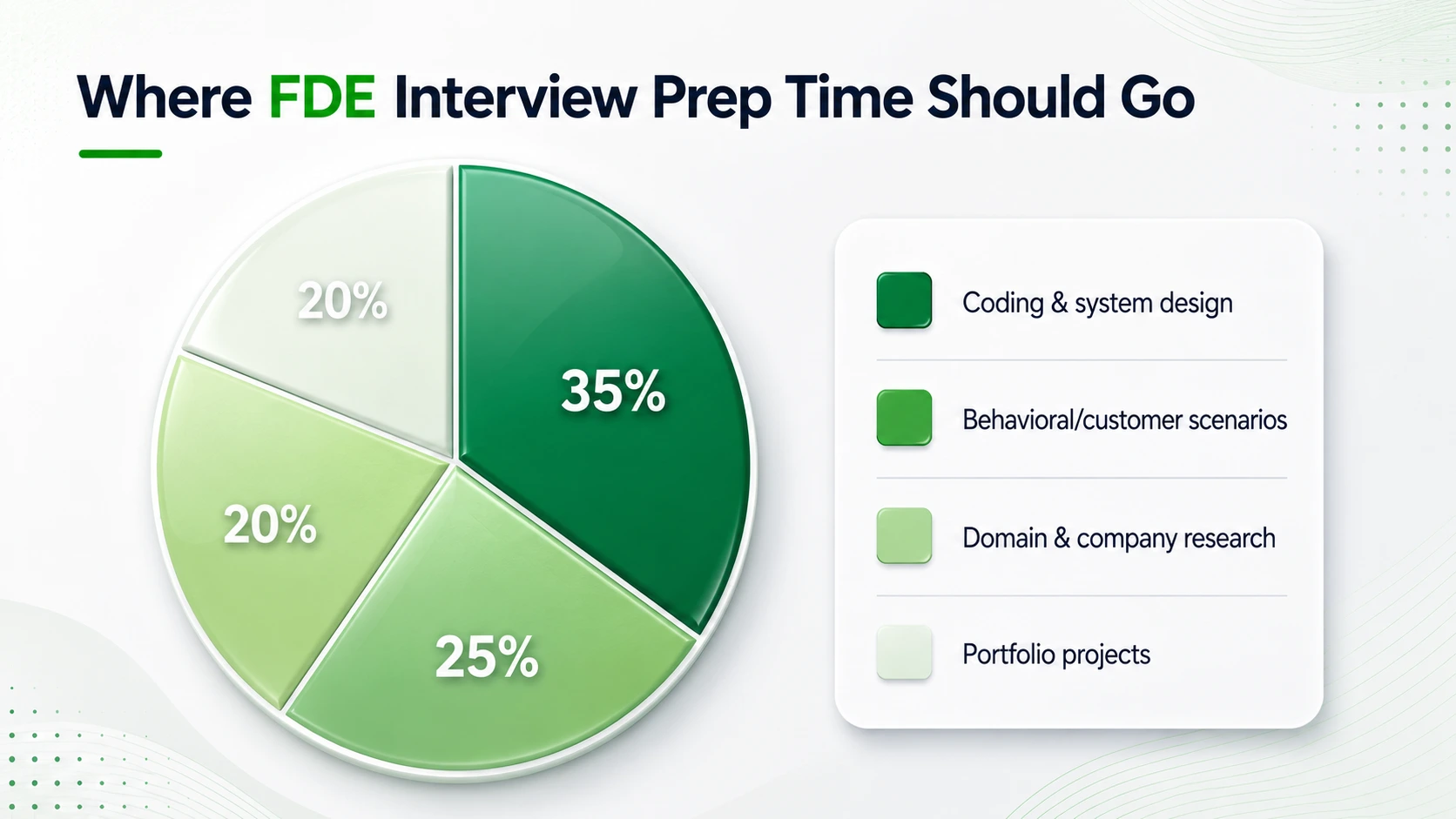
Suggested time allocation across the four pillars of FDE interview preparation.
Communication Skills That Get Tested Directly
Some FDE interview loops include a round that looks nothing like coding — a mock client call, a whiteboard session with a “stakeholder,” or a request to explain a technical tradeoff to someone non-technical. This isn’t a formality. It’s arguably the most predictive part of the whole process.
A useful practice drill: pick a technical decision from a past project — choosing a database, picking an auth strategy, whatever — and explain it out loud in under two minutes to someone with no engineering background. If that explanation includes jargon the listener has to stop and ask about, it needs trimming.
Common sub-skills interviewers probe:
- Clarifying an ambiguous ask before jumping to a solution
- Proposing a minimum viable version instead of the “ideal” build
- Setting realistic expectations without sounding defensive
- Translating technical risk into business risk language
A Simple 4-Week Prep Plan
Cramming everything in a weekend doesn’t work for this role — there’s genuinely too much surface area. A staged plan tends to work better.
| Week | Focus | Key Activities |
|---|---|---|
| 1 | Coding fundamentals | Refresh Python/JS, practice full-stack build exercises |
| 2 | System design under ambiguity | Practice open-ended design prompts, write clarifying questions first |
| 3 | Behavioral + domain research | Draft STAR-adapted stories, study target company and industry |
| 4 | Mock interviews + portfolio polish | Run mock client scenarios, tighten project write-ups |
How Itexus-Style Delivery Teams Mirror the FDE Model
It’s worth noting that the forward deployed pattern isn’t exclusive to a handful of Silicon Valley names. Software vendors that build custom banking and lending systems for clients — the model behind services like banking app development or digital lending systems — operate on a similar principle: engineers embed with the client’s requirements, adapt quickly, and iterate toward a working product rather than a theoretical spec. Studying how vendor teams structure discovery calls, prototype quickly, and hand off to client stakeholders (documented in a typical development process overview) offers a useful mental model even outside a formal FDE title. Reviewing a portfolio of delivered projects can also show what “shipped fast, shipped well” actually looks like in practice.
Frequently Asked Questions
What is the difference between a forward deployed engineer and a solutions engineer?
Do forward deployed engineers need a computer science degree?
How technical is the forward deployed engineer interview process?
Which programming languages matter most for this role?
Is forward deployed engineering a good long-term career path?
How much travel does a forward deployed engineer role involve?
What industries hire the most forward deployed engineers?
Final Thoughts
Preparing for a forward deployed engineer role isn’t about mastering one narrow skill — it’s about proving comfort across the whole loop: writing solid code fast, designing for ambiguity, and communicating like someone who actually cares whether the client’s problem gets solved. Panels can tell the difference between a candidate who memorized STAR answers and one who’s actually internalized what customer ownership means.
Start with the fundamentals, build two or three projects that mirror real client scoping decisions, and practice explaining technical tradeoffs to a non-technical audience until it feels natural rather than rehearsed. That combination, more than any single certification or algorithm drill, is what separates a strong FDE candidate from an average one.