
Quick Summary: An AI forward deployed engineer (FDE) is a hybrid software engineer and consultant who embeds directly with a customer to build, customize, and ship AI systems inside that customer’s own environment. Unlike a traditional engineer who ships generic product features from behind a desk, an FDE owns the last mile between a model’s raw capability and a working business outcome. The role blends coding, applied AI knowledge, and client-facing communication, and it has become one of the fastest-growing job titles in tech as companies race to turn large language models into production software.
Search job boards for almost any AI company right now and one title keeps popping up: forward deployed engineer. It sounds vaguely military, and honestly, that’s not an accident — the phrase does trace back to defense-adjacent tech culture. But the job itself has nothing to do with combat and everything to do with getting AI software to actually work for real customers, in real environments, under real constraints.
So what is an AI forward deployed engineer, exactly? Think of it as the person standing at the intersection of engineering, consulting, and product — someone who doesn’t just write code in a lab and hope it fits, but who sits with the customer, sees the mess of their actual workflows, and builds the thing that fixes it.
The Core Definition
A forward deployed engineer (FDE) is a technical role, usually employed by an AI or enterprise software vendor, whose job is to be physically or virtually embedded with a client’s team. Instead of building a one-size-fits-all product and shipping it over the wall, the FDE goes to where the problem lives.
That could mean sitting inside a bank’s operations center for weeks, wiring an AI model into a legacy loan-processing pipeline. It could mean joining a hedge fund’s trading desk to help data pipelines feed a risk model correctly. The common thread: the engineer isn’t shielded from the customer by layers of account managers and support tickets. They’re right there, writing code, debugging integrations, and adjusting the solution as the customer’s real needs surface.
This is different from a solutions architect, who mostly designs and advises, and different from a customer success manager, who mostly manages relationships. An FDE does the actual engineering — often production code that ships — while also carrying real responsibility for whether the customer gets value out of the deployment.
Where the Role Came From
Forward deployed engineering isn’t a brand-new invention, even if it feels that way given how often the title shows up in 2026 job postings. Palantir popularized the model years ago, pairing engineers with government and enterprise clients who had messy, high-stakes data problems that off-the-shelf software couldn’t touch. The approach worked because those clients needed custom integration, not just a product demo.
What’s changed is the AI wave. Large language models and agentic systems are powerful in a lab setting but famously brittle once they meet a customer’s actual data, actual compliance rules, and actual legacy systems. That gap — between an impressive demo and a working, trustworthy production system — is exactly where forward deployed engineers now operate. Companies building agentic AI products, from applied-AI startups to frontier labs, have leaned hard into the model because it’s often the only way to get AI to survive contact with a real enterprise environment.
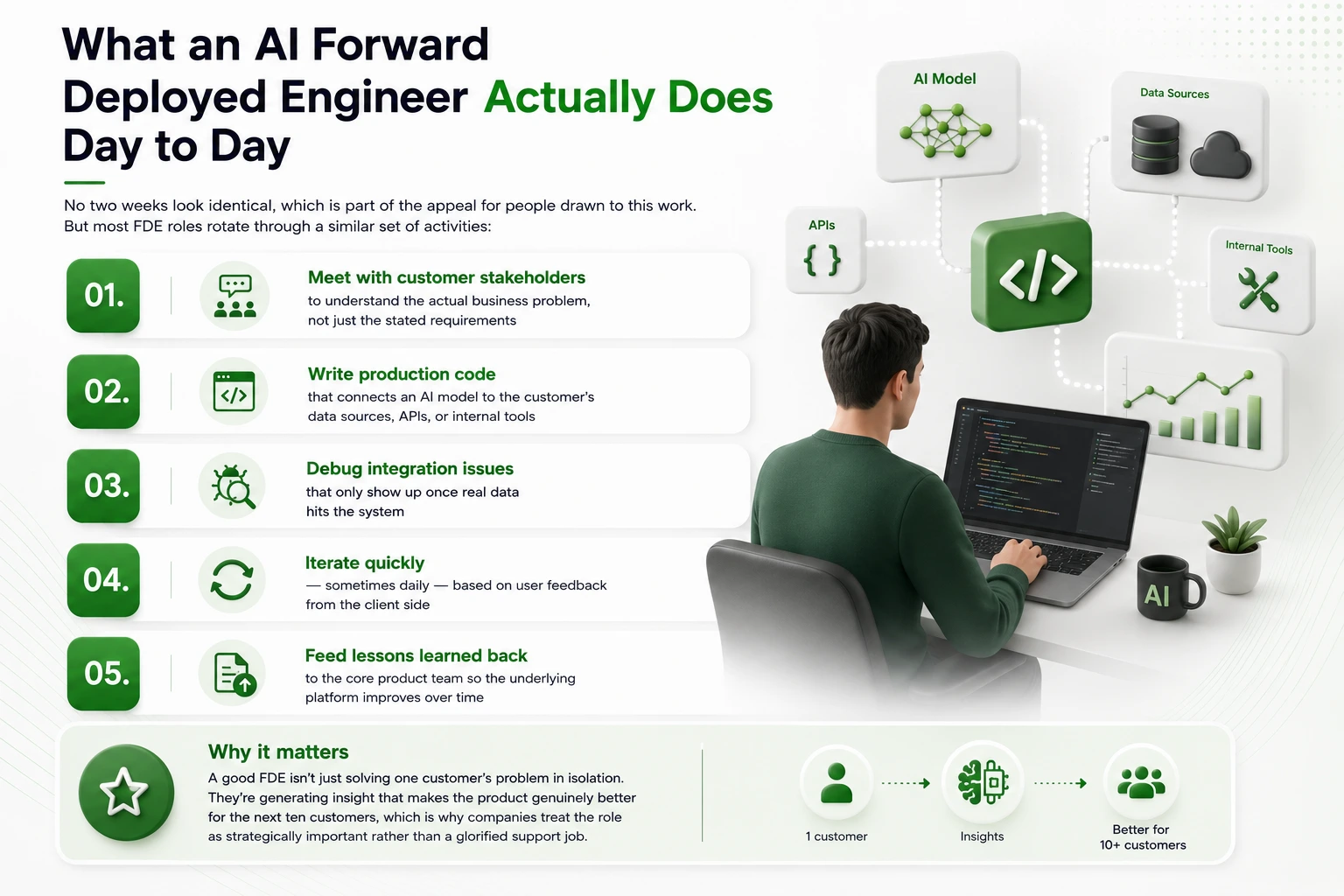
What an AI Forward Deployed Engineer Actually Does Day to Day
No two weeks look identical, which is part of the appeal for people drawn to this work. But most FDE roles rotate through a similar set of activities:
- Meeting with customer stakeholders to understand the actual business problem, not just the stated requirements
- Writing production code that connects an AI model to the customer’s data sources, APIs, or internal tools
- Debugging integration issues that only show up once real data hits the system
- Iterating quickly — sometimes daily — based on user feedback from the client side
- Feeding lessons learned back to the core product team so the underlying platform improves over time
That last point matters more than it sounds. A good FDE isn’t just solving one customer’s problem in isolation. They’re generating insight that makes the product genuinely better for the next ten customers, which is why companies treat the role as strategically important rather than a glorified support job.
Pre-Sales vs. Post-Sales Work
Many FDEs split time between two phases. In pre-sales, they might build a rapid proof of concept to prove the AI system can actually handle a prospective client’s data and use case before a contract is signed. In post-sales, they move into implementation — the harder, longer work of getting the system live, integrated, and trusted by the people who’ll use it every day. Some organizations split these into separate roles; others expect one engineer to do both.

Build AI Systems With Itexus
Itexus develops AI features for banking, trading, lending, insurance, wealth management, and internal financial operations.
Need Help Putting AI Into Production?
Itexus can help with:
- AI consulting and implementation
- RAG systems and copilots
- predictive analytics and fraud detection
- document intelligence
- AI agent workflow automation
 Contact Itexus to discuss your AI implementation needs.
Core Skills an AI Forward Deployed Engineer Needs
The skill set is unusually broad, which is exactly why the role is hard to hire for. Strong candidates typically combine several things at once.
| Skill Area | Why It Matters |
|---|---|
| Full-stack or backend engineering | FDEs ship real code, often under tight deadlines, directly into customer environments |
| Applied AI / ML fundamentals | Understanding model limitations, prompt design, and retrieval systems is table stakes now |
| Systems integration | Legacy APIs, data pipelines, and security constraints rarely match the documentation |
| Client communication | Explaining technical tradeoffs to non-technical stakeholders, often under pressure |
| Domain knowledge | Understanding the customer’s industry (finance, healthcare, logistics) speeds up trust and delivery |
| Comfort with ambiguity | Requirements shift constantly once real usage begins; rigid processes tend to fail here |
Notice that coding ability alone doesn’t cut it. Plenty of strong engineers struggle in FDE roles because they’re uncomfortable improvising in front of a client or because they’d rather write clean, generalized code than a scrappy fix that solves today’s problem. Neither instinct is wrong — they’re just a mismatch for this particular job.
Forward Deployed Engineer vs Other AI Roles
It helps to see the role next to adjacent titles, since job postings often blur the lines.
| Role | Primary Focus | Client Contact | Ships Production Code? |
|---|---|---|---|
| Forward Deployed Engineer | Custom implementation inside customer environment | High — often on-site or embedded | Yes |
| Solutions Architect | Technical design and pre-sales advisory | High, but less hands-on coding | Rarely |
| ML/AI Research Engineer | Model development and experimentation | Low | Sometimes, for internal tools |
| Customer Success Engineer | Post-sale support and relationship management | High | No, mostly configuration |
| Product Engineer | Building generalized product features | Low to medium | Yes |
Why FDEs Matter So Much in Fintech and Banking
Financial services is one of the clearest cases where forward deployed engineering earns its keep. Banks, lenders, and trading firms run on decades-old core systems, strict compliance rules, and data that rarely looks the way a vendor’s demo environment assumes it will. Dropping a generic AI product into that mix and hoping it works is a recipe for a stalled pilot.
An embedded engineer who understands both the AI stack and the realities of banking infrastructure can get a project from proof of concept to production far faster. That’s especially true for use cases like fraud detection tuned to a specific transaction pattern, an underwriting model that needs to respect a lender’s existing risk policy, or a trading desk tool that has to plug into a live market-data feed without breaking anything. Teams building custom AI software development and integration for financial institutions often end up doing exactly the kind of hands-on, embedded work an FDE does, even without the title.
The same logic applies across other fintech niches — digital lending platforms that need AI-driven risk scoring wired into existing loan workflows, or trading platforms that need low-latency AI signals integrated without disrupting execution speed. In both cases, the value isn’t the AI model itself — it’s the careful, hands-on work of making that model fit a specific, regulated environment.
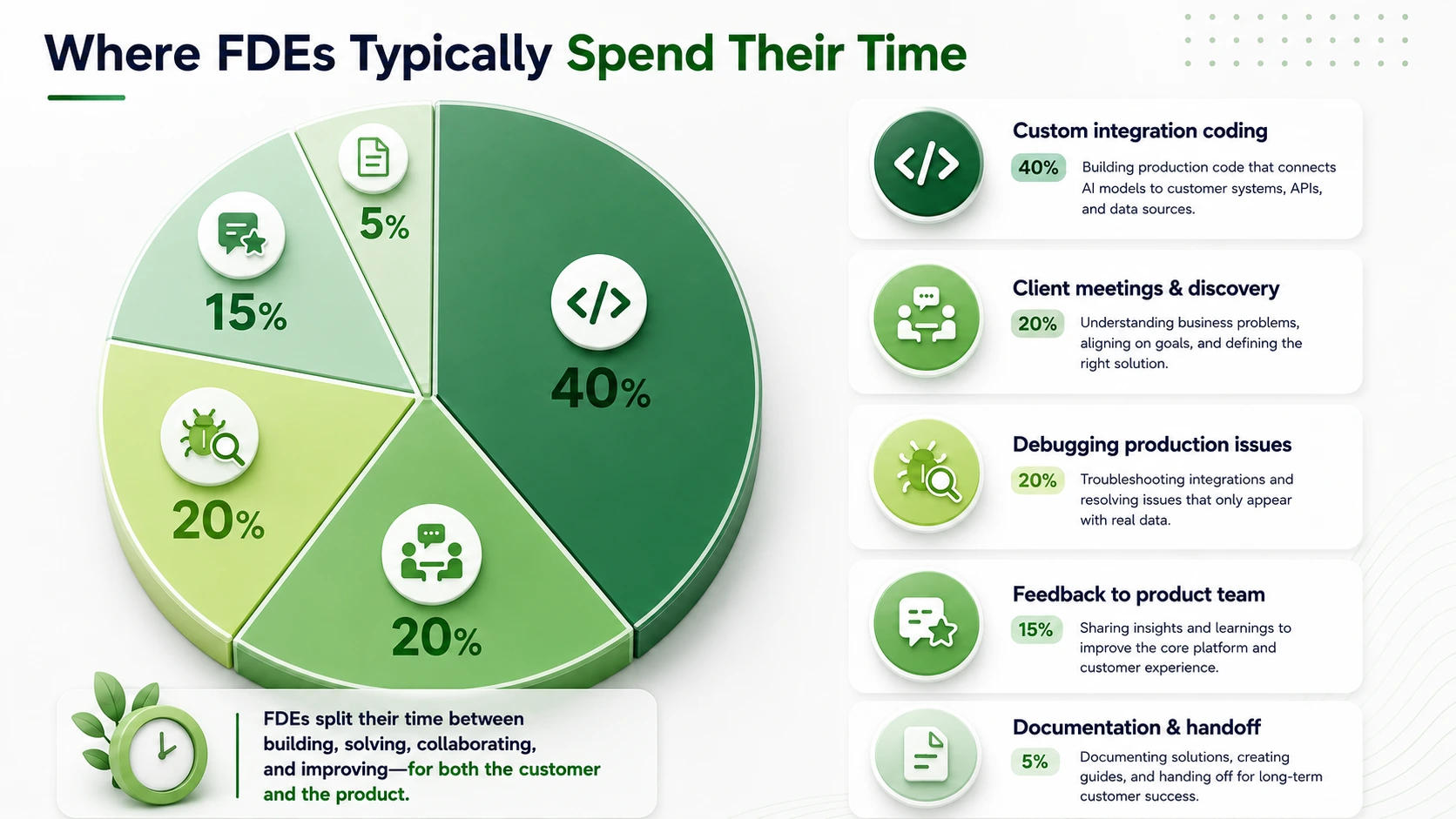
Rough breakdown of how a forward deployed engineer allocates a typical work week.
Salary and Career Outlook
Compensation for forward deployed engineers varies widely depending on company stage, industry, and location. As of 2026, general salary aggregators put average base pay for forward deployed engineers in the US somewhere in the $150,000–$165,000 range, according to sites like Glassdoor and Levels.fyi. At the high end — frontier AI labs and well-funded applied-AI startups — total compensation for senior or principal-level FDEs can run into the high six figures or beyond, reflecting how scarce the combined skill set really is. Because pay bands shift quickly in this space, it’s worth checking current listings on sites like Levels.fyi or Glassdoor rather than treating any single number as fixed.
Career-wise, the role tends to funnel in two directions. Some FDEs move into product management, since they’ve spent years hearing directly what customers actually need. Others move deeper into engineering leadership, having proven they can ship reliable systems under real-world pressure. Either path tends to pay off, since the role builds a rare combination of technical credibility and business fluency.
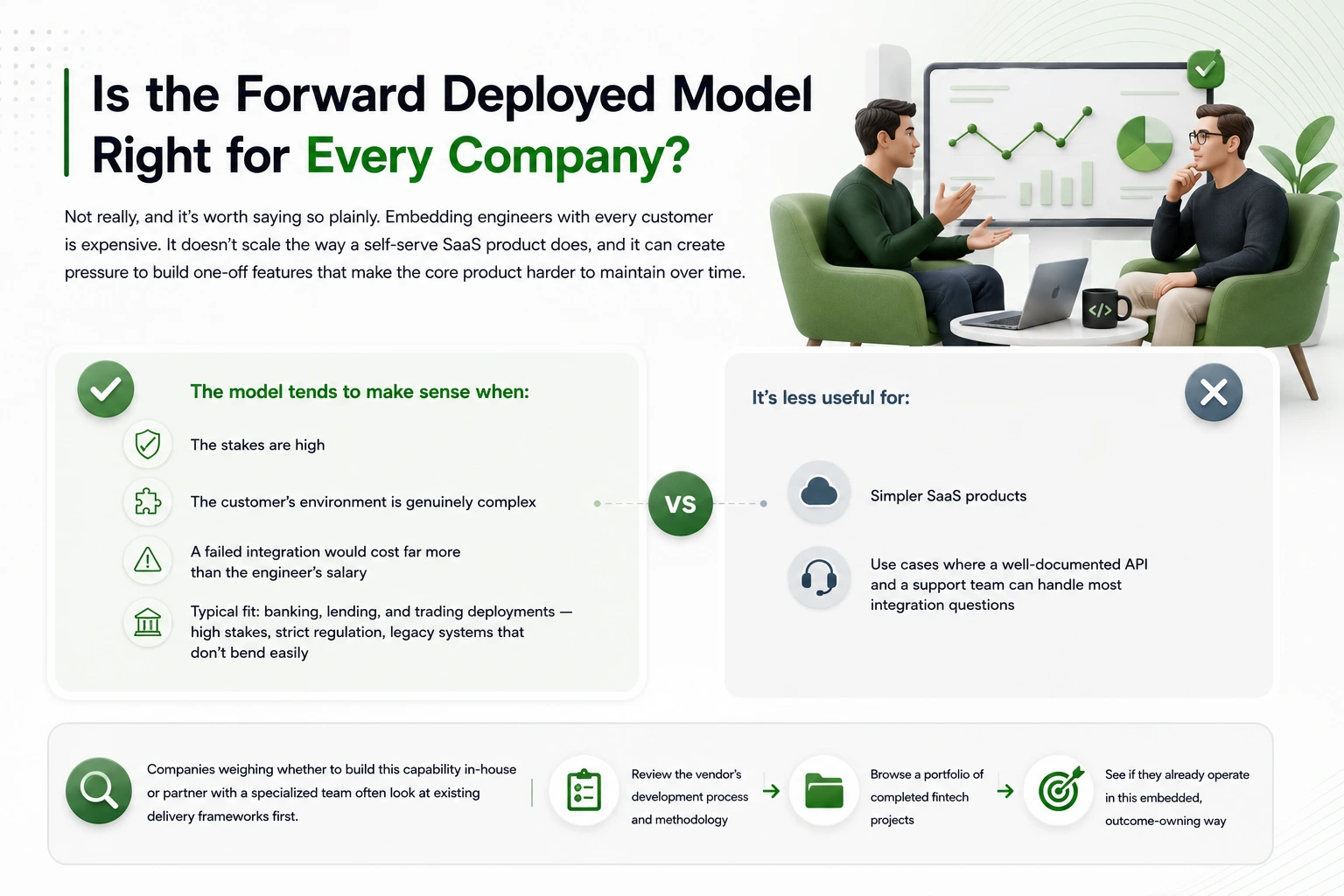
Is the Forward Deployed Model Right for Every Company?
Not really, and it’s worth saying so plainly. Embedding engineers with every customer is expensive. It doesn’t scale the way a self-serve SaaS product does, and it can create pressure to build one-off features that make the core product harder to maintain over time.
The model tends to make sense when the stakes are high, the customer’s environment is genuinely complex, and a failed integration would cost far more than the engineer’s salary. That’s exactly the profile of most banking, lending, and trading deployments — high stakes, strict regulation, legacy systems that don’t bend easily. It’s less useful for simpler SaaS products where a well-documented API and a support team can handle most integration questions on their own.
Companies weighing whether to build this capability in-house or partner with a specialized team often look at existing delivery frameworks first. Reviewing a vendor’s development process and methodology or browsing a portfolio of completed fintech projects tends to reveal pretty quickly whether that vendor already operates in this embedded, outcome-owning way.
FAQ: AI Forward Deployed Engineer
What does FDE stand for?
Is a forward deployed engineer the same as a software engineer?
Do you need an AI background to become a forward deployed engineer?
How much does an AI forward deployed engineer earn?
Why are forward deployed engineers suddenly in such high demand?
Can a forward deployed engineer work remotely?
Is forward deployed engineering a good long-term career?
Wrapping Up
An AI forward deployed engineer isn’t a support role dressed up with a fancier title. It’s a genuinely hybrid job — part engineer, part consultant, part product researcher — built for a moment when AI models are capable but still need a lot of careful, hands-on work to become reliable in messy, regulated, real-world environments. That’s especially true in fintech and banking, where legacy systems and compliance requirements punish anything shipped without close attention to the customer’s actual setup.
Companies evaluating whether they need this kind of embedded talent, whether in-house or through a development partner, are usually better off starting with a clear look at the specific integration problem rather than the job title. For fintech teams weighing that decision, reviewing how a development partner structures fintech software development engagements is a reasonable next step before committing to a build.