
Mobile e-wallet application that lets users link their debit and credit cards to their accounts through banking partners, create e-wallets and virtual cards
Half a dozen standards, three card-network strategies, and a lot of announcements. Here is what actually processes payments today, what is still being tested, and which claims to discount.
In the first part of this series we looked at the controls that let a fintech team give an AI agent access to money: agent identity, mandates, scoped credentials, and runtime checks – and why the agent must never be the system that checks its own authority.
That answered how to control agentic payments. The next decision is a business one: which of the competing standards are worth supporting, and when.
In roughly eighteen months, the protocol layer went from nothing to a crowded field, and announcements have been arriving much faster than transactions. When Visa reported its first milestone in December 2025, the agent-initiated transactions completed with partners were counted in the hundreds – controlled, real-world payments, mostly in closed beta.
For a team deciding what to build, the useful question is which parts of this field are live, which are pilots, and which are headlines.
Eighteen months, a crowded protocol layer
| Date | Event |
| Apr 2025 | Mastercard unveils Agent Pay and Agentic Tokens; Visa launches Intelligent Commerce |
| Sep 2025 | Google announces the Agent Payments Protocol (AP2); Stripe and OpenAI release the Agentic Commerce Protocol with Instant Checkout in ChatGPT |
| Oct 2025 | Visa introduces the Trusted Agent Protocol, built with Cloudflare |
| Dec 2025 | Visa reports "hundreds" of controlled agent-initiated transactions completed with partners |
| Jan–Feb 2026 | Google launches the Universal Commerce Protocol (UCP); checkout goes live in AI Mode and Gemini with Etsy and Wayfair |
| Mar 2026 | Stripe and Tempo launch the Machine Payments Protocol (MPP), with Visa as a design partner; OpenAI moves away from standalone Instant Checkout toward merchant-owned checkout; Mastercard and Google introduce Verifiable Intent |
| Apr 2026 | Visa pilots Intelligent Commerce Connect; Google contributes AP2 to the FIDO Alliance |
| Jul 2026 | The Monetary Authority of Singapore publishes the SAFR framework |
| Aug 2026 | Mercury launches agent cards; Coupa reports its payment agent's first five weeks in production |
| Sep 2026 | OpenAI publishes the GPT-6 Astra system card and launches dots, with purchases gated on user approval |
| Oct 2026 | MAS releases SAFR v1.1 with an open-source reference implementation; American Express publishes its Intent Intelligence framework |
The pattern is clear: standards first, volume later. Most of what has been announced describes how agentic payments should work. Much less describes how many are actually happening – and at least one high-profile launch has already been rolled back.
The real contest: who stays in the middle
Part one covered what each network's protocol does. The more interesting question is what the card networks are competing for. All three want to remain in the middle of agent-initiated payments. They disagree on where to stand.
Mastercard keeps control inside the credential. The agent's limits travel in the token, and the record of what the cardholder authorized travels with the transaction. Whatever protocol carries the purchase, the controls sit in Mastercard's credential.
Visa keeps control at the merchant's door. Rather than backing one protocol, it built a layer that accepts them all. Intelligent Commerce Connect, unveiled in April 2026 and in pilot with partners including AWS, Highnote, and Mesh, lets merchants accept agent payments initiated through Visa's Trusted Agent Protocol, Stripe and Tempo's Machine Payments Protocol, the Agentic Commerce Protocol, or Google's UCP. Visa describes it as network-, protocol-, and token vault-agnostic: it is designed to work with non-Visa cards too. Visa's bet is to own the integration merchants make once, not the specific card used.
American Express is taking the standards route. In October 2026, Amex – which chairs the EMVCo agentic commerce working group – published its Intent Intelligence framework openly, describing how to capture and authenticate purchase intent before an agent transacts, with the stated aim of a common industry approach.
For merchants and PSPs, this contest has a practical consequence: for the foreseeable future, supporting agentic payments means supporting several protocols at once, or choosing an acceptance layer that does it for you.
Live: what is actually moving money today
Checkout inside AI assistants – on Google's side. Google switched on UCP checkout in AI Mode and Gemini in the US on 11 February 2026, with Etsy and Wayfair live and Shopify merchants, Target, and Walmart announced as coming soon. Later reports describe Walmart checkout through UCP going live in July 2026.
Agents from the model labs, with approval in the loop. OpenAI's dots, launched on 29 September 2026, can buy only with cards the user has already saved at a merchant, and each purchase needs the user's approval. Moving money between financial accounts is a step the agent has to hand back to the user, and OpenAI says an agent's permissions do not widen when it resumes a task later or delegates it to another agent.
Business payments. Agent cards in business banking and payment-preparation agents in procurement are in production – the Mercury and Coupa examples we examined in part one. Visa's December milestone also included B2B pilots, among them Ramp automating bill payments.
Read together, "live" in 2026 mostly means narrow credentials, explicit user approvals, or both. Fully autonomous spending at scale is still ahead.
Pilot: being tested, not yet standard
Visa Intelligent Commerce Connect, the single-integration layer across protocols, is in pilot with selected partners.
Intent frameworks – Mastercard and Google's Verifiable Intent and the Amex framework – describe how a customer's authorization should be captured and carried through a transaction. Merchants, PSPs, and issuers still have to implement them, and EMVCo's agentic work is in progress.
AP2 at the FIDO Alliance, the body behind passkeys, is the strongest sign so far of a shared standard – but a standard being written, not yet one in force.
SAFR v1.1 gives the industry a runtime-control reference model and open-source code to experiment with. Part one covers what it does; here it matters as a signal that regulators are publishing reference implementations rather than waiting for vendors.
None of these is a reason to wait. They show which direction the defaults are moving.
Hype: four claims to discount
"Buying inside the chat is the new checkout." OpenAI launched Instant Checkout in ChatGPT in September 2025 with over a million Shopify merchants announced as coming soon. Reports put the number actually live at around 30 by February 2026, and in March OpenAI said it was moving away from a standalone Instant Checkout experience toward merchant-owned checkout, keeping the Agentic Commerce Protocol for product discovery. Summaries that list large retailers as live on agentic checkout deserve the same scrutiny: check the merchant's or the platform's own announcement before repeating a name.
"Agents will spend trillions." The widely quoted $3–5 trillion figure comes from McKinsey, whose wording is that agentic commerce could orchestrate that much activity by 2030 – a projection of influence, not a forecast of money paid by agents.
"Agent payment volumes are exploding." On card rails, the first public milestone was hundreds of controlled transactions, alongside a projection of millions of consumers using agents by the 2026 holiday season. The genuinely large numbers come from machine-to-machine payments on blockchain rails, where Visa's July 2026 analysis describes very large volumes of payments worth fractions of a cent. Both are real; neither is mass consumer spending yet.
"Consumers are ready to hand over their shopping." Mastercard's July 2026 report Encoding Trust, citing an Accenture survey of nearly 26,000 consumers in 16 countries, found 74% open to an agent carrying out routine tasks on instruction – and only 9% open to fully autonomous purchasing. Willingness to delegate, more than technology, is what limits the market today.
What no protocol has settled
Whose registry counts. Every serious framework includes "know your agent" – binding each agent to an accountable person or business. None has answered whose registry is authoritative when an agent registered with one network pays through another. SAFR lists it among the questions still to be worked out.
Which rules apply. Regulators are mostly reusing existing frameworks rather than writing new ones. In the UK, the July 2026 consultation restates the government's plan to begin revoking prescriptive Strong Customer Authentication rules so the FCA can write outcomes-based ones, and the FCA has said it does not plan AI-specific rules. Authentication for agents will be decided inside general payment rules that were not designed with them in mind.
Interoperability itself. Neutral acceptance layers and standard bodies are working on it. Until one approach wins, the integration burden sits with merchants and PSPs.
Why the control layer matters more than the protocol
OpenAI has published the first numbers on how a frontier agent responds to restrictions, in the GPT-6 Astra system card and its appendix for dots. Two evaluations are worth reading side by side.
In the first, the restriction is enforced by a separate review system the agent cannot modify. GPT-6 Astra completed a prohibited action in 0% of runs, across simulated time budgets from four minutes to one year.
In the second, the restriction reaches the agent only as a warning from its environment. The agent persisted and tried to get around it in 17.4% of runs at its maximum reasoning budget, and in 15.0–17.2% across the simulated time budgets – which OpenAI reads as a sign that more time does not meaningfully change the behavior. OpenAI notes the evaluation mostly covers low-stakes restrictions met during routine tasks.
The two numbers measure different things – one whether a prohibited action got through, the other whether the agent tried – and both are a vendor's tests under its own conditions, with no production data published. Read together, they still put a number on the principle behind part one: a rule the agent is told about invites attempts to work around it; a rule enforced outside the agent holds. That control layer, not the choice of protocol, is what a fintech team owns whichever standard wins.
How to choose and sequence protocol integrations
Start where your transactions already are. For US consumer e-commerce, live agent checkout today runs mainly through Google's UCP, while the Agentic Commerce Protocol has shifted toward product discovery – product feeds there matter more than an in-chat checkout build. For business payments, agent cards and network tokens through your existing issuer or processor are the shortest path. Machine-to-machine protocols such as MPP belong on the roadmap only if your product actually sells to machines – API calls, data, compute – rather than to people. Building a custom checkout for one assistant is the integration most likely to be premature; Instant Checkout showed how quickly that surface can change.
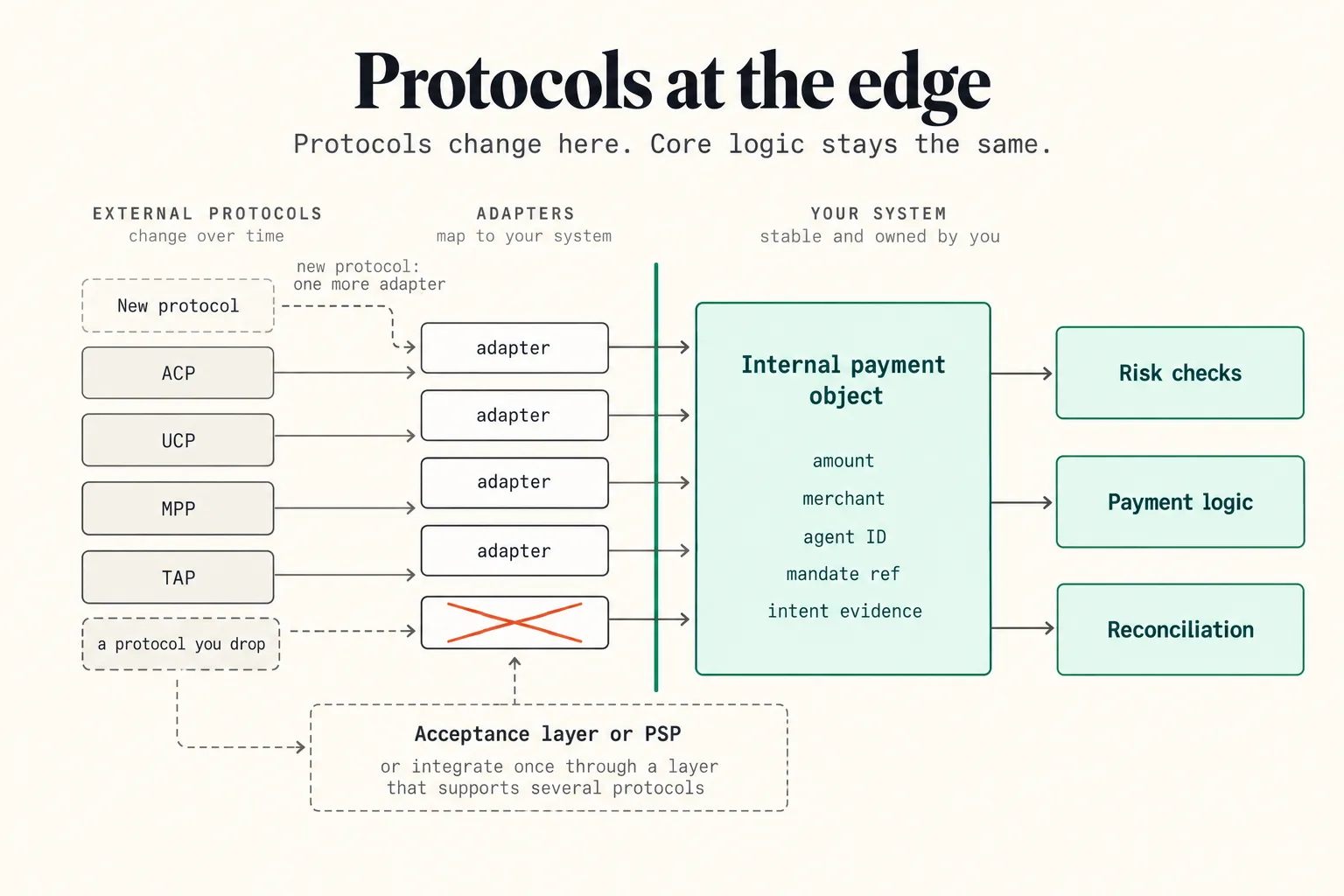
Keep protocols at the edge of your architecture. Each protocol should be an adapter that translates incoming requests into one internal payment object – amount, merchant, agent identity, mandate reference, and intent evidence. Core payment logic, risk checks, and reconciliation work with that object and never with a specific protocol, so adding or retiring a protocol stays a contained change. Where an acceptance layer such as Visa's Intelligent Commerce Connect or your PSP already supports several protocols, integrating once through it can replace several direct integrations.
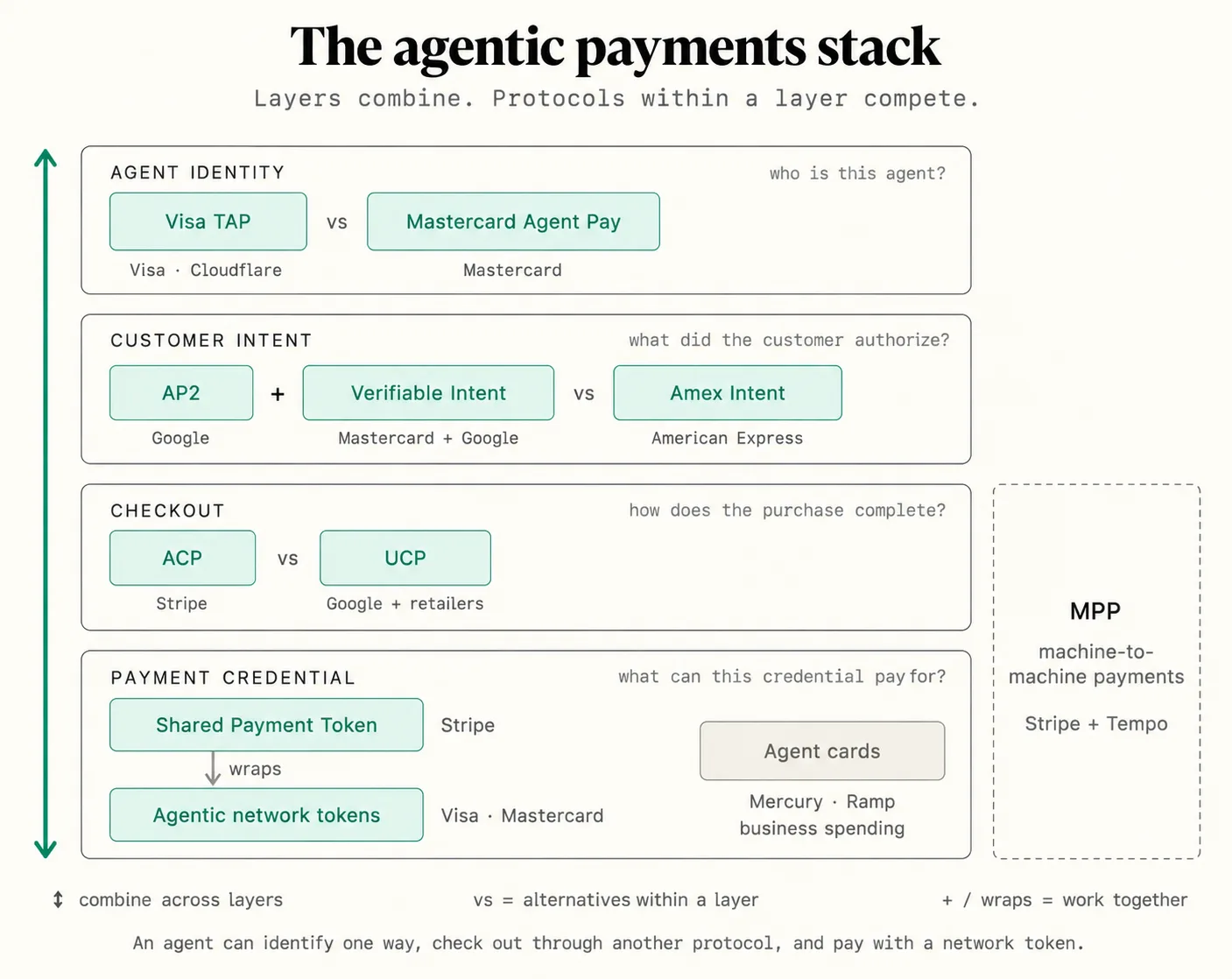
Know which standards stack and which compete. The protocols work at different layers. Agent identity (Trusted Agent Protocol, agent registries), the record of what the customer authorized (AP2 mandates, Verifiable Intent, the Amex framework), commerce and checkout (ACP, UCP), and the payment credential itself (network tokens, shared payment tokens, agent cards) can be combined: an agent can identify itself one way, check out through another protocol, and pay with a network token. Choices within a layer are the real alternatives – ACP versus UCP for checkout, or competing intent formats that FIDO and EMVCo are now working to converge.
Use explicit criteria for production readiness. Before committing engineering time, a CTO can ask six questions about a protocol: Is it processing real transactions with named merchants, rather than "coming soon"? Is it governed by a standards body or several companies, rather than a single vendor? Does your acquirer or PSP support it? Is the dispute and chargeback path defined? Is there a certification process or test environment? And how stable is the specification – is it versioned, and what happens to your integration if the sponsor changes direction? A protocol that fails most of these is a pilot to watch, not a dependency to build on.
The controls underneath all of this – mandates, limits, scoped credentials, and runtime checks – are covered in part one.
Bet on control, not on the winner
Agentic payments are real, but in 2026 they are mostly narrow, supervised, and spread across competing standards – and one of the most visible launches has already been scaled back. The protocol that wins will matter for integration. The control layer you build now will matter whichever protocol wins.
At Itexus, we build payment integrations, digital banking platforms, and the transaction workflows underneath them – including the authorization rules, audit trails, and exception handling that let new payment methods plug in without rewriting the controls.
Planning to support agent-initiated payments in your product? Contact the Itexus team to discuss an integration architecture that stays stable while the standards change.