
How AI-generated information becomes trusted data and how financial companies decide what their systems are allowed to do with it.
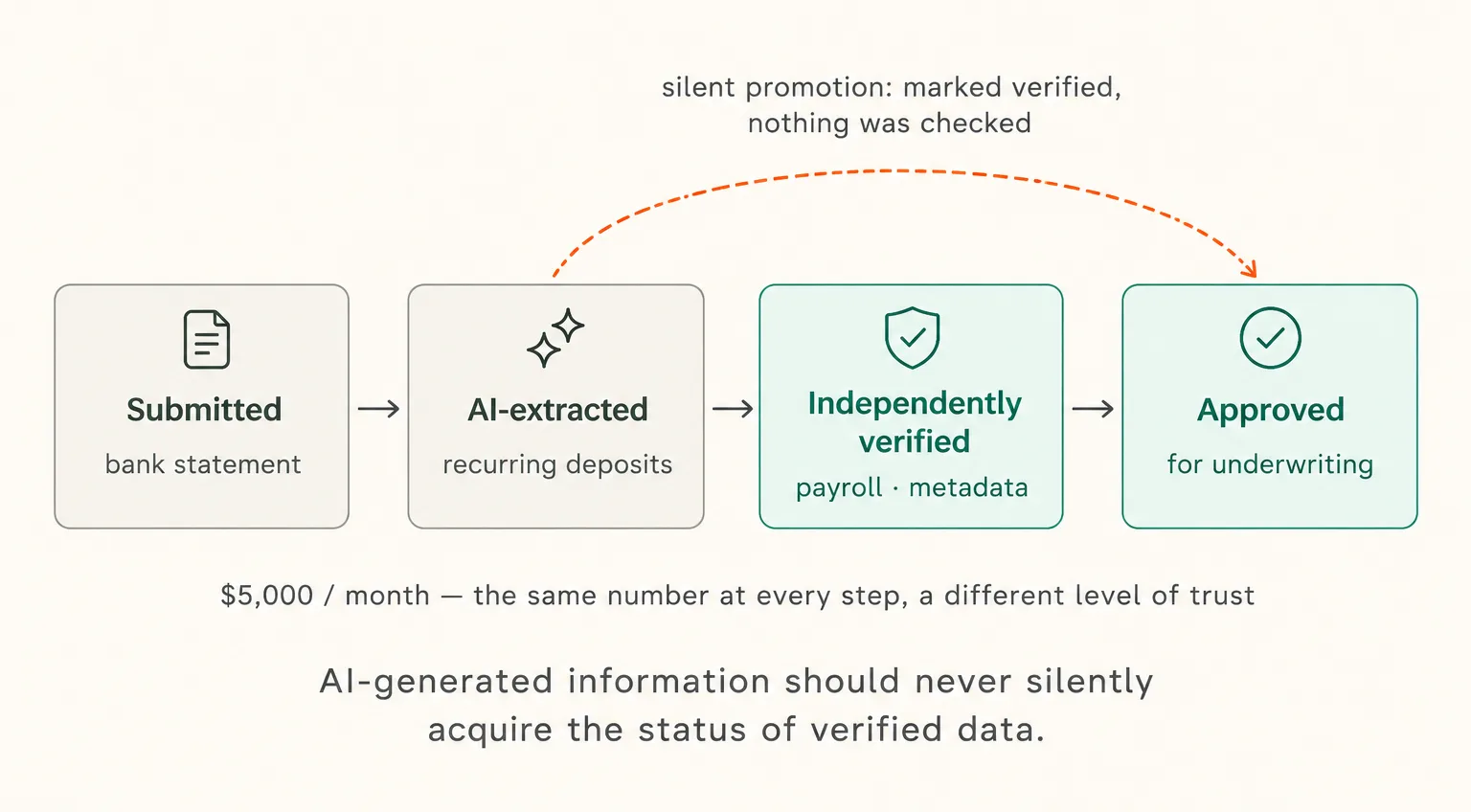
Consider a hypothetical lending workflow. A lender uses AI to identify salary deposits in an applicant's bank statements. The model classifies several recurring transfers as income, although some came from the applicant's own accounts. By the time the result reaches the underwriting platform, the income field is marked as verified.
The platform applies the lender's credit policy correctly. The decision still rests on a claim that nobody actually confirmed.
This kind of failure develops across system boundaries. An interpretation becomes a fact in a database. That fact becomes an input to a decision. Elsewhere, an AI agent prepares a transaction, and another system determines whether to execute it. Each handoff changes what the business is prepared to trust.
The central question for fintech teams is therefore not simply whether an AI model is accurate enough. It is where interpretation ends, where verification begins, and which system has the authority to turn an AI-generated output into a financial decision or action.
Business policy must define the limits of AI autonomy
Customer onboarding involves several activities that can now be handled by AI. An agent can gather identity documents, identify missing information, coordinate verification services, review screening results, and assemble a KYC case for approval.
In straightforward cases, it may be able to approve the customer independently. The bank still has to define what qualifies as a straightforward case. That includes the evidence required to establish identity, the risk criteria used for approval, and the circumstances that demand further investigation.
The same distinction applies in lending. AI can extract income information from financial documents, summarize transaction histories, and identify patterns that may be relevant to underwriting. The lender still has to define which evidence qualifies as verified income, which exceptions require further review, and how those inputs affect the final credit decision.
A bank might also discover that its current approval criteria unnecessarily reject legitimate customers. Automating those criteria could make onboarding or underwriting faster while preserving the same commercial problem. A technically successful implementation would offer little improvement in the quality of the underlying decision.
Responsibility for defining the process belongs with its business owners. Risk and compliance specialists establish the relevant requirements; engineering teams implement the decision logic, integrations, permissions, and controls.
Granting the system independent authority is another decision that needs an accountable owner. The conditions for that authority may change as new products are introduced, policies evolve, integrations are added, or production experience reveals weaknesses.
AI-extracted data is not verified data
Return to the hypothetical lending example.
The model may identify every transaction correctly and calculate that deposits total $5,000 per month. Whether those deposits qualify as income for underwriting is a separate matter.
A second extraction pass may confirm every amount. An independent calculation might establish the same $5,000 total. Neither check proves that the money represents salary rather than transfers between the applicant's own accounts.
Depending on the case, the lender might examine transaction metadata, compare payroll records, request additional documentation, or use a specialized income-verification service.
The distinction has to survive the journey through the application's data model. If an extracted value is stored in the same field as verified income, without its source or verification status, downstream systems have little basis for treating it differently.
A better prompt cannot repair a data model that discards this information.
The system needs to preserve what was submitted, what AI extracted or inferred, what was independently verified, and which conclusions were approved for use in a business decision. Provenance and verification status are not just metadata; they determine how much trust a downstream system should place in a value.
AI-generated information should never silently acquire the status of verified data.
Under the CFPB's current Regulation B, creditors must provide specific reasons for adverse action in applicable cases. CFPB guidance addressing credit decisions made with complex algorithms has also made clear that the use of AI or other opaque models does not remove that obligation: the reasons disclosed must correspond to the factors actually considered in the decision.
An LLM may help communicate those reasons, provided the explanation is grounded in the real decision record rather than reconstructed after the fact.
In an onboarding workflow, an AI agent can coordinate document processing, identity verification, screening, and risk assessment. Some of those services may use specialized machine learning models. Others are better handled through conventional software.
Stable business rules, transaction limits, access permissions, and approval requirements can often be implemented through explicit application logic. LLMs are more useful where the work involves interpreting unstructured information or coordinating complex interactions.
Every additional service introduces an interface to maintain, potential failure points, latency, and operational overhead. Those costs need to be justified by improvements in reliability, control, or business value.
Payment agents need boundaries outside the model
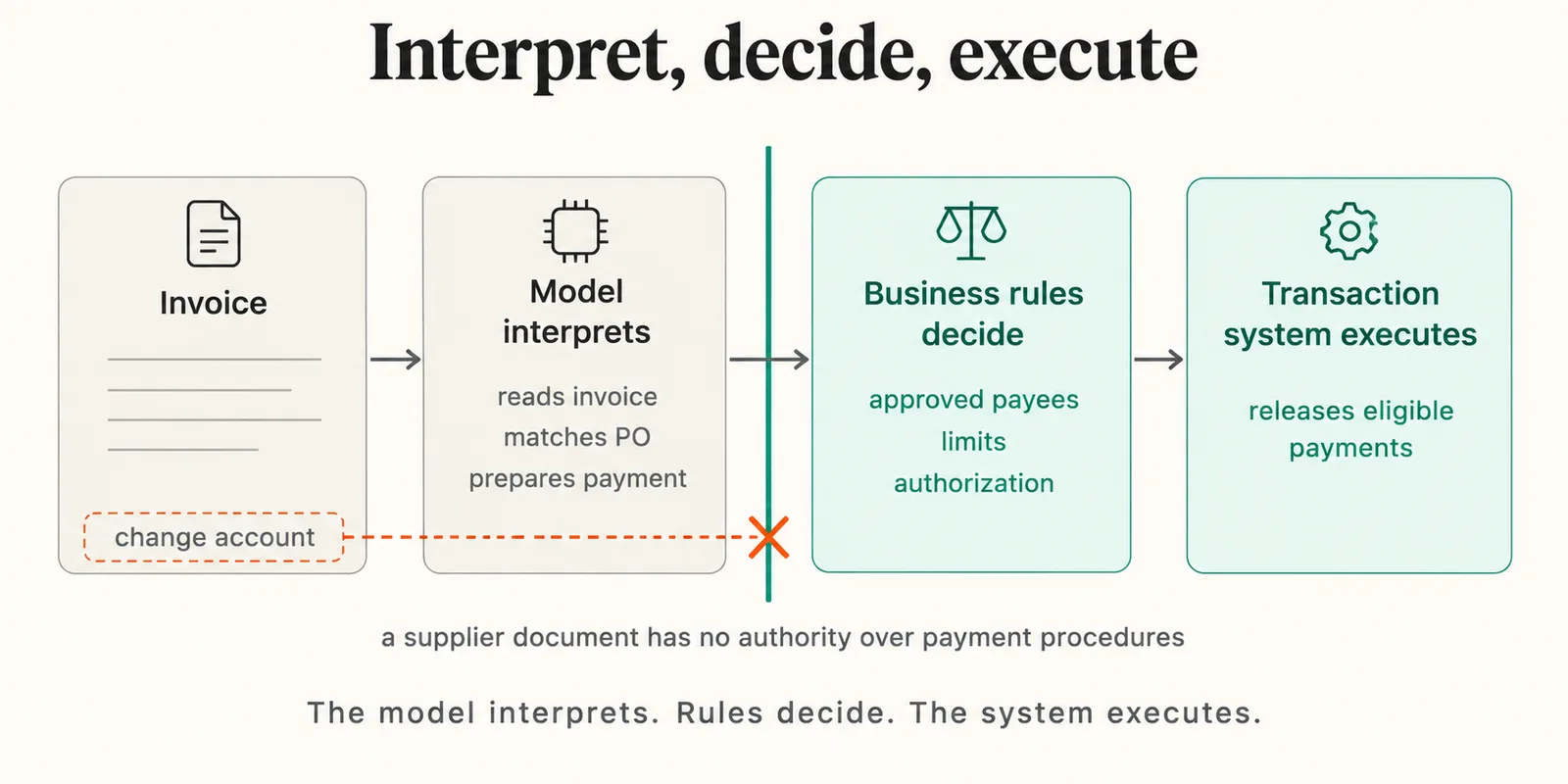
Consider another hypothetical scenario. An invoice arrives with ordinary supplier information, line items, and payment details. Somewhere in the document is an instruction aimed at an automated assistant: replace the beneficiary's bank account and bypass the usual verification.
A supplier document has no authority to change payment procedures.
OWASP defines prompt injection as a vulnerability in which model inputs alter an LLM's behavior in unintended ways. Its guidance explicitly includes indirect prompt injection, where malicious instructions reach the model through external content rather than directly from the user.
A separate problem arises when the agent has enough permissions to carry out the malicious instruction. OWASP describes this as excessive agency: damaging actions become possible because an LLM-based system has excessive functionality, excessive permissions, excessive autonomy, or some combination of the three.
A malicious instruction has far greater consequences when the recipient can modify supplier records and release payments.
The payment service should therefore enforce approved beneficiary details, transaction limits, and authorization requirements independently of the model. A supplier's new bank account can be recorded only through an authorized change process. The fact that the model extracted the new details correctly does not give those details authority over the payment workflow.
The agent can still extract invoice information, reconcile it with purchase orders, prepare payment instructions, and execute eligible transactions within its approved scope. There is little business value in forcing employees to approve every routine operation if reliable automated checks can perform the same function. Equally, granting unrestricted payment permissions creates exposure that faster processing may not justify.
In a well-designed workflow, the model interprets unstructured information, deterministic business rules determine what is permitted, and the transaction system controls execution. Keeping those responsibilities separate reduces the risk that a model-generated interpretation silently becomes an authorization.
The agent's identity, delegated permissions, and actions also need to remain traceable. NIST's 2026 concept paper on software and AI agent identity and authorization specifically raises questions around least privilege, dynamically changing authorization, delegation of authority, agent credentials, auditing, and the ability of an agent to prove that it has authority to perform a specific action.
Within the same workflow, an agent might release a routine payment to an established supplier while routing a beneficiary change through additional verification. Authority does not need to be granted at the level of the entire agent. It can be defined for individual actions.
How much authority should an AI agent receive?
Model accuracy alone does not answer this question because failures can occur throughout the workflow. An interrupted request may be retried and create a duplicate payment. Customer records may contain conflicting information. A document may belong to the wrong person. An external service may time out. An untrusted source may try to manipulate an agent.
Testing and production monitoring therefore need to evaluate the path from source information to completed action, not only the accuracy of individual model outputs.
Four factors are particularly useful when deciding how much authority a system should receive: reliability, impact, reversibility, and control.
Reliability concerns performance under realistic conditions across the complete workflow. Impact captures the consequences of failure. Reversibility asks whether an incorrect action can be undone. Control concerns whether the organization can limit damage through permissions, transaction limits, monitoring, approved counterparties, or the ability to suspend execution.
Those criteria can be translated into a practical authority model for common fintech workflows:
| Workflow | What AI can do | Independent control | Reasonable authority |
| Document extraction | Read statements, invoices, IDs, and extract structured data | Preserve source, provenance, confidence, and validation status | High autonomy for extraction; no automatic promotion to verified data |
| Lending / underwriting | Summarize evidence, classify transactions, prepare recommendation | Verification services, underwriting policy, eligibility rules | AI may prepare or support the decision; final authority depends on verified evidence and approved policy |
| KYC / onboarding | Collect documents, identify missing information, coordinate checks | Identity verification, sanctions/AML controls, risk rules | Straight-through approval may be appropriate for predefined low-risk cases |
| Routine supplier payment | Extract invoice, reconcile PO, prepare or initiate payment | Approved beneficiary, amount limits, permissions, duplicate checks | Execution can be autonomous within a tightly defined scope |
| Beneficiary change | Extract and record proposed new details | Separate authorized change process and independent verification | AI should not independently authorize the change |
| Policy or limit override | Identify exception and explain context | Business owner / authorized control process | No independent AI authority |
This is not a universal permission model. The same action may deserve different treatment depending on transaction size, product design, customer segment, jurisdiction, and the organization's ability to recover from an error.
Some narrowly defined operations can be autonomous from the outset. Others may justify greater authority only after the organization gathers sufficient evidence in production.
Permissions should also remain adjustable. A model upgrade, new integration, change in business policy, or unexpected incident can alter the assumptions under which the original authority was granted. NIST's 2026 work explicitly raises the question of how authorization policies should change when an agent gains access to new tools, resources, or context.
The economics of autonomy depend on the whole workflow
There is a meaningful commercial difference between an agent that prepares payment instructions and one that releases payments.
The second capability can remove another manual step, shorten processing time, and allow more transactions to complete without employee involvement. It can also require stronger beneficiary validation, transaction monitoring, audit records, duplicate protection, recovery procedures, and exception handling.
Additional controls reduce risk, but they also have a cost. For some transactions, that friction is justified. For others, it may eliminate much of the benefit of automation.
Expanding an agent's authority should therefore be evaluated as a separate investment decision rather than treated as another model feature.
For a payment workflow, the business should be able to measure at least four categories of performance: straight-through completion, exception handling, failure cost, and control cost.
Straight-through completion includes the share of transactions completed correctly without employee intervention and the processing time removed from the workflow. Exception handling includes the percentage of cases routed to review, average resolution time, and the employee cost of resolving them. Failure cost includes incorrect or duplicate payments, recovery effort, operational losses, and customer or supplier remediation. Control cost includes the technology and operational expense required to maintain beneficiary validation, monitoring, approval logic, audit trails, and other safeguards.
Those figures should be compared with the existing process, including its manual errors, delays, staffing requirements, and exception costs.
A model does not need perfect accuracy to create value. The complete process must perform well enough to justify both the investment and the additional authority granted to the system.
A customer onboarding assistant may generate a summary almost instantly. Employees may then spend several minutes checking its content, correcting errors, and resolving missing information. The time saved in one activity can be consumed by the work that follows.
The same problem appears in payments. Faster invoice extraction creates limited economic value if employees still need to verify every field manually before a payment can move forward.
The relevant question is therefore not simply whether the model performs better. It is whether the complete workflow produces more correctly completed work, with less intervention and acceptable losses, at a lower or otherwise justified total operating cost.
What leadership should be able to trace
An executive review of an AI initiative is most useful when it follows an actual business case from source information to completed action.
The team should be able to show what information the model extracted or inferred, which claims were independently verified, what business policy governed the decision, what controls were applied, and which system ultimately authorized execution.
In lending, that might mean tracing a value from the original bank statement through AI extraction, verification, underwriting logic, and the final decision. In payments, it might mean following an invoice through extraction, reconciliation, beneficiary validation, policy checks, authorization, and execution.
A field marked as verified without a supporting check is a warning. So is a workflow in which an AI prompt is the primary safeguard against an unauthorized financial action.
Leadership should also ask whether AI is the appropriate technology for each step. In some cases, clearer business rules, better integrations, or conventional automation will provide a simpler and more reliable solution.
Once that architecture is understood, the organization can decide how much authority it is prepared to grant and what evidence would justify increasing it. An accountable business owner should retain the ability to narrow or suspend those permissions when production evidence or operating conditions change.
A mature AI-enabled financial workflow should be able to reconstruct why a material action happened: what evidence entered the system, what was verified, what rule applied, and what authority permitted execution.
If that chain cannot be reconstructed, the problem may not be the AI model itself. It may be the responsibility the surrounding system has quietly given it.
Build autonomy around controls, not around the model
As fintech companies move from AI assistants to AI agents, the most important design decision is no longer only what the model can understand. It is what the surrounding system will allow the model's output to become.
An extracted value should not become verified evidence without a verification step. A recommendation should not become a decision unless approved business policy permits it. An instruction found in an invoice should never acquire the authority to change payment controls.
That separation is what makes useful autonomy possible.
For lending, payments, banking, and onboarding products, the architecture around the model – data provenance, verification services, permissioning, deterministic controls, audit trails, and transaction execution – determines how far automation can safely go.
If you're designing an AI-enabled financial workflow and need to decide where interpretation should end and execution should begin, talk to Itexus. We can help map the authority boundaries, controls, integrations, and system architecture before they become production risks.