
AI is changing software in two places at once. AI coding agents are increasing engineering teams' implementation capacity, while AI-powered features are becoming part of financial products, operations tools, customer support systems, and internal decision workflows. Both involve AI, but they create different engineering risks.
With AI-assisted development, the challenge is making sure faster implementation does not bypass architectural constraints, security requirements, or business rules. With AI inside the product, there is an additional problem: behavior can change even when the application code does not. A model update, prompt revision, retrieval change, or edited knowledge source can alter what the product tells a customer or employee without a conventional software release.
For fintech teams, this changes what “testing a change” means. The common principle is risk-based: the evidence required before release should be proportional to the consequences of failure. Critical requirements should also be defined independently of the system that produced the change, whether that system is a coding agent, an AI model, or a conventional development team.
Why AI-generated code needs independent requirements
Consider an illustrative example at a financial services company. A coding agent is asked to add case search to an internal customer-support platform containing account information for customers of several institutions. The agent implements the query, generates tests, and everything passes.
A separate integration test using records from multiple institutions exposes the problem: an employee can retrieve a case belonging to another customer account. The implementation itself works as written. What was missing was a requirement that results remain isolated by tenant, and the generated tests never challenged that assumption because their fixtures contained data from only one customer.
The issue is not simply that an AI agent wrote both the implementation and the tests. The deeper problem is that both were generated from the same incomplete requirement or context. If a critical constraint is absent from the specification, generating more tests from that same specification can preserve the same blind spot.
For properties such as customer isolation, payment authorization, access control, transaction limits, or ledger integrity, expected behavior therefore needs an independent source of truth. AI can help generate implementation and test coverage, but the requirements that define what must never be violated should come from product rules, architecture, security policy, or another controlled specification.
This becomes more important as coding volume increases. A 2026 NBER working paper analyzing more than 500,000 GitHub developers estimated a 240% increase in commit activity for autonomous coding agents, compared with a 30% increase in releases. The researchers caution that commits and releases represent different stages of software production and should not be treated as equivalent productivity measures, but the gap illustrates an important point: faster code production does not automatically translate into equally faster delivery.
A March 2026 DORA analysis of its 2025 research found a similar tension. Engineers often redirected time saved during code generation toward auditing and verification, while greater AI adoption was associated with both higher delivery throughput and greater instability.
Anthropic provides an extreme example of the same constraint. Between May and September 2026, the company reported that merged changes increased from roughly 2,500 to more than 30,000 per day, putting pressure on its existing source-control and CI infrastructure. Anthropic is an unusual case, but the underlying bottleneck appears at much smaller scales as well: when implementation becomes cheaper, slow integration tests, fragile interfaces, incomplete requirements, manual security review, and weak production observability become more visible.
Why AI product behavior can change without a code release
Now consider the same company using an AI assistant for its support team. The assistant summarizes cases and retrieves internal policies to help employees answer questions about refunds, disputes, fees, and account servicing. When the company's refund policy changes, operations updates the authoritative knowledge base. No application code is deployed.
The assistant remains available and technically functional, but it starts omitting an exception that makes a particular group of customers eligible for a refund. The retrieval pipeline runs, the model returns fluent answers, and the application itself has not failed. Yet the product is producing the wrong outcome.
This is a different change surface from conventional software. An AI-powered feature can depend on application code, model versions, prompts, retrieval configuration, ranking and context assembly, knowledge sources, permissions, and external tools or APIs. A change to any of them may alter behavior even if the deployed application version remains identical.
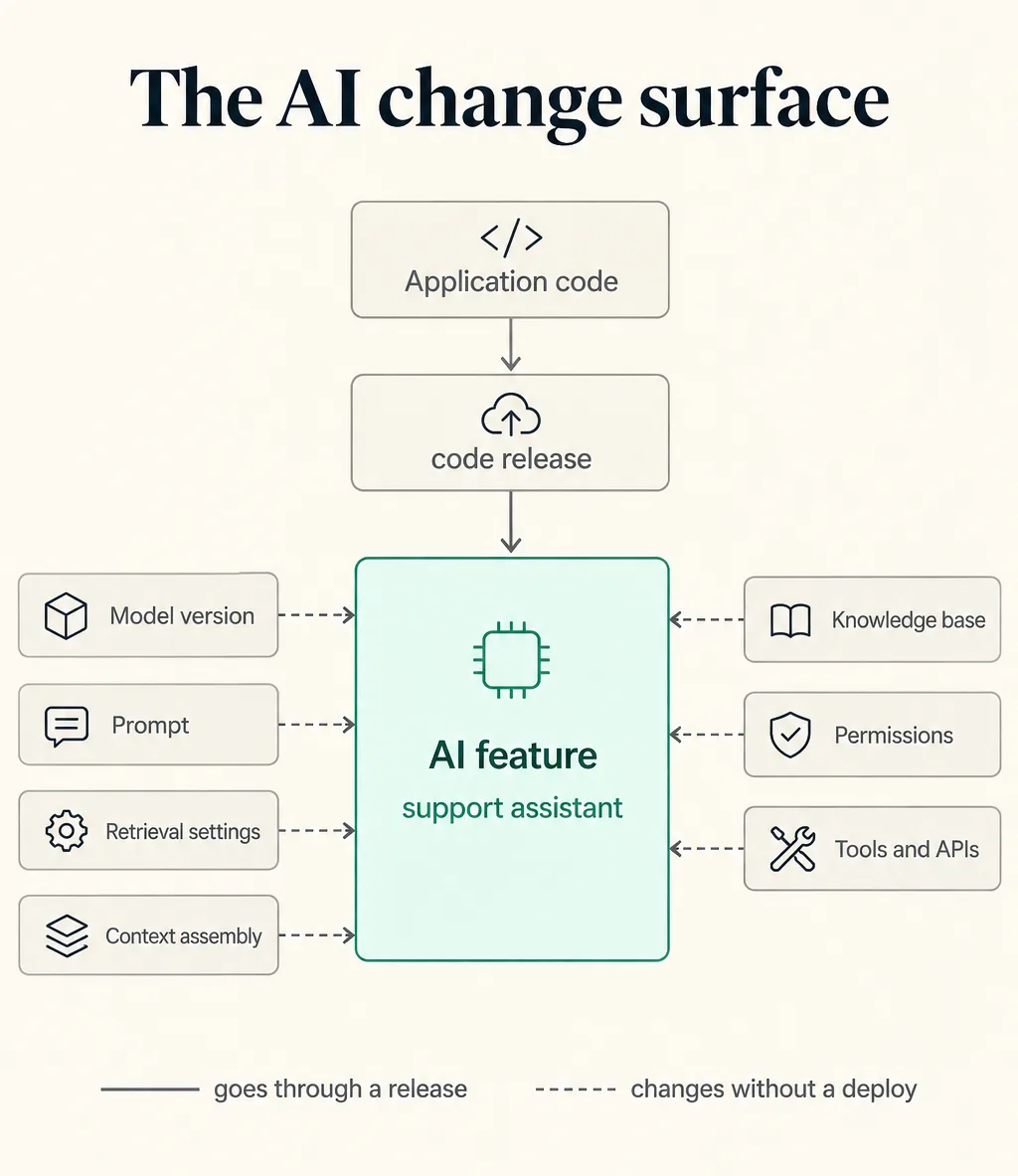
That has an operational consequence: application version alone is no longer enough to reconstruct what happened. For a consequential production interaction, teams may need to know the application version, model identifier, prompt configuration, retrieval settings, knowledge-source version, documents supplied to the model, permissions in effect, and resulting response.
This is why the idea that “product behavior can change without a deploy” matters operationally, not just conceptually. The system state that needs to be tested, monitored, and reconstructed is now larger than the source code.
One control model: evidence proportional to consequence
The answer is not to give every AI-related change the same approval process. A typo correction in an internal knowledge article should not require the same level of evidence as a change to payment authorization, customer-data permissions, refund eligibility, or investment guidance.
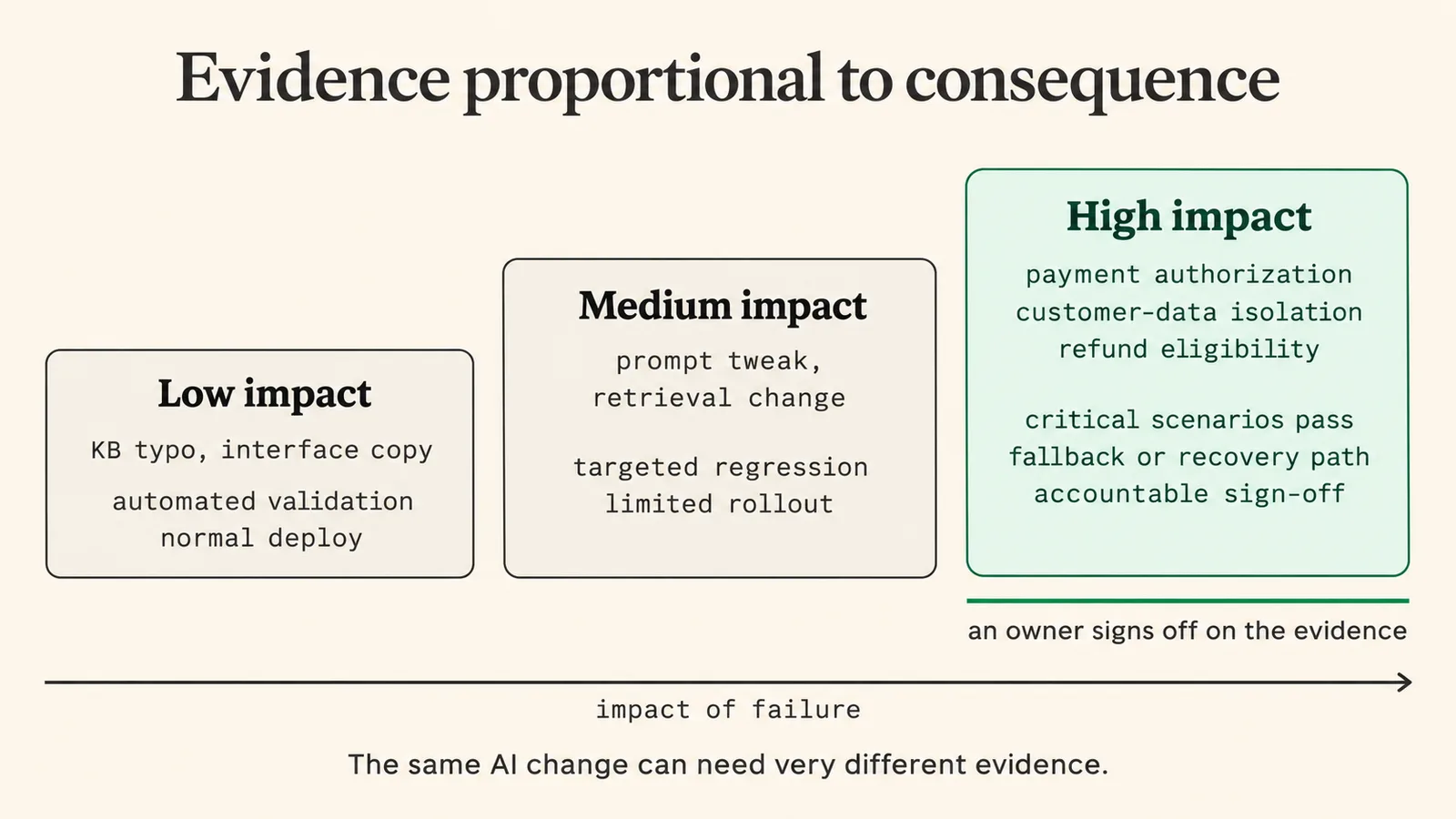
A more practical model is to classify changes by their possible impact. Low-impact changes may pass through automated validation and normal deployment. Medium-impact changes may require targeted regression evaluation and a limited rollout. High-impact changes should require explicit evidence that critical scenarios still pass, together with a defined fallback or recovery path.
The same principle applies regardless of where the change originated. A coding agent changing interface copy and a coding agent changing account isolation should not face the same gate. Likewise, a harmless knowledge-base correction and a policy update affecting customer eligibility should not be treated identically.
The table below provides a baseline rather than a universal standard:
| Change | Main risk | Baseline verification | Typical owner |
| AI-generated application code | Incorrect assumptions reproduced across implementation and tests | Independent requirements, integration tests, security boundaries, regression tests | Engineering / Security |
| Retrieval or context-assembly change | Critical information disappears before reaching the model | Fixed-corpus retrieval tests plus behavioral evaluation | Engineering / Product |
| Prompt change | Correct context produces different or unsafe behavior | Critical-case behavioral regression suite | Product / AI engineering |
| Model change | Quality or behavior changes without application-code changes | Evaluation against representative and high-risk cases | Product / AI engineering |
| Knowledge-base or policy update | AI applies incomplete, conflicting, or outdated rules | Policy-specific regression tests and effective-date validation | Business owner / Product |
| New AI tool or action | AI performs an unauthorized or overly broad action | Permission tests, limits, approval controls, abuse cases | Engineering / Security |
The ownership model will differ between companies, but every consequential change needs two things: a defined acceptance standard and someone accountable for deciding whether the available evidence is sufficient. Without them, testing becomes a collection of technical checks rather than an actual release control.
Itexus is a trusted partner












Itexus delivered the app according to the requirements. The team met all development milestones and deliverables. They were efficient, friendly, and cooperative. Itexus team was very timely with updates, a regular meeting cadence, and ad-hoc questions and answers via Slack. The team was very responsive and still is.
Stive Jackson
RMD, Investing Fund
Itexus’ work positions the business well for an imminent launch. They excel at managing their team, presenting frequent product demos to ensure that the project is aligned with development goals. An affordable price structure coupled with remarkable technical skill makes them an attractive partner.
Phill Osolinski
CEO Ryze Rewards
The assigned team was easy to work with and they are especially strong collaborators and communicators. They demonstrated flexibility, professionalism, and trust in everything they did, and completed the work on time and budget.
Sue Wollan Fan
CEO Mango Connects
Itexus excelled at both experimental AI and sprint-oriented UI/UX tasks. Itexus did strong project management work, too, a necessity in such a complicated project.
Jesse Dubin
Senior PM Standard&Poors
They’re a great group of developers who really understand the reality of business.
Andreea Vanacker
CEO SPARKX5
What conventional testing misses
Traditional integration testing remains necessary. It can verify that a system retrieves documents, calls a model API, parses the response, and returns a valid result. What it cannot establish by itself is whether the result preserves the information required for the correct business outcome.
For a financial support assistant, a behavioral evaluation dataset might include ordinary refund or dispute requests, incomplete customer information, conflicting documents, policy exceptions, outdated content, cases that should be escalated, and attempts to access information outside the employee's permissions. The acceptance criteria then focus on behavior: whether required facts were preserved, unsupported claims appeared, important exceptions were omitted, unauthorized information was exposed, or the assistant answered a question it should have escalated.
Exact wording is rarely a useful acceptance criterion for generative AI. Two answers can look very different and still be equally correct, while a fluent answer can omit the single fact that changes a financial outcome. Behavioral evaluations therefore complement conventional tests rather than replace them.
The distinction becomes especially useful when AI-generated code changes an AI-powered product. Suppose a coding agent is asked to improve the support assistant's latency by reducing the amount of context sent to the model. The change works technically: unit tests pass, integration tests pass, and response time improves. However, the revised context-assembly step drops an appendix containing an important exception to the refund policy.
Two checks are needed here. Deterministic regression tests can verify that critical information survives retrieval, ranking, filtering, and context assembly. Behavioral evaluation then tests what the model does with the information that reaches it. If required evidence never reaches the model, engineering investigates the retrieval pipeline; if the evidence is present but the answer is still wrong, the problem is more likely to sit in model behavior, prompts, or surrounding application logic.
Security requires a similar separation of responsibilities. OWASP identifies prompt injection as a major LLM risk and describes excessive agency as a problem that arises when an AI system receives more functionality, permissions, or autonomy than necessary.
For fintech architecture, the practical implication is straightforward: the model should not be the component that ultimately decides whether an action is permitted. If an AI assistant can initiate a refund, retrieve sensitive account information, alter payment details, or trigger another financial action, the surrounding system should independently enforce identity, tenant isolation, authorization, transaction limits, permitted tools, required approvals, and data-access boundaries.
The model may recommend or request an action. The control layer decides whether that action is allowed.
Fallbacks and production failures are part of the test strategy
AI product reliability also changes what rollback means. Consider a revised refund policy scheduled to take effect on Monday. Operations publishes the authoritative policy through the normal business process, but before the updated content is exposed through the AI assistant, the product team runs evaluations covering the revised eligibility rules and their exceptions.
If those evaluations fail, the policy should still take effect. The safer response is to disable AI guidance for the affected cases and direct employees to the current policy or a human specialist while leaving unaffected functionality available.
Simply restoring yesterday's model or retrieval index may not be safe if yesterday's configuration points employees to rules that are now obsolete. Recovery therefore needs to restore correct product behavior, not merely an earlier technical state.
Pre-release evaluation will also never capture every production failure. Customer complaints, employee corrections, escalations, and sampled interactions will reveal cases missing from the original test set. When a consequential defect appears, it should become part of the regression dataset so that future prompt changes, model upgrades, retrieval changes, and code modifications are tested against the same failure.
Over time, this evaluation set becomes a record of how the product has actually failed in the real world. NIST's Generative AI Profile takes a similarly lifecycle-oriented view, treating trustworthiness as something organizations need to manage across the design, development, use, and evaluation of AI systems rather than as a one-time pre-release check.
Engineering responsibility expands with the change surface
Coding agents can reduce the manual effort needed to implement some software, but they do not remove the engineering work required to deliver dependable financial products. Responsibility shifts toward defining constraints, designing verification, evaluating architectural consequences, maintaining delivery infrastructure, investigating failures, and deciding where automated output can be trusted.
At the same time, AI inside the product increases the number of components that can change customer outcomes. Engineering may own application code, a platform team may manage models and retrieval, operations may maintain authoritative policies, product may define acceptable AI behavior, and security may control permissions. Different teams can therefore change the behavior of the same feature without touching the same system.
The common responsibility is to identify which product properties must never change accidentally, define how those properties will be verified, and require evidence proportional to the consequences of failure. That is the control model that connects AI-assisted development with AI-powered products.
If your team is introducing coding agents or AI-powered workflows into a financial product, Itexus can help map the critical change surfaces, define risk-based release gates, and build the evaluation and access-control layer needed for production.




