
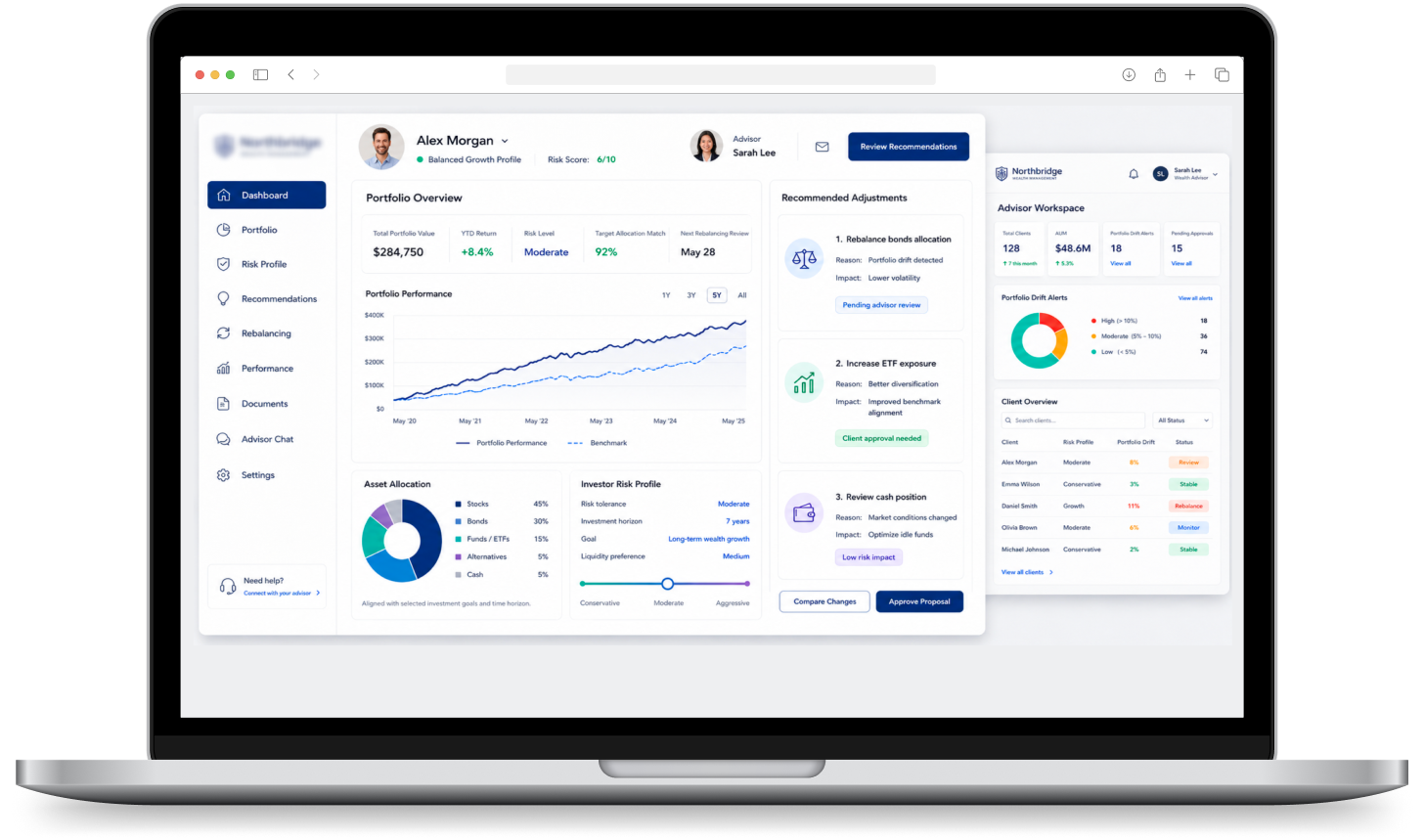
How Itexus modernized a legacy WealthTech platform for 450K+ investors, reaching 99.95% availability, 30% faster releases, and SEC/RIA-ready records.
Financial products are connecting more systems, while execution, oversight, and costs remain divided across organizations. PNC and ADP plan to embed payroll into business banking, and Nevis is expanding AI automation across advisor workflows. Meanwhile, the SEC is prioritizing technology and third-party risks, and a court ruling challenges debit interchange economics. For fintech teams, the question is how to retain control over workflows, decisions, and revenue assumptions that depend on external systems.
1. Appeals court strikes down Fed's debit interchange fee rule
On October 26, the Eighth Circuit Court of Appeals upheld a lower court ruling vacating the Federal Reserve's debit interchange fee regulation. The court found that the Fed improperly included fixed and other non-transaction-specific costs when calculating allowable fees under the Durbin Amendment. The existing framework caps interchange for covered issuers at 21 cents plus 0.05% of the transaction value, with a possible one-cent fraud-prevention adjustment. The appellate decision will not take effect until the court issues its mandate, following the applicable rehearing period or resolution of a rehearing petition. No replacement cap has been established.
Source: Payments Dive, October 26, 2026
Why it matters
Debit interchange is a revenue assumption embedded in card program economics. A revised fee structure could change the margins available to covered issuers and the commercial terms negotiated with fintech partners. The size and timing of any change remain uncertain.
That uncertainty extends beyond issuing banks. Neobanks and card programs receiving revenue shares through sponsor-bank arrangements may need to revisit forecasts, incentives, and contract structures. A payment product built around today's interchange assumptions could become less profitable without any change in transaction volume.
What teams should do
This applies to neobanks, debit card issuers, card program managers, banking-as-a-service providers, and fintechs receiving interchange-based revenue.
- Stress-test card program economics. Model lower interchange scenarios and calculate their impact on contribution margin, customer profitability, rewards, and acquisition incentives. Separate programs involving issuers above and below the $10 billion asset threshold.
- Review sponsor-bank agreements. Identify revenue-sharing formulas, pricing adjustment clauses, and which party bears the financial impact of changes to interchange regulation.
- Identify revenue concentration. Calculate how much of your product's gross profit depends on debit interchange and which customer segments become unprofitable under reduced rates.
- Prepare a pricing response. Define the financial triggers, approval process, and potential changes to fees or incentives that would follow a legally effective change in interchange rates.
2. SEC sets FY2027 examination priorities for AI, cybersecurity, and private credit
On October 23, the SEC published its FY2027 examination priorities, outlining areas of focus for its risk-based examination program covering more than 34,000 registrants. The agenda includes investment adviser conflicts and recommendations, private credit and complex products, broker-dealer supervision, cybersecurity, customer information protection, and advanced technologies, including AI. The SEC also identifies risks associated with third-party service providers and shared technologies. For automated investment tools, examinations will assess whether disclosures reflect actual practices and recommendations align with investor profiles. These priorities guide examinations under existing securities laws and create no new regulatory obligations.
Sources: SEC, October 23, 2026 · InvestmentNews, October 23, 2026
Why it matters
For regulated investment platforms, demonstrating supervision increasingly involves evidence spread across multiple systems. Explaining a recommendation may require the client's investment profile, source data, algorithm version, disclosures, and approval history. When these records are disconnected, examination preparation becomes a manual reconstruction exercise.
Third-party infrastructure makes that problem harder. A firm may rely on external providers for trading, analytics, or customer data while remaining responsible for its applicable controls. Vendor logs, access records, and incident histories therefore need to support the firm's own supervisory and examination processes.
What teams should do
This applies to SEC-registered RIAs, broker-dealers, private credit managers, automated investment platforms, and fintech providers supporting their regulated workflows.
- Run a 30-day evidence review. Select samples of investment recommendations, trades, and supervisory decisions. Measure whether compliance staff can reconstruct each action, its supporting records, and the responsible owner without manual cross-system investigation.
- Preserve decision lineage. Connect each recommendation to the relevant client profile, input data, algorithm or model version, disclosure, and supervisory approval, including subsequent changes.
- Review access and vendor controls. Verify permissions for privileged users, automated tools, and external providers. Document where third-party evidence is stored and how it can be retrieved during an examination.
- Test supervisory exceptions. Trace rejected trades, advisor overrides, flagged recommendations, and technology incidents through escalation, review, and resolution. Identify where approval records or accountability are missing.
3. PNC and ADP plan to embed payroll into small business banking
PNC Bank and ADP announced a strategic partnership on October 28 to bring payroll and HR services into PNC's digital banking platform. The planned offering, PNC Payroll by ADP, will give small businesses access to payroll processing, time tracking, HR, insurance, benefits, and retirement services alongside banking, payments, and cash management. ADP will provide AI-enabled automation and 24/7 access to payroll specialists. The companies aim to reduce the number of disconnected systems businesses use to manage employee and financial operations. A specific launch date has not been announced.
Source: PR Newswire, October 28, 2026
Why it matters
Business banking is expanding into the workflows that determine when and why money moves. Payroll creates recurring interactions around employee payments, funding requirements, and cash availability. Embedding it in a bank's interface gives the bank a role in daily business operations that extends beyond account access.
The complexity appears when a workflow crosses providers. A business may approve payroll in one interface, but payment execution and balance validation happen elsewhere. If funding fails, both systems must reflect the correct status, prevent duplicate attempts, and establish who resolves the exception. One customer experience still requires coordinated operations behind it.
What teams should do
This applies to SMB neobanks, business banking platforms, embedded payroll providers, e-wallets, and fintechs integrating workforce payments.
- Map the complete payroll execution path. Document which system owns payroll calculations, funding checks, payment initiation, settlement status, and corrections. Establish a shared definition of each workflow state.
- Test cross-provider failures. Simulate approved payroll with insufficient funds, rejected payments, delayed deposits, and duplicate submissions. Verify that both platforms display consistent statuses and support safe retries.
- Separate access and approval permissions. Distinguish employee-data access, payroll preparation, payment authorization, and banking administration to prevent users from gaining unintended financial authority.
- Measure operational cost per payroll run. Track completed payrolls, manual interventions, failed payments, and support cases to determine whether integration reduces the actual cost of serving each business.
4. Nevis raises $70M to expand AI-driven wealth management operations
US-based wealthtech company Nevis secured a $70 million Series B led by EQT Ventures, bringing its total funding to $110 million. Investors include Charles Schwab, Sequoia Capital, ICONIQ, Ribbit Capital, and QuantumLight. Nevis is developing an AI operating system that automates administrative workflows for financial advisors, including account opening, client briefings, and personalized proposals. According to the company, assets on its platform have grown from $50 billion to more than $700 billion over the past year, while its agents have completed over 100,000 operational tasks. The funding will support product development and team expansion.
Source: FinTech Futures, October 27, 2026
Why it matters
Wealth management automation is moving toward coordinated execution across CRM, planning, and custodial systems. The potential economic benefit comes from reducing the administrative work required to serve each client, allowing advisors to increase capacity without proportional growth in support staff.
The difficult part is completing workflows across systems with different rules and states. An agent might prepare an account application, but custodial validation, client consent, and advisor approvals still determine whether it can proceed. If exceptions require manual recovery, time saved during preparation may be lost before completion.
What teams should do
This applies to RIAs, wealth management platforms, brokerages, hybrid advisory firms, and fintechs building advisor-facing AI tools.
- Prioritize workflows by administrative cost. Measure the time advisors spend on onboarding, meeting preparation, proposals, and follow-ups. Select automation opportunities based on expected savings per completed task.
- Connect execution states across systems. Synchronize CRM tasks, document requests, account-opening progress, and custodial responses so agents can identify the next valid action.
- Define agent authority and recovery paths. Specify which actions require human or client approval, and test how agents recover from rejected applications, missing documents, and interrupted integrations without duplicating financial instructions.
- Measure end-to-end automation. Track completed workflows, human interventions, exception rates, and cost per completed task. Compare these metrics with the existing advisor-led process before expanding the agent's responsibilities.
Closing insight
Connected financial workflows expose three dependencies: who executes each action, who can explain and supervise the decision behind it, and how product economics change when regulatory requirements or partner terms shift. A useful review is to take one critical customer workflow and trace it from initiation to completion. Identify every external system involved, every approval boundary, where supporting evidence is stored, and what happens when an integration fails or a commercial assumption changes.
The capabilities that matter are reliable integrations, traceable decisions, clear system ownership, tested exception handling, and financial models that account for external dependencies. In our work with fintech teams at Itexus, these foundations often determine whether new capabilities reduce operating costs or simply move complexity between systems. If your platform is expanding through banking, payments, or AI integrations, Itexus can help assess the architecture and controls needed to support that growth.