
Quick Summary: A forward deployed engineer (FDE) writes production code embedded inside a customer’s environment and stays until the solution actually works in daily use, while a traditional consultant typically delivers recommendations, a specification, or a project plan and then hands off execution to someone else. FDEs are compensated closer to product engineers and are judged on whether the deployment sticks, whereas consultants are judged on advice quality, timelines, and stakeholder management. The lines blur at “implementation consultant” roles, but ownership of shipped, running code is the cleanest dividing line.
Ask five people what a forward deployed engineer actually does, and expect five different answers. Some call it “consulting with a laptop.” Others insist it’s a completely separate discipline that Palantir invented and the AI industry just rediscovered. Neither take is quite right.
The confusion is understandable. Both roles put a technical person in front of a client. Both involve travel, whiteboards, and awkward stakeholder meetings. But the incentives underneath each role point in almost opposite directions, and that difference shapes everything from how success gets measured to how much each role gets paid.
What a Forward Deployed Engineer Actually Does
A forward deployed engineer (FDE) is a software engineer who embeds directly with a customer, writes real production code against that customer’s data and infrastructure, and doesn’t consider the job done until the system is live and being used. Palantir popularized the title years ago, and by 2026 it’s become the go-to role at AI-native companies — Anthropic, OpenAI, Scale AI, and a growing list of fintech and enterprise-AI vendors all run some version of it.
The core job isn’t demoing a product. It’s dragging a product through a customer’s messy reality: legacy SQL databases, SSO and SAML integrations, data-residency rules, and the internal politics of getting production credentials from a security team. That “integration wall” is where most AI and software deployments quietly die, and the FDE is the person paid to break through it rather than write a report about it.
An FDE typically:
- Writes and ships production code, often directly in the client’s environment
- Sits with end users to watch how the product actually gets used, not just how it was scoped
- Iterates fast, sometimes shipping a fix the same day a problem surfaces
- Owns the outcome — adoption, usage, renewal — not just the deliverable
What a Consultant Actually Does
A consultant, by contrast, is generally brought in to diagnose a problem and recommend a path forward. In tech and IT consulting specifically, that often means requirements gathering, a specification document, a project plan, and a set of recommendations — after which the client’s own team, or a separate implementation team, does the building.
That’s not a knock on consultants. Advisory work is a real skill, and plenty of consulting engagements do involve hands-on implementation, especially in “implementation consultant” roles at enterprise software vendors. But the classic consulting model is built around the engagement ending. Consultants manage timelines, stakeholders, and scope; they’re incentivized to deliver against a defined specification on schedule, then move to the next client.
The Core Difference: Task vs. Outcome
Here’s the cleanest way to frame it: a consultant is generally paid for the task — the assessment, the roadmap, the migration plan. An FDE is paid for the outcome — the system working, in production, generating measurable value for the customer. One focuses on the deliverable. The other focuses on whether the deliverable actually gets used.
That distinction shows up in how each role gets evaluated internally, too. A consultant’s success metric might be “delivered the spec on time and under budget.” An FDE’s success metric is closer to “the customer renewed because the thing we built solved their actual problem.” Those are genuinely different jobs wearing similar clothes.
Where the Roles Overlap
It’s not a clean split, though. Plenty of “implementation consultants” at enterprise software vendors do write configuration code and stay through go-live. And plenty of FDEs spend real time on stakeholder management, scoping, and the soft-skill work that looks a lot like classic consulting. Some practitioners describe forward deployed engineering as resembling traditional tech consulting in structure, just executed with more speed and a tighter feedback loop with the product team back at headquarters.

Solve Fintech Problems With Itexus
Itexus works on complex financial software projects that require business analysis, technical planning, development, modernization, and production support.
Need More Than General Consulting?
Itexus can help with:
- digital transformation consulting
- project audit and rescue
- product discovery
- software development
- ongoing support and maintenance
 Contact Itexus to discuss your fintech project.
FDE vs. Consultant: Side-by-Side Comparison
| Dimension | Forward Deployed Engineer | Consultant |
|---|---|---|
| Primary output | Working, shipped code in production | Recommendations, specifications, project plans |
| Success metric | Adoption, usage, renewal | On-time, in-scope delivery |
| Typical employer | Product/software companies (Palantir, AI labs, fintech vendors) | Consulting firms, systems integrators, agencies |
| Client relationship length | Stays embedded through go-live and often beyond | Engagement typically ends at delivery |
| Codebase ownership | Often writes directly against the client’s production systems | Rarely writes production code personally |
| Feedback loop to product team | Direct — feeds real customer friction back into the roadmap | Indirect, if it happens at all |
How the Two Roles Compare on Pay
Average Forward Deployed Engineer Salary
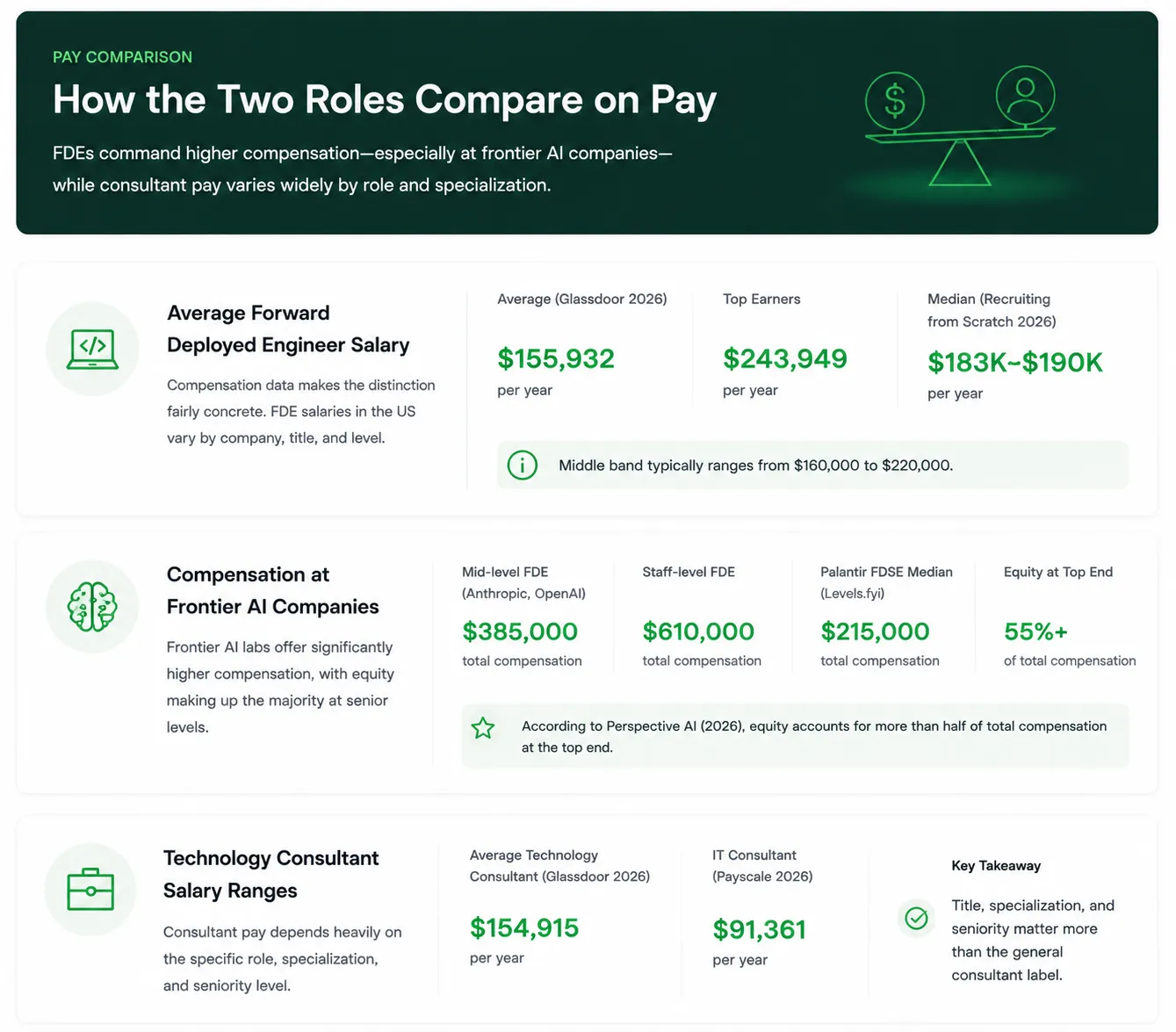
Compensation data makes the distinction fairly concrete. According to Glassdoor’s 2026 figures, the average forward deployed engineer salary in the US sits around $155,932 a year, with top earners reaching roughly $243,949.
A separate analysis of job postings by Recruiting from Scratch puts the 2026 median closer to $183,000-$190,000, with the middle band running from $160,000 to $220,000. The spread reflects how differently companies title and level the role.
Compensation at Frontier AI Companies
At the high end of the market, frontier AI labs push the numbers much higher. A 2026 compensation report from Perspective AI, drawing on Levels.fyi and public job postings, found mid-level FDEs at companies such as Anthropic and OpenAI earning roughly $385,000 in total compensation.
Staff-level FDE compensation reached around $610,000, well above Palantir’s FDSE median of about $215,000 reported through Levels.fyi. According to the same report, equity accounts for more than half of total compensation at the top end of the range.
Technology Consultant Salary Ranges
Consultant pay looks different depending on which type of consultant is being measured. Glassdoor puts the average technology consultant salary at about $154,915 a year in 2026, which is broadly in line with mainstream FDE compensation.
PayScale’s narrower IT consultant category averages closer to $91,361. The difference between those figures shows that the specific title, specialization, and seniority level often matter more than the general consultant label.
FDE vs. Implementation Consultant: A Narrower Comparison
The most useful comparison isn’t FDE versus generic “consultant” — it’s FDE versus implementation consultant, since that’s the role closest in day-to-day activity. The distinction often comes down to who unblocks the project versus who manages it. Implementation consultants typically own the project plan, the stakeholder cadence, and the timeline. FDEs typically own the technical blockers standing between a working demo and a system that survives contact with a real customer environment.
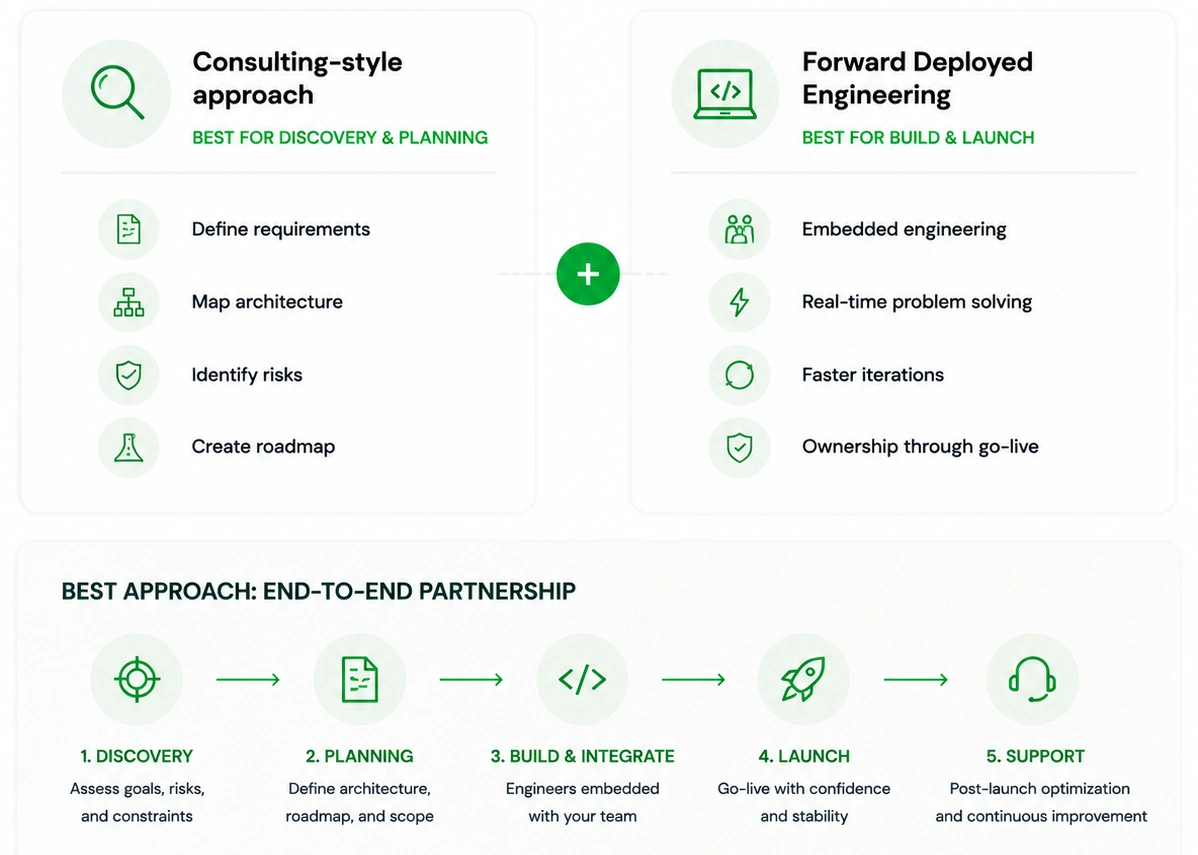
In regulated industries like banking and financial services, that difference matters more than it might elsewhere. A digital lending platform or a trading system can’t just be “configured” the way a CRM might be — it has to satisfy compliance requirements, integrate with core banking rails, and hold up under real transaction volume. Teams building this kind of software increasingly need engineers who can sit with a bank’s technical staff and solve the integration problem directly, not just hand over a requirements document. This is part of why fintech software development engagements often blend both models: consulting-style discovery up front, followed by embedded engineering through launch.
Why the FDE Title Is Growing Faster Than “Consultant”
Job-posting data tracked by several recruiting firms in 2026 shows forward deployed engineer postings growing sharply year over year, largely driven by AI companies that need someone who can get a model working against a customer’s real, messy data — not just demo it in a sandbox. Traditional consulting titles haven’t disappeared, but the market increasingly rewards people who can code and stay accountable for the outcome, rather than hand off a recommendation and move on.
That doesn’t mean consulting is dying. It means the highest-paid version of “customer-facing technical work” has shifted toward roles that blend engineering depth with the relationship-building skills consultants have always had. Banks, insurers, and lenders exploring AI software development for fraud detection or underwriting are increasingly asking vendors for exactly this hybrid: someone embedded enough to ship, but consultative enough to navigate compliance and stakeholder concerns.
Which One Does a Fintech Project Actually Need?
For a bank or lender evaluating a new digital platform, the honest answer is often “both, at different stages.” Early discovery — mapping regulatory constraints, defining the target architecture for a digital lending platform or a trading system — benefits from consulting-style structure: clear scope, defined milestones, documented recommendations. Once the build starts, though, especially for something like a Banking-as-a-Service integration or a white-label banking platform, having engineers embedded through go-live tends to matter more than having another slide deck.
Teams that follow a structured development process from discovery through post-launch support effectively borrow the best of both worlds — consulting rigor at the start, FDE-style ownership through the finish. It’s worth checking a vendor’s portfolio of completed projects to see whether their teams actually stuck around through launch or disappeared after delivering a spec.
The Bottom Line
Neither role is objectively “better.” A consultant brings structure, stakeholder management, and clear scope to a project that genuinely needs planning before it needs code. A forward deployed engineer brings the willingness to sit inside the mess of a real production environment and not leave until it works. The mistake is assuming the two are interchangeable, or that hiring one automatically covers what the other does best.
For financial institutions weighing how to staff a new platform build — whether that’s a banking app, a fintech app, or an AI-driven lending tool — the smarter question isn’t “FDE or consultant?” It’s “who owns this once it’s live?” Get that answer right, and the title on the business card matters a lot less than the accountability behind it.