
Quick Summary: A forward deployed engineer (FDE) builds and customizes software directly inside a customer’s environment, blending coding with consulting, while a product manager (PM) sets the roadmap and prioritizes what gets built across the whole customer base. Neither role replaces the other; the FDE feeds real-world implementation data back to the PM, and the two increasingly work side by side, especially in AI-heavy, enterprise-facing companies. Which path suits someone better depends on whether they’d rather live in a customer’s codebase or in a product’s long-term strategy.
The job title didn’t even exist for most engineers a decade ago. Now it’s showing up in job postings at Palantir, OpenAI, Scale AI, and a growing list of enterprise software companies. Forward deployed engineer. It sounds like a military term because, in a sense, it borrows one — and that’s not an accident.
At the same time, product managers are watching a new kind of colleague show up in their Slack channels: someone who’s technical, embedded with the client, and shipping code changes based on what a customer says in a meeting that morning. So the natural question follows. Is the forward deployed engineer quietly eating the product manager’s job? Or are these two roles solving completely different problems?
What a Forward Deployed Engineer Actually Does
The term traces back to Palantir Technologies, which built its early growth around engineers who left the office and sat inside customer organizations — intelligence agencies, banks, manufacturers — to build software that solved a specific, often messy, operational problem. Rather than shipping a generic product and hoping it fit, Palantir’s FDEs configured, extended, and sometimes rewrote parts of the platform on-site, in near real time.
That model has since spread well beyond Palantir. Companies building AI agents, data platforms, and complex B2B software have adopted the same playbook: send a technically strong engineer directly to the customer, let them build fast, and let the feedback loop compress from months to days. FDEs typically:
- Write production code while sitting in front of the client, not just requirements docs
- Translate a customer’s messy, undocumented workflow into working software
- Own the last mile of deployment — integrations, data pipelines, edge cases the core product team never anticipated
- Report patterns back to the core engineering and product teams so recurring customer needs become permanent product features
It’s a hybrid role by design — part software engineer, part consultant, part account manager. And that combination is exactly why it’s hard to hire for and why it commands attention in the current job market.
What a Product Manager Actually Owns
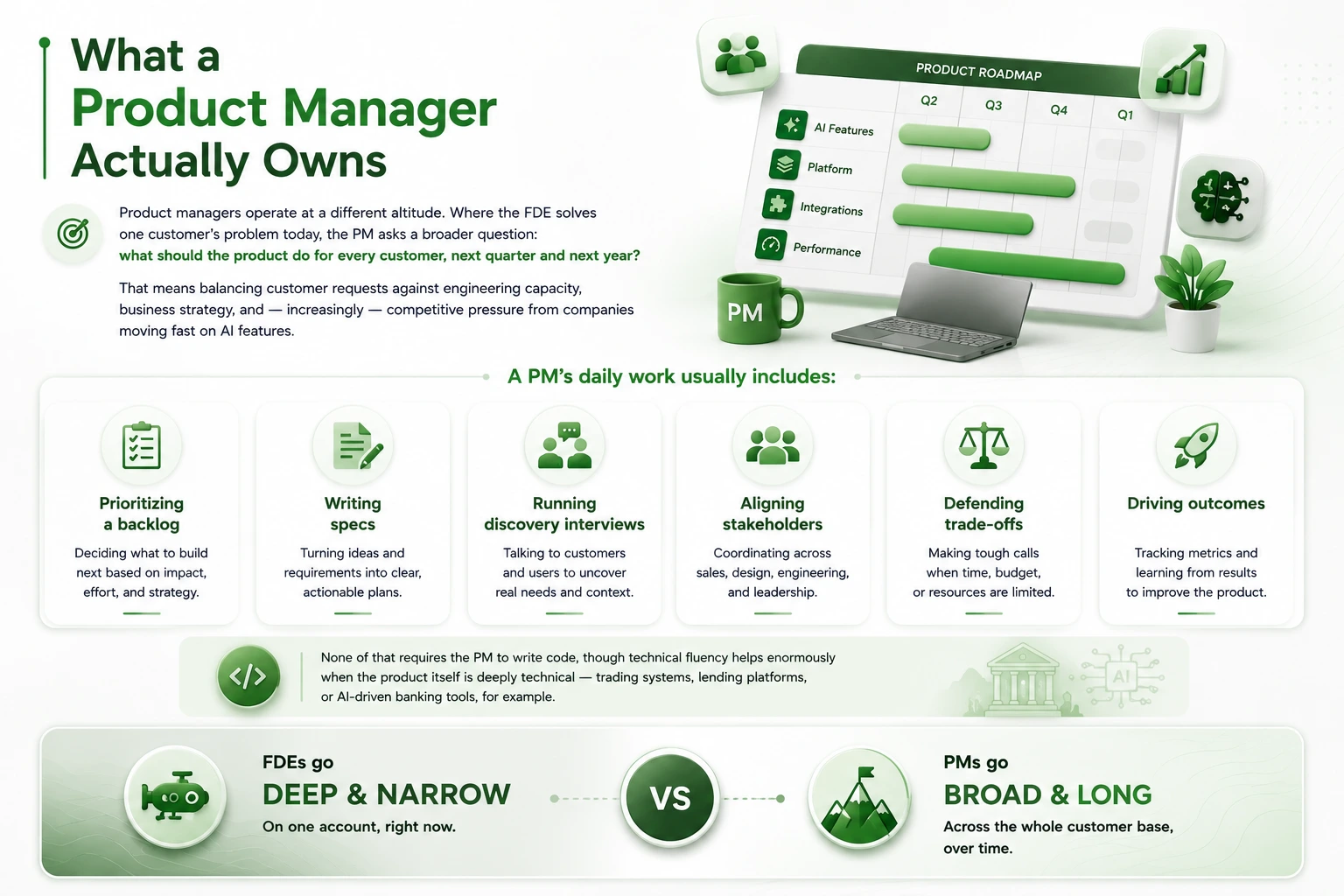
Product managers operate at a different altitude. Where the FDE solves one customer’s problem today, the PM asks a broader question: what should the product do for every customer, next quarter and next year? That means balancing customer requests against engineering capacity, business strategy, and — increasingly — competitive pressure from companies moving fast on AI features.
A PM’s daily work usually includes prioritizing a backlog, writing specs, running discovery interviews, aligning stakeholders across sales, design, and engineering, and defending trade-offs when not everything can ship at once. None of that requires the PM to write code, though technical fluency helps enormously when the product itself is deeply technical — trading systems, lending platforms, or AI-driven banking tools, for example.
The tension competitors online tend to frame as “FDE vs PM” really comes down to scope and horizon. FDEs go deep and narrow, on one account, right now. PMs go broad and long, across the whole customer base, over time.
Forward Deployed Engineer vs Product Manager: Side by Side
| Dimension | Forward Deployed Engineer | Product Manager |
|---|---|---|
| Primary focus | One customer’s implementation and outcomes | The product roadmap across all customers |
| Core skill | Hands-on coding, integration, rapid prototyping | Prioritization, strategy, stakeholder alignment |
| Where they work | Embedded on-site or in close, ongoing client contact | Mostly internal, cross-functional meetings and planning |
| Success metric | Customer adoption, deployment speed, retention of the account | Product usage, revenue growth, roadmap execution |
| Typical background | Software engineering, systems, sometimes consulting | Business, engineering, design, or a mix of all three |
| Career path | Solutions architect, engineering lead, or founder | Senior PM, head of product, VP product |

Turn Product Plans Into Software With Itexus
Itexus supports product delivery from initial requirements and prototypes to development, testing, deployment, and post-launch maintenance.
Need a Team to Build and Support Your Product?
Itexus can help with:
- requirements and roadmap planning
- UI/UX design
- custom web and mobile development
- integrations and testing
- production support
 Contact Itexus to discuss your product goals and delivery plan.
Why the Line Is Getting Blurry
Customer-Embedded Product Management
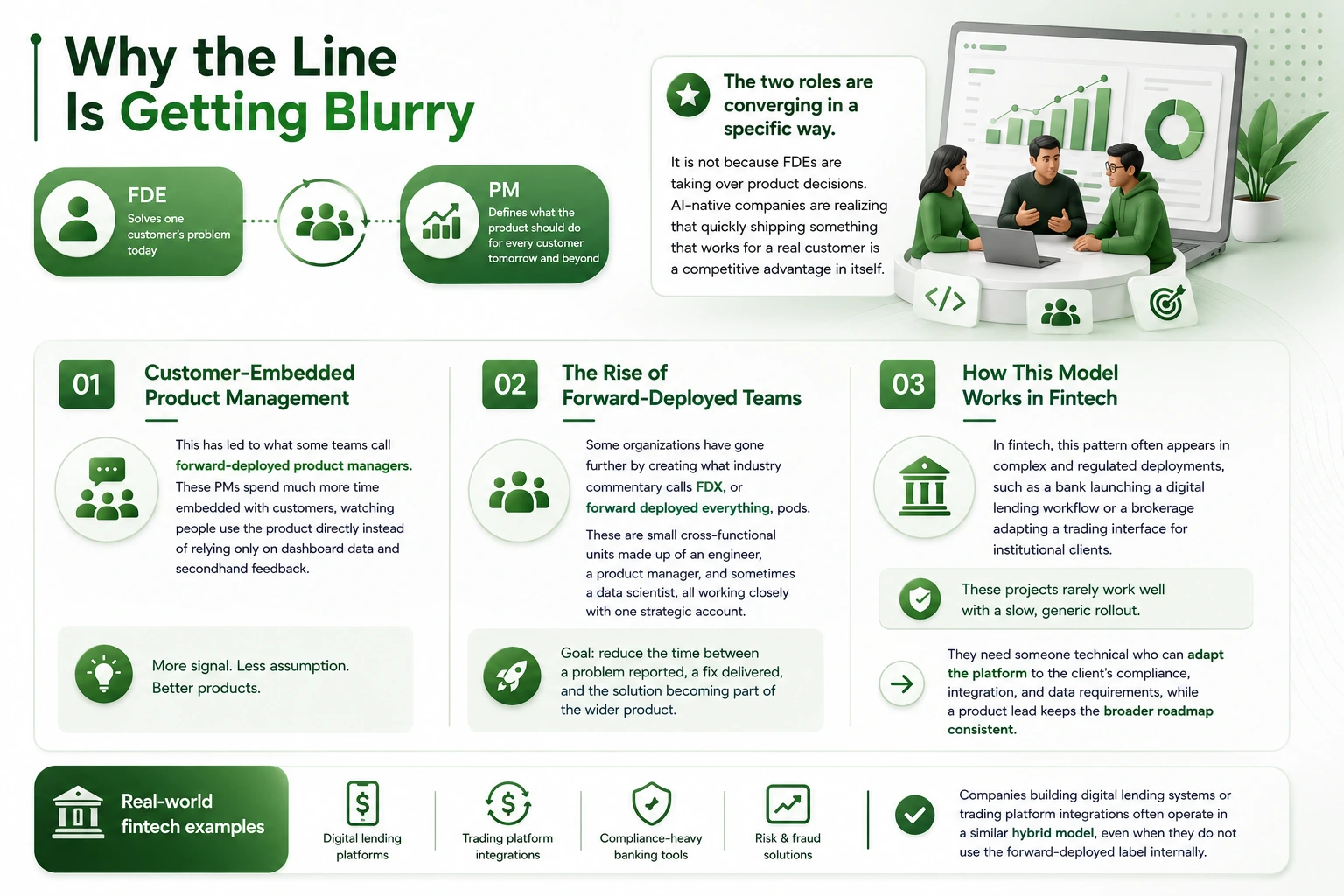
The two roles are converging in a specific way, and it is not because FDEs are taking over product decisions. AI-native companies are realizing that quickly shipping something that works for a real customer is a competitive advantage in itself.
This has led to what some teams call forward-deployed product managers. These PMs spend much more time embedded with customers than traditional product managers, watching people use the product directly instead of relying only on dashboard data and secondhand feedback.
The Rise of Forward-Deployed Teams
Some organizations have gone further by creating what industry commentary calls FDX, or forward deployed everything, pods. These are small cross-functional units made up of an engineer, a product manager, and sometimes a data scientist, all working closely with one strategic account.
The goal is to reduce the time between a customer reporting a problem, the team fixing it, and that solution becoming part of the wider product.
How This Model Works in Fintech
In fintech, this pattern often appears in complex and regulated deployments, such as a bank launching a digital lending workflow or a brokerage adapting a trading interface for institutional clients.
These projects rarely work well with a slow, generic rollout. They need someone technical who can adapt the platform to the client’s compliance, integration, and data requirements, while a product lead keeps the broader roadmap consistent.
Companies building digital lending systems or trading platform integrations often operate in a similar hybrid model, even when they do not use the forward-deployed label internally.
Will Forward Deployed Engineers Replace Product Managers?
Short answer: no, not in any complete sense. The two roles solve different problems, and a company that tries to run without dedicated product strategy — relying only on whatever the FDE closest to the loudest customer decides to build — tends to end up with a fragmented, unmaintainable product. That’s a well-known failure mode in enterprise software long before “FDE” became a job title.
That said, the skillset expected of PMs is shifting. Being comfortable in technical conversations, understanding what an FDE can realistically build in a sprint, and knowing when a customer-specific fix should or shouldn’t become a permanent feature — that’s becoming table stakes for product leaders at technical, AI-driven companies. PMs who can’t hold that conversation risk getting bypassed by engineers who are already in the room with the customer.
Compensation and Career Trajectory
Forward Deployed Engineer Compensation
Pay for both roles varies widely by company, industry, and location. Figures also change quickly, so specific salary numbers can become outdated within a year.
In general, compensation aggregators such as Levels.fyi and Glassdoor show forward deployed engineer pay tracking close to standard software engineering compensation at the same level. At some AI-first companies, it can be higher. This reflects the limited supply of people with both engineering and customer-facing skills, as well as the revenue-critical nature of the work.
Product Manager Compensation
Product manager compensation usually increases with seniority, team scope, and strategic responsibility. At senior and VP levels, it can overtake engineering compensation, particularly at companies where product strategy plays a major role in fundraising, positioning, and growth.
Anyone comparing offers should check current listings on Levels.fyi, Glassdoor, or the hiring company’s own salary ranges rather than relying on a fixed figure. AI hiring has pushed compensation upward across both career tracks in recent years.
Career Paths for Forward Deployed Engineers
Forward deployed engineers often move into solutions architecture, technical account leadership, specialized consulting, or founding roles. Their combination of client exposure, technical delivery, and product knowledge can translate well into building and leading a company.
Career Paths for Product Managers
Product managers typically progress into senior product leadership or general management. The role already requires them to think across customer needs, commercial goals, technical constraints, and the broader direction of the business.
Which Track Should You Actually Pursue?
Anyone deciding between the two tracks should be honest about what energizes them day to day. Forward deployed work rewards people who like solving a fire in front of them, who don’t mind travel or long client calls, and who get satisfaction from watching something they built go live within days. Product management rewards people who like zooming out, who can sit with ambiguity for weeks while a strategy takes shape, and who are comfortable saying no to good ideas because they don’t fit the roadmap.
Companies building fintech products — banking apps, lending platforms, white-label banking systems — increasingly need both types of thinking working together. A team following a disciplined development process can embed engineers close to a client’s operational reality while a product owner keeps the broader platform, like a white-label banking platform, coherent across every client that uses it. And as AI agents take on more of the routine deployment work, both roles are likely to spend less time on repetitive configuration and more time on judgment calls — which is exactly where human expertise, whether AI-focused as in AI software development, or product-focused, continues to matter.
FAQ: Forward Deployed Engineer vs Product Manager
Is a forward deployed engineer a type of product manager?
Do forward deployed engineers need a product management background?
Which role pays more, FDE or PM?
Can a product manager transition into a forward deployed engineer role?
Are forward deployed engineers only found at Palantir?
Will AI agents make forward deployed engineers unnecessary?
How do FDEs and PMs typically work together day to day?
The Bottom Line
Forward deployed engineers and product managers aren’t rivals fighting for the same seat. One lives close to the metal, inside a customer’s operational reality; the other lives close to the strategy, deciding what the whole product becomes over time. The companies getting the most value out of both — particularly in fintech, where a single client’s compliance or workflow quirk can derail a generic rollout — are the ones treating FDEs and PMs as two ends of the same feedback loop rather than competing headcount lines.
Teams evaluating how to structure this kind of delivery model for a banking, lending, or trading product can look at real examples in Itexus’s project portfolio or explore how a fintech software development team combines embedded engineering with disciplined product ownership on client-facing builds.