
Quick Summary: A forward deployed engineer (FDE) embeds with customers to deploy, configure, and extend a product on-site, while a software engineer (SWE) mostly builds product features for a broad user base from an office or remote desk. FDE pay tends to run higher at the median, largely because the role blends coding with high-stakes client work and direct revenue impact, but it also demands heavy travel and constant context-switching. Software engineering offers more predictable scope, deeper specialization, and a calmer day-to-day rhythm. The right choice comes down to whether someone wants to build for everyone or solve for one customer at a time.
Confusion around these two titles has spiked hard over the last two years, mostly because Palantir made “forward deployed engineer” a household name in tech circles, and now dozens of AI companies have copied the model. So what’s the real difference? Both roles write production code. Both need strong engineering fundamentals. But the environments they operate in, and what “success” looks like day to day, are almost opposites.
This piece breaks down the two roles across scope, daily work, required skills, pay, and career trajectory, then gives a straightforward answer on how to choose between them.
What Is a Forward Deployed Engineer?
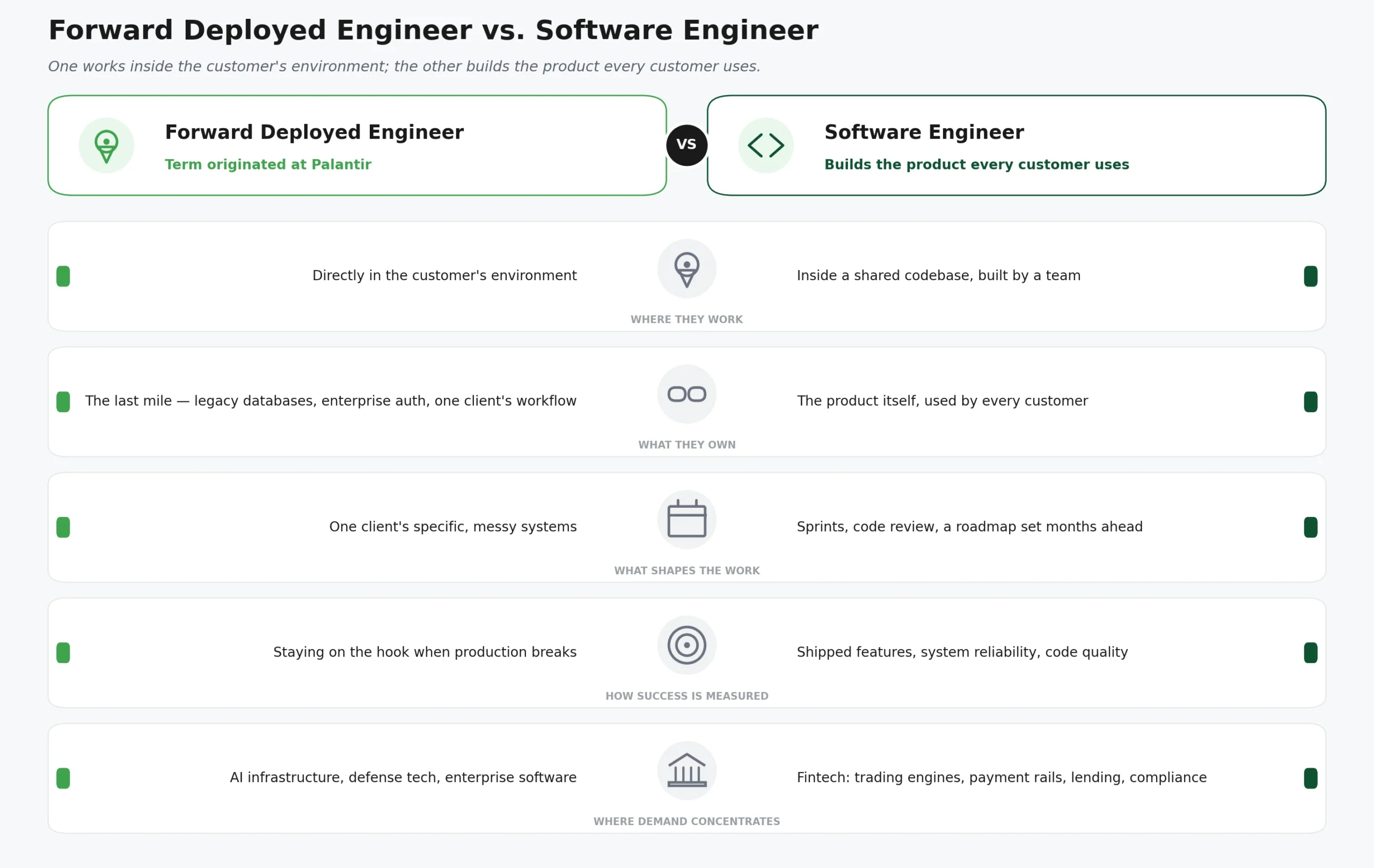
A forward deployed engineer is an engineer who works directly at, or extremely close to, the customer’s environment. The term originated at Palantir, where FDEs were sent into government agencies and enterprises to build custom integrations, workflow tools, and data pipelines tailored to that specific client’s problem. The model has since spread to AI infrastructure companies, defense tech, and enterprise software firms where the product only creates value once it’s wired into a customer’s messy, specific systems.
An FDE typically owns the last mile: connecting a platform to legacy databases, handling enterprise authentication, automating a client’s specific workflow, and staying on the hook when something breaks in production. According to recruiting data compiled by Recruiting from Scratch, demand for this role is concentrated at companies “where engineering and customer delivery are inseparable” — AI infrastructure, defense tech, and enterprise software with complex implementations.
What Is a Software Engineer?
A software engineer builds and maintains the product itself — the thing every customer uses, not a one-off version for a single client. Work happens mostly inside a codebase shared across a team, shaped by sprints, code review, and a roadmap set months in advance. Success gets measured by shipped features, system reliability, and code quality, not by how one specific customer’s rollout went.
In fintech specifically, this often means building trading engines, payment rails, lending decision systems, or compliance tooling that has to work identically for thousands of accounts at once — a very different bar than tailoring something for one enterprise client. Teams building this kind of infrastructure, including the kind covered in FinTech software development work, tend to prize consistency and repeatability over one-off customization.

Add Fintech Engineers With Itexus
Itexus provides developers who can join an existing team or support a project from discovery through deployment and maintenance.
Need More Than Standard Software Development?
Itexus services include:
- fintech staff augmentation
- custom software development
- technical discovery and planning
- integrations and modernization
- QA and production support
 Contact Itexus to discuss your team and delivery needs.
Core Differences at a Glance
Here’s where the two roles genuinely diverge, side by side.
| Dimension | Forward Deployed Engineer | Software Engineer |
|---|---|---|
| Primary location | Customer site or embedded remotely with one account | Company office or remote, working on shared product |
| Who benefits from the code | One customer (at a time) | All users of the product |
| Success metric | Customer adoption, deployment speed, retention | Feature velocity, uptime, code quality |
| Travel | Often heavy, especially early in an engagement | Minimal to none |
| Ownership scope | Full stack for one client’s implementation | Deep ownership of a system or service layer |
| Ambiguity level | High — requirements often undefined at the start | Lower — scoped by product and design specs |
| Customer contact | Direct and frequent, sometimes daily | Rare, usually filtered through product managers |
Skills That Actually Matter for Each Role
Software engineers lean hard on depth: mastery of a language, framework, or system (distributed systems, databases, security architecture) that lets them ship reliable code at scale. Career growth usually means going deeper into a specialization or moving into technical leadership over a codebase.
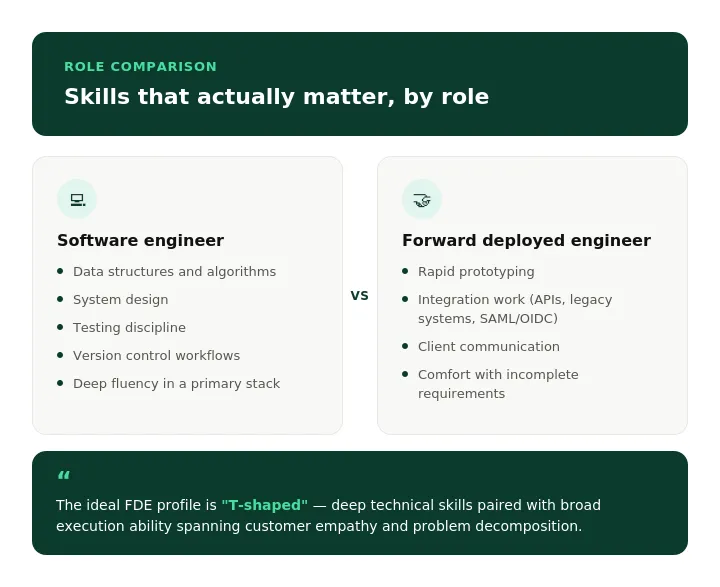
Forward deployed engineers need that same coding competence, but paired with something harder to teach: the ability to sit in a room with a frustrated client, figure out what they actually need (not what they asked for), and ship a working fix before the meeting ends. One 2026 industry guide described the ideal profile as “T-shaped” — deep technical skills paired with broad execution ability spanning customer empathy and problem decomposition.
- Software engineer core skills: data structures and algorithms, system design, testing discipline, version control workflows, and deep fluency in a primary stack.
- FDE core skills: rapid prototyping, integration work (APIs, legacy systems, enterprise auth like SAML/OIDC), client communication, and comfort operating with incomplete requirements.
Salary Comparison: What the Data Actually Shows
Salary figures for forward deployed engineers vary wildly depending on the source and how narrowly “FDE” is defined, so it’s worth looking at a range rather than a single number. Glassdoor puts the average FDE salary at roughly $155,900 per year based on employee-submitted data, while ZipRecruiter’s broader postings-based estimate lands closer to $116,000. Recruiting-data firm Recruiting from Scratch, drawing on active job postings and H-1B filings, reported a 2026 median of around $190,000–$200,000 for FDE-type roles, with a 90th-percentile ceiling near $292,000. At Palantir specifically, where the title originated, Levels.fyi lists a median forward deployed software engineer salary of roughly $163,000, though other analyses citing frontier-lab AI comp put senior FDEs well above $400,000 in total compensation once equity is included.
Software engineer pay is comparatively more standardized. Glassdoor and Rippling both put the average US software engineer salary around $148,000, while the Bureau of Labor Statistics’ broader occupational data (which spans a wider mix of roles and seniority) reports a lower median near $130,000. Total compensation at large tech employers, once bonuses and equity enter the picture, commonly lands between $155,000 and $220,000 for mid-to-senior engineers.
| Source | Forward Deployed Engineer | Software Engineer |
|---|---|---|
| Glassdoor (average) | ~$155,900/yr | ~$148,000/yr |
| ZipRecruiter (average) | ~$116,000/yr | ~$147,500/yr |
| Bureau of Labor Statistics (median) | Not separately tracked | ~$130,000/yr |
| Recruiting from Scratch (2026 median, postings) | ~$190,000–$200,000/yr | Varies by level/employer |
| Levels.fyi (Palantir FDSE median) | ~$163,000/yr | Varies by employer |
The takeaway: FDE compensation carries a wider spread and a higher ceiling, especially at frontier AI labs and defense-tech firms, but it’s also less standardized — two postings with the same title can differ by six figures depending on company stage and equity structure. Software engineer pay clusters more tightly, which makes it easier to benchmark but caps the upside outside of senior IC or management tracks.
Career Trajectory: Where Each Path Leads
Software engineers typically climb a well-worn ladder: junior, mid-level, senior, staff, then either principal engineer or engineering manager. Depth and system ownership drive promotion. Someone who spends years mastering distributed systems or, say, real-time trading infrastructure can become the person a whole org leans on for that domain — the kind of specialization that shows up in serious trading platform development or digital lending systems work, where correctness and latency matter more than customization.
FDEs tend to fork earlier. After a few years of embedding with customers, many move toward solutions architecture, technical account leadership, product management, or even founding their own company — the client exposure and problem-solving reps translate directly into those paths. Others stay technical and become staff or principal FDEs, effectively senior technical leads for the most complex accounts. It’s a path that rewards breadth and business instinct as much as raw coding depth.
Which Companies Hire for Each Role — and Why It Matters
Forward deployed engineer roles cluster at companies whose product only works after heavy customization: AI infrastructure firms, defense and government tech, and enterprise software vendors selling into large, complex organizations. Software engineer roles exist basically everywhere software gets built, from early-stage startups to banks running core infrastructure.
In fintech, this split shows up clearly. A bank rolling out a new digital lending product or a banking-as-a-service platform might need FDE-style talent temporarily, someone who can sit with the client’s compliance and ops teams and get a white-label deployment live, while the core engineering team building the underlying white-label banking platform stays focused on the shared codebase. Vendors that follow a structured delivery methodology often blend both approaches: a stable core engineering team plus specialists who handle client-specific rollout work, similar in spirit to an FDE function without necessarily using the title.
How to Choose Between the Two Paths
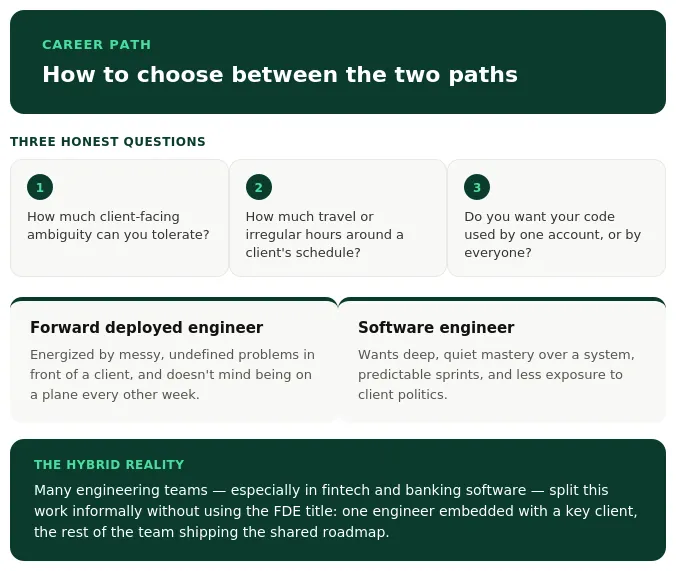
The decision usually comes down to three honest questions: How much client-facing ambiguity can someone tolerate? How much do they want to travel or work irregular hours around a client’s schedule? And do they want their code used by one account or by everyone?
Someone who gets energy from solving a messy, undefined problem in front of a client, and doesn’t mind being on a plane every other week, tends to thrive as an FDE. Someone who wants deep, quiet mastery over a system, predictable sprints, and less exposure to client politics usually does better as a software engineer. Neither is more “real” engineering than the other — they just optimize for different kinds of impact.
There’s also a hybrid reality worth naming: plenty of engineering teams, especially in fintech and banking software, informally split this work without ever using the FDE title. A team building banking app development features might have one engineer permanently embedded with a key client during rollout while the rest of the team keeps shipping the shared roadmap. Reviewing a vendor’s portfolio of completed projects often reveals this pattern: dedicated delivery specialists paired with a stable core build team.
Pros and Cons Side by Side
| Pros | Cons | |
|---|---|---|
| Forward Deployed Engineer | Higher pay ceiling, direct customer impact, fast career forks, varied work | Heavy travel, high ambiguity, less codebase depth, burnout risk |
| Software Engineer | Predictable scope, deep specialization, standardized pay bands, better work-life balance | Lower pay ceiling on average, less direct customer visibility, slower variety in day-to-day work |
Final Take
Neither role beats the other on paper — they just serve different appetites. Forward deployed engineering rewards people who like solving one hard, specific problem in front of the person who owns it, with pay and career mobility that can move fast when it works. Software engineering rewards people who want to build something durable at scale, with steadier hours and a clearer ladder.
For companies trying to figure out which model fits a given product, especially in regulated spaces like banking and lending, the honest answer is usually “some of both.” Firms exploring how AI-driven development and client-specific delivery intersect are increasingly blending core engineering teams with embedded delivery specialists to get the best of both models.