
Quick Summary: A forward deployed engineer (FDE) works post-sale, embedding with a customer to write production code, build custom integrations, and own the outcome once the deal closes. A solutions engineer (SE) works pre-sale, running demos and proof-of-concepts to help win the deal in the first place. Both roles sit close to customers and require strong technical chops, but their goals, timelines, and success metrics diverge sharply.
Ask ten people in tech to define “forward deployed engineer” and expect ten slightly different answers. The title has exploded in 2026, largely thanks to Palantir popularizing it and a wave of AI startups copying the model. Meanwhile, “solutions engineer” has been a fixture of enterprise software sales teams for well over a decade. So when a job posting lists both roles side by side, it’s worth asking: what’s the real difference, and does it matter which one a company builds its go-to-market motion around?
The short answer? Timing and ownership. An SE lives before the contract is signed. An FDE lives after it. That single distinction cascades into everything else — compensation structure, reporting lines, the kind of code each role touches, and even the personality types that tend to thrive in each seat.
What a Solutions Engineer Actually Does
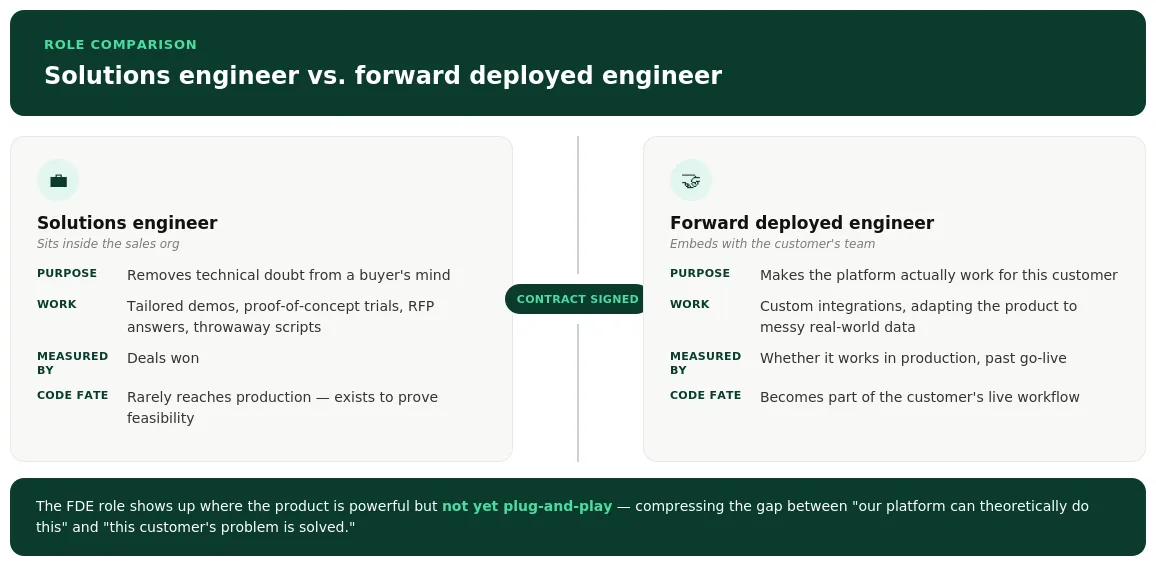
A solutions engineer, sometimes called a sales engineer, sits inside the sales organization and exists to remove technical doubt from a buyer’s mind. That means building demos tailored to a prospect’s stack, running proof-of-concept trials, answering technical RFP questions, and occasionally writing throwaway integration scripts just to prove something is possible.
SEs are measured on deals won, not systems shipped. Their code rarely reaches production. It exists to demonstrate feasibility, and once the contract closes, an implementation or customer success team typically takes over. This makes the SE role fundamentally a sales-support function with deep technical fluency layered on top — not an engineering role in the traditional sense.
What a Forward Deployed Engineer Actually Does
A forward deployed engineer shows up after the ink dries. They embed directly with a customer’s team, often on-site or in close daily contact, and write real production code that becomes part of the customer’s live workflow. FDEs build custom integrations, adapt the core product to fit messy real-world data, and stay engaged well past go-live to make sure the thing actually works in production, not just in a sandbox.
This role tends to show up at companies whose product is genuinely powerful but not yet plug-and-play — complex AI platforms, data infrastructure tools, or systems that need heavy customization before a customer sees value. The FDE essentially compresses the gap between “our platform can theoretically do this” and “this specific customer’s problem is now solved.”
Forward Deployed Engineer vs Solutions Engineer: Side-by-Side
| Dimension | Solutions Engineer | Forward Deployed Engineer |
|---|---|---|
| Sales stage | Pre-sale | Post-sale |
| Primary goal | Win the deal | Deliver the outcome |
| Where code lives | Demo environments, throwaway scripts | Production, running in the customer’s stack |
| Reports into | Sales or revenue org | Engineering or product org (often) |
| Time with a single customer | Days to weeks | Weeks to months, sometimes years |
| Success metric | Closed-won revenue, pipeline influenced | Adoption, retention, working integration |
| Typical company stage | Any B2B SaaS with a sales team | Complex platforms, AI startups, enterprise/government contracts |
Where Solutions Architect Fits Into This
A third title muddies the water further: the solutions architect (SA). An SA typically designs the high-level technical integration plan and hands it off to an implementation team, rather than writing the production code themselves.
Put simply, a forward deployed engineer owns the customer outcome directly, while a solutions architect owns the blueprint that someone else executes.
Why the Roles Often Overlap
Some organizations blur these lines entirely, especially smaller startups where one person might handle SE work in the morning and FDE-style implementation in the afternoon.
That overlap is common at early-stage companies that cannot yet afford three separate specialist roles.

Solve Client Problems With Itexus
Itexus combines consulting, software engineering, integrations, and ongoing support for complex financial products.
Need Technical and Client-Facing Delivery Support?
Itexus can help with:
- fintech consulting
- product discovery and prototyping
- custom software development
- project audit and rescue
- post-launch support
 Contact Itexus to discuss your product and technical requirements.
Compensation: Why FDE Pay Looks So Different
FDE compensation has climbed sharply as demand for the role has intensified, particularly at AI-focused companies. According to compensation data compiled by Recruiting from Scratch based on technical placements it tracked, the median base salary for a forward deployed engineer in 2026 sits around $210,000, with a 25th-percentile figure near $165,000 for mid-level roles and a 75th-percentile figure around $243,000 for senior and staff-level FDEs. Top offers at well-funded AI startups can exceed $300,000 in base pay alone, before equity.
Solutions engineer pay tends to run lower on average, largely because the role doesn’t require the same depth of hands-on coding or production ownership. That said, top-performing SEs at enterprise software companies with strong commission structures can still land total compensation packages that rival mid-level FDE offers, especially once bonuses tied to closed deals are factored in.
Reported base salary percentiles for forward deployed engineers in 2026.
Skills That Matter for Each Role
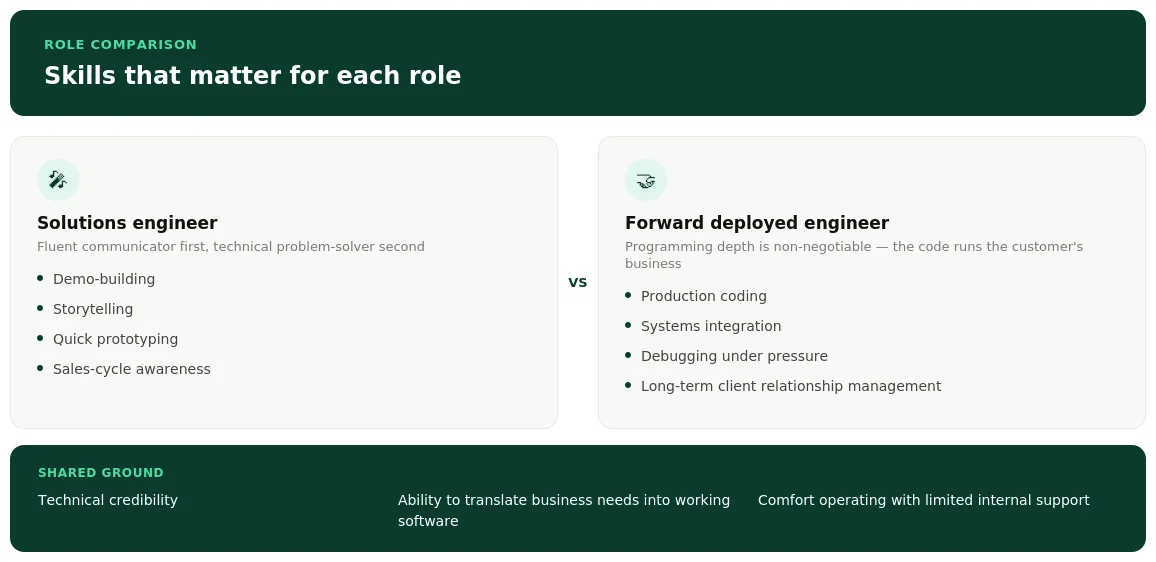
Solutions engineers need to be fluent communicators first, technical problem-solvers second. They have to translate a prospect’s business pain into a live demo within minutes, often in front of skeptical stakeholders. Presentation skills, quick thinking, and a decent grasp of the product’s API surface matter more than deep systems knowledge.
Forward deployed engineers need the opposite balance. Programming depth — often in Python, plus comfort with cloud infrastructure, data pipelines, and system integration — is non-negotiable, because the code they write actually runs the customer’s business. But soft skills still matter enormously: patience with messy legacy systems, empathy for frustrated client teams, and the discipline to hand off implementation work to a client’s own engineers rather than building everything alone indefinitely.
- Solutions Engineer: demo-building, storytelling, quick prototyping, sales-cycle awareness
- Forward Deployed Engineer: production coding, systems integration, debugging under pressure, long-term client relationship management
- Shared ground: technical credibility, ability to translate business needs into working software, comfort operating with limited internal support
Which Model Fits a Company’s Go-to-Market?
Not every company needs an FDE team. If a product is largely self-serve or requires minimal customization, a strong solutions engineering function paired with a standard customer success team usually covers the need just fine. The FDE model earns its cost when the product genuinely can’t ship value without hands-on, client-specific engineering — think complex data platforms, bespoke AI deployments, or systems integrating with legacy government or banking infrastructure.
Decision path for choosing between a solutions engineering model and an FDE model.
This is especially relevant in fintech and banking software, where regulatory constraints, legacy core banking systems, and highly specific compliance requirements often demand exactly the kind of embedded, production-level engineering an FDE provides. Companies building custom fintech software or rolling out a white-label banking platform frequently find that a purely pre-sale technical function isn’t enough — someone needs to stay engaged well past launch to make sure integrations with a bank’s existing core systems actually hold up under real transaction volume.
How the Roles Show Up in FinTech Specifically
Banking and lending platforms are a good stress test for this distinction. A solutions engineer at a lending software vendor might demo how a digital lending system handles underwriting rules during a sales pitch. But once the contract is signed, someone still has to map that lending logic onto the client’s actual loan origination data, connect to their credit bureaus, and handle edge cases the demo never covered. That’s FDE-style work, even if the company never uses the title.
The same pattern shows up in trading systems and AI-driven risk tools. Building a trading platform that works in a sales demo is one problem; getting it to reconcile cleanly with a client’s existing order management system, market data feeds, and compliance reporting is another problem entirely — and it’s the kind of problem forward deployed engineers are built to solve. Firms exploring AI-driven software integrations for fraud detection or underwriting run into this constantly: the model works beautifully in a controlled test, then needs weeks of hands-on tuning against messy production data.
Career Path: Moving Between the Two Roles
It’s common to see engineers move from SE into FDE roles, or the reverse, depending on what they want more of: variety and sales exposure, or deep technical ownership and client immersion. SEs who enjoy the technical side but want less “always be closing” pressure sometimes migrate toward FDE work. FDEs who get tired of extended client embeds and want broader exposure across many deals sometimes migrate back toward solutions engineering.
Neither path is a downgrade. They’re just optimized for different appetites — breadth and sales cadence on one side, depth and production accountability on the other.
The Bottom Line
Solutions engineers win the deal. Forward deployed engineers make the deal actually work once it’s signed. Neither role replaces the other — they solve different problems at different points in the customer journey, and mature go-to-market teams increasingly need both.
For companies building complex financial software, the FDE-style approach often ends up mattering more than the title suggests. Getting a lending engine, trading platform, or banking integration to actually perform in a client’s live environment takes sustained, hands-on engineering — not just a convincing demo. Teams evaluating how to structure that kind of post-sale technical support can look at how established development and delivery processes handle exactly this handoff, or browse a portfolio of completed fintech projects to see what production-grade implementation actually looks like in practice.