
Quick Summary: Becoming a forward deployed engineer means combining strong software engineering fundamentals with data skills, cloud systems knowledge, and genuine comfort working face-to-face with customers to solve messy, real-world problems. The fastest path runs through building a T-shaped skill set — deep in coding and data, broad in systems and communication — then proving it with hands-on deployment projects rather than just certificates. Most companies hiring FDEs today want engineers who can run a “data audit,” ship a working prototype fast, and iterate directly with the client rather than through layers of product managers.
Forward deployed engineering isn’t a brand-new job title, but it’s having a moment. Palantir popularized the role years ago, and now fintech, healthcare, and enterprise SaaS companies are all scrambling to hire people who can sit inside a client’s world and build software that actually fixes what’s broken there — not just what a roadmap says should be built.
So what does it actually take to get hired into one of these roles? The short answer: technical range, comfort with ambiguity, and a track record of shipping things that work under pressure. The longer answer takes a bit more unpacking.
What Is a Forward Deployed Engineer, Really?
A forward deployed engineer (FDE) is embedded directly with a customer — sometimes literally on-site, sometimes just deeply involved in their workflows — to build and adapt software that solves a specific, often messy, business problem. Unlike a typical backend or platform engineer who works several layers removed from the end user, an FDE is close enough to smell the problem firsthand. Think of it as a blend of software engineer, solutions consultant, and product manager. The job usually starts before a single line of production code gets written. It starts with understanding what’s actually broken.
That’s where the idea of a “data audit” comes in — a phrase that keeps showing up in FDE job postings and internal playbooks. Before building anything, an FDE typically digs into a client’s existing data: how it’s structured, where it’s messy, what’s missing. Only after that does the actual engineering begin.
Why the Role Is Exploding Right Now
Enterprise software buyers are tired of generic platforms that need six months of configuration before delivering value. They want outcomes, fast. That pressure has pushed companies — especially in fintech, where regulatory complexity and legacy systems collide constantly — toward hiring engineers who can move quickly inside a client’s environment instead of waiting for a slow, ticket-based support cycle. Firms building custom fintech software or standing up digital lending systems for banks increasingly need people who can parachute into a client’s stack, understand its quirks, and adapt a product on the fly rather than forcing a one-size-fits-all rollout.
The Core Skill Set: Going T-Shaped
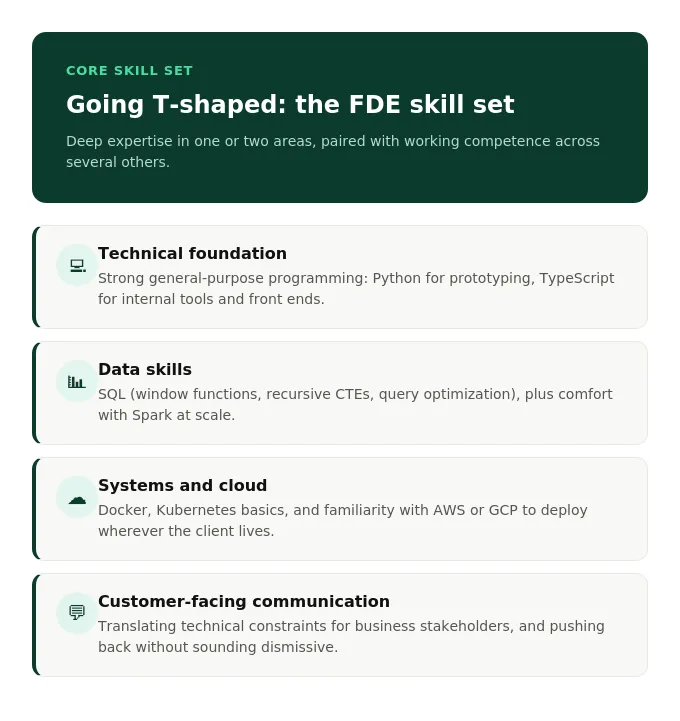
Nearly every FDE job description asks for a “T-shaped” profile — deep expertise in one or two areas, paired with working competence across several others. That’s not marketing fluff; it’s a fairly accurate description of how the job actually functions day to day.
Technical Foundation
Strong general-purpose programming is non-negotiable. Python shows up constantly because it’s fast to prototype in, and TypeScript matters when the work involves building internal tools or lightweight front ends for a client. Nobody expects mastery of ten languages — depth in one or two, with the flexibility to pick up a third when a project demands it, matters far more.
Data Skills
This is where a lot of aspiring FDEs underinvest. SQL isn’t optional — window functions, recursive CTEs, and query optimization come up constantly because most client problems start as data problems in disguise. A client says their reporting is broken; nine times out of ten, the real issue is a data model nobody fully understands. Comfort with Spark or similar large-scale data tools helps too, especially in fintech environments dealing with transaction volumes at scale.
Systems and Cloud
FDEs frequently deploy into environments they don’t control — a bank’s private cloud, a hospital’s on-prem servers, a legacy mainframe with a REST API bolted on. Docker, Kubernetes basics, and familiarity with AWS or GCP services give an engineer the flexibility to get something running wherever the client happens to live.
Customer-Facing Communication
This is the part that trips up otherwise-strong engineers. Sitting across from a frustrated operations manager and translating their pain into a technical spec is a different skill than writing clean code. It requires patience, active listening, and the confidence to say “that won’t work, here’s why” without sounding dismissive.

Build and Support Fintech Products With Itexus
Itexus works on banking, payments, trading, lending, wealth management, and insurance products that require development, architecture, integrations, testing, and ongoing support.
Need a Team With Experience Beyond Standard Coding Tasks?
Itexus services include:
- backend, frontend, and mobile development
- product discovery and technical planning
- cloud infrastructure and DevOps
- quality assurance and test automation
- production support and maintenance
 Contact Itexus to discuss your team, system, and delivery needs.
Step-by-Step Roadmap to Becoming an FDE
There’s no single accredited path into this role — no bootcamp hands out an “FDE certificate.” But a fairly consistent pattern shows up among people who land these jobs.
- Build engineering fundamentals. Two to three years of solid backend, data engineering, or full-stack work gives you the baseline credibility to be trusted near a client’s production systems.
- Get comfortable with messy data. Practice on real, ugly datasets — not textbook examples. Kaggle competitions help a little; contributing to open data projects helps more.
- Ship something customer-facing. A side project that a real person actually uses teaches lessons no internal tool ever will. Requirements change, users complain, edge cases appear out of nowhere.
- Take a bridge role. Solutions engineering, technical account management, or implementation consulting roles are natural stepping stones — they build the client-facing muscle without requiring a full FDE title yet.
- Target companies that explicitly hire FDEs. Palantir, Samsara, and a growing list of enterprise AI and fintech startups now post roles under this exact title. Apply directly, and tailor a resume toward deployment stories, not just feature-shipping stories.
FDE vs. Similar Roles
It helps to see how the role compares to adjacent titles, since job descriptions vary wildly between companies.
| Role | Primary Focus | Client Contact | Typical Background |
|---|---|---|---|
| Forward Deployed Engineer | Building & adapting software on-site with the client | High — embedded, hands-on | Full-stack or data engineer with strong communication skills |
| Solutions Architect | Designing technical architecture before handoff | Medium — advisory, less hands-on coding | Senior engineer, often pre-sales oriented |
| Implementation Consultant | Configuring existing product for the client | High — but limited custom coding | Business analyst or technical consultant |
| Backend/Platform Engineer | Building core product, rarely client-facing | Low — internal-facing | Traditional software engineering track |
Where FDEs Actually Fit in Fintech
Fintech is one of the sectors leaning hardest into this model, and for good reason. A bank rolling out a new trading platform or launching banking-as-a-service infrastructure can’t afford a generic implementation — every client has different compliance rules, legacy integrations, and risk tolerances. An FDE embedded with that client can adapt the deployment in ways a rigid, off-the-shelf rollout never could. The same logic applies to white-label banking platforms, where the underlying product stays consistent but the deployment needs constant tailoring to each bank’s brand, regulatory footprint, and customer base.
Common Mistakes People Make Chasing This Role
- Treating it as a title, not a skill set. Recruiters see through resumes padded with buzzwords but no actual deployment stories.
- Ignoring data skills. A weak SQL foundation shows up fast in technical interviews built around real-world messy schemas.
- Avoiding client conversations. Some engineers actively dodge stakeholder meetings — exactly the opposite instinct an FDE role demands.
- Overbuilding before understanding the problem. Jumping straight to code instead of running a proper discovery or data audit first is one of the most common early failures.
Industries Hiring the Most FDEs Right Now
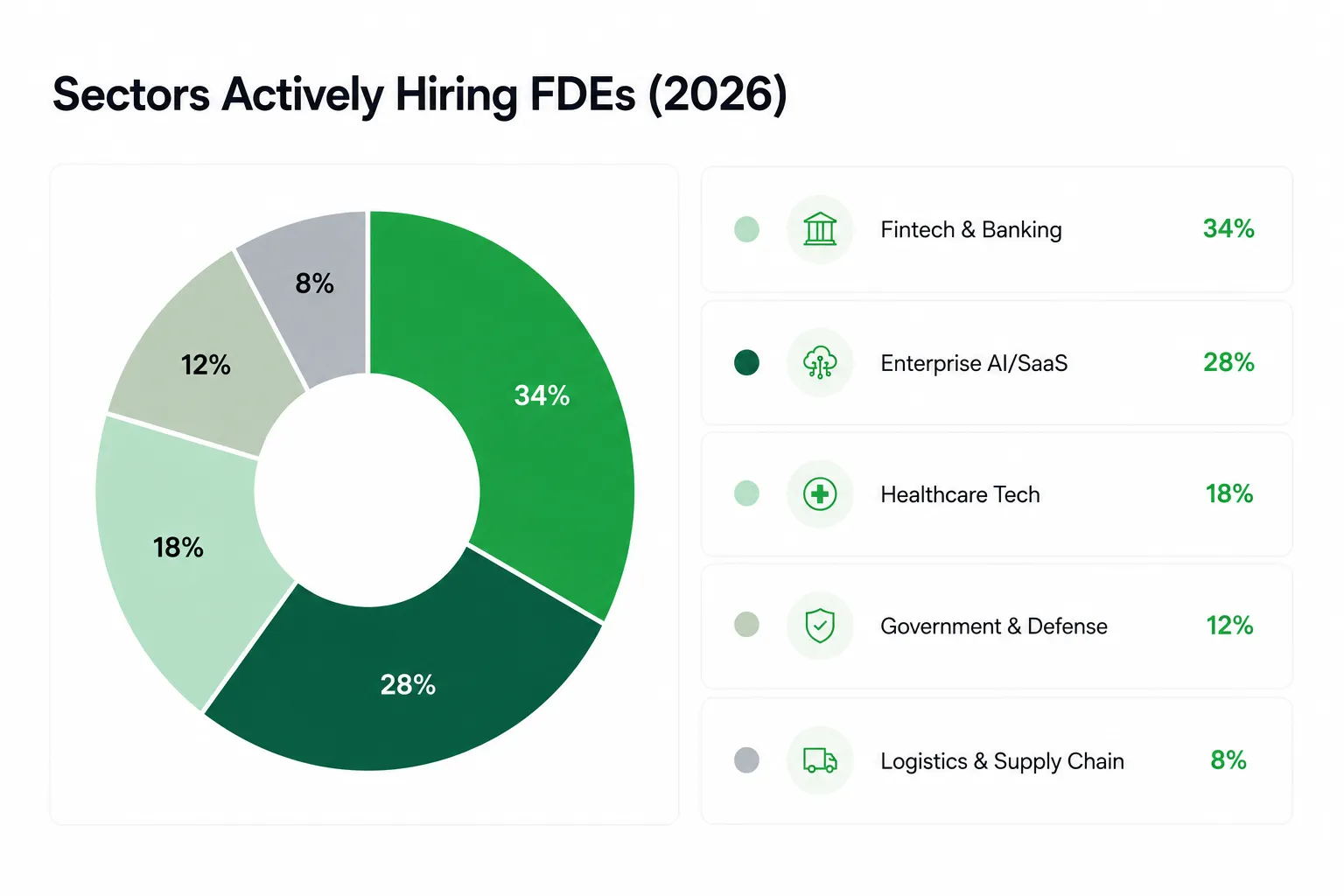
Fintech and enterprise AI dominate the demand right now, largely because both industries deal with high-stakes, highly customized deployments where a generic SaaS rollout simply doesn’t cut it. Teams exploring AI-driven software solutions for financial clients often lean on FDE-style engineers specifically because model behavior needs constant tuning against real client data, not a static training set.
Building a Portfolio That Actually Gets You Hired
Forget generic coding portfolios full of to-do apps. Hiring managers for FDE roles want evidence of three things: technical range, data fluency, and proof you can survive an ambiguous, client-facing problem without a detailed spec handed to you. A strong portfolio might include a project where raw, unstructured data got turned into something usable — a dashboard, an automated pipeline, a decision-support tool — built for an actual “client,” even if that client was a small business owner or nonprofit rather than a Fortune 500 company. Documenting the process, including the mess and the pivots, matters more than a polished final demo. Reviewing how established teams structure delivery — see how firms like Itexus approach their development process or browse a portfolio of completed fintech projects — can also give a useful sense of what “client-ready” work actually looks like in practice.
Final Thoughts
Becoming a forward deployed engineer isn’t about collecting a checklist of tools. It’s about proving — through real projects, real data, and real conversations — that ambiguity doesn’t scare you off. The engineers who thrive in this role tend to enjoy the mess: the undocumented legacy system, the client who can’t quite articulate what they need, the deadline that arrived yesterday. Start by strengthening the technical core, get uncomfortable with real data early, and look for any opportunity — even a small one — to sit across the table from an actual user. That’s where the role really begins.