
Quick Summary: Becoming a forward deployed engineer means combining strong software engineering skills with customer-facing problem solving, usually by mastering data fundamentals, building deployable AI or data products, and proving you can work directly inside a client’s environment. Most people break in through backend, data, or solutions engineering roles, then move laterally once they can show shipped, customer-facing work. There’s no single certification for this path — it’s built through targeted projects, sharp communication, and comfort with ambiguity.
Forward deployed engineer roles didn’t exist in most job boards a decade ago. Now they show up at AI startups, fintech companies, and enterprise software vendors that need someone who can sit inside a client’s world and build software that actually gets used. The title sounds glamorous. The reality is messier — half sales engineer, half backend developer, half therapist for frustrated stakeholders.
So how does anyone actually land this job? Not through a single course or bootcamp. It takes a specific mix of technical depth, business fluency, and the willingness to work where the problems are messiest — not in a clean internal codebase, but on-site, in a client’s data warehouse, in their Slack channel, in their world.
What Does a Forward Deployed Engineer Actually Do?
A forward deployed engineer (FDE) embeds directly with a customer — sometimes physically, sometimes just deeply on their systems — to solve a specific business problem using the company’s product as the toolkit. Instead of building generic features for thousands of anonymous users, an FDE builds something narrow and specific for one account, then figures out what parts of that solution should get folded back into the core product.
The role blends three things that rarely coexist in one job: hands-on coding, direct client relationships, and product judgment. That’s why FDE roles are hard to fill and even harder to train for through traditional computer science programs.
Forward Deployed Engineer vs. Other Engineering Roles
It helps to see how the role sits relative to jobs people already understand. The table below breaks down the closest comparisons.
| Role | Primary focus | Client contact | Ships to |
|---|---|---|---|
| Forward Deployed Engineer | Custom solutions on top of a product | Direct, ongoing, often on-site | One client’s environment |
| Backend Engineer | Core product infrastructure | Rare, usually via product managers | General production system |
| Solutions Engineer | Pre-sales technical demos | Direct, but shorter-term | Sales cycle, not long-term builds |
| Data Engineer | Pipelines and data infrastructure | Minimal | Internal data platform |
| AI/ML Engineer | Model development and tuning | Minimal to moderate | Model or inference service |
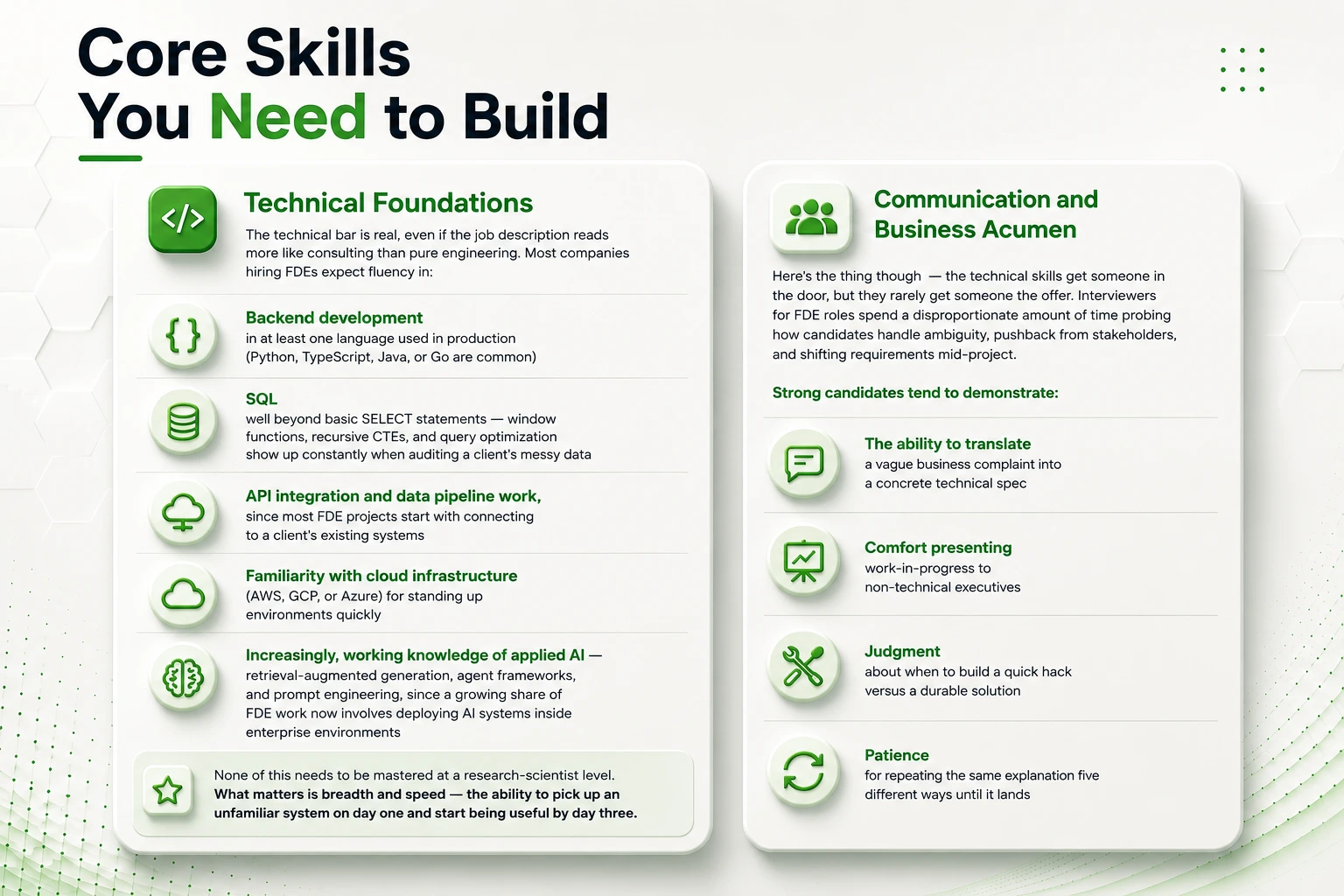
Core Skills You Need to Build
Technical Foundations
The technical bar is real, even if the job description reads more like consulting than pure engineering. Most companies hiring FDEs expect fluency in:
- Backend development in at least one language used in production (Python, TypeScript, Java, or Go are common)
- SQL well beyond basic SELECT statements — window functions, recursive CTEs, and query optimization show up constantly when auditing a client’s messy data
- API integration and data pipeline work, since most FDE projects start with connecting to a client’s existing systems
- Familiarity with cloud infrastructure (AWS, GCP, or Azure) for standing up environments quickly
- Increasingly, working knowledge of applied AI — retrieval-augmented generation, agent frameworks, and prompt engineering, since a growing share of FDE work now involves deploying AI systems inside enterprise environments
None of this needs to be mastered at a research-scientist level. What matters is breadth and speed — the ability to pick up an unfamiliar system on day one and start being useful by day three.
Communication and Business Acumen
Here’s the thing though — the technical skills get someone in the door, but they rarely get someone the offer. Interviewers for FDE roles spend a disproportionate amount of time probing how candidates handle ambiguity, pushback from stakeholders, and shifting requirements mid-project.
Strong candidates tend to demonstrate:
- The ability to translate a vague business complaint into a concrete technical spec
- Comfort presenting work-in-progress to non-technical executives
- Judgment about when to build a quick hack versus a durable solution
- Patience for repeating the same explanation five different ways until it lands

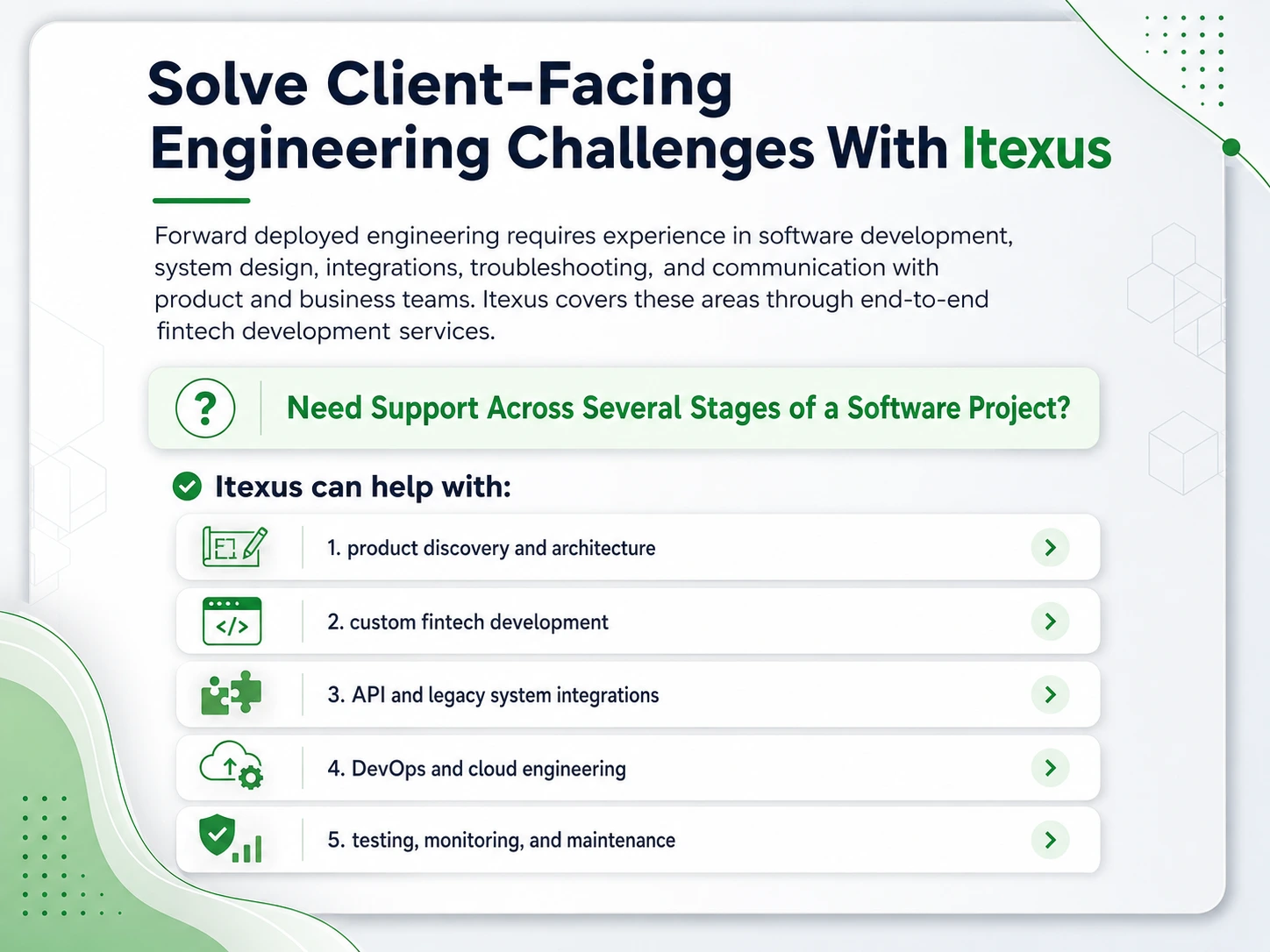
Solve Client-Facing Engineering Challenges With Itexus
Forward deployed engineering requires experience in software development, system design, integrations, troubleshooting, and communication with product and business teams. Itexus covers these areas through end-to-end fintech development services.
Need Support Across Several Stages of a Software Project?
Itexus can help with:
- product discovery and architecture
- custom fintech development
- API and legacy system integrations
- DevOps and cloud engineering
- testing, monitoring, and maintenance
 Contact Itexus to plan your financial software project.
The Typical Path Into the Role
Almost nobody starts their career as a forward deployed engineer. Most people arrive from adjacent roles — backend engineering, data engineering, solutions consulting, or even technical customer success — after proving they can handle both the code and the client conversation.
Companies building AI-driven products — including fintech platforms doing complex integrations — increasingly need this hybrid profile. Teams offering AI software development and integration services often lean on exactly this kind of engineer to translate a client’s operational mess into a working system, because generic off-the-shelf configuration rarely fits a bank’s or lender’s actual workflow.
How to Break In Without Prior FDE Experience
Nobody hires a “forward deployed engineer” straight out of school. The path in usually runs through one of these routes:
- Build a portfolio project that mimics the job. Take a messy, real dataset — public financial records work well — and build an end-to-end tool that ingests it, cleans it, and produces something a non-technical stakeholder could use immediately.
- Get client exposure early, even in small doses. Freelance work, consulting gigs, or a customer-facing rotation inside a current job all count. What matters is proof of handling a live stakeholder relationship.
- Target companies that explicitly run FDE programs. A handful of AI and enterprise software companies run structured trainee programs specifically for this path, often a few months long, pairing junior hires with client engagements from day one.
- Study the deployment side, not just the model side. Plenty of engineers can fine-tune a model. Fewer can wire that model into a client’s legacy stack, handle their auth system, and keep the thing running when the client’s IT team changes a firewall rule without telling anyone.
For engineers coming from a fintech background specifically, understanding how digital lending systems or trading platforms get built gives a real edge — a lot of FDE work in that sector involves bolting new capability onto systems that already handle live money movement, where mistakes are expensive and rollback plans matter.
What the Interview Process Usually Looks Like
FDE interviews are notoriously broad. Expect some combination of:
- A take-home or live coding exercise involving messy, real-world-shaped data rather than a clean algorithm puzzle
- A case study where the candidate has to scope an ambiguous client request into a shippable plan
- A roleplay or panel round simulating a difficult stakeholder conversation
- Questions about past projects that probe for ownership — did the candidate just write code, or did they also decide what to build and why
The bar isn’t about knowing every algorithm cold. It’s about showing calm, structured thinking when the requirements are fuzzy and the client is impatient.
Skills Checklist Before Applying
| Skill area | Minimum bar | Strong candidate signal |
|---|---|---|
| Coding | Can ship a working feature independently | Has deployed something used by real, non-technical users |
| Data handling | Comfortable with SQL joins and cleaning | Can optimize slow queries and handle messy, undocumented schemas |
| Communication | Can explain technical work to a manager | Can defend a technical decision to a skeptical client executive |
| AI/ML familiarity | Understands basic model concepts | Has integrated a model or agent into a real workflow |
| Domain knowledge | General industry awareness | Deep familiarity with one vertical, such as banking or lending |
That last row matters more than it looks. FDEs who understand one industry deeply — say, how a bank’s core system talks to a Banking as a Service layer, or how a white-label banking platform gets customized for different clients — tend to ramp up faster than generalists, because half the job is already understanding the client’s world before writing a line of code.
Where to Practice Before the Real Thing
Reading about the role only goes so far. A few concrete ways to build proof of capability:
- Recreate a small version of a real enterprise problem — say, reconciling transaction data across two mismatched formats — and document the whole process publicly
- Contribute to open-source tools that require integrating with external APIs, since that mirrors the connector work FDEs do constantly
- Look at how established teams structure client engagements; reviewing a process and methodology overview from a software delivery company can show how discovery, scoping, and deployment phases typically fit together
- Study a portfolio of finished client projects, such as a portfolio of completed software projects, to see the range of problems that get solved in production and how requirements evolve
FAQ
What background do most forward deployed engineers come from?
Do you need a computer science degree to become a forward deployed engineer?
Is forward deployed engineering the same as solutions engineering?
How long does it take to become a forward deployed engineer?
What industries hire the most forward deployed engineers?
Is coding still important if the job is mostly client-facing?
Can AI tools replace forward deployed engineers?
Final Thoughts
Becoming a forward deployed engineer isn’t about collecting a certificate or finishing a single course. It’s a gradual shift — building the technical range to handle unfamiliar systems, then layering on the communication skills to survive direct client contact, then finding a role or project that lets both get tested at once.
Start small. Build one project that mirrors real client messiness, not a textbook exercise. Get in front of a stakeholder, even an informal one, and practice explaining trade-offs out loud. Companies building complex, regulated systems — from fintech software development to banking app development — are exactly where this hybrid skill set gets tested hardest, and where the next wave of forward deployed roles is likely to open up.