
Deployed On-Premise GenAI Inside a Bank in 3 Weeks — Starting with Document Intelligence
Itexus deployed an on-premise LLM inside a security-constrained bank in 3 weeks — automating document classification, PDF bundle splitting, and field extraction, while defining a scalable AI architecture for future use cases.


Case Summary for Financial Services Leaders
A bank in a high-security regulated environment needed to adopt GenAI without using public SaaS AI services due to data confidentiality constraints. Building a full in-house AI platform from scratch was too slow and expensive for a first step. Itexus proposed a practical entry point: deploy an open-weight LLM on-premise inside the bank's own infrastructure, validate the model on a real document workflow, and define a scalable AI architecture for future automation.
Technologies: Python, PyTorch, HuggingFace Transformers, FastAPI, Docker.
Results: production-ready MVP in 3 weeks, 20 document types supported, 95% classification accuracy, ~2 seconds per page.
| Industry | Banking |
| Segment | Consumer Bank |
| Geography | North America |
| Deployment Model | On-Premise (air-gapped / private infrastructure) |
| Duration | 3 weeks (MVP scope) |
| Team Size | 2 (1 AI-Native Product Engineer + 1 Project Manager) |
| Delivery Model | AI-first SDLC |
| Services | AI-first product engineering, Banking software development |
| Technologies | Python, PyTorch, HuggingFace Transformers, FastAPI, Docker, PostgreSQL |
| Compliance | PCI DSS, SOC 2 |
About the Client
A regulated banking institution operating in a high-security environment processes sensitive customer documents across multiple internal operational workflows daily. The bank's security and compliance policies prohibit the use of externally hosted AI services — including public cloud LLM APIs — for any workloads involving customer data.
The bank required an AI adoption path that would fit within its existing controlled infrastructure, comply with strict data residency and confidentiality requirements, and be realistic as a first step rather than a multi-year platform investment.
The Challenge
The challenge was not technical in the narrow sense. The real question was: how does a security-constrained bank take a first step into GenAI adoption — without compromising its data perimeter and without launching a large, expensive platform program?
Business Challenge
Public SaaS AI tools — including major cloud LLM APIs — were off-limits for workloads involving sensitive customer documents.
Commissioning a full proprietary AI platform from scratch was too slow and too capital-intensive for a first step.
Existing document workflows were still operationally painful: manual classification, no bundle splitting, no field extraction.
The bank needed a pilot that proved GenAI could be run safely inside its own perimeter — not as an isolated experiment, but as a realistic operating model.
Technical Challenge
Deploying a capable open-weight LLM on-premise inside the bank's controlled infrastructure without relying on external inference APIs.
Building page-level document classification capable of handling multi-page PDFs and bundled files containing 5–10 consecutive documents.
Implementing document boundary detection inside PDF bundles — a non-trivial structural problem distinct from simple classification.
Designing structured field extraction with JSON output compatible with the bank's downstream processing systems.
Architecting the MVP as a foundation for future AI use cases — not a standalone utility — including an API Gateway, Document Processing Layer, and AI/ML Services Layer.
Solution
Itexus delivered the project through an AI-first SDLC model — a lean, AI-native delivery approach that enabled a 2-person team to move from concept to production-ready MVP in 3 weeks. The solution was deployed entirely on-premise inside the bank's protected infrastructure.
Document Intelligence MVP
Ingestion of multi-page PDF files from internal bank systems
Handling of document bundles containing 5–10 consecutive documents within a single PDF
Page-level document classification — each page is classified individually before boundary detection
Document boundary detection inside bundled PDFs — identifying where one document ends and the next begins
Structured field extraction from classified documents
JSON output formatted for integration with the bank's existing downstream systems
Scope expanded from 10 to 20 document types at the MVP stage
On-Premise Deployment & Security Controls
Sensitive customer documents remained within the bank's controlled environment at all times
The pilot operated as a realistic model of future AI adoption, not an isolated proof-of-concept disconnected from real infrastructure
Security controls included authenticated access, role-based permissions, auditability of processing events, and automatic cleanup of temporary processing artifacts
Target Architecture for Future Scale
API Gateway: a unified entry point for all AI service requests across the bank's internal systems
Document Processing Layer: orchestration of ingestion, classification, boundary detection, and extraction pipelines
AI/ML Services Layer: model serving infrastructure capable of hosting multiple models and supporting future automation scenarios
Use Cases Covered
The MVP addressed the following document automation use cases within the bank's internal workflows:
| Use Case | Description | Output |
|---|---|---|
| Document Classification | Page-level identification of document type across 20 classes | Document type label per page |
| PDF Bundle Splitting | Detection of document boundaries inside multi-document PDFs | Separated individual document records |
| Structured Field Extraction | Extraction of key fields from classified customer documents | Structured JSON |
| Downstream Integration | JSON output formatted for bank's existing internal systems | API-ready structured data |
| Audit Logging | Processing events logged with role-based access controls | Traceable processing history |
Problems Solved
Document processing time reduced by 40% with data extraction accuracy up to 95%.
Enabled safe GenAI adoption inside a regulated bank. The bank now has a validated, working model for running LLM-based automation inside its own infrastructure — without relying on public AI services or building a full platform program.
Expanded document type coverage. The system went from 10 to 20 supported document classes, with an architecture designed to extend further without fundamental rework.
Delivered a reusable AI infrastructure foundation. The MVP is not a standalone tool. The target architecture defined alongside it provides a platform for future AI use cases across the bank's operations.
Solution Architecture
The system is organized across three functional layers:
| Layer | Components | Function |
|---|---|---|
| API Gateway | REST API, Auth, Rate Limiting, Request Routing | Unified entry point for all AI service requests |
| Document Processing Layer | PDF Ingestion, Page Classifier, Bundle Splitter, Field Extractor | End-to-end document workflow orchestration |
| AI/ML Services Layer | LLM Inference Engine, Model Registry, Artifact Storage | Model serving, reusable for future AI use cases |
| Security & Compliance | IAM, Audit Logging, Artifact Cleanup, Role-based Access | Controls required in a regulated banking environment |
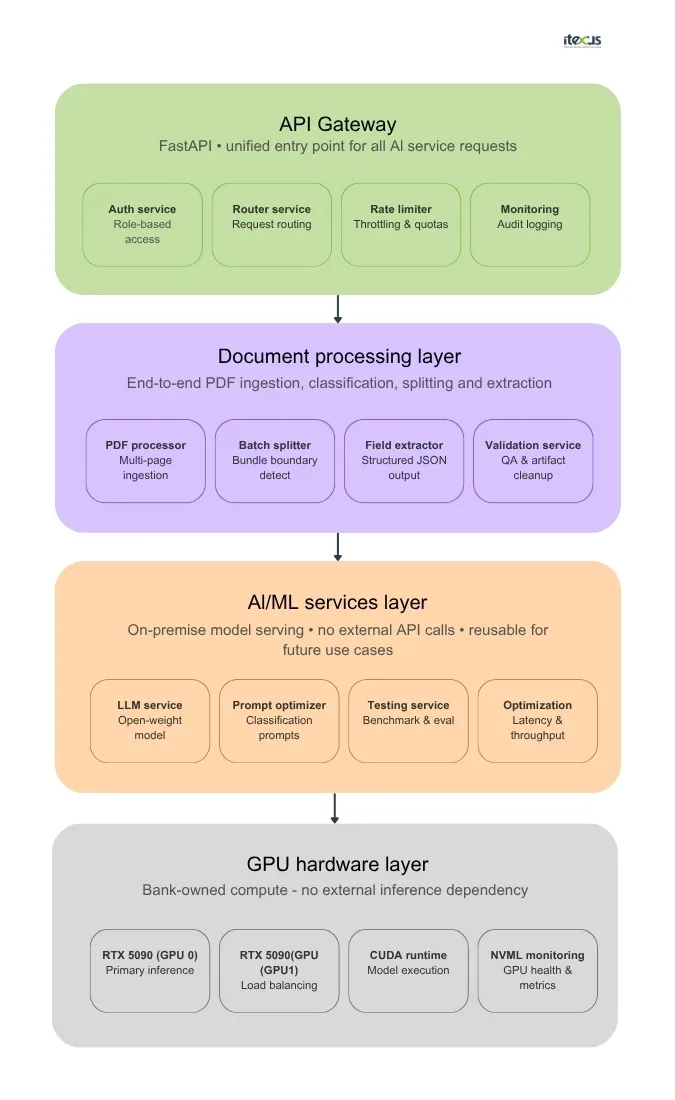
Integration Landscape
Integration points documented in the project:
Internal document management systems (source of PDF input)
Bank's downstream processing systems (consumer of JSON output)
Internal IAM and audit infrastructure
Open-weight LLM model (deployed on-premise, not via external API)
Technology Stack
| Category | Technologies |
|---|---|
| AI / ML | HuggingFace Transformers, PyTorch, open-weight LLM (on-premise) |
| Backend | Python, FastAPI |
| Document Processing | PDF parsing libraries, custom classification and extraction pipeline |
| Infrastructure | Docker, on-premise deployment |
| Database | PostgreSQL |
| Security | IAM, role-based access control, audit logging |
Compliance & Security
Security architecture was a first-class design constraint, not an afterthought. The solution was built specifically for a regulated banking environment with strict data residency requirements.
Security Measures Implemented
On-premise LLM deployment — no data leaves the bank's infrastructure
Authenticated access with role-based permission controls
Auditability — all document processing events are logged
Automatic cleanup of temporary processing artifacts
No external API calls during document processing
Controlled model deployment — model runs on bank's own hardware
Compliance Considerations
Data residency — customer documents remain within the bank's controlled perimeter
Internal security policy compliance — no public cloud or SaaS AI dependencies
Auditability requirements for regulated financial institutions
Architecture designed for future alignment with broader banking compliance frameworks (e.g. GDPR, sector-specific AI governance)
Delivery Approach
Delivery Model: AI-first SDLC
Team Composition
| Role | Scope |
|---|---|
| AI-Native Product Engineer | Architecture, model selection, pipeline implementation, on-premise deployment, security controls |
| Project Manager | Client communication, scope management, delivery coordination |
Governance
CI quality gates on all model outputs and pipeline components
Clear AI usage rules defined in repository
Restricted access to high-risk areas (production data, security controls)
Traceability and audit logs for all processing events
Scoped model context — no unnecessary data exposure to the model
Reference code patterns to ensure architectural consistency
Domain-based access controls aligned with bank's security requirements
No direct production changes — all changes via controlled deployment pipeline
Risk-based controls applied to security-sensitive components
Results
The bank received more than a working MVP. It received a validated, repeatable model for running GenAI inside its own environment — and a defined architectural path to extend AI automation to other workflows.
How This Expertise Can Help Your Team
The capabilities demonstrated in this project map directly to several recurring challenges in financial services AI adoption:
| AI-first Development | The delivery model used in this project. Lean teams, AI-native tooling, fast time-to-value on complex financial systems. |
| AI Software Development | Building AI-powered features inside banking products — classification, extraction, automation, intelligent workflows. |
| Banking Software Development | Engineering for regulated banking environments: security, compliance, integration with core banking systems. |
FAQ
What type of organizations is this solution most relevant for?
Banks, insurance companies, and other regulated financial institutions that process high volumes of customer documents and cannot use public cloud AI services due to data security or regulatory constraints. Also relevant for any financial institution looking to validate GenAI adoption without committing to a large platform program upfront.
What does 'AI-first SDLC' mean in practice, and how is it different from standard AI development?
AI-first SDLC means AI tooling is integral to the engineering workflow itself — not just used for specific tasks like code completion. In this project, it enabled a 2-person team to deliver in 3 weeks what a traditional team would typically take 3–6 months to scope, design, and build. The key difference is that the team structure, process, and toolchain are all designed around AI augmentation from day one.
Why was on-premise deployment important — couldn't this be done in a private cloud?
For this bank, deploying on private cloud infrastructure still meant relying on external service providers with access to the infrastructure layer. The requirement was for the model and all processed data to remain within the bank's own controlled environment — no external dependencies during inference. On-premise deployment satisfied this requirement; private cloud VPC configurations may or may not, depending on the bank's specific policies.
What were the biggest technical risks, and how were they managed?
The primary technical risk was model performance on the bank's specific document types, which differ from typical benchmark datasets. This was addressed by benchmarking the model against the bank's internal document set before committing to the approach, and by designing the pipeline to support model swapping without architectural changes. The second risk was document boundary detection in bundled PDFs — a problem that requires the model to reason about page sequences, not just individual pages. This was handled as a separate pipeline stage with dedicated validation.
How was the migration executed without disrupting operations?
The MVP was deployed as a new, parallel system — it did not replace existing document workflows during the pilot phase. This allowed the bank to evaluate the system on real documents against known-good results before committing to operational integration.
What happened after the MVP, and what is the next step?
The MVP delivered two things: a working production system for document intelligence, and a validated target architecture for future AI use cases. The next steps for the bank involve extending the document types covered and using the defined architecture to onboard additional automation scenarios — such as compliance document review or onboarding verification — onto the same AI infrastructure.
What lessons from this project apply to other banks considering GenAI adoption?
Three consistent patterns emerged: (1) Start with a real workflow that is currently painful, not a synthetic proof-of-concept. (2) Design for your security constraints from day one — retrofitting security onto a cloud-first architecture is more expensive than building on-premise from the start. (3) Use the first use case to define a reusable AI architecture — the pilot should be the first workload on a platform, not a one-off tool.
What factors most affect success in banking AI adoption projects?
Security architecture is the most commonly underestimated factor in regulated banking environments. Teams that treat it as a first-class constraint (not a compliance checkbox) reach production faster. The second critical factor is team composition: AI-native engineers with prior experience deploying models in regulated environments dramatically compress timelines compared to teams learning on the job.
Looking for a Fintech Engineering Partner?
We help financial institutions adopt AI safely, build fintech products that scale, and deliver engineering outcomes — not just code.