
Coding agents reduce the cost of writing code. The uncertainty in a fintech project sits elsewhere – in integrations, business rules, data quality and production readiness – and a credible estimate now has to be built on those.
Itexus is a trusted partner












Itexus delivered the app according to the requirements. The team met all development milestones and deliverables. They were efficient, friendly, and cooperative. Itexus team was very timely with updates, a regular meeting cadence, and ad-hoc questions and answers via Slack. The team was very responsive and still is.
Stive Jackson
RMD, Investing Fund
Itexus’ work positions the business well for an imminent launch. They excel at managing their team, presenting frequent product demos to ensure that the project is aligned with development goals. An affordable price structure coupled with remarkable technical skill makes them an attractive partner.
Phill Osolinski
CEO Ryze Rewards
The assigned team was easy to work with and they are especially strong collaborators and communicators. They demonstrated flexibility, professionalism, and trust in everything they did, and completed the work on time and budget.
Sue Wollan Fan
CEO Mango Connects
Itexus excelled at both experimental AI and sprint-oriented UI/UX tasks. Itexus did strong project management work, too, a necessity in such a complicated project.
Jesse Dubin
Senior PM Standard&Poors
They’re a great group of developers who really understand the reality of business.
Andreea Vanacker
CEO SPARKX5
AI coding agents can significantly reduce the effort needed to produce an initial implementation, particularly when requirements are well defined. A working prototype that once took weeks can appear in days. What has stayed expensive is everything a prototype leaves open: how external systems really behave, which business rules apply in edge cases, whether the data can be trusted, and what it takes to run the product in production.
For CTOs, founders and executives choosing a software development vendor, this changes how to read an estimate. The price of a fintech project depends less on how fast code gets written and more on what the vendor has verified, what it assumes, and which behavior it is prepared to guarantee. This article walks through one example to show where the uncertainty sits and how to compare proposals that cover it differently.
A two-day prototype and three different quotes
The example is hypothetical, built to show a pattern we see in fintech projects.
A wealth management firm serves families whose assets are held with three custodians. Its team uses a coding agent to build a polished prototype of a consolidated portfolio dashboard in two days, and asks three software vendors to quote a production version.
The prototype runs on sample data. In reality, the first custodian delivers positions in an overnight file. The second reports balances through an API, with pending transactions kept in a separate feed. The third has yet to approve production API access. Uneven coverage of this kind is normal in multi-custodian data aggregation.
The screens look finished. None of the vendors can tell from the prototype what the portfolio figures will actually mean when an advisor quotes them to a client.
Why coding effort stops working as the baseline for a quote
For many software vendors, the estimated effort of programming a feature was the basis for its price. Engineers calculated development days for interfaces, business logic and integrations. Testing, analysis, coordination and contingency were added on top, sometimes as percentages of implementation effort. The method was imperfect, but manual coding was a large and familiar share of the work.
An illustrative calculation shows what happens to that method. Suppose a feature previously needed twenty engineer-days for its initial implementation, with testing budgeted at another 30%: six days. A coding agent now helps produce a comparable initial implementation in three engineer-days. Applying the same percentage leaves less than a day for testing. The numbers are invented for the example and say nothing about how much faster AI makes any particular team. They show the mechanism: the integration requirements, business rules and failure scenarios stay as complex as they were, while the allowance for handling them shrinks with the coding effort.
Research points in the same direction. A May 2026 NBER working paper, <a href="https://www.nber.org/papers/w35275" target="_blank" rel="noopener noreferrer">Writing Code vs. Shipping Code</a>, studied more than 500,000 GitHub developers. Across successive generations of AI coding tools, the estimated cumulative effect on commit activity reached 240% at the autonomous-agent stage, while the effect on actual releases was 30%. <a href="https://dora.dev/insights/balancing-ai-tensions" target="_blank" rel="noopener noreferrer">DORA's March 2026 analysis</a> describes a similar pattern inside teams: time saved generating code is frequently re-allocated to auditing and verification, and, citing its 2025 report, that 30% of developers have little or no trust in AI-generated code. An earlier <a href="https://metr.org/blog/2025-07-10-early-2025-ai-experienced-os-dev-study/" target="_blank" rel="noopener noreferrer">randomized trial by METR</a> found that experienced open-source developers took 19% longer to complete tasks in their own repositories when using early-2025 AI tools, while believing they had worked faster. METR now treats that result as a snapshot of early-2025 tools, and newer tools may perform differently.
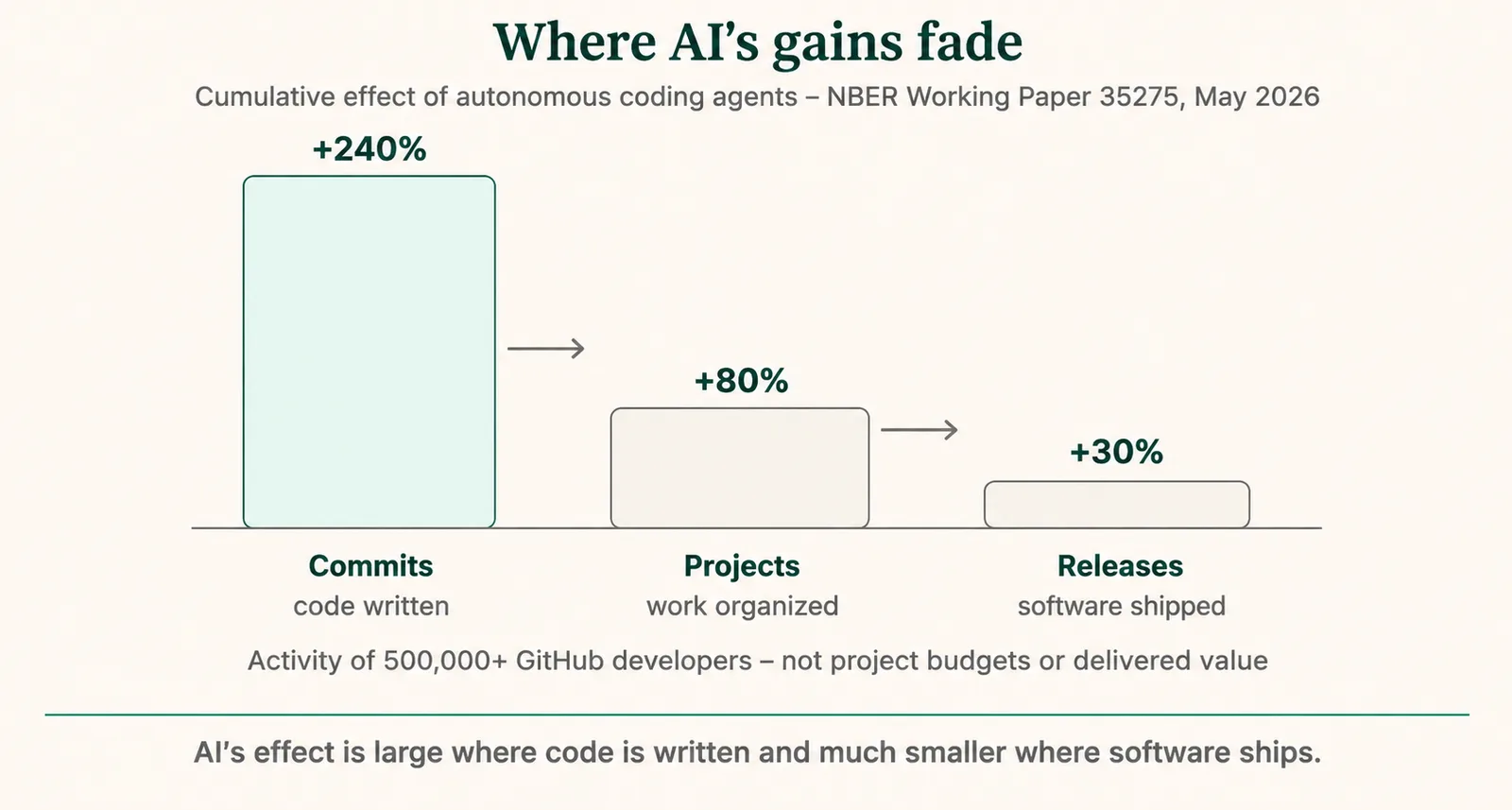
These findings need careful reading. Commits measure activity, and the studies cover neither commercial project budgets nor delivered business value. What they illustrate is that the effect of AI is uneven across the stages of software delivery – large where code is written, much smaller where software is integrated, verified and released.
What a software estimate consists of now
Planning the work stays. What changes is where the time goes: writing code takes a smaller share, while testing and waiting on other teams take more.
| Part of the estimate | What AI changes | What stays uncertain |
| Implementation | Initial code for interfaces, logic and integration scaffolding is produced much faster | Whether the implementation matches the behavior the business needs |
| Verification and testing | Tests are generated faster | Deciding what must be tested and confirming the results are right |
| Integrations | Adapters and test harnesses are cheap to build | How each external system behaves in practice, including its failures |
| Discovery | Prototypes and experiments cost less, so more questions can be tested early | Decisions that need the client's operations team or an external partner |
| Operational readiness | Monitoring, recovery and audit code is written faster | Which failures to plan for and who responds to them |
| External dependencies | Little | Production access, partner response times, approvals |
An agent can make a well-specified feature easier to estimate. In a project with several external systems, the items in the right-hand column decide the price.
From a dashboard request to the operational problem behind it
Conversations with the firm's operations team show that the dashboard is a means to an end. The real problem is reconciliation breaks.
Each morning, analysts compare the firm's portfolio records with custodian data and find figures that disagree. Advisors see totals that differ from custodian statements. Client reports go out late while someone works out which number is right. Many of the same causes – instrument identity, entity structures, cost basis – also explain why data fails to reconcile during a wealth platform migration.
Surfacing those breaks early, with the source records attached, may address the problem more directly than a continuously updated consolidated dashboard. It is also a smaller and better-defined piece of work.
Before any comparison can run, the team has to agree on the reconciliation rules: the date as of which positions and balances are compared, which source counts as the record for each figure, and which transaction types – trades, corporate actions, fees, transfers – are included. Every data constraint the engineers uncover then changes the scope, cost, timeline or acceptance criteria:
- Stale data. An overnight file means the first custodian's positions are as of the previous close. The product has to show an as-of time on every figure, and the acceptance criteria have to define how old a figure may be before it is flagged.
- Pending transactions. A balance that excludes an unsettled trade will mislead an advisor. Settled and pending amounts need to be modeled separately, which adds work to the data model and to testing.
- Asynchronous API responses. When a custodian accepts a request and delivers the result later, the product needs states for "requested", "completed" and "failed", plus timeouts and retries. That is additional scope a synchronous prototype hides.
- Failure handling. If a custodian is unavailable, the product can show the last confirmed figure with its timestamp. It should never present that figure as current. Each failure case becomes an acceptance test.
- Audit trail. Each resolved break needs a record of what differed, which source was accepted and who decided. This shapes the data model from the start and is costly to add later.
- Production access. Credentials from a custodian can take weeks to arrive. They affect the schedule regardless of how quickly the integration code is written.
A coding agent can produce implementations of several approaches. The engineers still have to establish which guarantees are feasible and which ones the business needs. They recommend starting with reconciliation exceptions for the custodians that can be verified, and explain what that release can reliably deliver, what remains outside its control, and when the full dashboard would become worth the investment.
What a bounded technical discovery should deliver
Before extending the prototype, the team runs a limited investigation of the custodian integrations. Coding agents make the necessary test components inexpensive. The investigation has a capped budget and one purpose: establish which custodians can support a reliable reconciliation process.
The findings are specific. The first custodian's overnight file is consistent, and a separate API reports intraday transaction status, including pending items; the engineers verify how pending items are flagged and how corrections are restated. The second custodian's standard endpoint returns settled balances only, a separate endpoint lists pending transactions, and requests for transaction history are processed asynchronously with an explicit completion or failure status. Production access to the third custodian remains unresolved.
A discovery like this should end with deliverables the client can use with any vendor:
- Verified API capabilities – what each external system was observed to do, with evidence.
- Assumptions – what is still taken on trust, stated explicitly.
- Integration risks – known gaps, such as unsupported functions or unstable feeds.
- Acceptance tests – the scenarios the release has to pass, including failed requests and late data.
- Dependencies – what is needed from third parties, who owns each item and by when.
- Scoped architecture – the design for the narrowed first release.
- A revised estimate – for that scope, with the remaining uncertainty named.
It should also answer the questions that have to be closed before anyone commits a budget. Which behavior will be guaranteed? Which integrations are verified and which are assumed? What happens when a source fails or delivers late? How will the result be accepted?
With those answers, the narrower scope has a credible basis for an estimate: the relevant APIs have been examined, expected behavior is agreed, and the important exceptional cases are known. The full dashboard stays harder to price, because some custodian capabilities are unverified and the cost of continuous synchronization depends on details that are still open. The firm can fund another bounded investigation before committing to the full platform.
[CTA-2]
Before comparing vendor quotes, check these five things
Quotes for the same request can differ widely because they cover different products: one vendor prices a dashboard that displays whatever the custodians supply, another reconciliation with exception handling, a third continuous synchronization across all three custodians. To compare them, the buyer has to bring them to the same scope and result.
- Guaranteed behavior. What exactly will the product do, and under which conditions? "Shows consolidated balances" and "shows settled and pending balances with an as-of time for each custodian" are different commitments.
- Acceptance criteria. How will both sides know the work is done? Look for specific scenarios, including failures, rather than a list of screens. For example: if a custodian's update does not arrive by the agreed time, the system keeps the last confirmed figure, shows its timestamp and marks the data as stale. A requirement written this way can be tested and holds the vendor to a specific behavior.
- Verified integrations. Which external systems has the vendor actually tested against, and which does it assume will work as documented?
- External dependencies. What does the schedule rely on that the vendor does not control, and what happens to the price and dates if it arrives late?
- Post-launch responsibility. Who maintains the integrations when a custodian changes its format, and what is included in support?
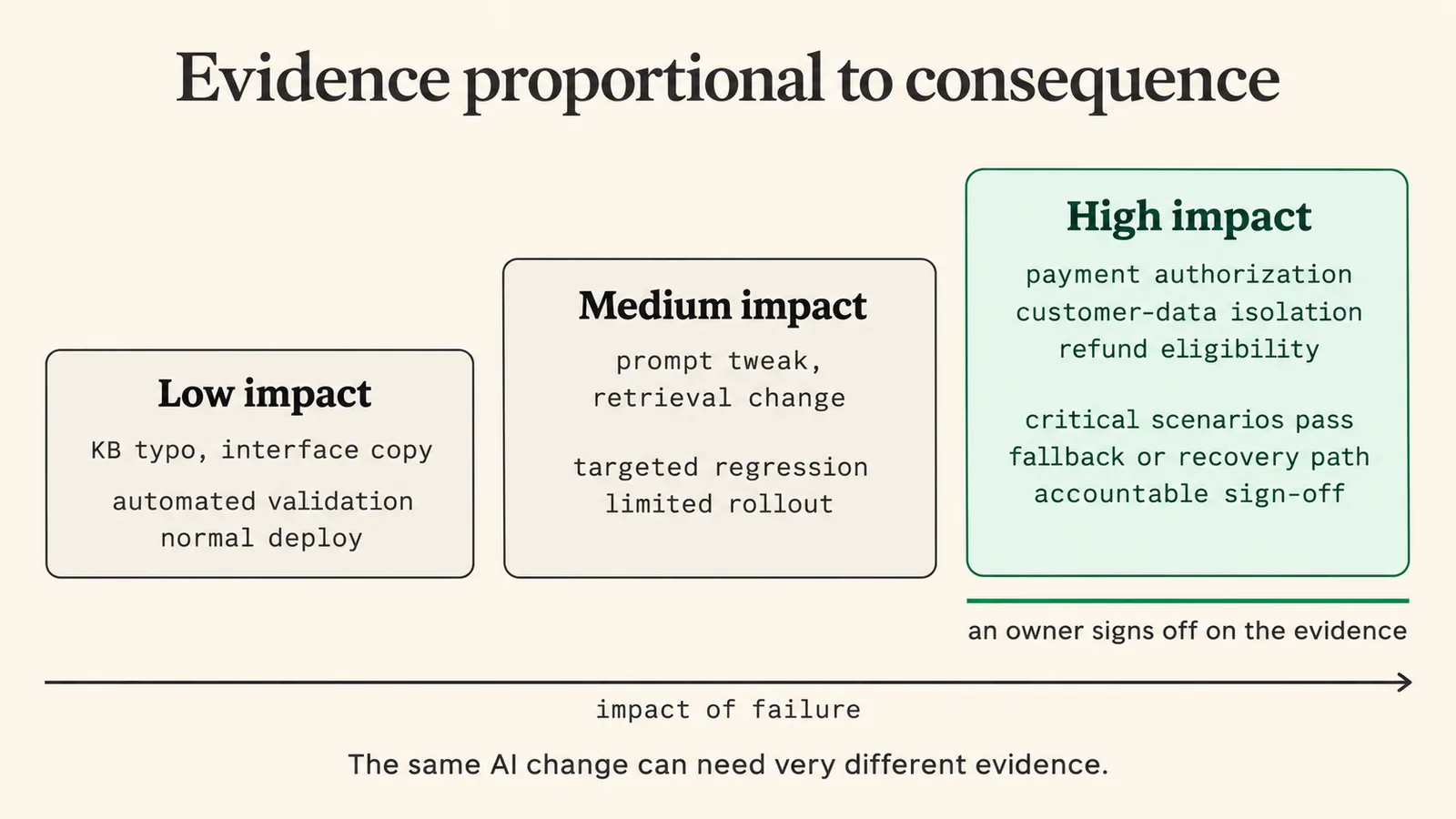
In the example, the firm asks the three vendors to revise their offers against the same two-custodian scope and acceptance criteria. One still relies on standard balance feeds and prices the work without handling pending transactions or asynchronous responses; its lower quote leaves out the agreed behavior. Another demonstrates the integration against representative custodian data, documents the remaining dependencies and includes the required failure handling.
Fixed price, time and materials, or discovery first
The commercial model should follow how much is known.
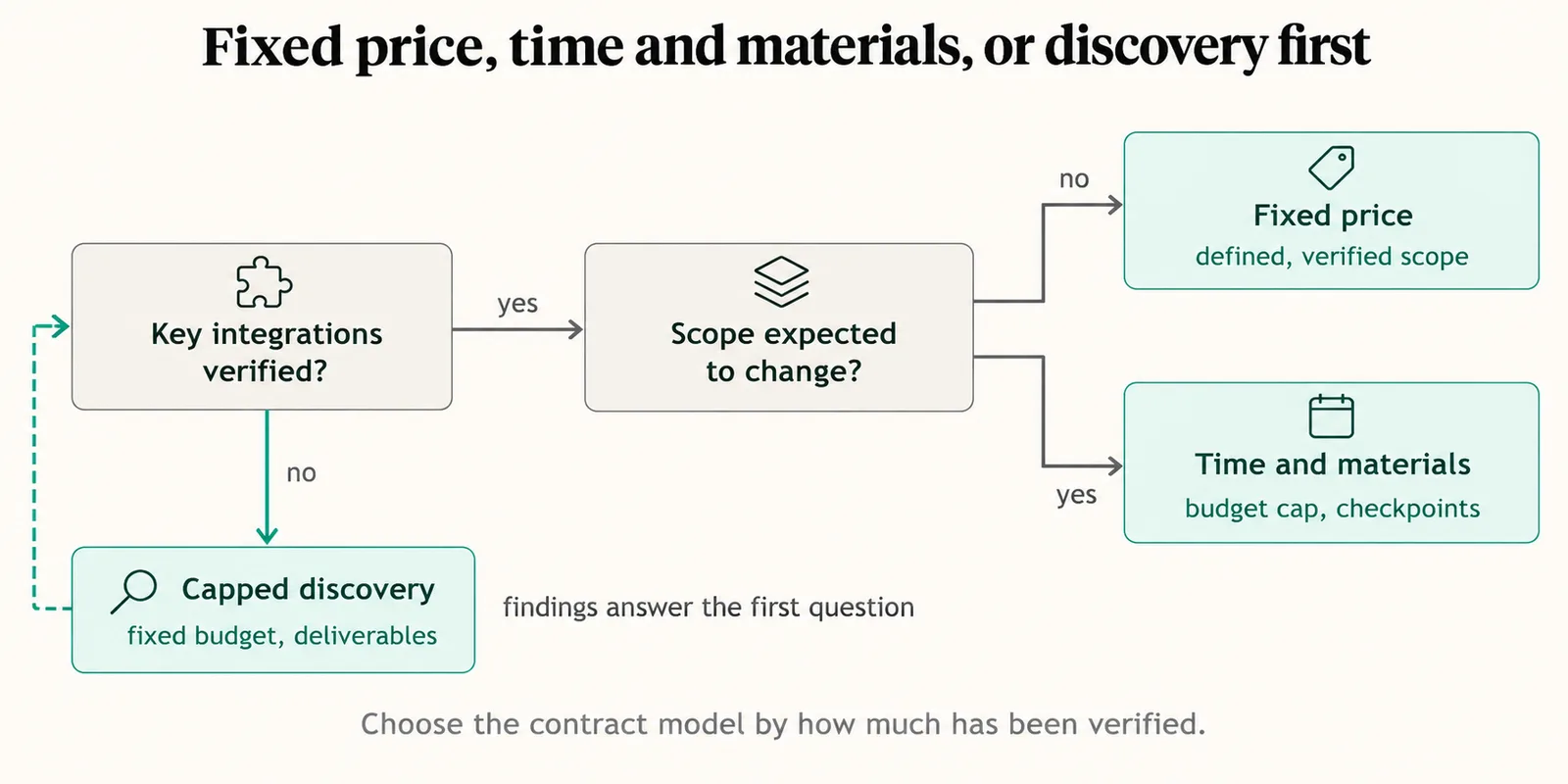
Fixed price suits a well-defined scope like the narrowed two-custodian release after discovery – and that release did not fit before it.
Time and materials suits work where the scope is expected to change: ongoing product development, or integrations with partners whose behavior is still being learned. It works best with a budget cap and regular checkpoints at which the client can stop or redirect.
A capped discovery first suits projects where the main integrations are unverified. It is short, has a fixed budget and defined deliverables, and its output becomes the basis for either of the other two models.
The quote for the first release is also only part of the cost. Custodians change formats, reconciliation rules evolve, and someone has to monitor the integrations and respond when they fail. Documentation, operational diagnostics and the ability to hand development to another team affect the total cost well beyond the initial build, so it is worth asking vendors to price maintenance separately.
The contract can specify the required reconciliation behavior, responses to custodian failures, acceptance tests and maintenance responsibilities. It cannot reasonably make the vendor solely accountable for eliminating reconciliation breaks, because custodian data quality and the firm's own processes also affect that outcome. The firm measures the business result after release: the number of unresolved breaks, the time to resolve them and the share of reports delivered on time.
In the example, the firm commissions the two verified integrations from the vendor whose proposal covers the agreed behavior, makes the remaining dependencies explicit and offers acceptable maintenance terms. The full dashboard is deferred until the third custodian's capabilities are confirmed.
What a credible estimate is based on
AI does not eliminate software scoping. It changes what a credible estimate is based on.
When code becomes cheaper to produce, the estimate rests on what has been verified. A vendor that finds an unexpected constraint, tests it and adjusts its recommendation gives a buyer more to evaluate than a confident delivery date.
The practical step is to check assumptions and integrations before signing a full implementation commitment. A short, capped investigation limits the initial financial commitment while the biggest unknowns are still open.
If you are estimating a fintech product or comparing vendor proposals, Itexus can help with a bounded technical discovery: verifying the integrations, writing down the assumptions and turning them into a scope and estimate you can compare. <a href="[ссылка на страницу контактов]" target="_blank" rel="noopener noreferrer">Contact us</a> to discuss your project.




