
Quick Summary: A forward deployed engineer (FDE) at Palantir is a software engineer who embeds directly inside a customer’s organization to build, configure, and ship software on Palantir’s platforms — often within days rather than months. The role blends hands-on coding with product thinking, client relationship management, and rapid problem-solving in the field. Pay typically lands between roughly $150,000 and $300,000+ depending on level and location, and the model has since inspired similar hybrid engineering roles across fintech and enterprise software. It’s part engineer, part consultant, part product manager — all rolled into one job title.
Ask ten software engineers what a “forward deployed engineer” is and at least half will shrug. It’s a strange title for a strange job. Palantir didn’t invent the idea of embedding engineers with customers, but it turned that idea into a defining feature of its culture — and, arguably, a competitive advantage nobody else has quite replicated.
So what does the job actually involve? And why has it become one of the most talked-about roles in tech hiring circles, well beyond Palantir’s own walls? Here’s a breakdown of the role, the skills it demands, and why the concept is bleeding into other industries, fintech included.
Forward Deployed Engineer, Defined
A forward deployed engineer — sometimes written FDE, or FDSE for “forward deployed software engineer” — is a technologist who works on-site or in close, continuous contact with a customer’s team, rather than sitting back at headquarters building generic product features. Palantir sometimes calls these engineers “Deltas” internally, a nod to the idea of small, agile teams inserted where the problem actually lives.
The core distinction from a typical software engineering job is proximity. A standard backend engineer might ship a feature that thousands of anonymous users eventually touch. An FDE, by contrast, sits with an oil-and-gas ops team, a hospital network, or a defense unit, watches how they actually work, and writes code that solves that specific team’s problem — often the same week it’s identified.
What a Forward Deployed Engineer Actually Does Day to Day
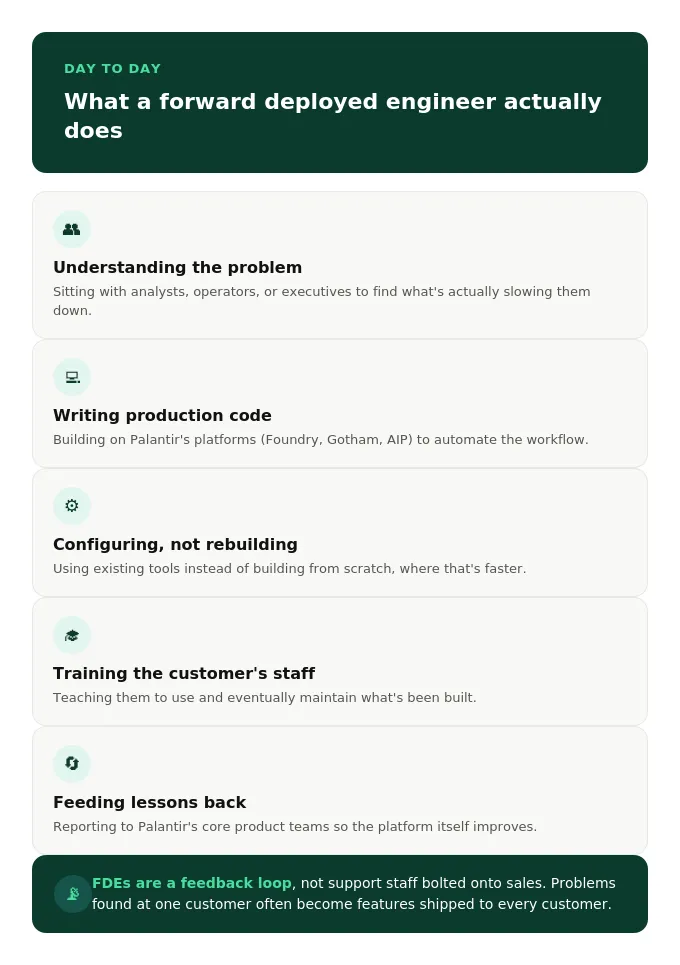
Job postings and internal accounts tend to describe the work in three overlapping buckets: understanding the problem, building the solution, and making sure it sticks. In practice that means:
- Sitting in meetings with analysts, operators, or executives to figure out what’s actually slowing them down
- Writing production code against Palantir’s platforms (Foundry, Gotham, AIP) to automate or streamline that workflow
- Configuring existing tools rather than building from scratch, where that’s faster
- Training the customer’s own staff to use and eventually maintain what’s been built
- Feeding lessons learned back to Palantir’s core product teams so the platform itself improves
That last point matters. FDEs aren’t just support staff bolted onto a sales team — they’re a feedback loop. Problems discovered in the field at one customer often turn into features that ship to every customer. It’s a much tighter connection between engineering and market reality than most software companies manage.

Get Software Delivery Support From Itexus
Palantir is known for forward deployed engineers who work closely with customers on technical and operational problems. Itexus provides a related service model through fintech consulting, embedded developers, custom development, and project delivery support.
Need Engineers Who Can Work Closely With Your Internal Team?
Itexus can help with:
- financial software developers for hire
- fintech consulting and technical discovery
- custom software development
- complex system integrations
- project audit and rescue
 Contact Itexus to discuss your team, system, and delivery needs.
Forward Deployed Engineer vs. Traditional Software Engineer
The differences go beyond where the desk sits. Traditional engineering roles optimize for scale and reusability; forward deployed roles optimize for speed and fit to one customer’s context. Neither approach is inherently better — they solve different problems.
| Dimension | Traditional Software Engineer | Forward Deployed Engineer |
|---|---|---|
| Primary location | Company office or remote, centralized | Embedded on-site or in close daily contact with the customer |
| Success metric | Feature quality, uptime, scale | Whether the customer’s specific problem gets solved |
| Typical cycle | Weeks to months per feature, sprint-based | Days, sometimes hours, per iteration |
| Customer contact | Indirect, via product or sales teams | Direct and continuous |
| Skill emphasis | Systems design, architecture | Rapid prototyping, communication, domain learning |
Why Palantir Built the Model This Way
Palantir’s customers — governments, banks, hospital systems, manufacturers — tend to run on messy, bespoke, decades-old data infrastructure. A generic off-the-shelf product rarely fits that mess cleanly. Palantir’s answer was to send engineers into the mess itself, armed with a flexible platform, and let them build the specific integration or workflow the customer needs.
This is, in effect, a bet that substance beats form. Rather than shipping a rigid product and hoping customers adapt their processes to it, Palantir adapts the product to the customer in real time. The trade-off is that it’s expensive and hard to scale — every FDE is a scarce, highly skilled resource, not a line item that grows for free with revenue.
Skills and Traits That Make FDEs Successful
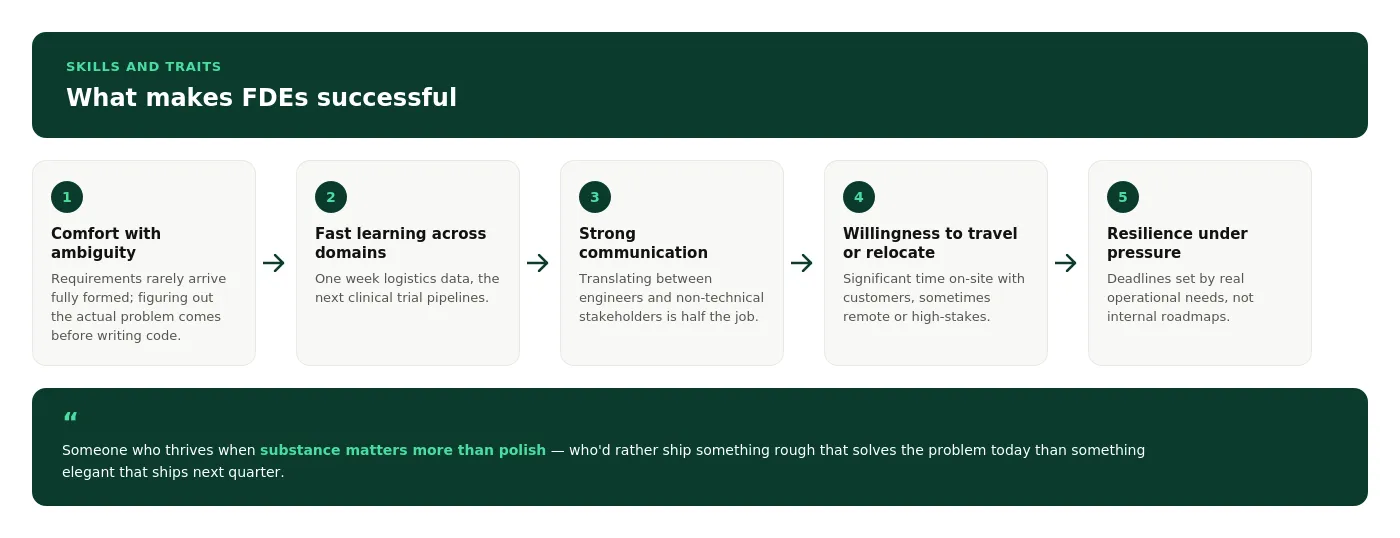
Technical chops alone don’t cut it. The role rewards a fairly unusual combination of traits:
- Comfort with ambiguity — requirements rarely arrive fully formed; FDEs often have to figure out the actual problem before writing a line of code
- Fast learning across domains — one week might mean logistics data, the next might mean clinical trial pipelines
- Strong communication — translating between engineers and non-technical stakeholders is half the job
- Willingness to travel or relocate — many FDE roles require significant time on-site with customers, sometimes in remote or high-stakes environments
- Resilience under pressure — deadlines are often set by real operational needs, not internal roadmaps
Recruiters at Palantir have described the ideal candidate as someone who thrives when substance matters more than polish — someone who’d rather ship something rough that solves the problem today than something elegant that ships next quarter.
Forward Deployed Engineer Salary in 2026
Compensation varies widely by level, location, and whether a role is titled “software engineer” versus “AI engineer” versus a more generalist “forward deployed engineer.” Public compensation trackers in 2026 put entry-level total compensation somewhere in the $150,000–$200,000 range, with senior and staff-level FDEs climbing well past $300,000 once equity and bonuses are factored in. Palantir itself has listed specific openings with base salary ranges around $135,000–$200,000 for certain positions, though total compensation — including restricted stock units — typically runs higher.
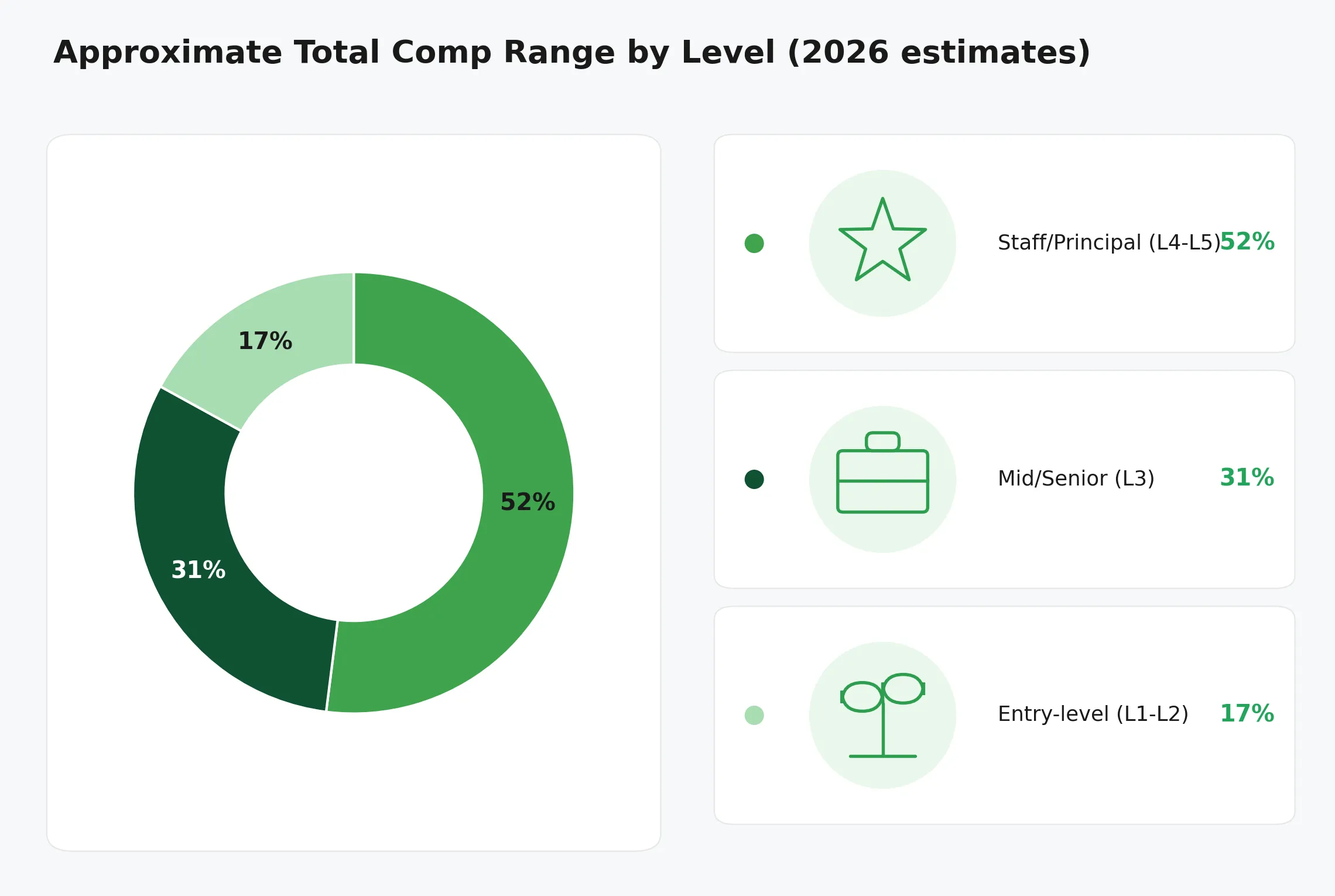
Numbers shift constantly as Palantir posts new roles and third-party trackers update their samples, so anyone evaluating an offer should check current listings directly rather than relying on any single figure floating around online.
The Career Path: Where FDEs Go Next
Because the role forces exposure to sales cycles, executive stakeholders, and product strategy all at once, former FDEs often move into product management, solutions architecture, or startup founding roles. Palantir alumni founding fintech and defense-tech startups have become something of a running joke in venture circles — and it’s not entirely a coincidence. The role is, in a sense, unpaid (well, generously paid) training for building and selling software to skeptical enterprise buyers.
Is the Forward Deployed Model Spreading Beyond Palantir?
Yes, and this is where things get interesting for industries outside defense and government. Fintech, in particular, shares a lot of Palantir’s original problem: legacy infrastructure, regulatory complexity, and customers who can’t just “switch to a SaaS tool” without months of integration work.
Banks rolling out new lending platforms, trading systems, or embedded finance products increasingly need engineers who can sit close to the client’s operations team, not just hand over a spec sheet and disappear. That’s part of why fintech-focused development shops now lean on embedded, cross-functional teams for projects like digital lending platform builds or custom trading platform development — the underlying logic is the same as Palantir’s FDE model, even if nobody calls it that on the org chart.
The same pattern shows up in banking-as-a-service integrations, where a vendor’s engineers often need to work hand-in-glove with a bank’s compliance and ops teams to get a product live, rather than shipping a black-box API and walking away.
Forward Deployed vs. Other Hybrid Engineering Roles
| Role | Primary Focus | Customer Proximity |
|---|---|---|
| Forward Deployed Engineer | Building custom solutions on a flexible platform | Very high — embedded, often on-site |
| Solutions Engineer / Sales Engineer | Demoing and configuring product for prospects | Moderate — pre-sale, less hands-on coding |
| Customer Success Engineer | Post-sale support and troubleshooting | Moderate — reactive rather than building new features |
| Implementation Consultant | Rolling out a fixed product per a playbook | High, but less coding-heavy than an FDE |
Should Engineers Pursue This Path?
It depends on what someone wants out of a career. Engineers who love pure architecture work, deep technical rabbit holes, or quiet focus time tend to find the FDE lifestyle exhausting — constant travel, shifting priorities, and client-facing pressure aren’t for everyone. But for engineers who get energy from ambiguity, who like seeing their code matter within days rather than quarters, and who don’t mind living out of a suitcase for stretches, it’s hard to find a role that teaches more, faster.
Some of that same logic applies to teams building products, not just hiring for them. Companies designing fintech applications or planning a white-label banking platform often find that embedding engineers with early customers — rather than working purely from a spec — surfaces usability problems long before launch. It’s a smaller-scale version of the same instinct that drives Palantir’s model.
The Bottom Line
A forward deployed engineer at Palantir isn’t a normal software job, and it isn’t trying to be. It’s a deliberate bet that the fastest way to solve a customer’s messiest problems is to put a skilled engineer directly in the room where those problems happen, give them a flexible platform, and let them build. That bet has paid off well enough for Palantir that other industries — fintech especially — are borrowing pieces of the playbook for their own embedded engineering teams.
Whether that means hiring engineers who work more like FDEs, or partnering with a development team that already operates that way, the underlying lesson holds: software built too far from the customer tends to miss the mark. Teams exploring what an embedded, outcome-driven engineering process could look like for their own product can review examples in this portfolio of completed fintech projects or read through the development process and methodology behind them.
FAQ: Forward Deployed Engineer at Palantir
What does FDE stand for at Palantir?
FDE stands for Forward Deployed Engineer. A closely related title, FDSE, stands for Forward Deployed Software Engineer — Palantir uses both, sometimes interchangeably, depending on the team and posting.
Do forward deployed engineers need to travel a lot?
Often, yes. Many roles require significant time on customer sites, which can mean frequent travel or extended relocation depending on the account and industry — government and defense engagements in particular.
Is a forward deployed engineer a coding job or a consulting job?
Both, really. The role involves writing real production code, but it’s wrapped in consulting-style responsibilities: discovery, stakeholder management, and translating business problems into technical solutions.
How much does a Palantir forward deployed engineer earn?
As of 2026, total compensation commonly ranges from roughly $150,000 for entry-level roles to well over $300,000 for senior and staff-level engineers, factoring in base salary, bonus, and equity. Specific figures vary by posting and location, so checking current Palantir job listings is the most reliable way to get exact numbers.
What skills should someone build to become an FDE?
Strong fundamentals in software engineering are the baseline, but candidates also need practice with rapid prototyping, data modeling, client communication, and comfort operating without a fully defined spec. Exposure to a specific industry vertical — finance, healthcare, logistics — can be a real advantage.
Is the forward deployed engineer model unique to Palantir?
Palantir popularized the title, but the underlying concept — engineers embedding directly with customers to build tailored solutions quickly — has since spread to other software companies, including fintech vendors building custom lending, trading, and banking platforms.
How does this role differ from a solutions architect?
A solutions architect typically designs the technical approach and may hand off implementation to others. An FDE usually does both the designing and the hands-on building, staying embedded through delivery rather than stepping back after the plan is set.