
In the last decade, access to the stock market became easier for end users. Trading apps became faster, cleaner, and more intuitive. But while the front-end experience improved, the brokerage infrastructure behind it remained slow, fragmented, and difficult to build.
Launching brokerage functionality today still requires a complex mix of regulatory registration, onboarding workflows, clearing and custody coordination, market-data integrations, funding flows, account management, order routing, compliance controls, and security systems. For many platforms, building this from scratch can take months or years.
Vestra is built to solve that infrastructure problem. We are not building another trading app. We are building an embedded investing API and brokerage infrastructure API that allows fintechs, neobanks, loyalty platforms, e-commerce products, community apps, and other digital platforms to embed investing functionality directly into their own user experiences.
Our goal is simple: make regulated brokerage primitives secure, compliant, reusable, and ready to integrate from day zero.

Why Platforms Need Embedded Investing Infrastructure
Many consumer-facing products are moving toward embedded financial services. Neobanks may want to offer a wealth tier. Loyalty programs may want to connect rewards with fractional investing. E-commerce platforms may want stock-based rewards. Community platforms may want creator payouts tied to portfolios.
The opportunity is large, but the infrastructure burden is heavy. Most platforms do not want to spend 18 months applying for a broker-dealer license, integrating clearing and custody vendors, building KYC and AML flows, connecting market data, managing funding, and maintaining trading infrastructure.
They need an embedded investing API that turns brokerage functionality into a single integration layer.
Vestra provides that layer.
Brokerage Infrastructure API Built for Day-Zero Embeddability
Vestra collapses the complexity of brokerage infrastructure into a unified integration surface. Partners can choose the level of control they need: a headless API, white-label interfaces, reference mobile and admin surfaces, or future modular SDK flows.
The platform is designed for partners that want to launch investing and brokerage features without rebuilding every regulated component themselves.
Headless Embedded Investing API
For partners that want full control over the user experience, Vestra provides a production-grade REST and WebSocket API.
The API exposes the full brokerage lifecycle:
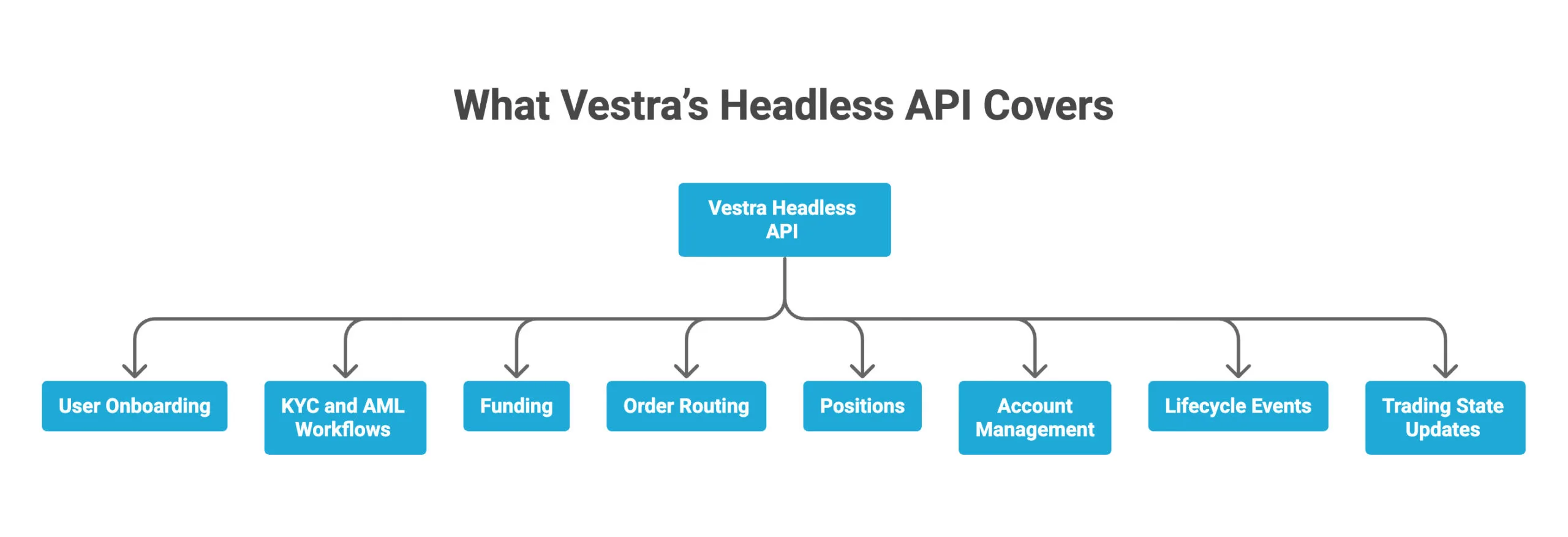
- user onboarding;
- KYC and AML workflows;
- funding;
- order routing;
- positions;
- account management;
- lifecycle events;
- trading state updates.
This headless model allows partners to own every pixel of the customer experience while relying on Vestra for the regulated brokerage infrastructure underneath.
The platform is also multi-tenant by design. Vestra uses Row-Level Security isolation at the database layer, so each tenant’s users and data remain tenant-scoped by default. Tenant A’s users never exist in the same execution context as Tenant B’s, and every query is scoped by design rather than by convention.
White-Label Brokerage Infrastructure for Different Product Experiences
Not every partner needs to build a full investing interface from scratch. Vestra also supports white-label theming for partners that want to launch faster while preserving their brand experience.
Theming is JSON-driven and tenant-scoped. Partners can configure branding, colors, typography, radii, and design tokens through a validated schema. The Aura design system then applies those tokens across mobile and web surfaces.
This allows the same brokerage infrastructure to support different kinds of products: a premium wealth experience, a rewards-based investing product, or a broader fintech platform without requiring a separate codebase for each partner.
Webhooks for Brokerage and Investing Lifecycle Events
Embedded investing works only when partner systems stay synchronized with brokerage events. Vestra supports signed webhooks for every major state transition.
Webhook events include:
- account approval;
- deposit completion;
- order fill;
- withdrawal settlement;
- other lifecycle changes across the brokerage flow.
This allows partner applications, ledgers, notifications, dashboards, and back-office systems to stay in lockstep with the Vestra platform.
Embedded Compliance: KYC and AML Built Into the Flow
Compliance cannot be added as an afterthought in brokerage infrastructure. Vestra includes embedded compliance primitives directly inside the user flow.
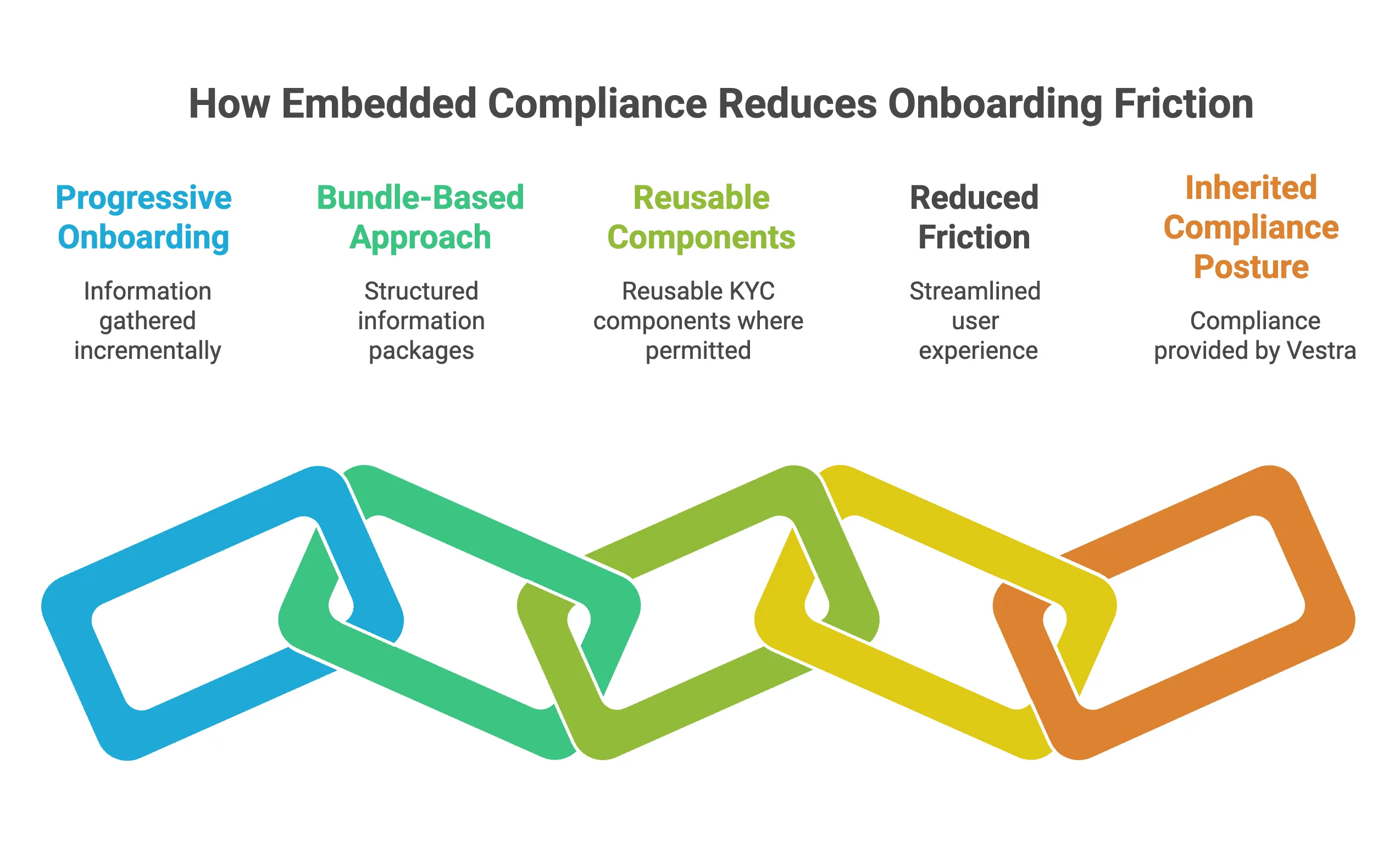
KYC and AML onboarding is progressive, bundle-based, reusable, and designed to reduce unnecessary friction. Instead of asking users for every disclosure before they understand the product, Vestra captures information incrementally through structured bundles such as personal, financial, identity, evidence, and agreements.
Where the partner’s license permits, this information can be reused across tenants. This helps reduce abandonment while keeping compliance embedded in the product experience.
Partners inherit the compliance posture instead of re-implementing it from the ground up.
Reference Mobile and Admin Surfaces
Vestra’s brokerage infrastructure API ships alongside production-ready reference surfaces.
These include:
- a Flutter mobile application;
- a React admin panel;
- API-driven brokerage workflows.
Partners can use these surfaces as-is, fork them as a starting point, or ignore them and build their own experience entirely against the headless embedded investing API.
This gives partners flexibility: full control when they need it, faster launch paths when they do not.
SDK Roadmap for Modular Embedded Investing Flows
Vestra is also developing modular drop-in SDKs for Flutter, iOS, Android, and Web.
These SDKs are being designed around the same integration patterns that made embedded financial flows easier to adopt in other categories. The goal is to let partners embed certified KYC, funding, or trading flows behind a single function call.
With this model, a partner could add a compliant trading experience much faster than building the full workflow from scratch.
The principle is consistent across the platform: every regulated primitive a partner would otherwise need to build, test, and maintain should be available through Vestra’s embedded investing infrastructure.
Embedded Investing Should Reduce Friction, Not Manipulate Users
Embedded investing is not just an infrastructure challenge. It is also a product design challenge.
Regulators have pushed back against gamified investing patterns, including confetti animations, scratch-off rewards, push-notification nudges, and other engagement mechanics that can trivialize trading or increase trading frequency among retail users.
Vestra draws a clear line: the dopamine loop is not engagement. Lowering unnecessary friction is.
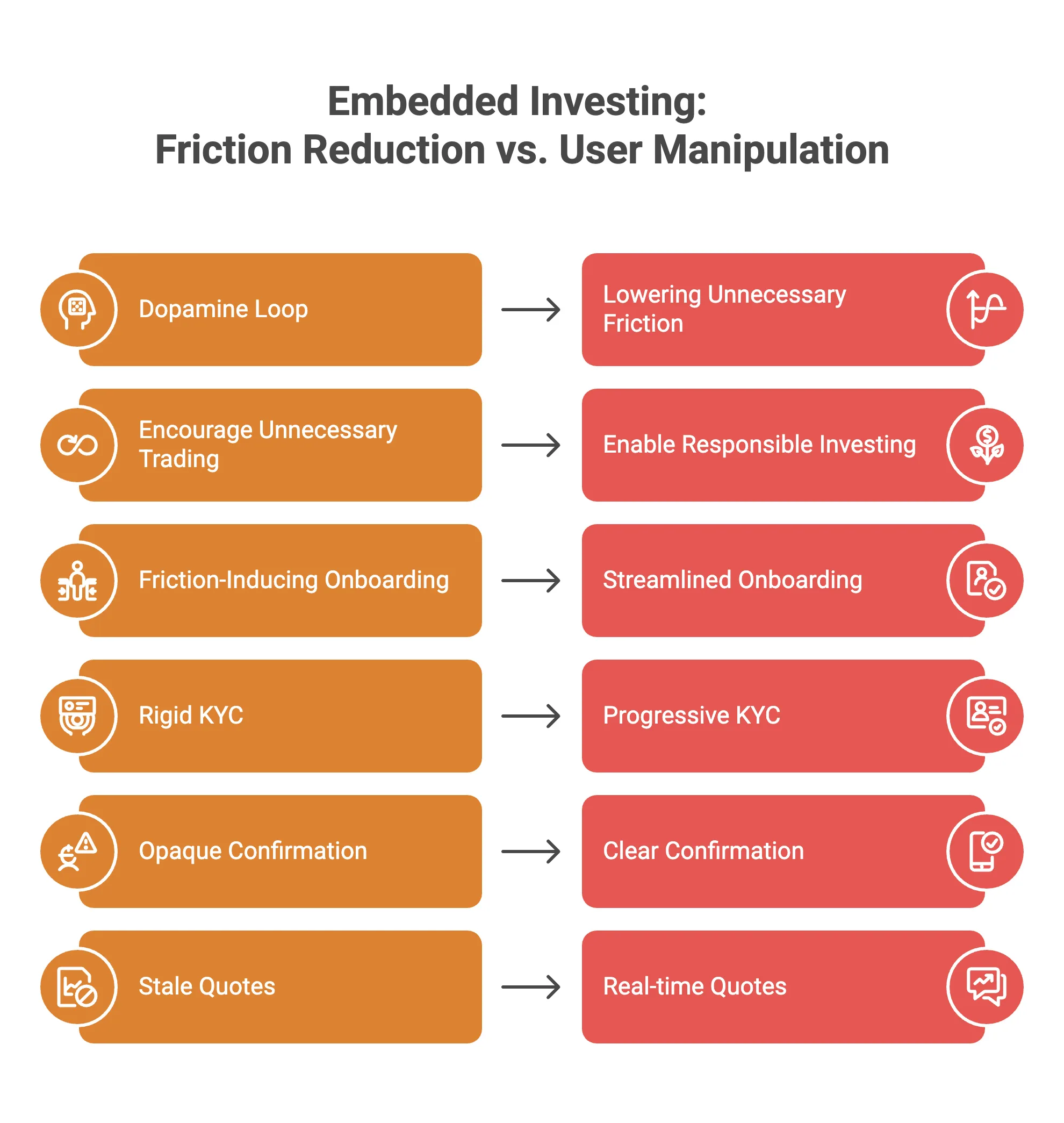
A well-designed embedded investing experience should help users do what they came to do quickly, clearly, and safely. It should not use manipulative engagement loops to encourage unnecessary trading.
Vestra’s embedded experience is optimized around practical friction reduction:
- onboarding that completes;
- progressive KYC;
- two-tap trading after authentication;
- clear review and confirmation before order execution;
- real-time quote updates over WebSocket;
- session resumption on reconnect;
- contextual education at the point of decision;
- respectful defaults without confetti, leaderboards, or engagement-driven stock carousels.
The goal is to make investing functionality usable without making it irresponsible.
Security in Brokerage Infrastructure API Design
Online-first brokerage platforms face serious security risks, including account takeover attempts and new-account fraud using stolen or synthetic identities. A polished user interface is not enough if the infrastructure does not match the threat model.
Vestra integrates security into the core of the brokerage infrastructure API.
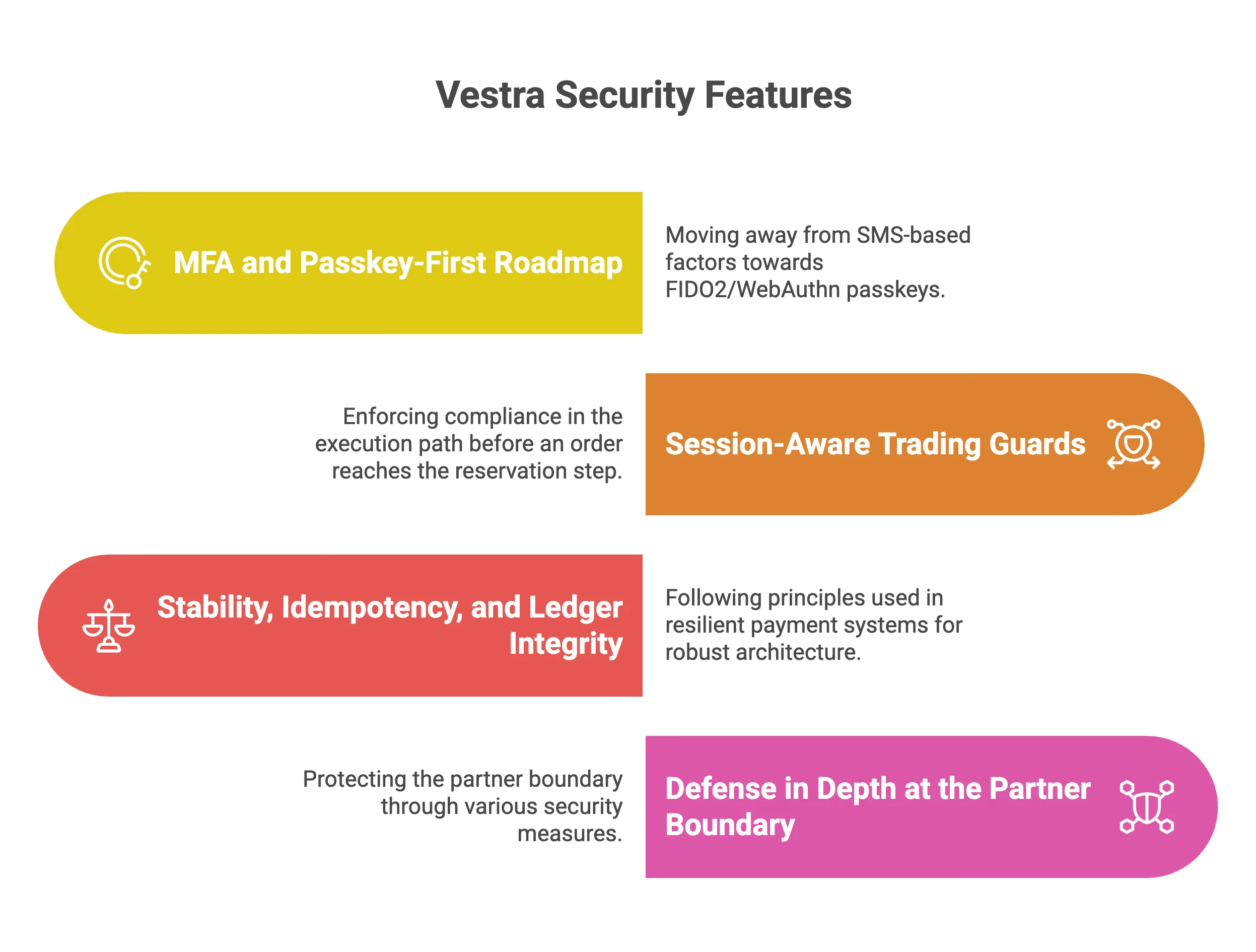
MFA and Passkey-First Roadmap
Vestra currently secures user sessions with OTP-based authentication and TOTP for admin elevation.
The near-term roadmap is to move away from SMS-based factors, which are vulnerable to SIM-swap and adversary-in-the-middle attacks, and toward FIDO2/WebAuthn passkeys bound to device biometrics.
Because passkeys are cryptographically bound to the legitimate origin, they cannot be replayed on a phishing domain.
Session-Aware Trading Guards
Vestra enforces compliance in the execution path.
Before an order reaches the reservation step, the order engine checks trading-status policy. It verifies that:
- the symbol is not halted;
- LULD pauses are respected;
- MWCB conditions are handled;
- SSR restrictions are observed;
- regulatory halts are enforced;
- the user’s KYC is verified;
- the market session permits the order type.
These controls are server-authoritative and fail fast. There is no silent queueing and no client-side workaround.
Stability, Idempotency, and Ledger Integrity
Vestra’s architecture follows principles used in resilient payment systems.
The platform includes:
- idempotent order submission through Redis-backed idempotency keys;
- reconcilable ledgers with double-entry accounting;
- deterministic replay;
- circuit breakers around external dependencies;
- initiation-time locked FX rates for withdrawal settlements;
- end-to-end traceability for every fill.
This makes double-submits structurally impossible and keeps brokerage activity auditable across the full transaction lifecycle.
Defense in Depth at the Partner Boundary
Vestra protects the partner boundary through:
- per-tenant API keys;
- scoped OAuth for end-user actions;
- signed webhooks;
- database-level RLS isolation.
A misconfiguration in one tenant’s integration is contained by design.
Use Cases for Vestra’s Embedded Investing API
Vestra’s embedded investing infrastructure is designed for platforms that want to add brokerage functionality inside an existing product experience.
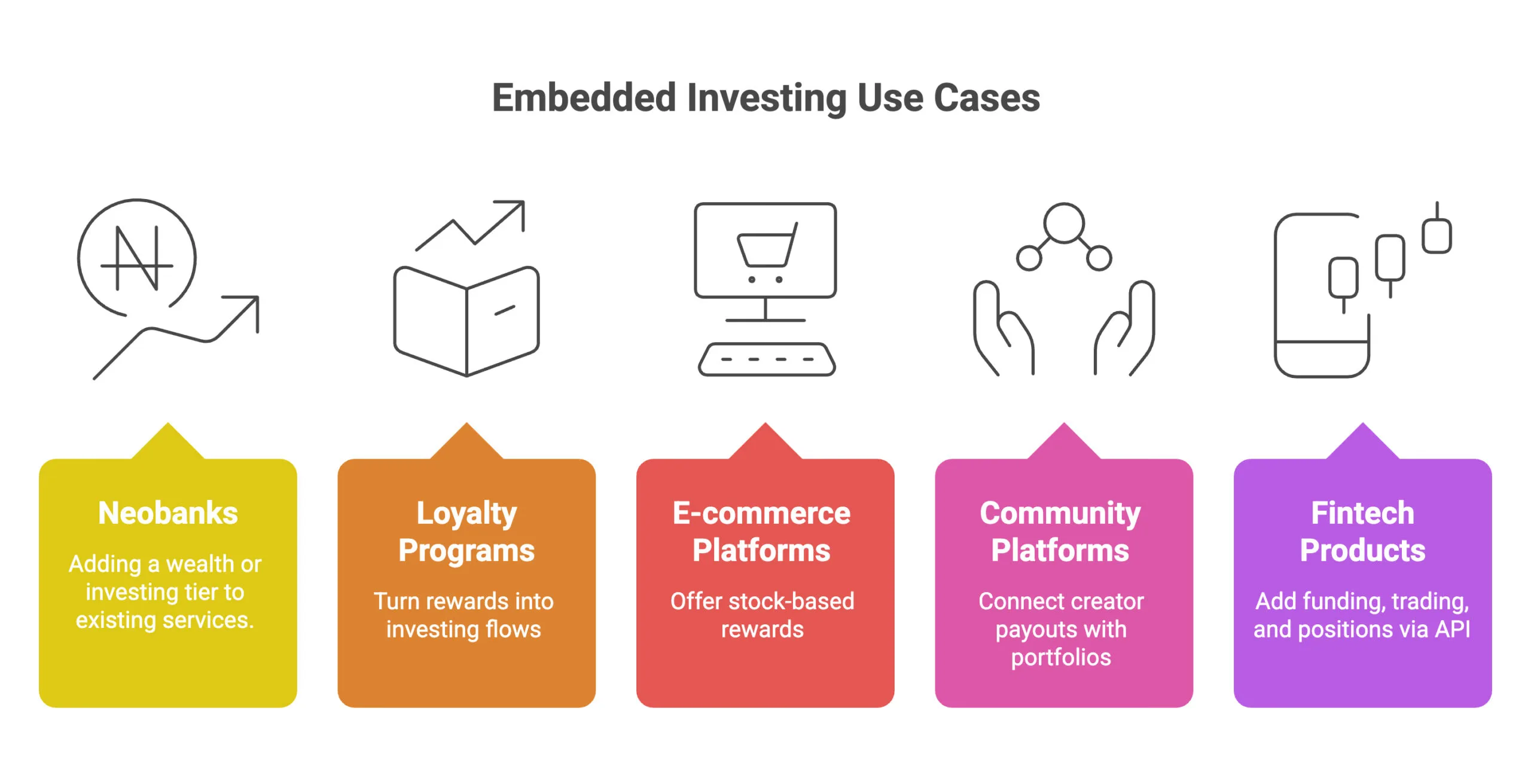
Potential use cases include:
- neobanks adding a wealth or investing tier;
- loyalty programs offering investing-related rewards;
- e-commerce platforms experimenting with stock-based rewards;
- community platforms connecting creator payouts with portfolios;
- fintech products adding account funding, trading, and positions through a unified brokerage API.
The common pattern is the same: the partner owns the user relationship, while Vestra provides the brokerage infrastructure layer underneath.
The Future of Wealth Infrastructure Is Embedded
The future of finance is not a single destination app. It is a set of capabilities that can live wherever the user already is: inside a neobank, loyalty app, creator platform, e-commerce experience, or super-app.
The firms that win will not only be the ones with the flashiest front end. They will be the ones with infrastructure that is secure, compliant, reliable, and invisible in exactly the right ways.
Vestra is building that foundation: a multi-tenant brokerage infrastructure platform with RLS-isolated tenancy, progressive KYC, double-entry ledger accounting, idempotent money movement, a reservation-first trading engine with regulatory guardrails, production-ready mobile and admin surfaces, and a roadmap for modular embedded investing SDKs.
Secure. Compliant. Frictionless. Ready to embed from day zero.
Welcome to Vestra.