
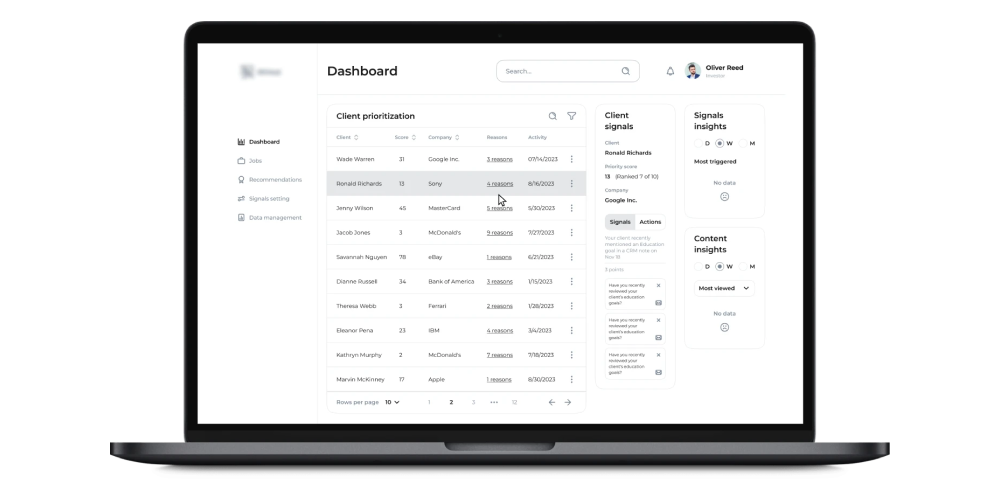
AI client portfolio and market analysis platform built for a top asset manager: NLP over news, research and CRM notes for personalized adviser insights.
The data businesses and people generate just by operating is turning into financial infrastructure: transactions, shipments, account balances, and fund records. Plaid released credit models that score borrowers on cash flow rather than traditional credit history. FedEx and Stripe agreed to turn shipment signals into a basis for small-business lending. M1 launched an AI advisor that gives fiduciary advice built on a client's actual account data. And KKR paid $5.1 billion for Gen II, the operational and data backbone of private-fund administration. As operational data moves into the execution path of lending, advice, and reporting, the control point becomes its provenance, consent, and accuracy.
Plaid releases cash-flow credit models and instant data sharing for lenders
Plaid unveiled new AI models at its Fall Product Release, led by LendScore 2, a cash-flow-based credit risk score the company says is 42% stronger at predicting repayment than traditional credit data alone. It added specialized versions for auto, home, and short-term lending, plus LendScore Arc, a transformer-based model that learns from the order and timing of a borrower's transactions. A new feature, Instant Link, lets consumers who connect accounts to Plaid's Consumer Reporting Agency consent to share cash-flow insights for future applications, with lenders accessing them in under two seconds. Every LendScore is delivered through Plaid's CRA, with consumers retaining FCRA rights.
Source: Plaid
Why it matters
Cash-flow underwriting is moving from an alternative data experiment to delivered infrastructure, with scores a lender can consume like a traditional bureau pull. By routing this through its own Consumer Reporting Agency, Plaid places itself in the regulated credit-reporting chain, which means cash-flow data now carries FCRA obligations: dispute handling, accuracy requirements, and adverse-action reasoning. A lender now consumes the score as a regulated credit product rather than a signal it interprets privately.
The transformer-based model raises a harder question than accuracy. A score that learns from the sequence and timing of transactions is more predictive but less directly explainable, and under FCRA a lender still has to give a borrower specific reasons for a denial. Teams adopting these models inherit the gap between model performance and the explainability a regulator and a declined applicant require, so reason-code mapping and model governance become part of the integration, not an afterthought.
What teams should do
This applies to lenders, BNPL providers, neobanks, and any product making credit decisions on thin-file or cash-flow data.
- Confirm your adverse-action process maps to cash-flow model outputs, so a denial based on a LendScore produces specific, compliant reasons a borrower can act on.
- Validate a transformer-based score against your own portfolio before deployment, since network-level lift may not hold on your specific borrower mix.
- Treat cash-flow data pulled through a CRA as regulated credit data, with dispute and accuracy handling, not as informal alternative signals.
- Preserve the consent record for each borrower's shared cash-flow data, so you can show what was permissioned and for which application.
- Keep a fallback underwriting path for borrowers who decline data sharing, so a thin-file applicant is not auto-excluded from a decision.
M1 launches a fiduciary AI advisor built on clients' own account data
M1 launched M1 Advisor, an AI financial advisor built into its platform and offered through M1 Advisory Services, an SEC-registered investment adviser bound by fiduciary duty. The advisor reads a client's actual M1 balances, positions, and rates across investing, cash, and borrowing accounts, and can incorporate outside accounts linked through Plaid. It is non-discretionary: it advises and explains its reasoning, but the client decides and acts. M1 states client data is not used to train AI models, including third-party models. The service is free for M1's clients, who hold about $14 billion across more than 400,000 accounts, through 2027.
Source: M1
Why it matters
AI advice is being anchored to a client's real account data and wrapped in a fiduciary structure, which separates it from generic chatbot guidance. Because the advisor sees actual balances, positions, and rates, its output is specific and actionable, and because it operates under an SEC-registered adviser, that output carries fiduciary and disclosure obligations. The advice is a regulated product whose quality depends on the accuracy and completeness of the account data feeding it.
The non-discretionary boundary is the load-bearing design choice. Keeping the AI as an advisor that recommends while the client acts keeps it outside discretionary-management rules, but that line only holds if the product enforces it and records what was advised. The firm still has to show how a given recommendation followed from a client's data and goals, so traceability from account data to advice becomes a compliance requirement, and the no-training commitment on client data becomes a stated boundary clients and regulators will check.
What teams should do
This applies to wealthtech platforms, robo-advisors, neobanks adding advice, and any product delivering AI-generated financial guidance.
- Ground AI advice in the client's verified account data, and show the data and logic behind each recommendation so it can be checked.
- Enforce the non-discretionary line in the workflow, so an advisory output cannot trigger a trade or transfer the client did not direct.
- Record how each recommendation followed from the client's data and stated goals, so fiduciary advice can be reconstructed under review.
- State plainly whether client financial data trains any model, including third-party models, since that boundary is now a competitive and compliance point.
- Reconcile linked external account data for accuracy before advising on it, since advice built on a stale or misread balance is a fiduciary risk.
FedEx and Stripe turn shipment data into small-business lending signals
FedEx Dataworks and Stripe announced a long-term collaboration to use signals from FedEx's logistics network, combined with Stripe's financial infrastructure, to expand financing access for small and medium-sized businesses. The first joint solution, planned for early 2027, aims to let operational data such as shipment activity and fulfillment performance inform Stripe Capital underwriting for businesses that traditional bank-statement and credit-score models underserve. FedEx will also add Stripe as a payment processor, bringing more than 50 payment methods to its checkouts. FedEx says it moves more than $2 trillion in global commerce daily.
Source: FedEx
Why it matters
A logistics company is monetizing its operational data as a lending input, which opens a new category of underwriting signal outside the financial system entirely. Shipment volume and fulfillment consistency describe a business's real activity in ways a bank statement does not, so a logistics-heavy SMB that looks thin on paper can look strong on shipping data. The signal that decides a loan starts coming from a shipping network rather than a bank.
That introduces a dependency and a data-quality problem fintech lenders have not faced. An underwriting model built on FedEx shipment data inherits that data's coverage and accuracy, and a business that ships through multiple carriers presents only a partial picture to any single one. Lenders adopting this signal have to understand what the data does and does not capture, because a model that treats one carrier's view as complete will misread a business that splits its shipping.
What teams should do
This applies to SMB lenders, embedded-finance providers, payment platforms, and any product underwriting business borrowers.
- Assess what operational data sources actually cover before weighting them, since a single carrier's shipment view misses a business that ships through several.
- Validate that a new operational signal predicts repayment on your book, rather than assuming shipment activity correlates with creditworthiness.
- Define how you reconcile operational data with financial data in underwriting, so two partial pictures do not produce a confidently wrong decision.
- Evaluate the dependency on a single data provider for a core lending signal, and what happens to your model if that data access changes.
- Review the consent and permitted-use terms for operational data entering a credit decision, since its use in underwriting carries obligations the raw data did not.
KKR buys Gen II for $5.1B to own the data backbone of fund administration
KKR agreed to acquire Gen II Fund Services, a private-capital fund administrator, for a total enterprise value of $5.1 billion, buying it from Hg, General Atlantic, and other investors through KKR's Core Private Equity strategy. Gen II serves more than 275 investment managers representing over $2 trillion in private-fund capital, and has quadrupled revenue and EBITDA since 2020 through organic growth and four acquisitions. Its technology includes a client portal and AI and automation tools for onboarding and bank reconciliations. KKR said it will invest further in Gen II's proprietary technology and AI-enabled solutions.
Source: KKR
Why it matters
Fund administration is where private-market operational data gets reconciled into the records managers report and investors rely on: capital calls, distributions, and positions. KKR is valuing that layer at $5.1 billion, which puts a price on the systems that turn raw operational data into trusted financial records. The value sits in operating the data layer every manager depends on.
The emphasis on AI for reconciliations and onboarding shows where the margin is won. Fund administration is high-volume matching across managers and custodians, and automating it accurately is what lets the business scale. For back-office technology teams, auditable reconciliation at scale now has a market price, which raises the bar on the accuracy and audit trail these systems must guarantee.
What teams should do
This applies to fund administrators, back-office and reconciliation platforms, fintech infrastructure providers, and any product automating financial operations.
- Build reconciliation automation with a complete audit trail, since provable accuracy is what makes this work defensible at scale.
- Measure reconciliation exception rates and resolution time, because those metrics determine whether automated back-office work actually scales.
- Design investor and fund data models for complex, multi-entity structures, since the value sits in handling complexity competitors cannot.
- Preserve the provenance of each reconciled figure, so a capital call or distribution can be traced to its source under audit.
- Evaluate your back-office tooling as a potential product in its own right, since the market now prices reliable operational infrastructure as a scaled asset.
Closing insight
Look at the data your product turns into a financial decision: a borrower's transaction history, a business's shipping activity, a client's account balances, a fund's reconciled positions. For each, ask whether you can prove where it came from, whether you have consent to use it that way, and whether you can explain the decision it produced to a regulator or the person affected. This week moved operational and behavioral data into the execution path of lending, advice, and reporting, where accuracy and provenance stop being data-quality concerns and become compliance ones.
Durable products control that pipeline end to end: they know each signal's coverage and limits, keep the consent and lineage behind it, and map a model's output to reasons a person can act on. In our work with fintech teams at Itexus, these components usually decide whether data-driven underwriting or AI advice survives a dispute, an audit, or a regulator's question.