
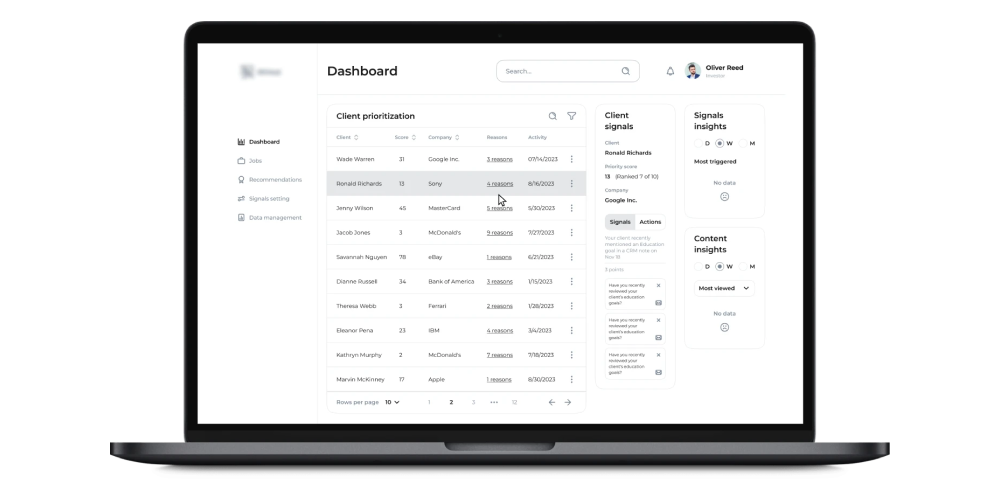
AI-based data analytical platform for wealth advisers and fund distributors that analyzes clients’ stock portfolios, transactions, quantitative market data, and uses NLP to process text data such as market news, research, CRM notes to generate personalized investment insights and recommendations.
New data on financial advisor AI adoption: AI-disclosing RIAs grew headcount 15% versus 8% and assets per advisor 22% versus 12%. The distance between using AI and integrating it is where the economics live
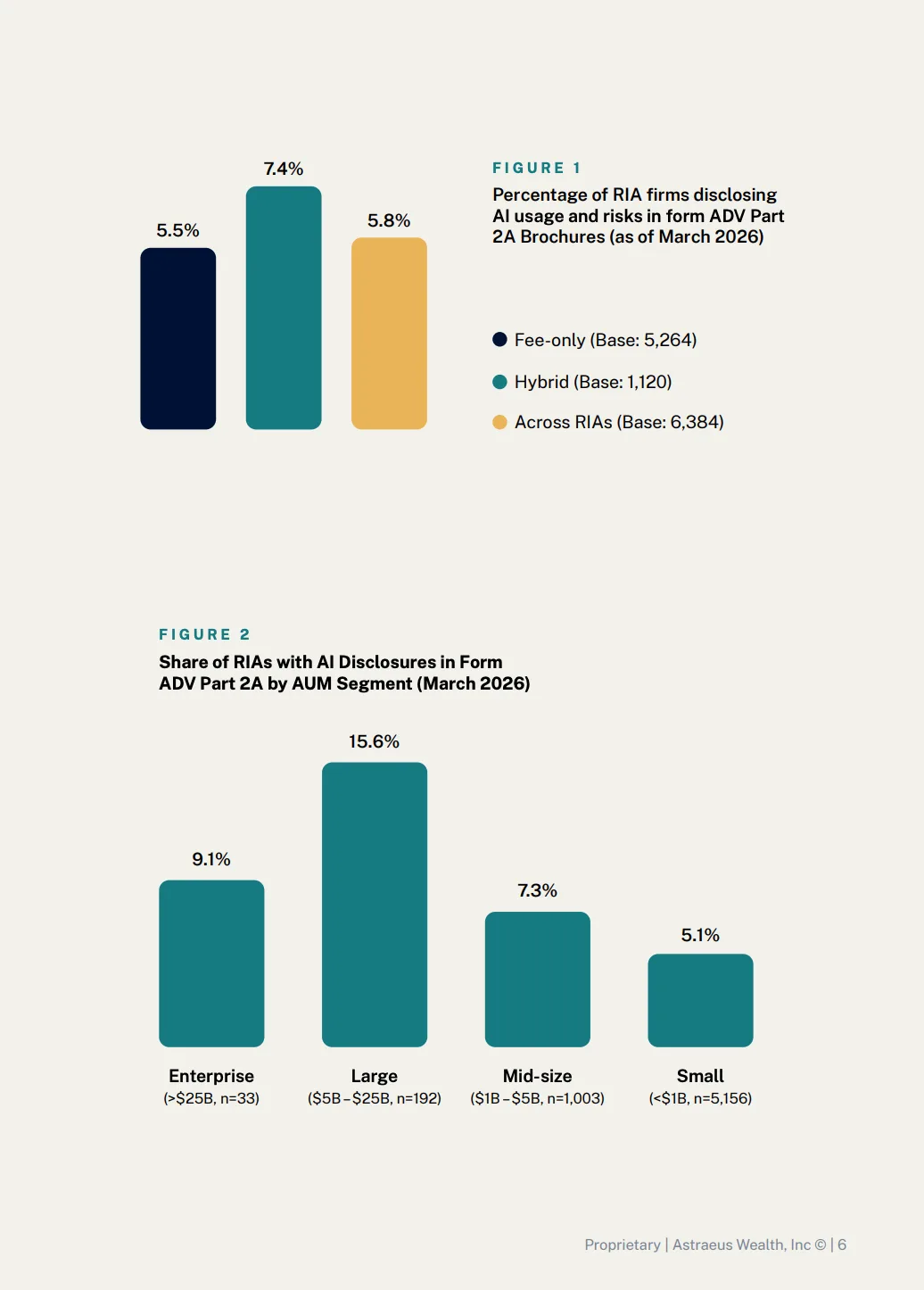
The loudest financial advisor AI conversation right now is about headcount going down. The regulatory filings say the opposite. New research from Astraeus and Pirker Partners went through the Form ADV filings of 6,384 independent RIAs – disclosures firms make to a regulator, with counsel in the room, not answers to a survey. Firms that disclosed meaningful AI use grew total headcount 15% between April 2025 and April 2026. Firms that did not grew 8%.
The adopters are hiring faster, and each of their advisors is carrying more. That is a capacity story, and capacity, not replacement, is where the economics of AI in wealth management are actually being decided.
Using, disclosing, integrating – three different populations
Most AI statistics in this industry get quoted as if they measured the same thing. They measure three different things.
Using AI is an advisor behavior. Schwab's survey of 533 RIAs found 63% now use AI in some capacity – more than double the 2023 rate – concentrated on notetaking and email drafting. Fidelity's study of wealth management firms points the same way: more than two-thirds already use generative AI, and four in five users report efficiency gains, though half of the users are still only piloting.
Disclosing AI is a firm-level commitment. Only about 6% of independent RIAs disclosed AI use in their March 2026 ADV filings – yet those firms manage roughly 11% of industry assets. The report treats 6% as a floor, not a census: each firm decides with counsel whether its AI use is material enough to mention, and larger firms document more diligently.
Integrating AI is an operating-model decision. Of Schwab's AI users, only about one in ten has fully integrated AI into business strategy, and 82% rely on generative tools through individual experimentation rather than firm-wide systems.
The gap between the first number and the third is the whole story. Sixty-three percent of advisors pasting text into a chat window is adoption. It is not operating leverage.
The capacity math
Advisors spend close to 70% of their time on behind-the-scenes work rather than direct client engagement, per Deloitte's analysis drawing on Cerulli data. That 70% is the reservoir every AI business case draws from.
The Astraeus data shows what tapping it looks like. Among enterprise and large AI-disclosing RIAs, median assets under management per advisor grew 22% in a year, against 12% at same-sized firms without AI disclosures – ten points of extra per-advisor growth, in one year, in a business that charges fees as a percentage of assets. Revenue per advisor moves almost linearly with assets per advisor; an advisor's compensation does not. That spread is operating leverage, and it appears without a single position being eliminated. Nearly half the disclosed use cases sit in administration – meeting notes, document generation – which means the hours are being bought back from paperwork and returned to clients.
At industry scale, Deloitte projects agentic AI could lift advisor productivity 30% to 100% by 2032, freeing 25–50% of the time advisors currently spend on operational tasks – capacity Deloitte's press release values at up to $350 billion in annual revenue. Those are projections, and they should be read as such. The ADV filings are not projections.
What this data can actually claim
The Astraeus authors are careful with their own headline numbers, and this article will be too. AI-disclosing firms were already growing faster before the current wave: a median four-year AUM growth rate of 11% versus 9% for non-disclosers. Firms with the scale to invest in enterprise AI are the same firms with momentum, resources and operational pain worth automating – a point the report's authors make themselves. So the filings show no evidence of AI adoption translating into job losses at these firms, while AI-disclosing RIAs also posted stronger growth. They do not prove AI caused the outperformance. For a buying decision, the first claim is the one that matters: the downside scenario the industry keeps debating does not appear in this dataset.
The advisor shortage AI is stepping into
The replacement narrative has a second problem: there is no surplus to replace. McKinsey estimates the US wealth industry faces a shortage of 90,000 to 110,000 advisors by 2034 – 30–37% of current headcount – as roughly 110,000 advisors, holding 42% of industry assets, retire over the decade. Closing the gap requires a 10–20% productivity boost, which McKinsey sizes as the equivalent of adding 30,000–60,000 advisors without hiring them.
Read against that backdrop, the ADV data makes structural sense. Firms are not buying AI to shed advisors they struggled to recruit. They are buying capacity per advisor, because advisors are becoming the scarcest asset in the industry.
Where the leverage lives: three stages, three very different numbers
Deloitte's model is the cleanest published answer to why some firms get transformation and others get a subscription bill. Its modelled scenarios – projections, not observed results – illustrate how uplift scales with integration depth:
| Stage | What AI actually does | Modelled productivity uplift |
| Assistive tools | Standalone helpers: notes, drafts, summaries | ~32% |
| Embedded copilots | AI inside governed workflows, with bounded delegation | ~57% |
| AI-native operating model | Multistep workflows run end to end; advisors supervise agents | ~103% |
The pattern is the useful part: the uplift comes from how deep AI sits in the workflow, and it roughly triples between a standalone tool and an operating model. Buying more tools moves a firm along the wrong axis.
The bottleneck is integration, and integration runs on data
Ask advisors what limits their technology and the answer is consistent: 69% name limited integration between disconnected tools as the biggest challenge, per Cerulli's research – ahead of cost, ahead of features. Schwab's use-case data says the same thing from the other side: AI today automates the work around advisor judgment, not the judgment itself.
We have seen this distinction firsthand in wealth-management systems: the useful AI layer is rarely another destination for the advisor to visit. It is intelligence inserted into an existing workflow – an overnight scoring engine that tells each advisor which clients to call first and why, inside the CRM they already have open. And for the use cases that move from personal productivity into firm-wide operating leverage, one dependency grows fastest in importance: the quality and accessibility of the data underneath. A copilot or a scoring engine is reasoning over the firm's instrument data, ownership structures, cost basis and computed performance. If that layer is fragmented across disconnected tools, AI does not fail loudly; it answers confidently from bad inputs. The sequence that keeps appearing across our wealth engagements is the reverse of the order in which AI gets bought: own and reconcile the data layer first, then automate on top of it. Where reconciliation actually breaks – and the five tests that catch it before go-live – is a separate article: 4 Reasons Wealth Platform Migrations Fail to Reconcile.
Where the payback arrives first
The pattern from our wealth-platform projects: AI-agent ROI arrives fastest where expensive people do repetitive work over documents and data, and a human keeps the final call. Ranked by speed to payback:
1. Private-markets document processing. Capital-call notices, fund reports and K-1s arrive as PDFs and get keyed in by hand. An agent extracts the figures, flags anomalies and routes exceptions to a human. This is where analysts lose the most hours – and where extraction accuracy is easiest to measure.
2. Reconciliation exceptions. The agent compares positions across custodians and surfaces only the mismatches, so the team reviews a few percent of cases instead of touching all of them. The math sells itself.
3. Client report drafting. Commentary and statements drafted from consolidated data, reviewed by a human before sending. The payoff compounds: each new family stops adding linear workload to the reporting team.
4. KYC data gathering. Agents assemble documents and screening results; compliance officers make the decision. Preparation compresses from days to hours, and the judgment stays where regulators expect it.
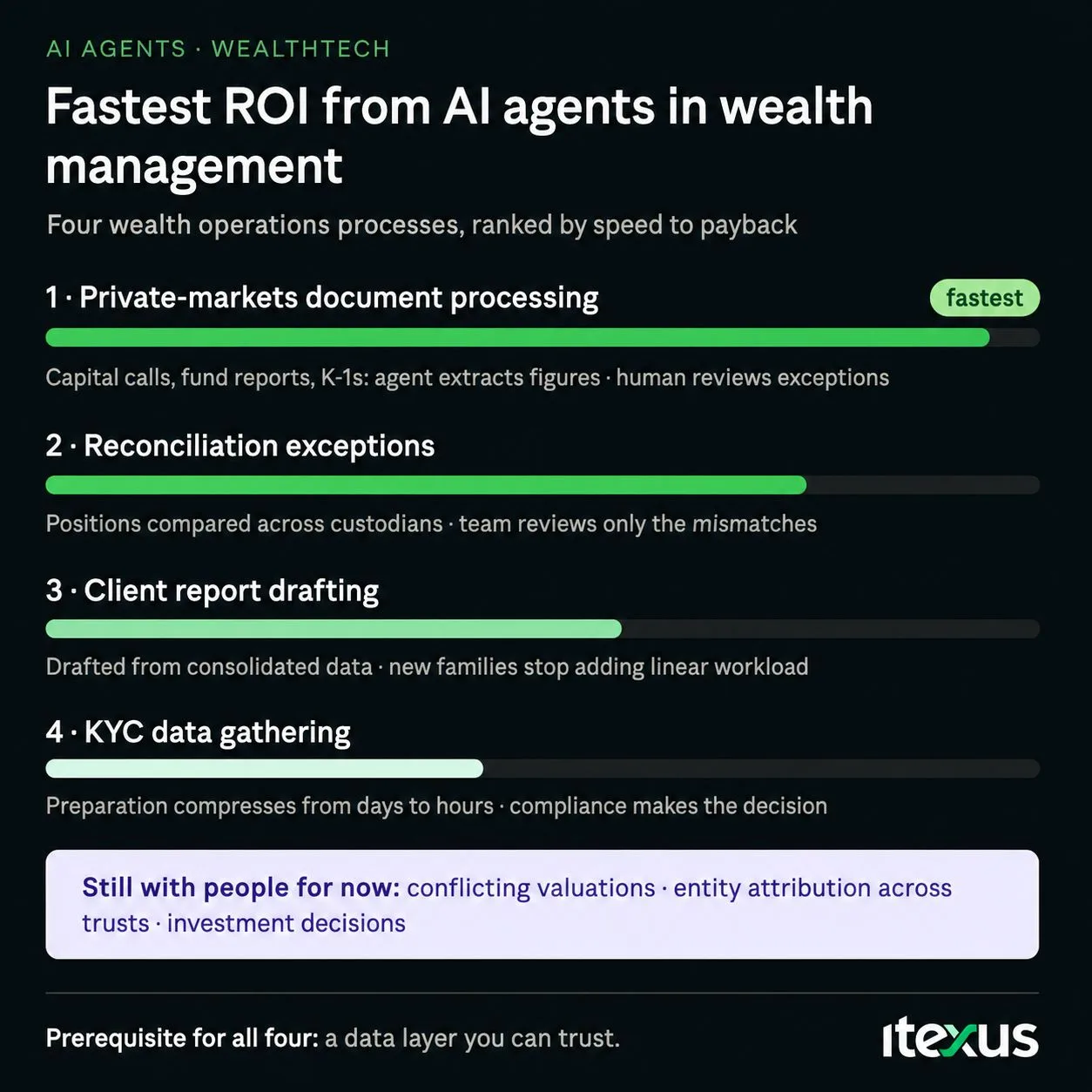
Some work stays with people for now: resolving conflicting valuations, attributing transactions across entities, investment decisions. And one prerequisite applies to all four processes above – they pay off only when the data layer beneath them works, which is exactly the dependency this section started from.
The capacity audit: five questions before the next AI tool
A practical translation of everything above, worth answering before the next vendor demo.
1. Where do your advisor hours actually go? Measure your firm's version of the 70/30 split. The reservoir determines the business case; a firm whose advisors already spend half their time with clients buys less uplift than the averages promise.
2. Which workflows are integration-ready? An AI use case is ready when the data it needs lives in systems it can reach, with permissions defined. Everything else is a pilot that will stall at the demo stage – where half of Fidelity's users currently sit.
3. What data will the AI reason over, and does it reconcile? If two of your systems disagree on a household total or a return series today, an assistant will inherit the disagreement and phrase it fluently.
4. Where is the confidence gate? Decide, per workflow, what gets auto-approved and what routes to a human queue – and keep a link from every AI-produced figure back to its source. AI does not get to invent numbers.
5. Which capacity KPI moves, from what baseline? AUM per advisor, clients per advisor, prep time per meeting – pick the metric before deployment. The firms in the Astraeus data can show 22% because assets per advisor was measurable before AI touched anything.
The operating model is the AI strategy
The regulatory record shows AI-adopting RIAs hiring faster and carrying more assets per advisor – capacity gains, arriving in an industry short of advisors. The gains concentrate where AI is integrated into the operating model rather than used as a standalone tool, and integration depth is set by one thing firms fully control: whether their data layer is connected and reconciled enough for AI to reason over it.
If you are deciding where AI can actually increase advisor capacity, start from the workflows and the data they run on. Itexus builds wealth management software and the intelligence layer on top of it – portfolio analytics, advisor workflow, document intelligence and scoring engines delivered inside the tools advisors already use. An AI-readiness and data assessment maps where advisor hours go, tests whether the data layer reconciles, and returns a ranked list of AI use cases with a measurable capacity KPI attached – scoped work, typically measured in weeks. Contact Itexus to discuss one for your wealth platform.