
Quick Summary: A Solutions Architect designs the technical blueprint before a deal closes, while a Forward Deployed Engineer embeds with the customer after signing to build, integrate, and keep the system running. The split comes down to timing and ownership — pre-sale design versus post-sale execution — and most fintech and enterprise software teams eventually need both.
Two job titles, one recurring headache for hiring managers: forward deployed engineer vs solutions architect. Both sit close to the customer. Both need to speak fluent code and fluent business. And both get lumped together in job postings that, frankly, don’t know what they’re asking for.
Here’s the thing though — these roles solve different problems at different moments in the customer relationship. Confuse them, and a company ends up hiring a brilliant systems designer to do hands-on integration work they were never trained for, or a scrappy builder to write architecture diagrams that never leave a slide deck. Neither outcome is good for the budget or the customer.
This guide breaks down what each role actually does day to day, where the responsibilities overlap, what companies tend to pay for each, and — most usefully — how to decide which one a team actually needs to hire next.
What a Solutions Architect Actually Does
A Solutions Architect (SA) is a pre-sale and design-phase specialist. Their job is to translate a customer’s business requirements into a technical blueprint: reference architectures, integration diagrams, security and compliance mappings, and a proof-of-concept that proves the approach will actually work before anyone signs a contract.
SAs typically work alongside account executives during the sales cycle. They run technical discovery calls, answer the “can your platform do X” questions, and build the case that justifies the deal. Once the contract is signed, the SA usually hands the design off to an implementation or engineering team and moves to the next opportunity. Ongoing production support is rarely part of the job description.
In fintech specifically, this often means designing how a core banking system connects to a lending engine, or how a trading platform’s risk module talks to a compliance layer — work that overlaps heavily with the kind of architecture decisions covered in fintech software development engagements.
What a Forward Deployed Engineer Actually Does
A Forward Deployed Engineer (FDE) picks up roughly where the SA leaves off — but the job is far more hands-on than “implementation.” FDEs embed directly inside a customer’s environment, sometimes on-site for months at a time, and write the actual code that makes a platform work inside that customer’s specific data, workflows, and constraints.
The role was popularized by Palantir, where FDEs are known for parachuting into a client’s operation, learning the domain fast, and shipping working software against real, messy data rather than a tidy demo environment. That DNA has since spread to AI infrastructure startups, defense-tech companies, and increasingly to fintech vendors selling into banks and asset managers with complex legacy stacks.
Unlike an SA, an FDE doesn’t hand off and disappear. They stay close to the deployment, fix what breaks, adapt the integration as requirements shift, and often become the informal owner of that customer’s technical success for months or years.
Forward Deployed Engineer vs Solutions Architect: Key Differences
The two roles get confused because both are technical, both are customer-facing, and both require the ability to explain complex systems in plain language. But the differences show up clearly once you look at timing, ownership, and deliverables.
| Dimension | Solutions Architect | Forward Deployed Engineer |
|---|---|---|
| Primary phase | Pre-sale, design | Post-sale, build and maintain |
| Main output | Architecture diagrams, proposals, proofs of concept | Working, deployed, production code |
| Customer contact | Sales calls, technical workshops | Embedded, often on-site or near-constant |
| Success metric | Deal closed, technical objections cleared | System live, adopted, and delivering value |
| Typical background | Cloud architecture, systems design, pre-sales engineering | Full-stack or backend engineering, rapid prototyping |
| Ownership horizon | Ends at handoff | Continues through deployment and iteration |
Ownership is the sharpest dividing line. An SA is judged on whether the design holds up on paper and whether it helps close the deal. An FDE is judged on whether the thing actually works once it’s plugged into a customer’s real, often chaotic, production environment — and keeps working after that.

Plan and Build Systems With Itexus
Itexus supports fintech products through discovery, architecture, software development, integrations, cloud engineering, testing, and maintenance.
Need Architecture and Delivery Support?
Itexus can help with:
- product discovery and prototyping
- system architecture
- custom fintech development
- API and legacy integrations
- cloud and DevOps engineering
 Contact Itexus to discuss your product architecture and delivery needs.
Where Sales Engineers Fit Into the Picture
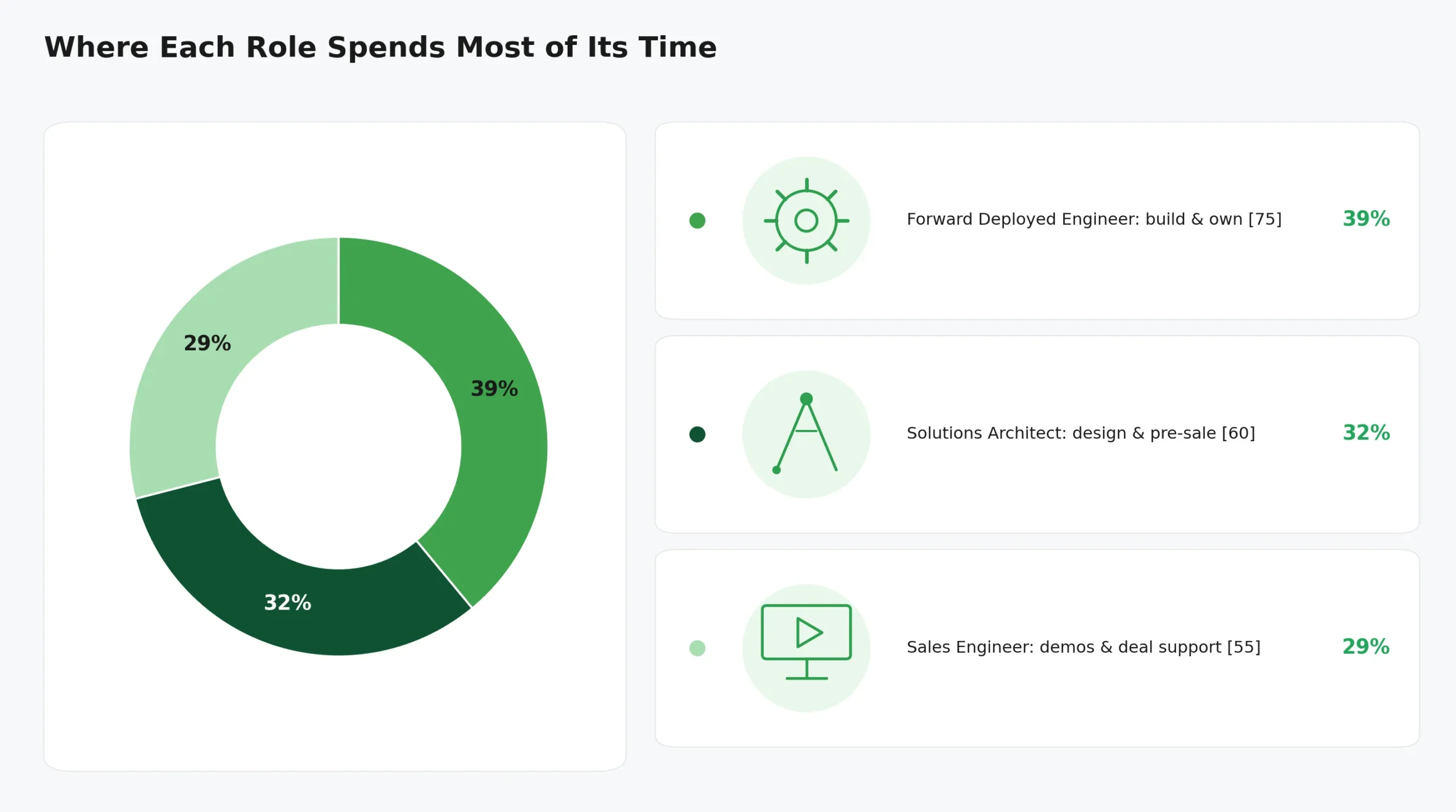
Most comparisons stop at two roles, but a third title keeps showing up in the same conversations: the Sales Engineer (SE). SEs overlap with SAs on the pre-sale side, but they tend to focus more narrowly on the sales motion itself — running demos, handling RFPs, and answering technical objections in real time during a pitch.
An SA typically goes deeper on architecture and long-term design; an SE is often more focused on winning the specific deal in front of them. In smaller companies, one person frequently does both jobs. In larger enterprise software or fintech vendors, the two get split so the SA can spend time on complex integration design while the SE keeps the sales pipeline moving.
Salary and Career Path Comparison
Forward Deployed Engineer Compensation
Compensation data is clearest for the FDE role because it is newer, concentrated among a handful of high-profile employers, and closely tracked by compensation databases.
At Palantir, where the FDE title originated, Levels.fyi puts total compensation for Forward Deployed Software Engineers in the United States at roughly $171,000 to $295,000 per year, with a reported median package of around $211,000. Glassdoor’s crowdsourced data places average base salary closer to $177,000 for the same employer. The gap is a reminder that equity and bonuses can make up a large part of FDE compensation at companies like Palantir.
Solutions Architect and Sales Engineer Pay
Solutions Architect and Sales Engineer compensation varies more by industry, seniority, and company type. Pay can look very different depending on whether the role sits inside a cloud vendor, a fintech startup, or a traditional enterprise software company.
Rather than relying on one figure that applies to only part of the market, it is better to review current listings on Glassdoor, Levels.fyi, or Payscale for the relevant industry and seniority level. Fintech and banking-related roles may pay more when they require experience with compliance, security, and technical architecture.
Career Paths for Solutions Architects
Solutions Architects often move into pre-sales leadership, solutions engineering management, or product management. Their experience translating technical capabilities into business value prepares them for roles that combine customer communication, strategy, and technical planning.
Career Paths for Forward Deployed Engineers
Forward Deployed Engineers often move into technical program management, founding engineer positions, or specialized domain consulting. Their hands-on customer experience and focus on shipping solutions can translate well into roles that require technical depth, speed, and a strong understanding of customer needs.
How to Decide Which Role Your Company Needs
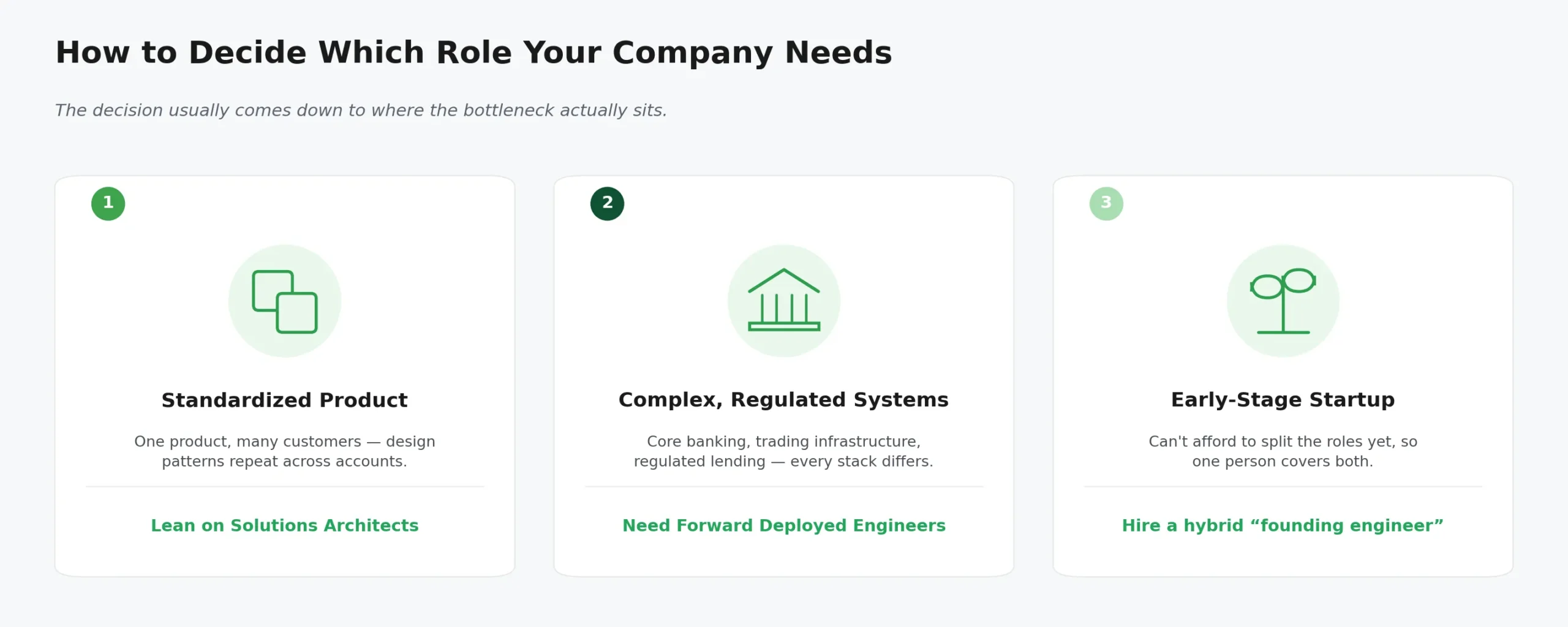
The decision usually comes down to where the bottleneck actually sits. If deals are stalling because prospects don’t trust the technical fit, that’s a Solutions Architect problem. If deals are closing but customers are churning because the product never quite works in their environment, that’s a Forward Deployed Engineer problem.
A few practical signals worth weighing:
- Companies selling a fairly standardized product to many customers usually lean on Solutions Architects, since design patterns repeat across accounts.
- Companies selling into complex, high-stakes environments — core banking systems, trading infrastructure, regulated lending platforms — tend to need Forward Deployed Engineers, because every customer’s data, compliance rules, and legacy stack are different.
- Early-stage startups often can’t afford to split the roles and instead hire one hybrid “founding engineer” who does design and deployment together, at least until deal volume justifies specialization.
For fintech vendors specifically, this tension shows up constantly around integration work — connecting a new digital lending platform to a bank’s existing core, or wiring a trading platform into a client’s risk and settlement systems. The design might be sound on paper, but it still needs someone to make it work against a specific bank’s messy, decades-old infrastructure. That’s exactly the gap FDE-style roles were built to close.
Where the Roles Genuinely Overlap
Despite the differences, there’s real overlap worth acknowledging. Both roles need to read code and read a room. Both need enough business fluency to explain a technical tradeoff to a non-technical stakeholder without losing the thread. And in practice, a strong SA who stays engaged past the handoff starts acting a lot like an FDE — while an FDE who gets pulled into early sales conversations starts acting a lot like an SA.
That blurring is one reason some companies now hire for a combined “Solutions Engineer” title that flexes across both phases, particularly in mid-market software companies that can’t justify three separate specialist headcounts. It works, but it asks a lot of one person — and it’s worth being honest about that tradeoff before writing the job posting.
Companies building white-label financial products often feel this most acutely, since a white-label banking platform needs both airtight architecture up front and hands-on support once a bank or fintech partner actually starts using it. Skimping on either side tends to show up later as churn or support escalations.
AI Is Reshaping Both Roles
It’s worth flagging that the rise of AI-native products is pulling both roles closer together again. Deploying a large language model or an agentic system inside a regulated financial institution isn’t a one-and-done integration — it needs continuous tuning, monitoring, and adjustment as data drifts and model behavior shifts. That’s pushing more companies to hire FDE-style talent specifically for AI rollouts, while SAs increasingly need to understand model architecture, not just infrastructure diagrams. Teams building on top of AI software development capabilities, including tools like Noxs AI, are seeing this shift play out firsthand as AI-driven fintech products move from pilot to production.
The Bottom Line
Forward deployed engineer vs solutions architect isn’t really a competition — it’s a sequence. The SA gets the deal signed with a design that holds up under scrutiny. The FDE makes sure that design survives contact with a real customer’s real systems. Skip the first and sales stalls on unanswered technical questions. Skip the second and adoption dies quietly after the champagne.
Companies evaluating their own technical hiring — or looking for a development partner that already blends both skill sets across fintech projects — can look through examples of how design and deployment come together in practice in this portfolio of completed projects, or read more about the end-to-end process in how the delivery process works from design through post-launch support.