
Built a Supply Chain Finance Platform with Privacy-Safe AI Underwriting — Starting with the Client Portal
Itexus built a client portal, a lender operations desk and an AI underwriting module for an insurance-backed supply chain finance lender. The platform covers bulk invoice intake, insurer-gated funding and de-identified credit memos. The lender owns the platform and can license it.

Key Success Metrics
Case Summary for FinTech Leaders
A non-bank lender pays clients' suppliers upfront and extends the clients' payment terms under trade credit insurance. Clients submitted invoices as emailed spreadsheets, and onboarding a new client took about two weeks of manual underwriting. Off-the-shelf AI tools could not meet two constraints: identifying applicant data could not reach a language model, and every credit decision had to be explainable and reproducible. Itexus de-identified documents before any model call and placed deterministic credit rules ahead of the model. Delivery started with the portals.
Technologies: Python, FastAPI, PostgreSQL, React, Keycloak, Temporal, Docling, Presidio
| Industry | FinTech — Supply Chain Finance / Commercial Lending |
| Segment | Non-bank lender, insurance-backed payables finance for mid-market companies |
| Geography | North America and Europe |
| Deployment Model | Cloud, single-tenant deployment on a multi-tenant-capable architecture |
| Duration | 7 months |
| Team Size | ~9 engineers (Delivery Manager, Business Analyst, Solution Architect, Backend Engineers, Frontend Engineers, QA Engineer, DevOps Engineer, UI/UX Designer) |
| Delivery Model | Phased delivery: fixed-price discovery → phased build of portals → capped T&M for AI underwriting |
| Services | Lending Software Development · AI/ML Development · FinTech Product Discovery · UI/UX Design |
| Technologies | see Technology Stack |
| Compliance | Designed for ECOA / Reg B, SR 26-2, GDPR and the EU AI Act; SOC 2 Type II-ready |
About the Client
The client is a non-bank lender that finances trade payables for mid-market companies. It pays the client's suppliers directly and later bills the client on extended terms. Facilities are unsecured and wrapped by third-party trade credit insurance. The insurer makes its own independent approval decision before any funding.
The platform handles banking details, audited financial statements and credit decisions for applicants in several jurisdictions. That placed it under US fair-lending rules and, for European applicants, under GDPR. The lender also planned to license the software to other funders. Every architectural and licensing choice had to survive redistribution, not just internal use.
The Challenge
Faster AI underwriting that never exposes applicant identities to a model and keeps every decision explainable.
Business Challenge
Clients had no portal and emailed invoices as spreadsheets, so staff re-keyed every row into a third-party legacy system by hand.
Underwriters spent about two weeks preparing each new client's memo by hand.
No funding could go out without the insurer's approval, and a reduced or withdrawn limit could make already-submitted invoices unfundable.
The lender wanted to own the platform and license it under other brands.
Declined applicants were owed specific reasons, and any decision had to be reproducible months later under the policy then in force.
Technical Challenge
Consistent pseudonymization is cross-document entity resolution: abbreviations, legal-form variants, OCR noise.
Identifiers also sit in logos, signatures and letterheads, beyond text-based NER.
Multi-page financial tables from scanned PDFs had to be extracted without numeric drift.
A 5-minute SLA covered OCR, detection, rules evaluation and the LLM call.
Insurer limit revocations had to recompute capacity for in-flight invoices without race conditions.
Solution
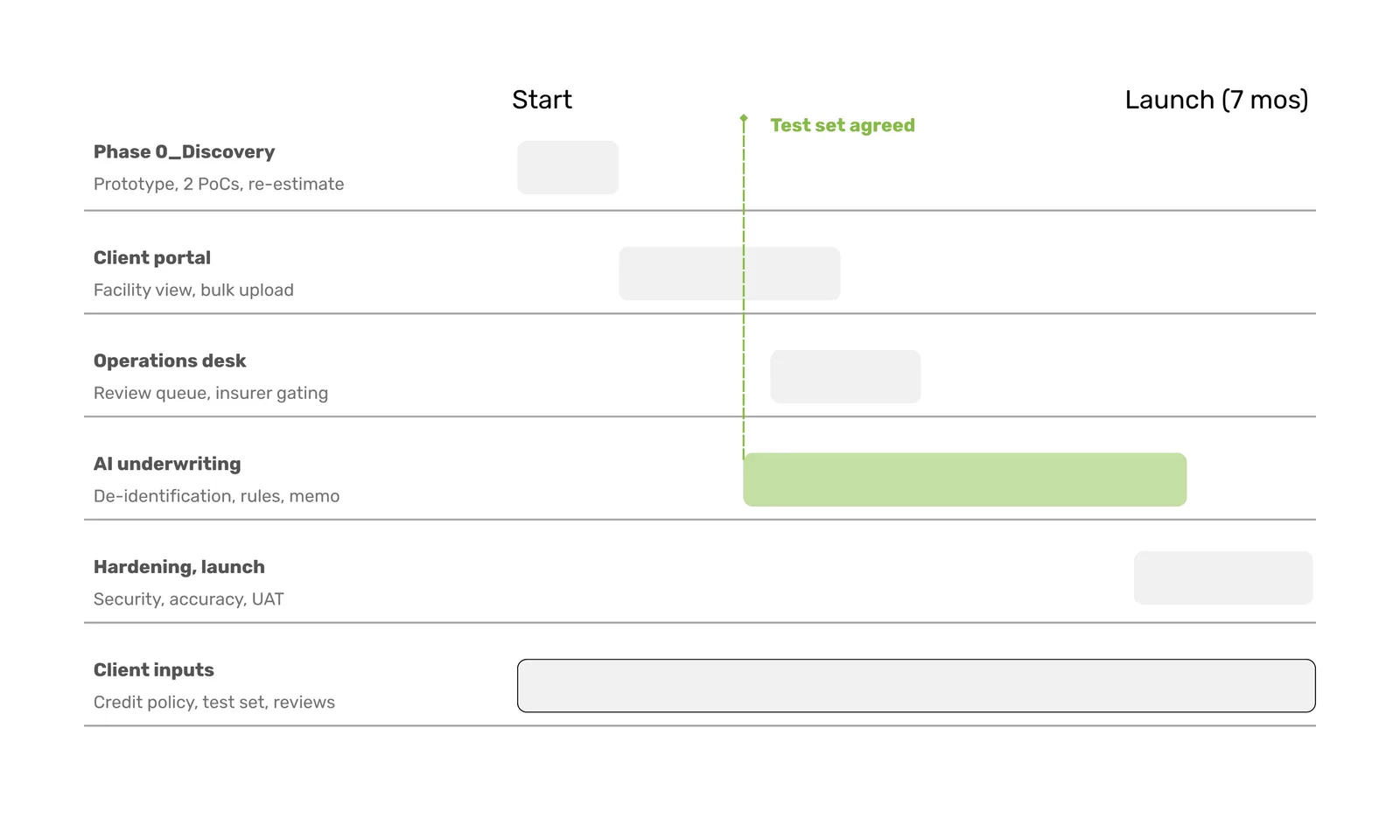
Itexus delivered the platform with a ~9-person cross-functional team over 7 months, deployed on AWS. Delivery started with a discovery phase and proofs of concept on the two riskiest components. The client and operations portals shipped next, and AI underwriting followed once its accuracy target could be measured.
Client Portal and Facility Visibility
Facility overview showing limit, amount outstanding, available capacity and amounts coming due.
Bulk CSV/Excel invoice upload with row-level validation, suggested corrections and a check-answers step before submission.
Capacity preview that recalculates available funding as failed rows are corrected or excluded.
Searchable invoice register with a full status history for every invoice.
Supplier management with three bank-detail formats: US routing, UK sort code and IBAN/BIC.
Repayment schedule and account statements; the platform records payments and never moves money.
Lender Operations Desk and Insurer Gating
Review queue for approving, rejecting with structured reason codes, or requesting more information.
Insurer decisions stored as dated, versioned records supporting nil limits, reductions and withdrawals.
Funding blocked automatically until an insurer approval is recorded.
Facility limit management and portfolio-level exposure views.
Append-only, hash-chained audit trail covering every decision and configuration change.
De-Identified AI Underwriting
Public application flow with verified sign-up, e-signed NDA and financial-statement upload.
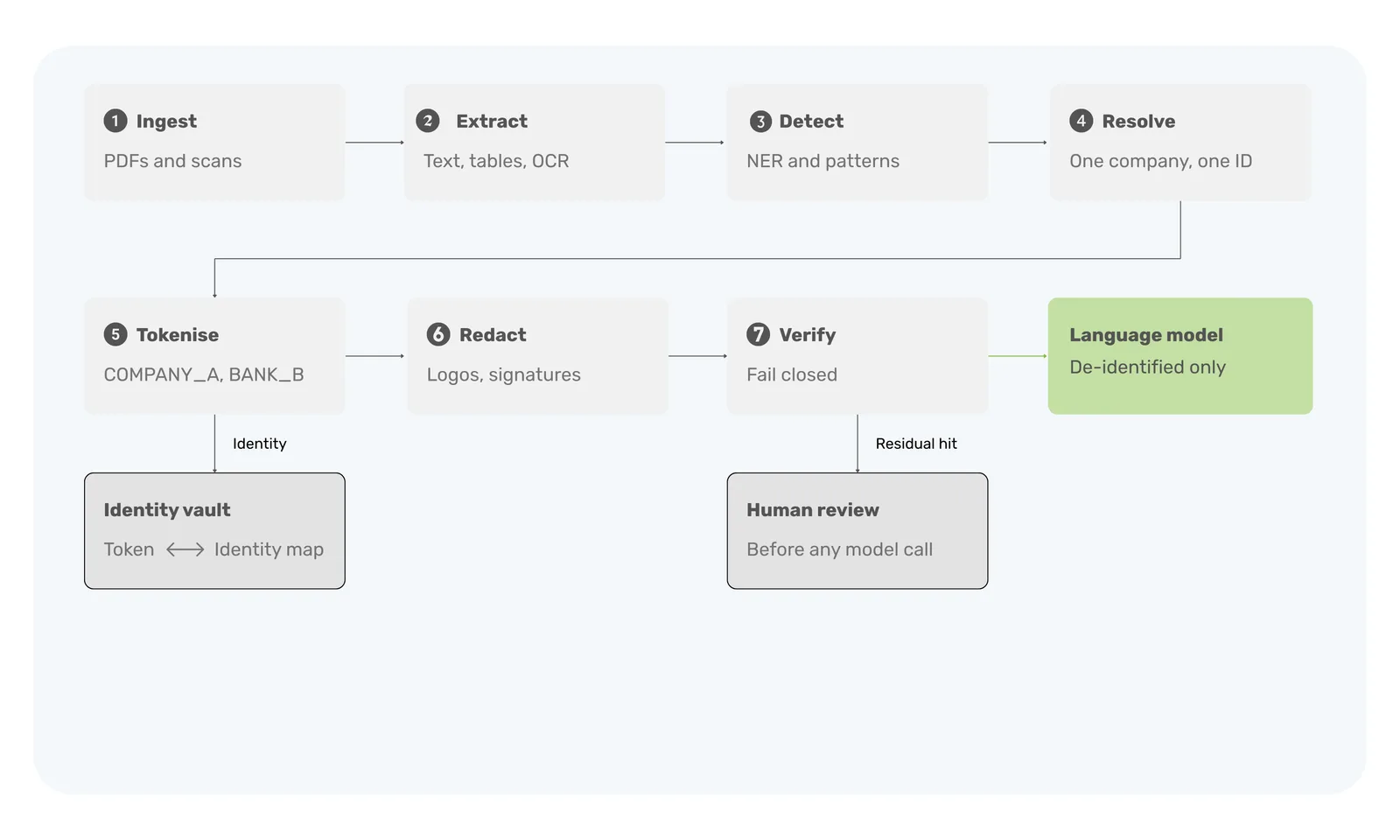
Layout-aware extraction for digital PDFs, with an OCR path for scanned statements.
Layered entity detection: deterministic patterns, NER models, zero-shot role detection and structural rules for signatures and letterheads.
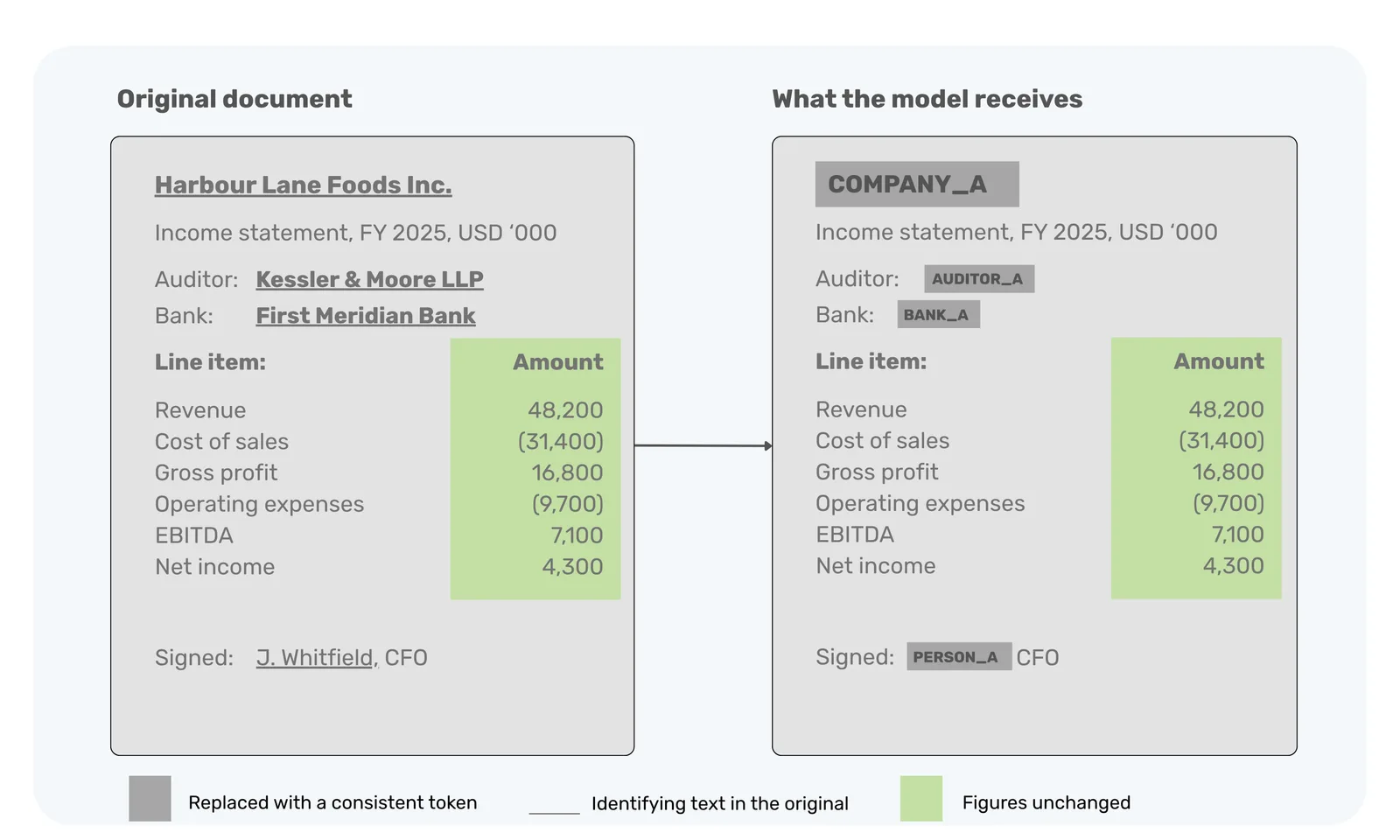
Entity resolution that maps every mention of one company to one stable token across the document set.
A post-redaction verification sweep that fails closed and routes any residual hit to human review.
Deterministic credit-box rules evaluated before the model, with thresholds stored as data rather than code.
A policy-conditioned language model drafts the credit memo; underwriters decide, and borderline cases route to a human rather than being declined automatically.
Controlled re-identification for authorized staff, with every reveal written to the audit trail.
Platform Foundation for Future Scale
Multi-tenant-capable data model and identity realms, so the lender can run partner programs or license the platform.
Tokenized design system that re-brands the portals per tenant without code changes.
Documented REST API, so planned intake channels (API, SFTP, ERP connectors) plug into the same validation pipeline.
Licence gate in CI that fails the build on copyleft or non-commercial dependencies.
Decision log that tags each outcome with its policy version, ready for future model validation.
Use Cases Covered
| Use Case | Description | Output |
|---|---|---|
| Invoice batch submission | Client CFO uploads a batch and fixes failed rows before submission | Validated batch with ID and capacity impact |
| Invoice review | Lender staff approve, reject or query submitted invoices | Decision record with structured reason code |
| Insurer gating | Staff record the insurer's decision for a facility | Versioned insurer record; funding unlocked or blocked |
| Repayment tracking | Client sees what was funded and when it is due | Repayment schedule and account statement |
| Applicant pre-screening | Prospect applies and uploads financial statements | Indicative, non-binding pre-approval |
| Credit memo drafting | Model drafts a memo from de-identified statements | Draft memo tagged with policy version |
| Controlled re-identification | Authorized underwriter reveals the real applicant | Audit entry with user, time and reason |
Problems Solved
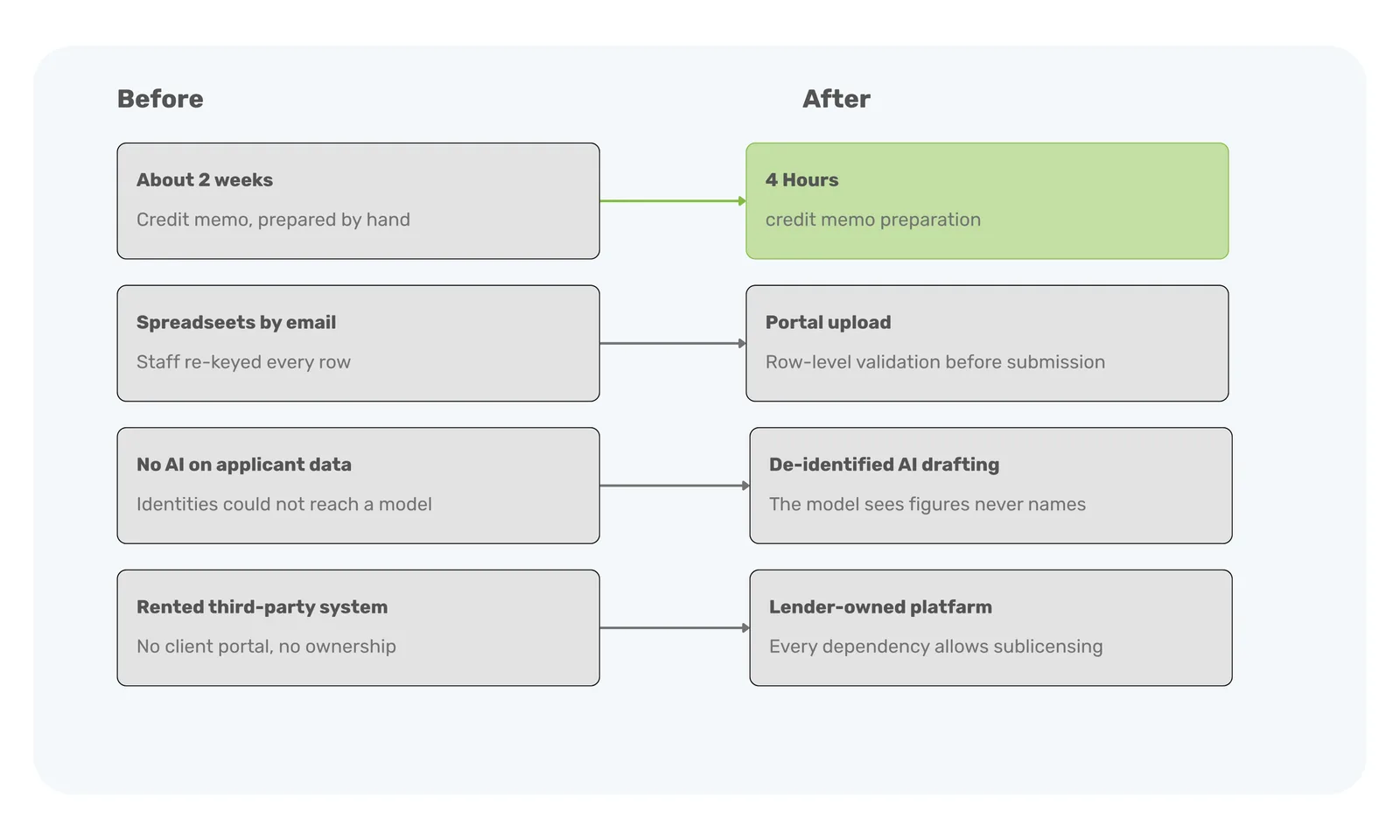
Credit memo preparation cut from about two weeks to 4 hours.
Invoice intake moved out of the inbox. Clients submit and correct batches themselves, so staff no longer re-key spreadsheets.
Insurer risk became visible before funding, not after. Staff see which invoices become unfundable if an insurer cuts a limit.
AI assistance without identity exposure. The model sees only de-identified content, and every step is logged and reproducible.
An owned, licensable asset instead of a rented system. The lender owns the code and every dependency permits sublicensing — the first product on a platform, not a one-off tool.
Solution Architecture
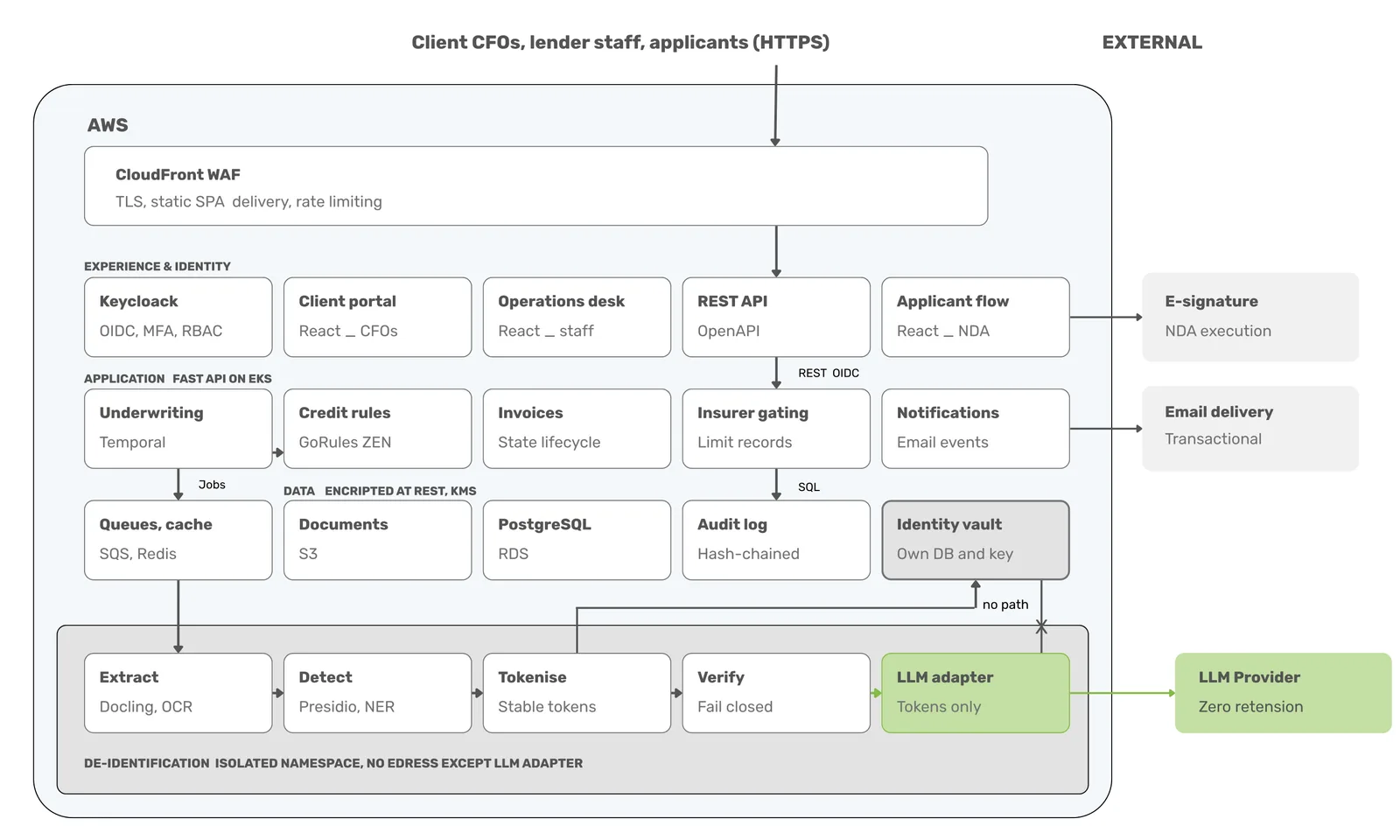
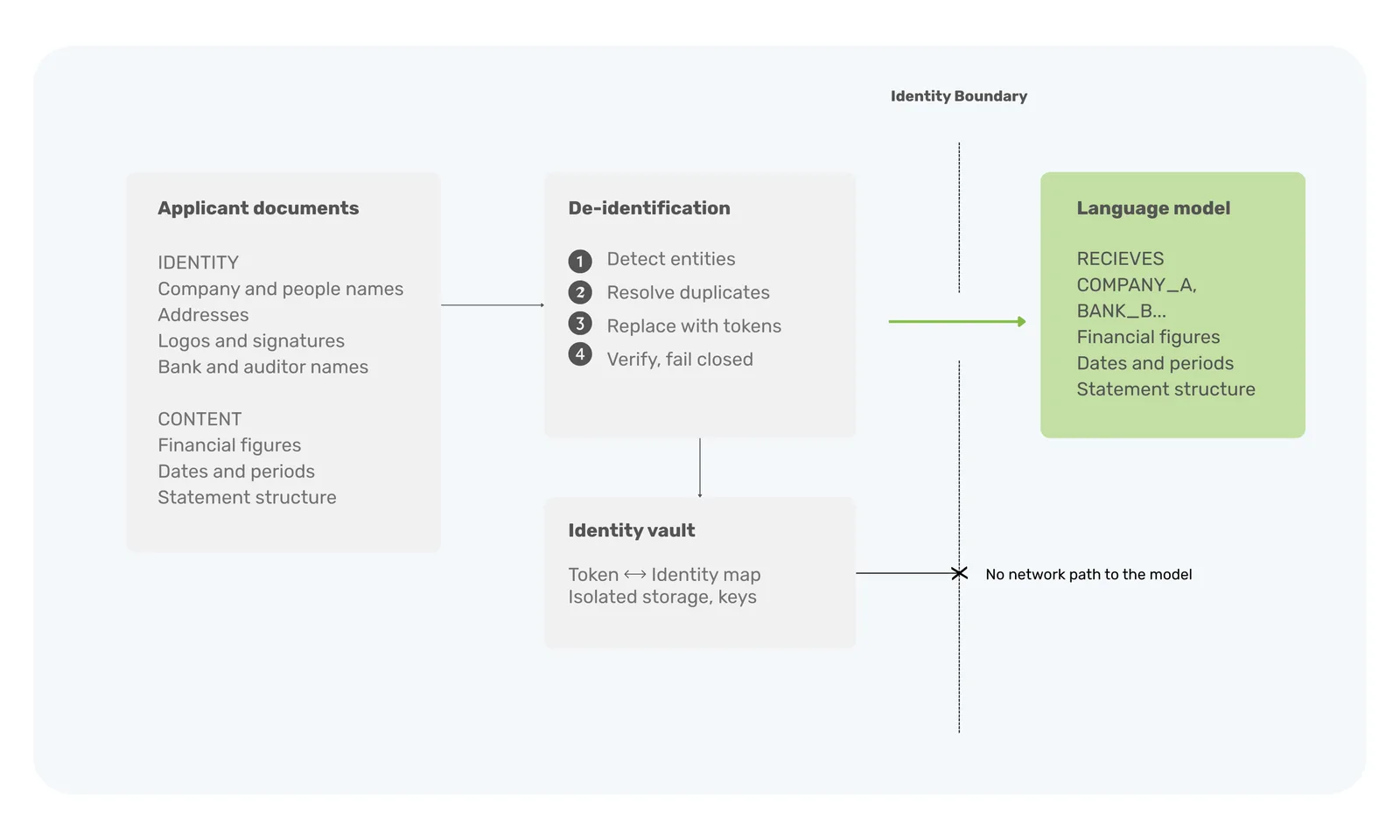
The platform separates identity from analysis: identifying data lives in a segregated vault that the model-calling services cannot reach.
| Layer | Components | Function |
|---|---|---|
| Experience | Client portal, operations desk, public application flow (React) | User interaction, validation feedback, reporting |
| Application & Workflow | FastAPI services, invoice state machine, durable workflow engine | Invoice lifecycle, insurer gating, async underwriting pipeline |
| Decisioning | Rules engine with decision tables, policy versioning, LLM adapter | Credit-box evaluation first, memo drafting second |
| De-Identification | Extraction, layered entity detection, entity resolution, verification sweep | Removes identity before any model call |
| Data & Audit | PostgreSQL, segregated identity vault, append-only hash-chained log | Records, token mapping, tamper-evident history |
| Security | Keycloak (MFA, RBAC), KMS, field-level encryption, zero-retention model endpoint | Access control, encryption, provider data isolation |
Integration Landscape
E-signature — embedded click-to-sign NDA in the application flow; a simple electronic signature is legally sufficient (Dropbox Sign)
LLM service — credit memo drafting on de-identified content only, under zero-retention and no-training terms (Azure OpenAI)
Email delivery — account verification and recovery, submission and decision notifications
Insurer — no integration by design; the insurer decides independently and staff record its decisions in the operations desk
ERP and file channels — planned: API, SFTP and ERP/accounting connectors (e.g. NetSuite) feeding the same validation pipeline; CSV/Excel upload at launch
KYC/AML — planned; the provider is chosen once launch compliance requirements are confirmed
SSO — planned; email and password with MFA at launch
Internal ledger and funding instruction export
Technology Stack
| Category | Technologies |
|---|---|
| AI/ML | Presidio, spaCy, GLiNER, Azure OpenAI |
| Document Processing | Docling, pdfplumber, Tesseract / OCRmyPDF |
| Backend | Python, FastAPI, SQLAlchemy |
| Decisioning & Workflow | GoRules ZEN, Temporal, XState |
| Frontend | React, TypeScript |
| Data | PostgreSQL |
| Infrastructure & Security | AWS (EKS, RDS, KMS, WAF), Keycloak, Terraform, CI/CD |
Compliance & Security
Security was treated as the first design constraint. The architecture had to prove, not just claim, that identity never reaches the model.
Security Measures Implemented
MFA for all users and role-based access control on every endpoint.
Field-level encryption for banking details and the identity vault.
Identity vault on separate storage, credentials and keys, with no network path from model-calling services.
Model endpoint configured for zero data retention and no training, confirmed in writing by the provider.
Append-only audit trail with hash chaining and attributed re-identification events.
Dependency and licence scanning in CI; separate dev, staging and production environments.
Compliance Considerations
Fair lending (US): deterministic rules produce specific principal reasons for adverse decisions, as 12 CFR 1002.9(b)(2) requires.
Model risk: credit-box rules stay deterministic, and deterministic rule-based processes fall outside the model definition in SR 26-2.
GDPR: the design is treated as pseudonymization, not anonymization, with a documented residual-risk review.
EU AI Act: corporate credit assessment falls outside Annex III 5(b), and any natural-person path (e.g. guarantors) is gated separately.
SOC 2 Type II: the architecture is designed to generate audit evidence continuously. This is readiness for a future audit, not certification.
Delivery Approach
Delivery Model: Phased delivery — fixed-price discovery, fixed price per phase for the portals, capped T&M for AI underwriting until the accuracy threshold was agreed.
Team Composition
Delivery Manager · Business Analyst · Solution Architect · Backend Engineers · Frontend Engineers · QA Engineer · DevOps Engineer · UI/UX Designer
Governance
Acceptance criteria agreed for each feature before development.
Proofs of concept on the two riskiest components before committing to a build price.
AI underwriting accepted against measured entity-detection accuracy on a client-supplied test set.
Fixed review windows for milestone acceptance built into the schedule.
Licence gate on every build to protect the client's right to sublicense.
Weekly progress and budget reports; scope changes approved in writing.
Results
The lender prepares a credit memo in 4 hours instead of about two weeks, on a platform it owns and can license.
How This Expertise Can Help Your Team
Itexus builds lending platforms in which regulatory constraints shape the architecture from the first sprint.
Lending Software Development
Facility, invoice and repayment logic built for a lender that records money flows but never moves funds.
AI/ML Development
A de-identification pipeline and policy-conditioned memo drafting, where the model assists underwriters and deterministic rules own the decision.
UI/UX Design
An exception-first client portal designed to replace spreadsheet workflows for finance teams.
FAQ
What type of organizations is this solution most relevant for?
Non-bank lenders, supply chain finance providers and trade finance funders that underwrite companies from financial statements. It fits best when three conditions meet. The lender wants AI to speed up underwriting. Applicant data is too sensitive to send to a model as-is. And credit decisions must stay explainable. It also suits lenders who plan to license their platform to other funders, because every component was chosen to allow sublicensing.
Why were deterministic rules placed before the language model?
Regulators expect lenders to state the specific reasons behind an adverse credit decision. A language model cannot reliably give those reasons. Deterministic rules can, and every outcome traces to a versioned policy. Under current US supervisory guidance, deterministic rule-based processes also fall outside the definition of a "model", which avoids a full model-validation burden. The language model therefore drafts the narrative and the rules make the call. Borderline cases go to a human underwriter.
Is de-identification the same as anonymization?
No. Because authorized staff can reverse the token mapping, the design is pseudonymization in the GDPR sense, and the platform describes it that way. It is a strong control, not an absolute guarantee. For that reason, acceptance was based on measured detection accuracy against the client's own test documents, plus a documented residual-risk review. Financial figures, dates and statement structure stay intact, so underwriting quality does not suffer.
What were the biggest technical risks, and how were they managed?
Three risks dominated. Consistent token substitution might not hold on real statements. The credit policy might be expert judgment rather than thresholds. And no test set existed to measure accuracy. Itexus ran proofs of concept on the first two during discovery. AI underwriting was scheduled after the portals, so that the client's test set would exist before that module was built. Zero-retention terms with the model provider were started early, because their approval lead time sits with the provider.
Why were the portals delivered before AI underwriting?
The client portal and operations desk solved the most urgent daily problem — invoices arriving by email — and did not depend on any missing input. AI underwriting did depend on one. Its acceptance criterion was accuracy measured on a test set that did not yet exist. Building toward a target that cannot be measured is a delivery risk, so Itexus sequenced the modules on technical grounds rather than commercial ones.
How long does a similar project take and what drives the cost?
This project took about 7 months. The main cost drivers are the de-identification layer, the number of intake channels, and the non-functional bar: encryption, audit, accessibility and uptime. In this type of platform, the shared foundation and security work form a large share of the effort. Cutting screens therefore saves less than phasing modules. A paid discovery phase with proofs of concept is the most reliable way to turn a rough estimate into a committed budget.
Looking for a lending platform partner?
We help lenders speed up underwriting with AI, protect sensitive applicant data, and own the platform they build.