
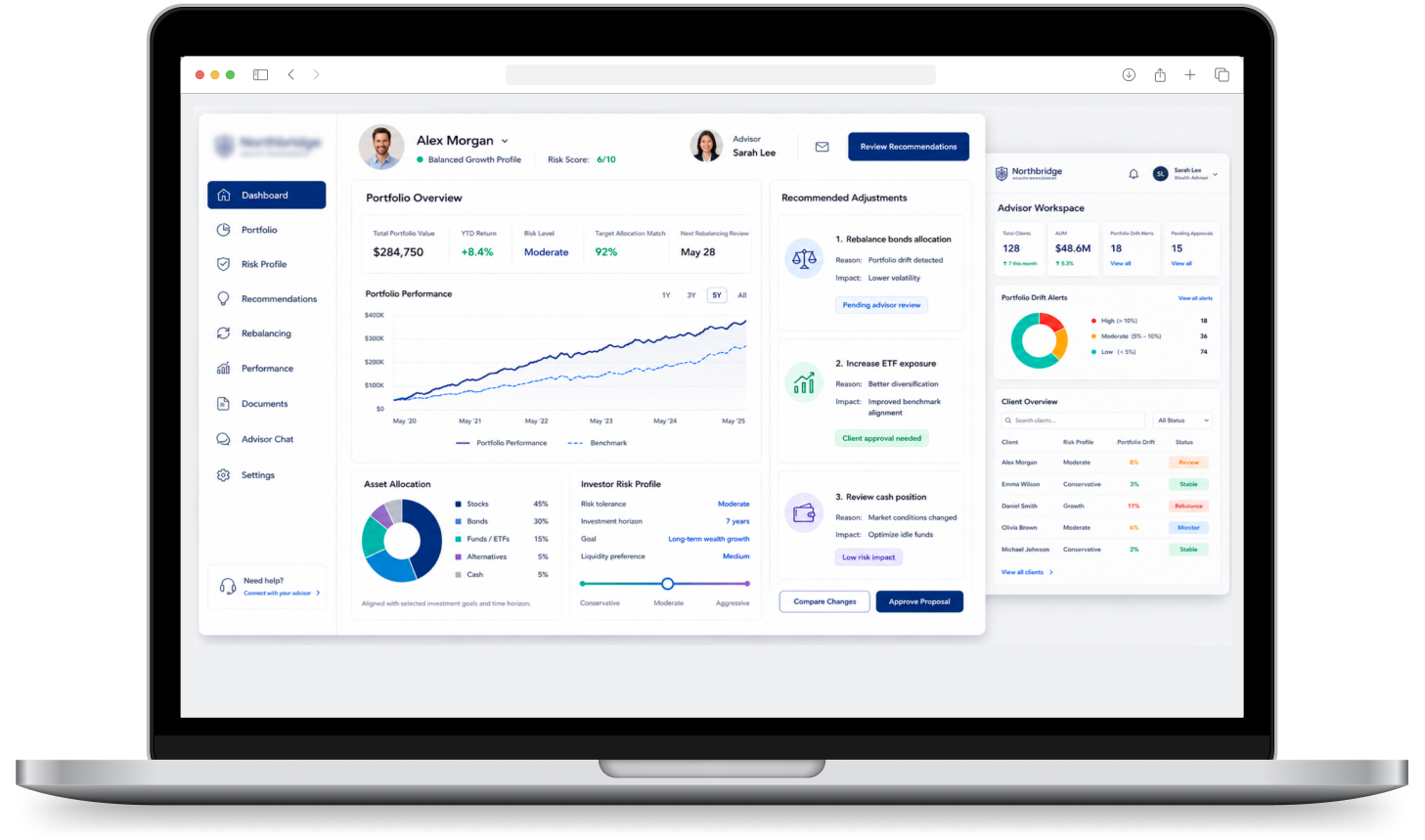
How Itexus modernized a legacy WealthTech platform for 450K+ investors, reaching 99.95% availability, 30% faster releases, and SEC/RIA-ready records.
The Fed raised rates for the first time since 2023, and the wealth-management stack spent the week absorbing a second kind of pressure. KeyCorp and other banks lifted the prime rate to 7%, repricing the cost of capital under every lending and deposit product. At the same time, AI moved further into advisory operations: Anthropic launched Claude for Financial Advisors, Pave raised to automate portfolio construction, and Amex bundled a 2.95% business savings account into its card membership. Costlier capital and cheaper advice operations are hitting the same products at once, and the teams that come out ahead are the ones that can reprice, move data, and automate decisions while still reconciling every action underneath the interface.
Anthropic launches Claude for financial advisors, wired into custodians and asset managers
Anthropic released Claude for Financial Advisors, a suite of connectors and workflow skills that automate research, meeting preparation, portfolio-oversight review, compliance checks, and documentation. It connects to custodians, asset managers, and wealth platforms including BlackRock, Vanguard, Charles Schwab, Addepar, Envestnet, iCapital, and Orion. Anthropic states investment recommendations and consequential decisions remain with advisors and their clients. The product runs on Claude Cowork with a plugin, priced roughly $70 to $120 per user per month, and Anthropic recommends Enterprise plans for the audit logs that support recordkeeping.
Source: Reuters, September 2026
Why it matters
AI in regulated professions is shifting from a standalone assistant to a layer on top of the tools people already use, and the point of control moves to the connectors, not the model. When the value comes from reaching a firm's data across many existing systems, whoever owns that integration layer captures the workflow, while the model itself becomes replaceable. The competitive question turns from model quality to who holds the connections into the systems of record.
The second shift is that the line between assistance and regulated advice is becoming an architectural decision, not a legal footnote. Drawing the boundary at research and prep while reserving recommendations for a licensed human keeps an AI tool outside the definition of regulated advice, and audit logs turn that boundary into something a firm can prove. The design work is defining where the tool's output stops, who signs off past that point, and how both are recorded.
What teams should do
This applies to RIAs, wealth platforms, broker-dealers, and any advisory firm adopting AI tools connected to custodial and portfolio data.
- Define exactly which connected systems the tool can read, so an AI plugin's data access matches your least-privilege and client-consent requirements.
- Hold the advice boundary inside your own supervision workflow, so research and prep from the tool never crosses into an un-reviewed recommendation to a client.
- Assign named supervision for AI-assisted output, since the responsibility for what reaches a client stays with a person regardless of what the tool drafted.
- Verify how client data is handled and retained by the AI layer before connecting custodial and CRM systems, since consent scope becomes a data-governance boundary.
- Measure the prep and documentation time actually reclaimed, so adoption rests on advisor capacity gained rather than the novelty of the integration.
KeyCorp and Major Banks lift the prime rate to 7% after the Fed's first hike since 2023
Following a quarter-point Federal Reserve rate increase, its first since 2023, KeyCorp and other major US banks including JPMorgan, Bank of America, Citigroup, and Wells Fargo raised their prime lending rate to 7% from 6.75%, effective September 17. The Fed flagged possible further increases in the coming months, citing persistent inflation. The prime rate tracks the federal funds rate and serves as the reference for pricing credit cards, personal loans, and other variable-rate products. Bank shares fell on the day amid broader market weakness.
Source: Reuters, September 2026
Why it matters
A rate move is a signal, but for fintech products it is a repricing event that ripples through systems, not just spreadsheets. Every variable-rate product tied to prime has to reprice on the effective date: card APRs, lines of credit, adjustable loans. That means the rate change has to propagate correctly through the loan ledger, disclosures, billing statements, and any downstream calculation, and a lag or mismatch between the posted rate and the charged rate is a compliance and reconciliation problem, not a rounding error.
The direction is what makes this harder than another step in a known trend. After a long easing cycle, teams tuned affordability models, funding assumptions, and pricing logic in a falling-rate world, and a tightening cycle inverts the conditions those models learned. Assumptions built for rates going down can misjudge risk and demand when rates start going up, so the cost of capital re-enters the roadmap as a variable to actively manage rather than a tailwind to assume.
What teams should do
This applies to lenders, card issuers, BNPL providers, neobanks, and any product with variable-rate lending or interest-bearing deposits.
- Verify that a prime-rate change propagates atomically across the loan ledger, disclosures, and billing, so the rate charged always matches the rate posted.
- Test your rate-change pipeline before the effective date, since a lag between the Fed move and your systems creates a window of incorrect charges.
- Revisit affordability and risk models tuned during the easing cycle, because rising rates shift default risk and repayment behavior the models may not capture.
- Recompute unit economics on variable-rate products, since funding cost, deposit pricing, and loan demand all move together in a tightening cycle.
- Stress-test your book against the further hikes the Fed flagged, rather than treating this increase as a one-off adjustment.
Pave Finance raises $15M to automate portfolio construction for advisors
Pave Finance, a New York-based AI portfolio management platform for financial advisors, raised more than $15 million in an oversubscribed Series A at a $100 million valuation, following a $14 million seed round in 2025. The platform automates portfolio construction, management, and trading, tracking more than 50,000 securities and integrating with custodians including Schwab, Fidelity, and BNY Pershing. Pave says it represents about $130 billion in assets across more than 300,000 accounts, and offers both discretionary and non-discretionary options. The capital will expand its engineering and market-facing teams.
Source: Pave Finance, September 2026
Why it matters
Portfolio construction and rebalancing have been the manual core of an advisor's day, which caps how many clients one advisor can serve with personalized portfolios. Automating that core changes the constraint from advisor hours to system throughput, letting a firm scale personalized management across more accounts. The bottleneck moves from labor to the reliability of the automation that now touches trading.
That shift raises the stakes on data integrity in the execution path. When software constructs and trades portfolios across custodians, the platform has to keep positions, cost basis, and cash consistent across every integrated system, and a mismatch between the platform's view and a custodian's can send an automated trade against stale holdings in a live account. The failure mode here is specific: not a bad insight, but a correct-looking trade executed on wrong data before anyone reviews it.
What teams should do
This applies to wealthtech platforms, RIAs, robo-advisors, and any product automating portfolio construction, rebalancing, or trading.
- Reconcile positions, cost basis, and cash against each custodian before executing, since an automated trade on stale data hits a real client account.
- Test rebalancing behavior against edge cases (illiquid holdings, corporate actions, partial fills) before letting it run unattended in live accounts.
- Define the boundary between discretionary and non-discretionary actions in the product, so automation only trades where the client granted authority.
- Add pre-trade checks that halt execution when platform and custodian data disagree, rather than trading through the discrepancy.
- Instrument how many accounts one advisor manages before and after automation, so the scaling claim rests on measured capacity, not projection.
American Express expands banking offerings for businesses with new high-yield savings account
American Express launched a high-yield Business Savings account with a 2.95% APY, no minimum balance, and no monthly maintenance fees, bringing Business Checking and Business Savings together under American Express Business Banking. The account supports ACH, wire transfers, and check deposits, with instant no-fee transfers to Amex Business Checking and integration with accounting software. Amex said a new payroll solution and AI capabilities will roll out to Business Checking customers early next year. The savings account is available as of September 15.
Source: Yahoo Finance, September 2026
Why it matters
The yield gets the customer in the door; the workflow integration is what keeps them. A high-yield rate is easy to match and easy to leave, so Amex is pairing it with checking, payroll, and accounting integration to convert a card relationship into a primary banking one. The strategy turns a commodity deposit product into a sticky operating ecosystem, where the switching cost is the payroll runs and accounting syncs a customer would have to rebuild elsewhere.
The timing against the rate news sharpens the point. A 2.95% APY is a deposit-cost commitment, and Amex explicitly notes the rate can change at any time, which makes deposit pricing a lever it will manage as funding costs shift. For any product courting deposits with yield, the discipline is treating the headline rate as a variable cost while building the integrations that retain the deposit after the rate stops being competitive.
What teams should do
This applies to neobanks, business banking products, spend-management platforms, and card issuers adding deposit accounts.
- Model a yield-bearing deposit account as a variable cost that moves with funding rates, not a fixed feature, so a rate war does not erode your margin unmanaged.
- Build the integrations that create switching cost (payroll, accounting sync, instant transfers), since those retain deposits when a competitor offers a higher rate.
- Instrument the path from card or single-product customer to primary banking relationship, so you can measure whether bundling actually deepens the account.
- Keep deposit, spend, and payroll data on a shared model, so the cross-product view that justifies the bundle is real rather than four siloed accounts.
- Define how quickly you can reprice the APY across systems and disclosures, since a rate you advertise has to change cleanly when funding costs move.
Closing insight
Two forces hit the advisory and lending stack this week from opposite ends: capital got more expensive, and the operational work around advice got cheaper to automate. Run one review across both. For every product tied to a variable rate, confirm the repricing propagates cleanly through your ledger and disclosures. For every AI or automation layer touching client portfolios, confirm you can show what it did, on what data, and where a human stayed in the decision.
In our work with fintech teams at Itexus, that traceable record is usually what separates a product that can absorb a rate turn or adopt an AI workflow safely from one that ships incorrect charges or un-auditable decisions. As margins tighten and automation spreads, the durable products are the ones that can account for every number and every action after the fact.