
Quick Summary: A forward deployed engineer (FDE) is a customer-facing software engineer who embeds directly inside a client’s team to implement, customize, and troubleshoot a product in the real environment where it’s used. Rather than building generic features from a distant HQ, FDEs sit close to the actual workflow, translate messy business problems into working software, and feed what they learn back into the core product. The role has become especially common at AI and enterprise software companies, and it’s increasingly relevant in fintech, where regulatory quirks and legacy systems make off-the-shelf software rarely enough.
What Is a Forward Deployed Engineer, Exactly?
Strip away the jargon and a forward deployed engineer is a software engineer who doesn’t stay put. Instead of working purely inside a product team, an FDE gets sent out — sometimes literally onsite, sometimes just deeply embedded on calls and shared channels — to work alongside a customer’s own staff.
The job blends three things that don’t usually live in one role: hands-on coding, product judgment, and the kind of relationship management normally reserved for account managers. An FDE writes real code, but the code exists to solve one client’s specific mess of data pipelines, legacy systems, and workflow quirks. It’s less “ship a feature to everyone” and more “make this thing work, here, now, for this customer.”
That’s the core tension of the role, actually. Forward deployed engineering sits at the seam between engineering and customer success, and the best people in the seat are comfortable being pulled in both directions at once.
Where the Term Came From
The phrase gained traction through Palantir, which built much of its early growth model around engineers who lived inside client organizations — intelligence agencies, hospitals, manufacturers — writing software against real operational data rather than shipping a generic SaaS product. Palantir’s public materials describe forward deployed teams as the ones who translate a customer’s messy reality into something the platform can actually run on.
Since then, the model has spread well beyond Palantir. AI startups adopted it almost wholesale, because generative AI products tend to fail the moment they touch a customer’s actual data and workflows. Enterprise software companies picked it up too, for the same reason: a demo that works in a sandbox often falls apart against real production systems.
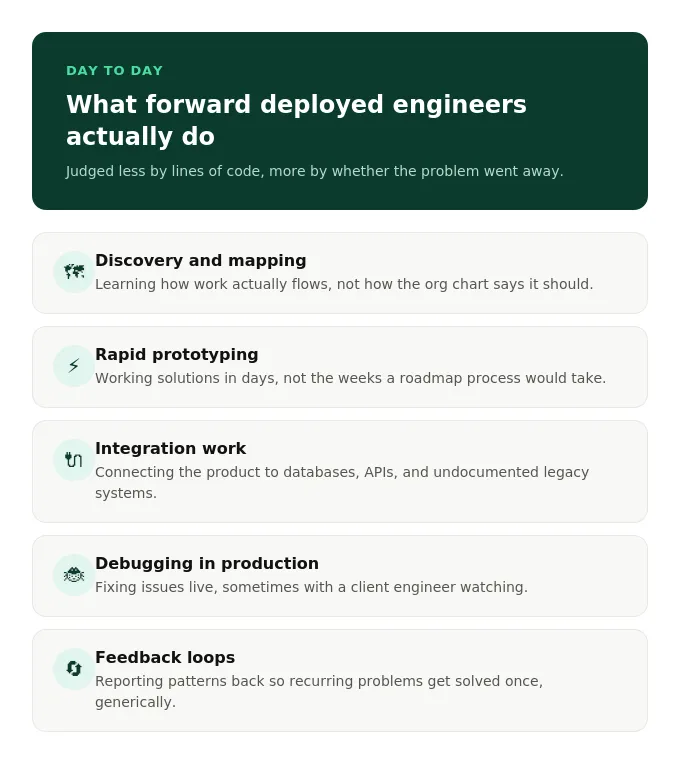
What Forward Deployed Engineers Actually Do Day to Day
No two weeks look the same, which is part of the appeal and part of the exhaustion. But most FDE work clusters around a handful of recurring activities.
- Discovery and mapping: sitting with the customer’s team to understand how work actually flows, not how the org chart says it should.
- Rapid prototyping: building a working version of a solution in days rather than the weeks a traditional roadmap process would take.
- Integration work: connecting the core product to the customer’s databases, APIs, and legacy systems — often the ugliest, least documented part of the stack.
- Debugging in production: fixing issues live, sometimes on a client’s own infrastructure, sometimes with a client engineer watching.
- Feedback loops: reporting patterns back to central product and engineering teams so recurring problems get solved once, generically, instead of repeatedly by hand.
Notice how little of that list looks like traditional feature-factory engineering. An FDE is judged less by lines of code and more by whether the customer’s problem actually went away.
A Typical Engagement, Simplified
Picture a bank piloting a new fraud-detection model. A forward deployed engineer might spend the first week just reading the bank’s transaction schemas and talking to analysts about false-positive rates. Week two is spent wiring the model into the bank’s existing case-management tool. By week four, the FDE is training the bank’s own team to maintain the integration — because eventually, the FDE has to leave, and the thing still needs to run.

Add Embedded Engineers to Your Product Team With Itexus
Itexus provides software engineers who work inside existing product and delivery workflows, supporting development, integrations, testing, and production systems.
Need Engineers Who Can Work Closely With Your Team?
Itexus can help with:
- fintech software development
- embedded engineering and staff augmentation
- API and legacy system integrations
- AI implementation
- cloud, QA, and production support
 Contact Itexus to discuss your product and engineering needs.
Forward Deployed Engineer vs. Other Customer-Facing Roles
The title gets confused with several adjacent jobs. Here’s roughly how they differ in practice.
| Role | Primary Focus | Writes Production Code? | Typical Location |
|---|---|---|---|
| Forward Deployed Engineer | Custom implementation embedded with a specific customer | Yes, regularly | Onsite or deeply embedded remotely |
| Solutions Engineer | Pre-sales technical support, demos, proofs of concept | Occasionally, mostly demo code | Mostly remote, pre-sale |
| Customer Success Manager | Relationship health, renewals, adoption | Rarely | Remote, account-focused |
| Core Product Engineer | Building generic features for all customers | Yes, constantly | HQ or fully remote, product-focused |
| Implementation Consultant | Configuration and process, less custom code | Rarely to occasionally | Onsite, project-based |
Skills That Make a Good Forward Deployed Engineer
Technical depth matters, obviously. But it’s not the whole story — a brilliant engineer who freezes in front of a frustrated client isn’t going to last in this role.
| Skill Category | What It Looks Like in Practice |
|---|---|
| Full-stack coding ability | Comfortable moving between backend integrations, scripting, and occasional frontend fixes |
| Rapid prototyping | Can produce a working proof of concept in days, not sprints |
| Systems thinking | Understands how a change ripples through a client’s existing infrastructure |
| Communication under pressure | Can explain a technical blocker to a non-technical stakeholder mid-crisis |
| Domain curiosity | Willing to learn the customer’s industry — banking regulations, hospital workflows, logistics — well enough to speak its language |
| Tolerance for ambiguity | Comfortable when the spec is “figure it out” rather than a detailed ticket |
Why Companies Lean on This Model
Here’s the thing though — most enterprise software fails not because the core product is bad, but because it never quite fits the customer’s actual environment. Legacy databases, odd compliance rules, undocumented workarounds built up over a decade: none of that shows up in a sales demo.
Forward deployed engineering closes that gap by putting an engineer directly against the mess instead of hoping a generic onboarding flow will handle it. For AI products specifically, this matters even more. A model that performs well on a public benchmark can behave unpredictably against a client’s real, dirty, inconsistent data, and someone has to be there to catch that early.
This is especially true in financial services. A digital lending platform, a trading system, or a banking app rarely gets deployed into a clean, empty environment — it has to sit next to core banking systems, KYC processes, and compliance reporting that were never designed with the new tool in mind. That’s part of why fintech firms building custom digital lending systems or trading platforms often lean on engineers who can work hands-on inside a client’s existing stack rather than shipping a rigid, one-size-fits-all product.

Rough time breakdown across a typical forward deployed engineering engagement.
Forward Deployed Engineering in FinTech
Banking and financial software carry a particular kind of complexity: regulatory reporting rules, fraud thresholds tuned to a specific customer base, and integrations with core systems that were sometimes written decades ago. A generic banking app or trading dashboard rarely survives first contact with that reality unmodified.
That’s where the forward-deployed mindset earns its keep, even for teams that don’t use the exact title. Whether it’s tailoring a banking app to a specific client’s compliance workflow, adapting a white-label banking platform to a regional regulator’s requirements, or wiring AI-driven fraud detection into an existing case-management tool through services like AI software development and integration, the underlying pattern is the same: sit close to the actual environment, adapt fast, and only generalize the solution once it’s proven to work.
Companies exploring this approach for their own platforms can look at how established fintech project case studies and a documented development process handle the handoff between custom implementation and long-term product ownership.
Salary and Career Path
Compensation for forward deployed engineers varies enormously depending on company stage, industry, and location, so any figure should be treated as a rough benchmark rather than a promise. As of 2026, several salary-tracking sites put U.S. median base pay for the role somewhere in the $180,000–$210,000 range, with senior and staff-level FDEs at well-funded AI companies sometimes clearing $250,000 or more in base salary before equity. Compensation reports from frontier AI labs push the top end even higher, though those figures represent a small slice of the market rather than the norm. Anyone evaluating an offer should check current listings directly rather than relying on any single aggregator, since ranges shift quickly in this space.
Career paths out of the role tend to go one of three ways: into product management (since FDEs accumulate deep insight into what customers actually need), into technical leadership on delivery or professional services teams, or into founding roles — a fair number of startup founders spent time as forward deployed engineers before realizing they’d essentially been running mini-companies inside someone else’s org chart.
Challenges of the Role
It’s not all exciting proofs-of-concept and grateful clients. The role has real downsides that don’t always make it into recruiting pitches.
- Travel and irregular hours: onsite engagements can mean weeks away from home, or calls that stretch across time zones.
- Context switching: jumping between wildly different client environments, each with its own stack and politics, is mentally exhausting.
- Scope creep: clients often ask for “just one more thing,” and saying no requires real backbone.
- Burnout risk: the always-on, high-pressure nature of live customer environments doesn’t suit everyone long-term.
- Career ambiguity: because the title is still fairly new, some organizations don’t have a clear promotion ladder for it yet.
How to Become a Forward Deployed Engineer
Most FDEs don’t start their careers with that title — they grow into it from adjacent roles.
A background in backend or full-stack development is the usual starting point, followed by deliberate exposure to client-facing work — implementation projects, technical pre-sales, or consulting engagements. From there, the jump to a formal FDE title usually happens by volunteering for a messy pilot project that nobody else wants and delivering on it.
The Bottom Line
A forward deployed engineer isn’t a rebranded support role or a glorified consultant — it’s a genuinely different way of building software, one where the engineer goes to the mess instead of waiting for the mess to be summarized into a ticket. For companies whose products live or die on how well they fit a specific, regulated, and often outdated environment — fintech being a prime example — that proximity isn’t a nice-to-have. It’s often the difference between a pilot that gets shelved and one that becomes a permanent part of how a client operates.
Teams weighing whether to build this capability in-house or partner with specialists who already run this model can start by reviewing how a fintech software development partner structures embedded delivery, or explore how AI-assisted tooling like Noxs AI supports faster, more customized implementations in the field.