
Wealth management workflows often depend on context that no single system holds completely. Before a client report, portfolio review, reconciliation check, or advisor briefing is ready, teams often need to confirm which data is current, which restrictions apply, why figures changed, and which commentary or disclosure language can be used.
A RAG-based workflow changes the starting point. Instead of making teams search through systems one by one, it retrieves relevant context from approved sources before the work moves forward. The workflow links outputs to source evidence, flags missing or conflicting information, and gives advisors, operations teams, and compliance reviewers a governed way to verify context before it is used in a client-facing or operational process.
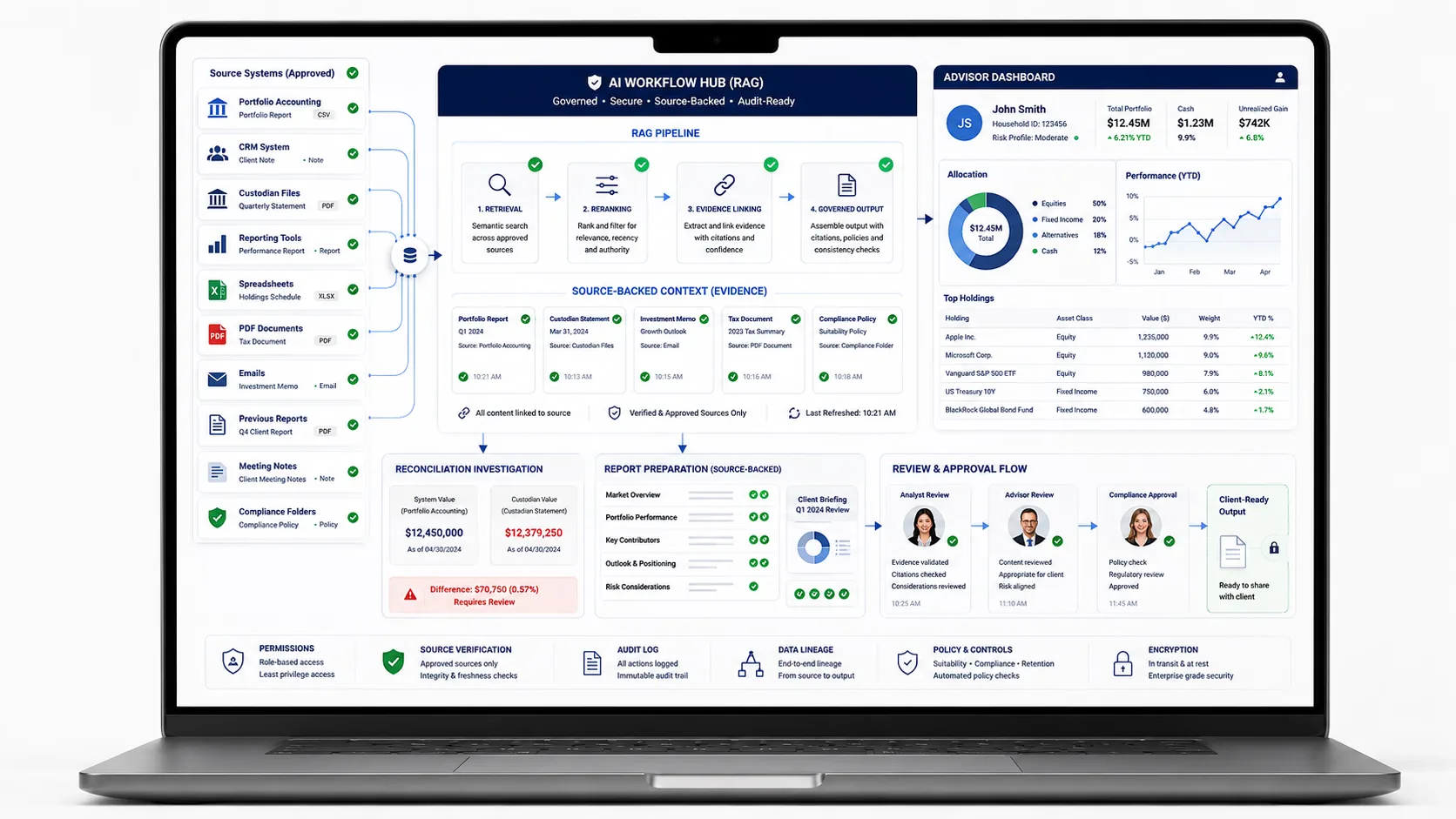
Why fragmented systems slow down client reporting
Client reporting is where fragmented wealth management systems become visible. A quarterly report or portfolio review often requires input from several systems, document stores, and teams.
Relevant context may sit across:
- portfolio accounting systems;
- CRM;
- trading or order management tools;
- custodian portals;
- reporting tools;
- spreadsheets, PDFs, and emails;
- meeting notes and previous reports;
- compliance folders.
Before a report can move to review, analysts often need to assemble the context manually. They may need to:
- export data from portfolio accounting or reporting tools;
- compare figures across system outputs;
- check transactions, cash movements, fees, and positions;
- search previous reports and advisor commentary;
- verify client restrictions and approved disclosure language;
- look for exception notes in emails or spreadsheets;
- confirm with operations, advisors, or compliance which source is current.
This creates practical reporting issues. Reports take longer to prepare, the same checks are repeated every reporting period, and figures may differ across systems. Source ownership becomes harder to confirm, client-facing statements take more effort to verify, and compliance review often requires additional evidence gathering.
For wealth management teams, the reporting challenge is a context assembly problem. They need a workflow that brings client, account, portfolio, transaction, and document evidence together before analysts begin drafting and reviewing the report.
Why search tools and point automation still leave reporting teams with manual work
Traditional search helps teams find documents. It does not always show which information is current, approved, relevant, or safe to use in a client-facing report.
A reporting analyst may find CRM notes, prior reports, emails, statements, spreadsheets, and compliance files for the same client. The harder task is to determine:
- which source is current;
- which figure was used in the last report;
- whether another system shows a conflicting value;
- which restriction applies to the account;
- which statement has compliance-approved support.
Standalone automation can improve individual steps, such as exporting data, extracting fields from a PDF, filling a template, or routing a task for review. These steps help, but they do not assemble the full client, account, portfolio, transaction, and document context needed for reporting.
Wealth management teams need source-backed context assembly. The workflow should retrieve relevant information from approved sources, connect exact data with narrative context, show where each input came from, and prepare the output for human review.
How RAG helps teams retrieve verified context before reports and reviews
A RAG pipeline helps wealth management teams turn approved client, portfolio, transaction, and document information into source-backed context for review.
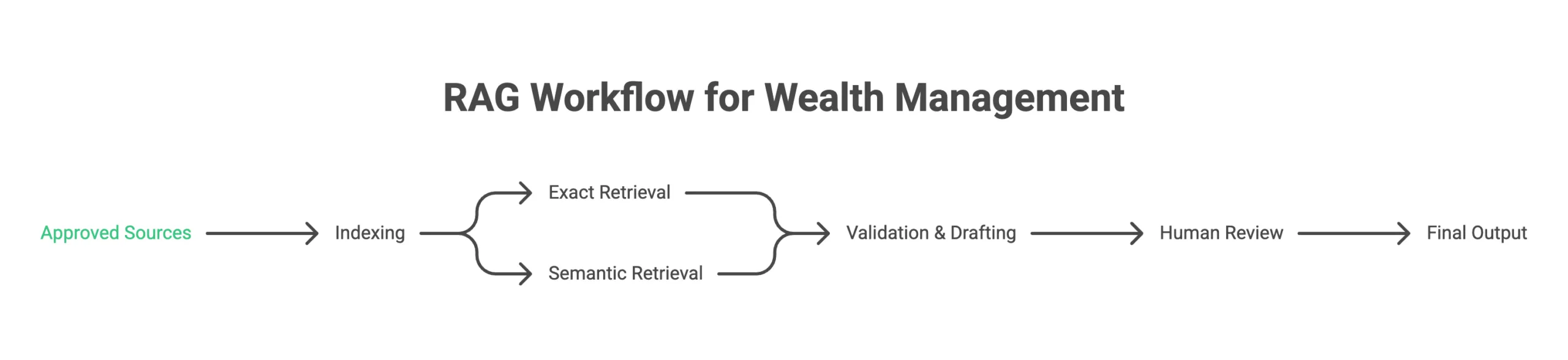
The workflow starts with approved sources, such as portfolio accounting systems, CRM records, reporting tools, custodian files, spreadsheets, PDFs, emails, meeting notes, compliance records, previous reports, investment memos, and tax documents. The pipeline indexes this information so teams can retrieve relevant evidence without searching each system separately.
The system should combine exact retrieval with semantic retrieval:
- exact retrieval helps find account numbers, transaction IDs, ISINs, tickers, reporting dates, fee terms, positions, and cash balances;
- semantic retrieval helps find meeting notes, client preferences, investment rationale, compliance comments, prior recommendations, and historical explanations.
A well-designed RAG workflow shows where each input came from, flags missing documents, conflicting figures, stale sources, or low-confidence information, and prepares a draft or summary for human review. Analysts, advisors, operations teams, and compliance reviewers can then check the evidence, edit the output, and approve the final version before it is used in a report, briefing, service request, or operational workflow.
Use case: faster client reporting with source-backed evidence
Client reporting is one of the most practical use cases for a RAG pipeline in wealth management. A quarterly report, investment review, or family office update often requires more than performance numbers. It requires the evidence behind the numbers.
Reporting teams may need to collect and verify:
- holdings;
- transactions;
- cash movements;
- fees;
- performance figures;
- client restrictions;
- previous recommendations;
- advisor rationale;
- tax context;
- approved disclosure language;
- prior report commentary;
- exception notes.
These inputs often sit across portfolio accounting systems, CRM records, custodian files, reporting tools, spreadsheets, previous reports, emails, and compliance folders. Analysts may spend hours exporting data, checking figures, searching past commentary, and confirming which source is current before the report is ready for review.
A RAG workflow changes the starting point. It retrieves relevant client, account, portfolio, transaction, and document evidence from approved sources before the report is drafted. It can show where each input came from, surface missing or conflicting information, and prepare a source-backed draft section for analyst review.
For example, when preparing a portfolio review, the system can retrieve the transactions that affected performance, the restrictions that apply to the account, the advisor’s previous rationale, and the disclosure language approved for that type of commentary. The analyst reviews the evidence and edits the draft instead of rebuilding the context manually.
The value is practical: faster report preparation, fewer repeated checks, clearer source traceability, and more consistent client-facing narratives across reporting periods.
Use case: faster reconciliation investigation with traceable evidence
Reconciliation breaks are rarely solved by looking at one number. When positions, cash balances, fees, transactions, NAV, or performance figures differ across systems, teams need to understand where the difference came from and which source should support the final report.
The explanation often lives outside the main system of record:
- a fee adjustment documented in an email;
- a corrected transaction in a custodian file;
- a cash movement noted after the reporting cut-off;
- a corporate action reflected in one system before another;
- an exception comment stored in a spreadsheet;
- a prior approval captured in an operations note;
- a previous report that used a different value.
A RAG workflow helps operations and reporting teams assemble the evidence around the break. It can retrieve related transactions, previous report values, custodian statements, exception notes, approval records, emails, and supporting documents connected to the same account, reporting period, or instrument.
This gives analysts a clearer investigation path. They can compare conflicting records, identify which source was used before, see whether an adjustment was reviewed, and document why the final figure changed. The workflow supports the investigation rather than treating reconciliation as a purely manual search through files and messages.
The value is stronger control over exception handling: less time spent looking for evidence, clearer explanations for changed figures, and a better audit trail for reporting, operations, and compliance review.
Use case: better advisor preparation with complete client context
Advisors and relationship managers often need a complete client view before a meeting, review, or service request. The relevant context may be spread across CRM notes, previous reports, emails, investment memos, account documents, tax records, estate documents, and compliance files.
A useful advisor briefing may require:
- recent portfolio changes;
- previous recommendations;
- client restrictions;
- liquidity needs;
- tax or estate context;
- open service issues;
- meeting history;
- prior objections or preferences;
- advisor rationale;
- relevant investment commentary;
- compliance-sensitive notes;
- documents supporting client-specific constraints.
This context is often available, but difficult to assemble quickly. Advisors may rely on CRM search, old reports, email threads, or colleagues who remember the relationship history. That creates friction before client meetings and increases the risk that important context is missed.
A RAG workflow can retrieve relationship context from approved sources and prepare a structured briefing for review. It can bring together account details, recent activity, previous recommendations, meeting notes, restrictions, open requests, and supporting documents in one place.
For example, before a portfolio review, the system can summarize what changed since the last meeting, retrieve the rationale behind previous recommendations, flag relevant restrictions, and show which documents support the client’s preferences or constraints. The advisor still reviews the briefing, but the preparation process starts with verified context instead of manual search.
The value is better meeting preparation, more consistent client service, and less dependence on memory or fragmented notes. Advisors can spend more time reviewing client needs and explaining decisions, while operations and support teams spend less time answering repeated context requests.
Use case: new product and strategy support
New products and strategies often create operational work before they become stable system workflows. A new ETF, SMA, model portfolio, alternative strategy, or tax-aware offering may require new eligibility rules, fee terms, restrictions, disclosure language, reporting templates, operational checklists, and exception handling notes.
When the core platform does not fully support the structure, teams often manage the process through spreadsheets, PDFs, emails, and internal instructions. This creates another source of fragmented context.
A RAG workflow can make product and strategy knowledge easier to reuse. It can retrieve product rules, disclosure language, similar historical launches, reporting requirements, account restrictions, and exception notes before teams prepare reports, advisor briefings, or operational checklists.
This helps firms support new products with clearer documentation, faster internal alignment, and less dependence on manual workarounds.
Governance: source-backed, reviewable, auditable AI
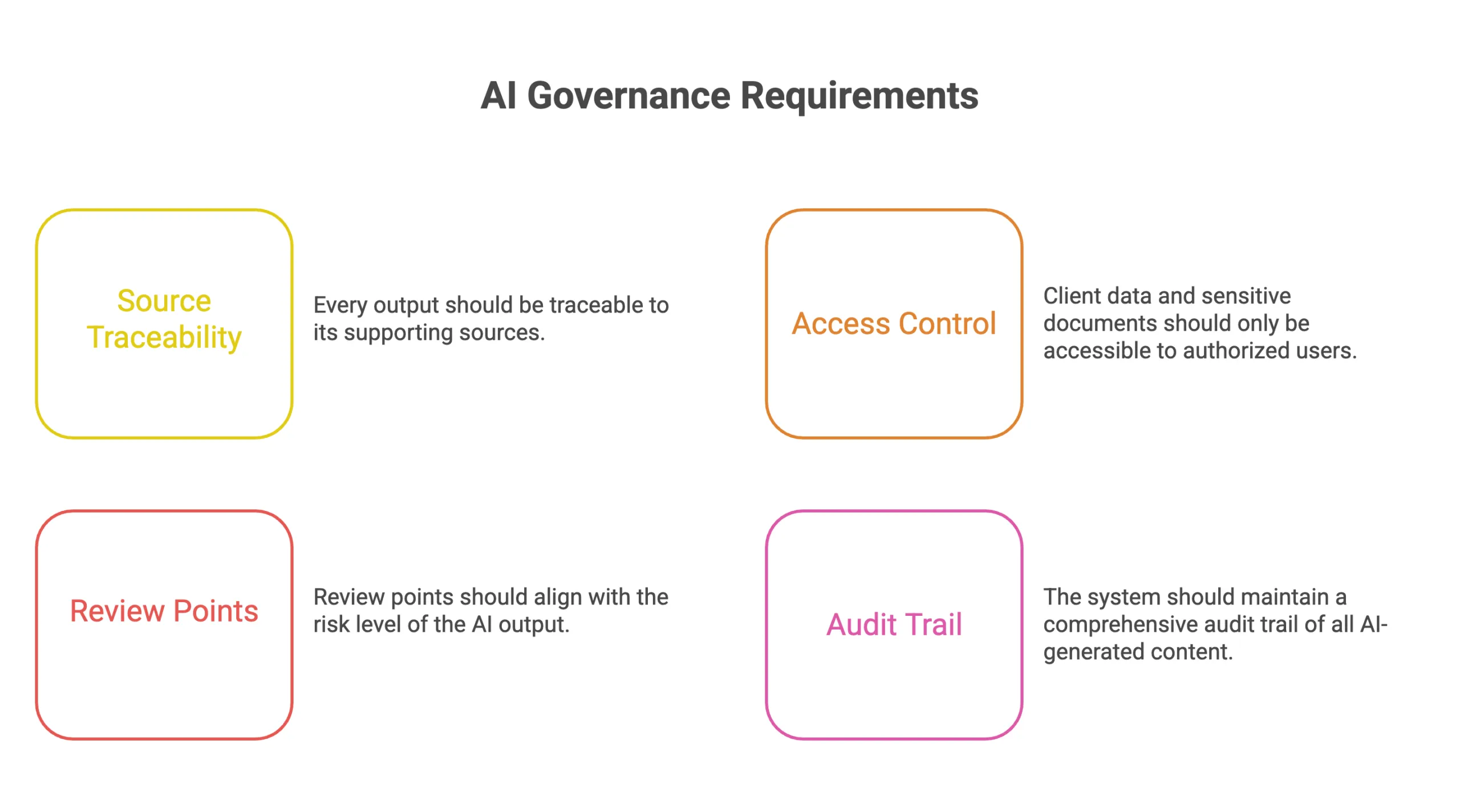
In wealth management, AI-generated output can affect client reports, advisor briefings, reconciliation notes, and compliance review. A RAG workflow should therefore make every output traceable before it is used in a client-facing or operational process.
The system should retrieve information from approved sources and reviewed documents. For each answer, draft, or summary, users should be able to see:
- which source supported the output;
- which document version was used;
- whether the source was approved, draft, or archived;
- when the source was last updated;
- whether any conflicting records were found.
Access control should be part of the workflow. Client data, tax records, estate documents, internal notes, and compliance materials should appear only for users with the right role, client-level, or document-level permissions.
Review points should match the risk of the output. Analysts can check figures in report drafts. Advisors can review client context before meetings. Compliance teams can approve language used in client-facing materials. Exceptions, unsupported statements, and low-confidence outputs should move to review instead of being treated as ready-to-use content.
The system should also keep an audit trail. It should record which sources were retrieved, what draft was generated, what edits were made, who reviewed the output, and which version was finalized. This gives teams a clearer view of how evidence shaped the final report, briefing, or reconciliation note.
Architecture: what the solution looks like in practice
A practical RAG architecture for wealth management should connect approved data sources, retrieve relevant evidence, prepare review-ready outputs, and preserve the controls needed for reporting, operations, and compliance.
The workflow usually includes:
- Source connectors: portfolio accounting systems, CRM records, reporting tools, custodian files, document storage, emails, spreadsheets, and compliance folders.
- Document processing: extraction of text, tables, metadata, and layout from PDFs, statements, reports, emails, forms, and scanned documents.
- Context enrichment: client ID, account ID, reporting period, document type, source system, approval status, timestamp, and access rules.
- Retrieval layer: keyword search, semantic search, and structured filters.
- Reranking: prioritization of the most relevant sources before draft generation.
- LLM layer: preparation of report sections, advisor briefings, reconciliation notes, or exception summaries.
- Governance layer: permissions, source links, conflict flags, review queues, and audit history.
Hybrid retrieval matters because wealth management workflows require both exact data and narrative context:
- keyword search helps find account numbers, transaction IDs, ISINs, tickers, dates, fee terms, positions, and cash balances;
- semantic search helps find meeting notes, advisor rationale, client preferences, prior recommendations, and compliance comments;
- structured filters narrow results by client, account, reporting period, document type, or approval status.
The architecture should keep governance inside the workflow. Permissions are checked before retrieval. Drafts remain linked to the sources used. Missing documents, conflicting records, stale sources, and low-confidence extractions are flagged for review. Audit logs record which sources were retrieved, what output was generated, who reviewed it, and which version was finalized.
How to implement a RAG workflow in wealth management
A practical RAG implementation should start with one workflow where fragmented information already creates measurable work. Client reporting is often the best starting point because the manual steps are visible: collecting data, checking figures, finding prior commentary, confirming restrictions, and preparing outputs for review.
A focused pilot should define:
- the workflow scope: quarterly reporting, advisor briefing, or reconciliation support;
- approved sources: portfolio accounting, CRM, reporting tools, custodian files, previous reports, spreadsheets, emails, and compliance folders;
- required metadata: client ID, account ID, reporting period, source system, approval status, timestamp, and access rules;
- retrieval logic: exact search for IDs, tickers, dates, positions, cash balances, and fees; semantic search for rationale, meeting notes, preferences, restrictions, and compliance comments;
- review rules: which outputs go to analysts, advisors, or compliance before use;
- audit requirements: retrieved sources, generated drafts, edits, reviewers, and approved versions.
The pilot should also have clear success metrics:
- time to prepare a report;
- time to collect supporting evidence;
- number of systems opened per workflow;
- average time to investigate a break;
- percentage of statements linked to sources;
- number of compliance comments or report revisions.
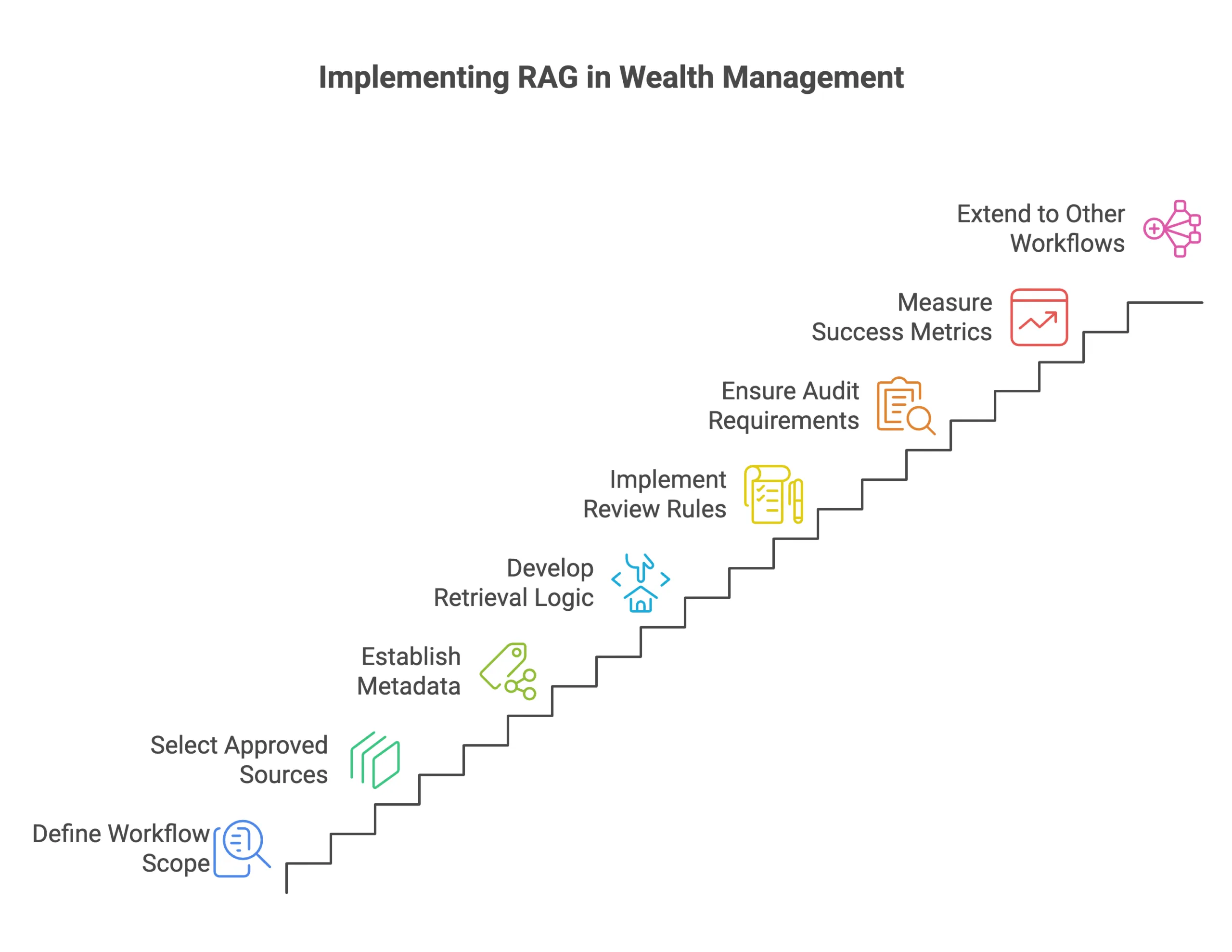
This keeps the first RAG workflow focused, reviewable, and measurable. Once the firm proves value in one reporting or review process, the same foundation can extend to reconciliation, advisor preparation, product support, and other document-heavy workflows.
Business impact: measurable automation value
The value of AI automation for wealth management should be measured at the workflow level. A RAG pipeline creates value when it reduces the manual work required to prepare reports, investigate exceptions, and review client-facing outputs.
The clearest impact is in reporting. Analysts can spend less time collecting holdings, transactions, fees, restrictions, prior commentary, and approved disclosure language across systems. This can shorten the path from data cut-off to report review and reduce the number of repeated checks in each reporting cycle.
RAG also supports exception handling. When positions, cash balances, fees, transactions, or performance figures differ across systems, the workflow can retrieve related records, prior report values, exception notes, custodian statements, and approval history. This helps teams explain why a figure changed and document the evidence behind the final output.
Useful metrics include:
- time to prepare a client report;
- time to collect supporting evidence;
- number of systems opened per report;
- number of manual copy-paste steps;
- average time to investigate a reconciliation break;
- number of unresolved exceptions at reporting cut-off;
- percentage of report statements linked to sources;
- number of compliance comments or report revisions.
The business impact is a reporting and review process that is faster, easier to verify, and easier to reproduce. Teams can scale client reporting and advisor support with clearer visibility into the sources, approvals, and decisions behind each output.
Conclusion: RAG as workflow infrastructure
Wealth management firms need reliable ways to retrieve, connect, and verify the information that supports reporting, servicing, and client advice.
A RAG pipeline brings client, account, portfolio, transaction, and document evidence into one source-backed process. It supports report preparation, reconciliation investigation, advisor briefings, and compliance review by showing where information came from, flagging missing or conflicting records, and preparing outputs for human review.
As workflow infrastructure, RAG connects approved sources, preserves permissions, links outputs to evidence, and keeps review and auditability inside the process.
The practical value is a reporting and review workflow with less manual context assembly, more consistent client-facing outputs, faster exception investigation, and clearer visibility into the sources and decisions behind each result.