
Many banks already use generative AI in requirements work, testing, documentation, code generation, and engineering support. The next challenge is integrating AI into the software development lifecycle so it improves delivery outcomes while preserving security, compliance, auditability, and production stability.
In banking, software changes affect payment processing, customer data, KYC and AML workflows, fraud controls, reconciliation logic, and regulatory reporting. Faster output creates value only when teams can release validated changes with lower delivery effort, fewer defects, and stable controls.
This article explains how banks can approach AI adoption in the software development lifecycle, where AI usually delivers the strongest return, which areas should remain human-led, how to structure an AI SDLC, and how to measure success through delivery performance rather than activity metrics.
What an AI Software Development Lifecycle Means in Banking
An AI SDLC is a governed delivery model in which AI is used across software development under explicit rules for context access, output validation, security controls, audit evidence, and human approval.
A mature AI SDLC usually includes five core elements:
- Approved use cases and boundaries: where AI can assist, where it cannot be used, and which activities remain human-led.
- Context and access controls: what repositories, documentation, tickets, logs, and internal knowledge AI tools can access.
- Validation and review rules: how AI-generated requirements, tests, code, documentation, and analysis are checked before they influence delivery.
- Security, compliance, and audit evidence: how teams capture tool usage, approvals, test results, risk decisions, and release evidence.
- Measurement and accountability: how the organization tracks delivery impact, quality, cost, risk, and ownership of production-impacting changes.
NIST’s Secure Software Development Framework (SSDF, SP 800-218) recommends secure development practices that integrate into SDLC models. Its SP 800-218A extends that guidance to generative AI and dual-use foundation model development. The NIST AI Risk Management Framework offers a structure (Govern, Map, Measure, Manage) for identifying and managing AI risk. These are voluntary frameworks, not laws, though the SSDF is referenced in US federal software-acquisition attestation requirements, including the CISA Secure Software Development Attestation Form. They do not replace internal governance, legal review, or regulatory obligations. What they share is a single principle: AI-assisted delivery must be managed as part of the engineering system, not bolted onto it.
Why AI ROI Depends on Delivery Control
DORA research shows why AI ROI cannot be judged by coding speed alone. The report measures software delivery through the full path to production: lead time for changes, deployment frequency, change failure rate, rework rate, and failed deployment recovery time. It also found that 90% of surveyed technology professionals use AI at work and more than 80% report higher individual productivity, while 30% still have little or no trust in AI-generated output.
That tension matters for banking. Generative AI can accelerate requirements, tests, documentation, implementation plans, and code, but each output still has to pass through review, validation, security checks, release approval, and operational controls. A single change may affect payment flows, KYC/AML integrations, fraud controls, customer data, reconciliation logic, audit evidence, and regulatory requirements.
AI creates economic value only when it reduces total delivery effort or shortens the path to a stable release without increasing review cycles, defects, security findings, or support workload. Baseline metrics should be defined before rollout: cycle time, review effort, defect escape rate, security findings, release stability, and cost per delivered change.
Where Banks Should Start with AI in the Software Development Lifecycle
The strongest candidates for an AI SDLC pilot share three characteristics: low operational risk, straightforward validation, and measurable outcomes.
Requirements and Acceptance Criteria
Requirements work is a practical starting point because outputs can be reviewed before implementation begins. AI can generate acceptance criteria, edge cases, workflow states, permission matrices, and test scenarios. Success is measured through reduced clarification cycles and less rework during development.
QA and Regression Testing
Test generation offers clear validation criteria and limited production risk. AI can draft unit, regression, negative-path, and edge-case tests. Teams can measure impact through defect detection, test coverage, and post-release quality metrics.
Integration Scaffolding
Banking products depend on KYC/AML providers, payment processors, fraud platforms, and open banking APIs. AI can generate adapter layers, DTO mappings, provider mocks, and contract tests. Outputs remain easy to validate through documentation, sandbox environments, and integration testing.
Documentation and Audit Evidence
Release notes, architecture decisions, test evidence, and audit records follow structured formats and require significant engineering effort. AI can automate much of this work while keeping humans responsible for final approval. Impact is visible through reduced documentation effort and audit preparation time.
Maintenance and Defect Analysis
Engineers often spend substantial time reconstructing context from logs, incidents, commits, and prior fixes. AI can summarize dependencies, identify affected modules, and suggest regression-test scope. Success is measured through faster investigation and resolution cycles.
AI Adoption Matrix for Banking SDLC
Not all SDLC activities offer the same ROI-to-risk balance. The best starting points are repetitive, easy to validate, and far enough from production-critical decisions to keep review manageable.
| SDLC Activity | ROI Potential | Risk Level | Recommended Start |
| Documentation | High | Low | Yes |
| Test generation | Very High | Low | Yes |
| Requirements analysis | High | Medium | Yes |
| Integration code | High | Medium | Yes |
| Production code generation | Medium | High | Later |
| Architecture design | Low | Very High | No |
| Security decisions | Low | Critical | No |
| Risk sign-off | Low | Critical | No |
The pattern is clear: start where AI can reduce manual effort without weakening control. Documentation, test generation, requirements analysis, and integration scaffolding are strong early candidates. Architecture, security, and risk decisions should remain human-led.
Where AI Should Not Start
AI SDLC should not begin with the most sensitive parts of a banking platform. Ledger logic, authorization rules, cryptography, payment settlement, reconciliation, fraud decisioning, AML escalation, and production infrastructure require narrow permissions and strict review.
In these areas, AI can support analysis, documentation, test-case generation, threat-modeling, and reviewer assistance. Production-impacting changes should remain engineer-led and pass through existing SDLC controls. OWASP guidance for AI-assisted development supports least-privilege access, human review, and additional controls for security-sensitive changes.
Leadership also needs a clear boundary between AI as an engineering tool and AI as a decisioning system. This article addresses AI inside the software delivery process. AI used in credit scoring, fraud, AML, or other customer-impacting decisions falls under model risk management, fairness, explainability, validation, monitoring, and independent review.
What Banks Restrict in Practice
Public disclosures suggest that large financial institutions rarely prohibit AI outright. Instead, they restrict the use of public AI tools in areas involving confidential data, customer information, internal systems, source code, or regulated decision-making processes.
Several major banks introduced restrictions on employee use of public or externally hosted generative AI tools. JPMorgan Chase restricted ChatGPT due to third-party software and compliance concerns, according to Bloomberg reporting summarized by Glenbrook. More recently, Reuters reported that JPMorgan blocked Hong Kong staff from accessing Anthropic’s Claude models, following a similar Goldman Sachs move to remove Claude from approved tools for Hong Kong-based bankers. The common concern is not the technology itself but the potential exposure of non-public information to external models, vendors, licensing constraints, and regional risk.
A similar pattern appears in AI-enabled decisioning. The European Banking Authority notes that, under the EU AI Act, AI systems used to evaluate creditworthiness or establish credit scores of natural persons are classified as high-risk AI systems. That means they are subject to additional governance, oversight, documentation, and monitoring requirements rather than unrestricted deployment.
A common pattern emerges across financial institutions: AI is typically adopted first in documentation, testing, knowledge retrieval, engineering assistance, and workflow automation before being introduced into areas that directly affect customer outcomes, security controls, risk decisions, or regulated business processes.
What Regulators and Auditors Will Ask
Regulators rarely address AI-assisted software development as a separate category. They usually treat it through existing control areas: ICT risk, operational resilience, outsourcing, model risk, data governance, change management, and accountability.
For European banks, the ECB links AI adoption to strong governance, risk management, DORA, and the EU AI Act. The main supervisory concerns are data quality, explainability, model lifecycle controls, and accountability. In the UK, the PRA and FCA take a technology-neutral approach, focusing on governance, validation, monitoring, operational resilience, and third-party risk. MAS emphasizes pre-deployment checks, monitoring, change management, and AI model risk governance. FINMA is more explicit: banks should maintain an AI inventory, classify use cases by risk, define responsibilities, document controls, test models, and train staff.
For AI-assisted development, auditors will likely ask for evidence rather than broad AI statements: approved tools, repository access rules, prohibited use cases, human review points, CI/CD checks, audit logs, third-party assessments, and proof that AI-generated outputs do not weaken security, compliance, or release stability.
Implementation: A Phased Rollout
For banking and fintech teams, treat AI SDLC as a controlled operating model, not a tool rollout, and sequence it.
Phase 1: establish the harness and pilot narrow. Run an AI-readiness assessment of the product domain, codebase, architecture, CI/CD pipeline, test coverage, security controls, data sensitivity, and integrations. Stand up repository-context rules, an approved model-and-tool matrix, prompt and rule templates, a test-generation workflow with human review, dependency controls, CI/CD gates for AI-assisted code, and audit-evidence templates. Pilot on bounded, verifiable work: test generation, integration scaffolding, API contract testing, documentation automation, defect analysis, and maintenance of existing modules. Instrument the pilot with a dashboard tracking quality, cost, security, and delivery impact. Define in advance when a measurable signal should appear, using the organization’s own delivery cadence rather than perceived speed.
Phase 2: expand on evidence. Widen scope only where the pilot shows a measured net benefit, carrying the same controls forward.
Throughout, the highest-risk areas stay engineer-led: authorization, ledger logic, settlement, reconciliation, fraud decisioning, cryptography, AML escalation, and production infrastructure can benefit from AI-assisted analysis and review, but not from unreviewed autonomous change. This sequencing is especially relevant for banks, fintechs, payment processors, digital wallets, lenders, and platform vendors that depend on customized integrations across KYC/AML, fraud, open banking, payment, lending, credit-scoring, and data-aggregation systems.
How to Measure Success
AI adoption in banking should be measured through delivery outcomes rather than activity levels. More generated code, tests, or documentation does not necessarily improve engineering performance.
A pilot should track a small set of metrics before and after AI adoption:
- Cycle time: time from approved requirement to production release.
- Review effort: engineering time spent reviewing and validating AI-assisted output.
- Defect escape rate: defects discovered after release.
- Security findings: vulnerabilities identified during review, testing, or production.
- Release stability: failed deployments, rollbacks, and post-release incidents.
- Cost per delivered change: delivery effort, tooling costs, and review overhead relative to completed work.
Success appears when teams deliver changes faster while maintaining or improving quality, security, and operational stability. If output grows but review effort, defect rates, or release incidents increase, the bottleneck has simply moved to another part of the delivery process.
How Much Does It Cost to Implement AI within Banking Engineering teams?
There is no single benchmark for the cost of implementing AI inside banking engineering teams. The budget depends on scope: a coding-assistant rollout, an AI SDLC pilot, and a full agentic engineering platform are different investment profiles. Available implementation benchmarks suggest that AI development projects often range from $25,000 to $500,000+, with fintech and banking implementations reaching $30,000 to $1M+ depending on compliance, data, integration, and infrastructure requirements. Master of Code also notes that data, integration, and infrastructure are usually the main cost drivers, while hidden costs such as inference, monitoring, human review, and compliance can increase total budget by 30–100%.
Broader AI implementation estimates point to the same cost structure. Riseup Labs estimates that data preparation can consume 30–50% of the budget, infrastructure can range from several thousand dollars to $10,000–$50,000+ per month, mid-size integrations can cost $20,000–$80,000, enterprise integrations can exceed $150,000, compliance can add 10–20%, and maintenance can add 15–30% annually. 7T’s implementation-cost analysis puts hidden enterprise AI costs in ranges such as $25,000–$150,000 for compliance, $30,000–$200,000 for legacy integration, $20,000–$100,000 for security and access controls, and $15,000–$75,000 annually for retraining and change management.
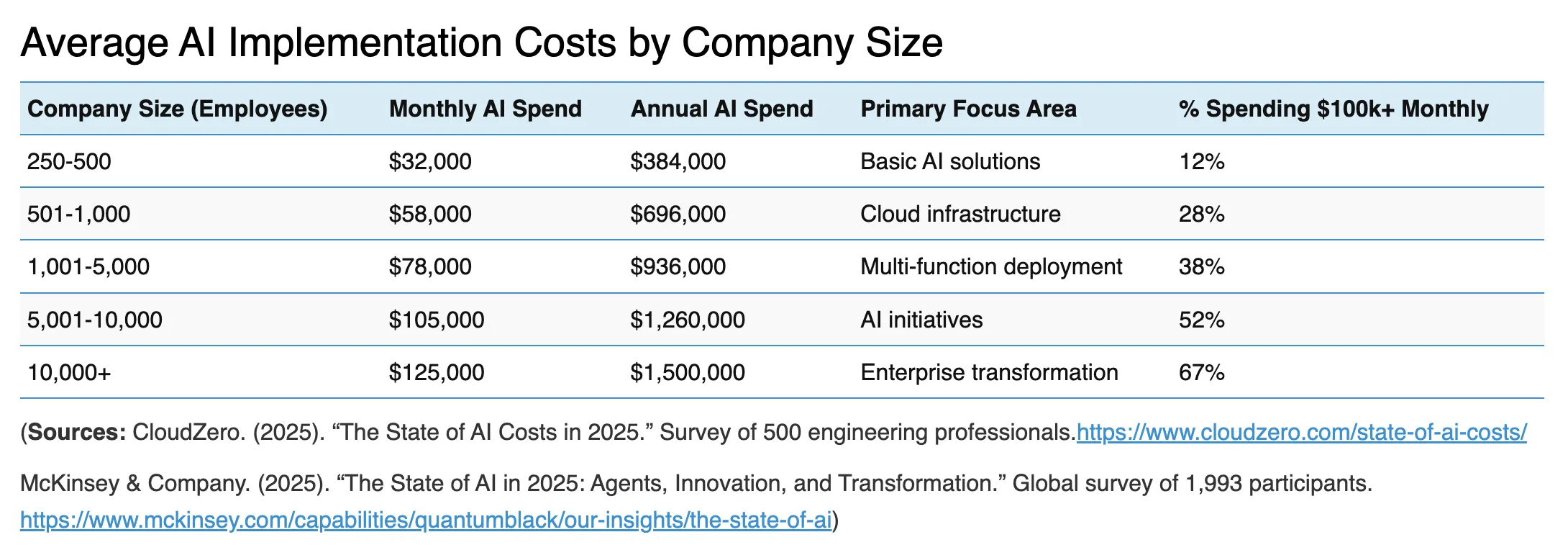
Source: https://7t.ai/blog/cost-of-implementing-ai-in-business-7tt/
For banking engineering teams, the practical budget is usually built from several layers: licenses and model usage, SDLC integration, repository access controls, security review, audit logging, data governance, developer training, evaluation, and ongoing cost monitoring. My conclusion: a narrow banking engineering pilot can fit into a five-figure budget when it uses existing tools and limited repositories, but a governed rollout across engineering teams usually moves into six figures once integration, security, compliance, training, and measurement are included.
Common Rollout Mistakes
Research on AI-assisted software development points to a recurring challenge: generating more output is easier than validating and releasing it safely.
- Measuring output instead of delivery outcomes
DORA links software delivery performance to the full delivery system, including testing, deployment, operational stability, and feedback loops. Code volume, pull requests, and generated artifacts are weak metrics. CTOs should track cycle time, defect rates, change failure rates, release stability, and operational performance.
- Scaling output without scaling validation
AI can increase the volume of requirements, code, tests, and documentation entering the pipeline. Review, QA, security, and compliance capacity may not grow with it. METR’s 2025 randomized controlled trial found that experienced developers working on mature codebases were 19% slower with AI tools, despite expecting productivity gains.
- Starting with high-risk systems
Ledger logic, payment authorization, settlement, fraud decisioning, AML escalation, cryptography, and production infrastructure require stricter controls than documentation, testing, or integration scaffolding. OWASP guidance supports least-privilege access, human review, and additional controls for security-sensitive changes.
- Expanding access before governance
AI tools may touch source code, architecture documentation, incident records, internal knowledge bases, and operational data. NIST AI RMF and SSDF emphasize governance, access control, accountability, and traceability. These controls should be defined during the pilot, not after rollout.
- Scaling before baseline metrics
DORA and BCG both point to the same conclusion: AI creates value when it improves delivery outcomes across the lifecycle. Teams need baseline metrics for cycle time, review effort, defect escape rate, security findings, release stability, and incidents before expanding AI usage.
Executive Decision
AI SDLC is ready to scale only when the pilot shows measurable improvement in delivery outcomes without increasing review burden, security findings, release instability, or operational incidents.
If AI increases activity but does not improve cycle time, defect rates, audit readiness, or cost per delivered change, the organization has added another layer of engineering work rather than improved the delivery system.