
Banking app development is costly because much of the work sits outside code production.
In regulated financial products, teams spend significant time clarifying requirements, rebuilding integrations, extending QA cycles, reviewing security risks, preparing compliance evidence, stabilizing releases, and maintaining systems after launch. Artificial intelligence in banking can reduce some of this effort, but it can also add review, governance, and quality-control costs when adoption is poorly managed.
This makes ROI difficult to estimate from productivity claims alone. In banking and fintech delivery, AI creates financial value when it reduces rework, shortens release cycles, lowers operational effort, or brings business value forward.
This article explains where AI can reduce banking app development costs, where it can add hidden costs, and how to calculate ROI using cost-saving and time-to-market models.

The Executive Economics
Start with where the money actually goes. In regulated banking delivery, hands-on-keyboard coding is often only one part of total delivery cost. The larger spend sits in the loops surrounding it: clarifying ambiguous requirements across product, risk, and compliance; building and re-building third-party integrations; QA and regression; security review and remediation; producing audit and compliance evidence; stabilizing releases; and maintaining systems for years.
The exact distribution depends on the product type, regulatory exposure, integration depth, and project size. A digital wallet, a trading platform, and a corporate banking application will not have the same cost profile. Still, a typical fintech delivery budget often spreads across several major workstreams rather than sitting mostly in coding.
| Activity | Banking / Regulated Systems | Wallets / Payments | What Drives the Cost |
| Business analysis and requirements | 15–20% | 10–15% | Scope, user flows, edge cases, stakeholder alignment, regulatory requirements |
| Architecture and security design | 10–15% | 8–12% | Scalability, resilience, data flows, access control, transaction safety |
| Development | 25–40% | 30–45% | Frontend, backend, mobile, APIs, business logic, admin panels |
| QA and testing | 15–25% | 15–25% | Functional testing, regression, integration testing, edge cases, test automation |
| Compliance and audit preparation | 5–15% | 5–10% | Documentation, audit trails, regulatory checks, evidence collection |
| Integrations with core systems and third parties | 10–20% | 10–20% | Core banking, KYC/AML, payment processors, market data, broker APIs, open banking |
| DevOps, releases, and support setup | 5–10% | 5–10% | CI/CD, monitoring, environments, deployment, release stabilization |
Note: The ranges are directional estimates based on Itexus delivery experience across banking, payments and digital wallet projects. They are informed by industry research on software delivery economics, testing costs, DevOps performance, compliance requirements, and banking technology transformation from NIST, DORA, IBM, McKinsey, Deloitte, Accenture, and BCG.
That cost structure has a direct consequence that every CFO should internalize: even a large speed-up in coding touches only part of total delivery cost. A tool that makes typing code dramatically faster but adds review burden, dependency risk, and rework downstream can raise net cost. This is not just theoretical. It is the practical implication of the evidence below.
So the economics are best modeled not as a single ROI figure but as a set of levers:
- Cost AI can remove: rework from unclear requirements, repetitive integration scaffolding, late-discovered defects, manual test authoring, manual documentation and audit-evidence assembly, and slow context reconstruction during maintenance.
- Cost AI can add: more code and pull requests to review, more dependencies to verify, more tests to stabilize, more security exceptions to investigate, model/token spend, and longer release stabilization if output outruns review capacity.
Net savings are the first list minus the second. Because that balance is specific to your codebase, team, and controls, no credible external percentage can be imported as your number. The right financial posture is to baseline your current delivery economics, run a controlled pilot, and measure the delta locally. Any vendor or internal proposal that promises a fixed percentage saving without that local measurement should be treated as a sales claim, not a forecast.
The governance harness is also an upfront investment: tooling and enterprise model contracts, controls and templates, and enough review capacity so earlier output does not simply move the bottleneck to reviewers. That cost is real and should be budgeted before any savings are expected.
Define in advance when a measurable signal should appear, using your own delivery cadence rather than an external benchmark. Any proposal promising returns faster than your own delivery process can demonstrate them is a sales claim rather than a forecast.
How Is AI Used in Banking App Development?
In banking app development, artificial intelligence in banking works best before and around coding:
- translating requirements into testable specifications
- mapping dependencies across core banking systems
- payment APIs, KYC/AML providers
- customer data flows
- release constraints.
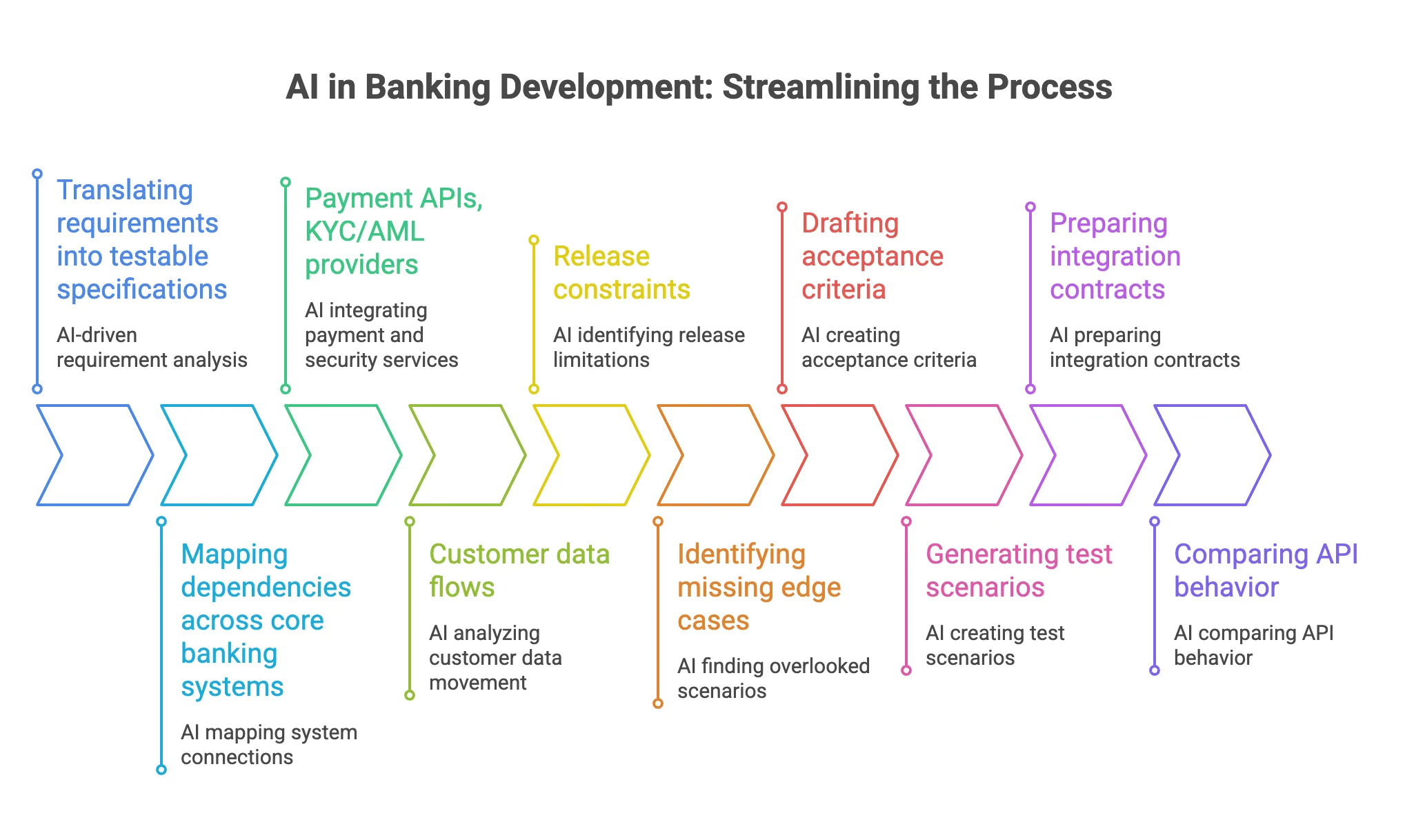
For engineering teams, this changes the delivery workflow. AI can help identify missing edge cases, draft acceptance criteria, generate test scenarios, prepare integration contracts, compare API behavior, and surface inconsistencies between product logic, compliance requirements, and technical implementation.
This is how AI reduces costs in banking development: by lowering rework, review friction, QA gaps, and release risk before they become expensive downstream problems. In AI digital banking projects, the value depends on whether AI-assisted work can be traced, reviewed, tested, and approved against security rules, transaction logic, access controls, audit evidence, and production-readiness criteria.
Where AI Delivers the Highest ROI in Banking and Financial Services
The value of AI depends heavily on the nature of the work being performed. Based on Itexus delivery experience across banking, payments, wealth management, trading, and fintech platform projects, the strongest ROI tends to appear where work is repeatable, well-scoped, and easy to validate.
Projects with standardized workflows, predictable implementation patterns, and clear testing criteria are often better candidates for AI-assisted development. In these cases, teams can automate portions of implementation, testing, documentation, and integration work while maintaining appropriate review processes.
The economics are different in projects dominated by legacy dependencies, complex financial logic, or specialized risk models. Here, the primary constraints are often validation, compliance, and domain expertise rather than implementation effort alone. As a result, improvements in coding speed may have a smaller effect on overall delivery economics.
| Project Type | Expected AI ROI | Why |
| Mobile banking apps | High | Large volumes of repeatable frontend and backend code, standard user flows, extensive UI work |
| Customer self-service portals | High | Reusable patterns for authentication, dashboards, notifications, and workflows |
| Wealth management dashboards | High | Significant amounts of presentation, reporting, and integration code |
| CRM and internal operations platforms | High | Repetitive business logic, forms, workflows, and administrative functionality |
| Lending systems | Medium | AI accelerates development, but integrations, compliance, and workflow complexity remain major cost drivers |
| KYC/AML workflows | Medium | Strong automation potential, but regulatory requirements increase review and testing effort |
| Payment processing platforms | Medium | Integration work, security controls, and transaction reliability often limit net savings |
| Core banking modernization | Lower | Legacy dependencies, migration risk, and business-critical workflows dominate project economics |
| Treasury platforms | Lower | Domain expertise, operational risk, and validation requirements outweigh coding speed |
| Risk and pricing engines | Lower | Mathematical correctness, model validation, and regulatory scrutiny create bottlenecks outside development itself |
What the Evidence Actually Supports
The strongest evidence for AI in software development supports targeted acceleration, not blanket cost reduction. Developer speed becomes financially relevant only when it changes delivery economics: lower effort, shorter cycle time, fewer defects, faster release, or earlier business value.
A controlled study by researchers at GitHub and Microsoft found that developers completed a specific, self-contained task, implementing an HTTP server in JavaScript, 55.8% faster with GitHub Copilot than a control group. The result is useful for bounded, greenfield coding tasks, but limited for banking economics because it measures task speed, not total delivery cost.
The counterevidence matters just as much. A 2025 randomized controlled trial by METR found that 16 experienced open-source developers working across 246 tasks on mature repositories they knew well took 19% longer with early-2025 AI tools. They expected AI to make them 24% faster and believed afterward they had been roughly 20% faster. They were slower while feeling faster.
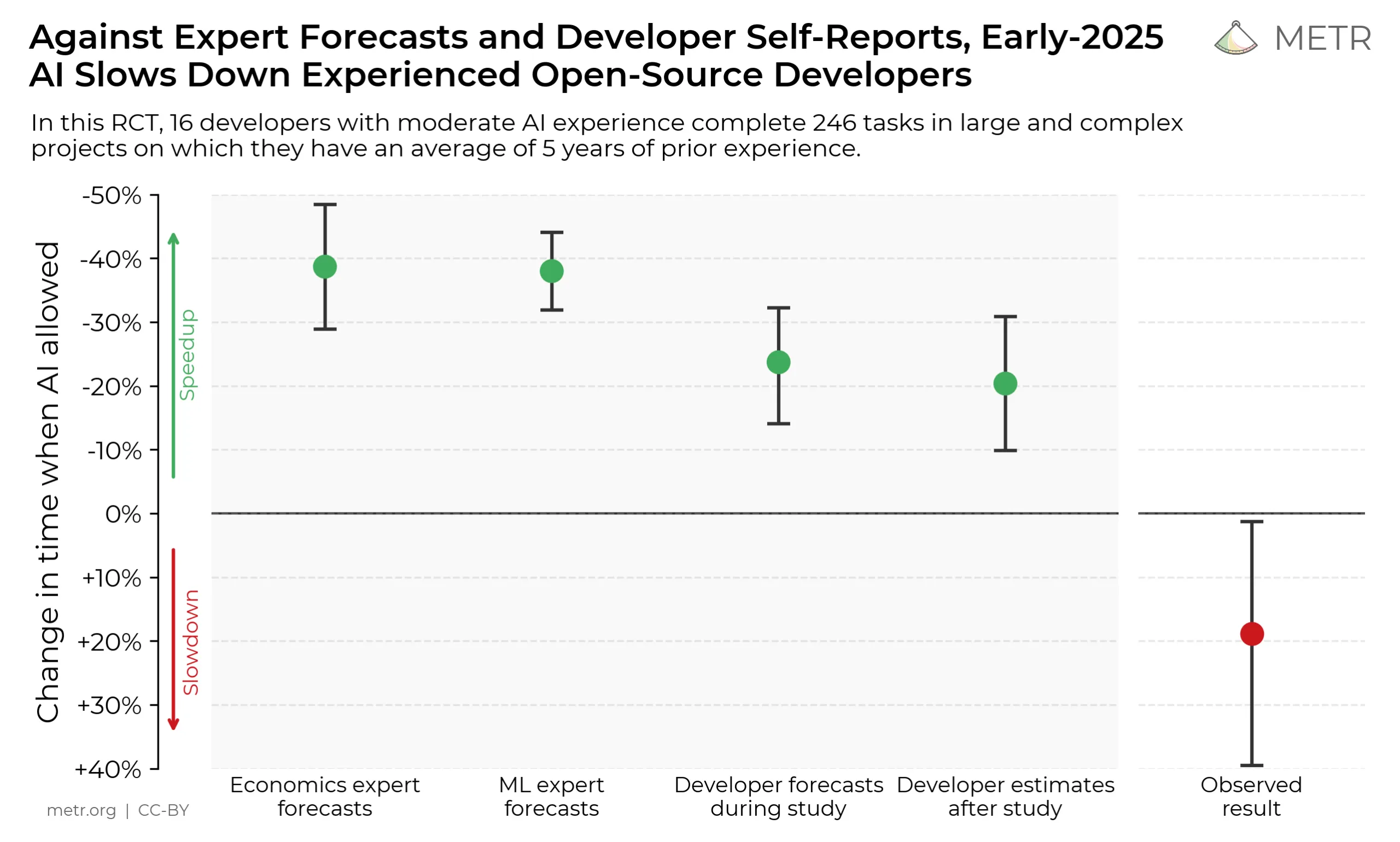
Source: METR, 2025.
That gap matters for financial decisions. Self-reported productivity and tool satisfaction cannot prove cost savings. A team may produce more output while the organization absorbs more review, testing, remediation, and stabilization work downstream.
BCG’s 2026 Future of Finance report adds a useful economic frame: AI impact should be measured through unit economics, such as cost-to-serve, cost per transaction, processing speed, revenue uplift, and risk reduction. It also argues that the strongest results come when institutions reshape functions and processes end-to-end, rather than layering AI onto existing workflows.
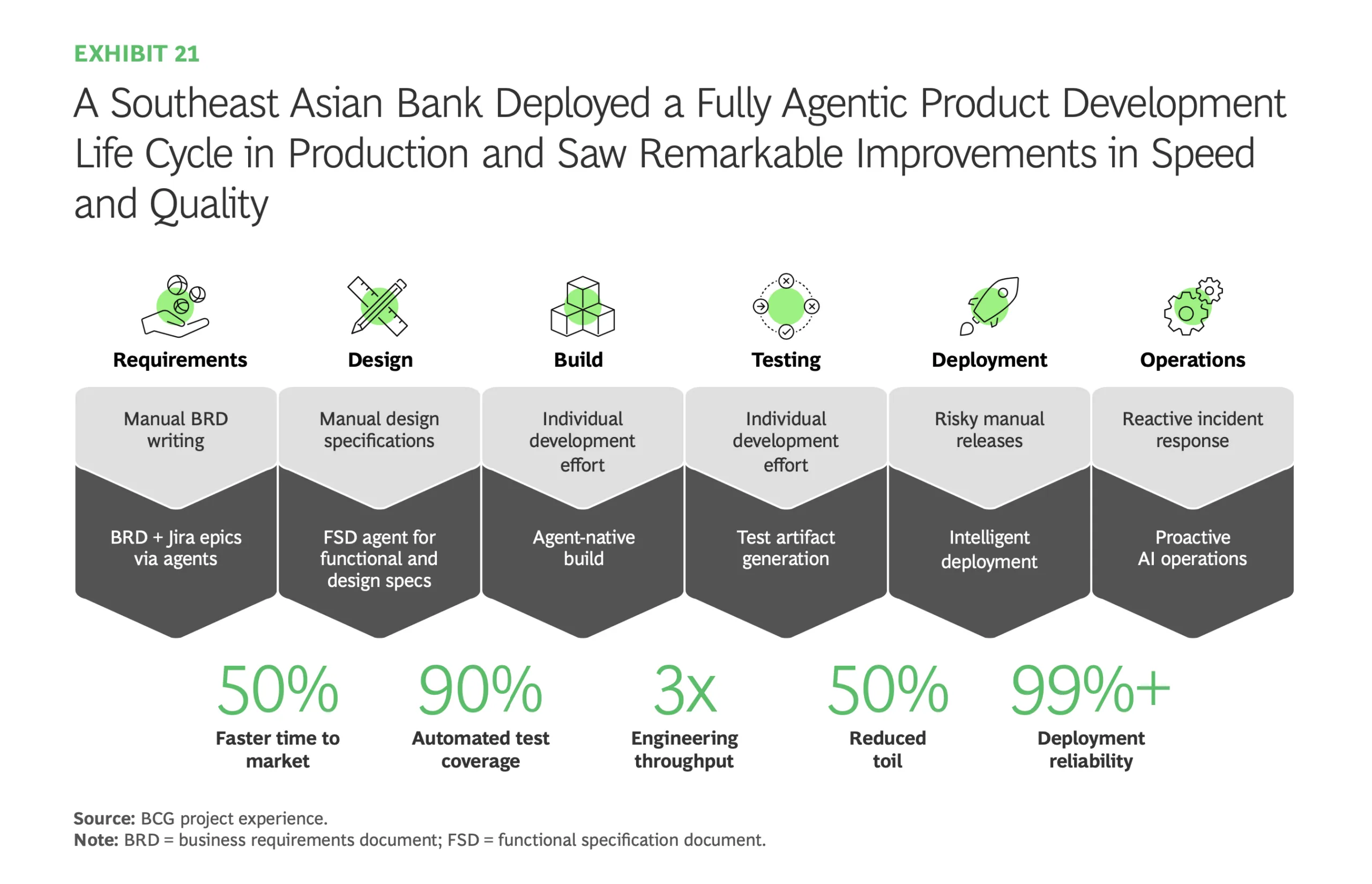
Source: BCG, The Future of Finance 2026. Exhibit 21 shows how agentic AI can support the full product development lifecycle, from requirements to operations.
The software development evidence points in the same direction. BCG reports that one US G-SIB integrated agentic AI software engineers into the development process and saw around 30% average productivity uplift across engineering teams, with about 60% uplift for top-performing cohorts. In another example, a Southeast Asian bank deployed an agentic product development lifecycle and reported more than 50% faster time-to-market, 3x engineering throughput, 90% automated test coverage, and deployment reliability above 99%.
These numbers are not universal banking cost benchmarks. They show where the economics become meaningful: when AI changes the full delivery system, from requirements and design to build, testing, deployment, and operations.
The financial conclusion is narrow but useful. AI is more likely to improve project economics when the work is bounded, context-rich, testable, and reviewable. It is less likely to reduce total cost when the main constraints are legacy dependencies, regulatory validation, security review, domain judgment, or release risk.
How to Measure Whether It Is Working
Accepted code suggestions are not a sufficient metric; they say nothing about whether delivery became cheaper, safer, or more predictable. Establish a baseline, then run a controlled pilot on comparable workstreams and measure the delta.
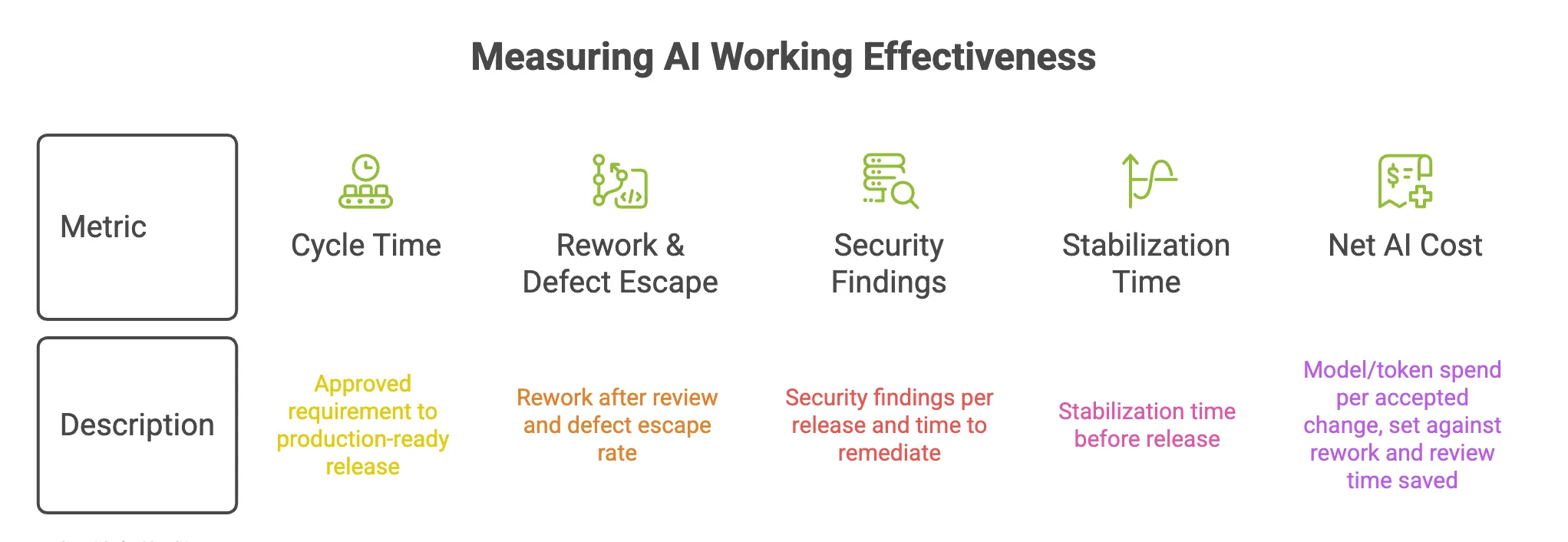
The metrics that matter most to leadership are a small set of outcomes, each with a clear definition and denominator:
- cycle time from approved requirement to production-ready release;
- rework after review and defect escape rate;
- security findings per release and time to remediate them;
- stabilization time before release;
- net AI cost: model/token spend per accepted change, set against the rework and review time saved.
Engineering leaders can track finer-grained signals beneath these: requirement-clarification time, review effort per AI-assisted pull request, AI-suggested dependencies rejected by policy, AI-generated tests rewritten or removed, incidents where AI output caused rework, and tasks where AI was disabled because risk outweighed benefit.
The goal is not to prove AI is always faster. It is to find where AI safely shortens loops and where it should stay limited to analysis, testing, documentation, or reviewer support. Metrics only compare meaningfully when defined consistently across teams and time.
How to Calculate ROI from AI Adoption
Across fintech, banking, payments, and wealth management delivery work, we have seen that the largest gains rarely come from code generation alone. The more consistent improvements appear around the code: faster requirements clarification, quicker prototyping, earlier test creation, cleaner documentation, integration scaffolding, and smoother knowledge transfer across teams.
ROI should be calculated against the business objective. Some organizations use AI to reduce delivery and maintenance costs. Others use it to release revenue-generating features earlier. The measurement model should reflect that difference.
Method 1: Cost-Saving ROI
This method fits projects where the main objective is reducing the cost of delivery, maintenance, or internal operations.
It is common for:
- internal banking platforms;
- operational tools;
- advisor portals;
- back-office systems;
- compliance and reporting applications.
The formula is:
Cost-Saving ROI = (Cost Savings – AI Adoption Costs) / AI Adoption Costs
Where:
Cost Savings = design savings + development savings + QA savings + BA/documentation savings + support/DevOps savings
AI Adoption Costs = tooling + governance + security review + training + additional code review
Example: Banking Operations Platform
In one banking platform engagement, the client needed to improve the efficiency of customer onboarding, internal compliance workflows, reporting processes, and third-party integrations. Multiple teams were spending significant time on documentation, data reconciliation, operational reviews, and coordination across systems.
The project focused on building a banking operations platform that centralized workflows, reporting dashboards, document management, and integration processes. The goal was to reduce operational overhead, improve delivery efficiency, and lower the amount of manual effort required across BA, engineering, QA, and support.
During the six-month delivery cycle, AI-assisted workflows were used for requirements structuring, prototype iteration, test case generation, documentation drafts, and integration scaffolding. Human review remained in place for business logic, security-sensitive changes, and final approvals.
Before AI-assisted workflows, the estimated delivery cost for the relevant workstream was:
| Activity | Before AI |
| Business analysis and documentation | $45,000 |
| Development | $180,000 |
| QA and testing | $70,000 |
| Support and DevOps preparation | $25,000 |
| Total | $320,000 |
After AI-assisted workflows were introduced, the team estimated the following savings:
| Savings Source | Estimated Savings |
| Faster requirements structuring and documentation | $10,000 |
| Development acceleration on repeatable implementation tasks | $35,000 |
| Earlier test case creation and QA support | $15,000 |
| DevOps and support documentation efficiencies | $5,000 |
| Total Savings | $65,000 |
AI adoption also created additional costs:
| AI Adoption Cost | Cost |
| Enterprise AI tools | $8,000 |
| Governance and security review | $7,000 |
| Team training | $5,000 |
| Additional code review effort | $5,000 |
| Total AI Costs | $25,000 |
With $65,000 in savings and $25,000 in AI adoption costs, the cost-saving ROI was 160%. (ROIcost = (65,000-25,000)/(25,000)=160%)
In practical terms, every dollar invested in AI adoption generated approximately $1.60 in net savings for that workstream.
Method 2: Economic ROI
Cost reduction is not always the main objective. In competitive fintech markets, the larger value may come from releasing features earlier.
This is common for:
- digital banking products;
- neobanks;
- payment platforms;
- consumer fintech applications;
- wealth platforms where new features influence acquisition, retention, or AUM growth.
The formula is:
Economic ROI = (Cost Savings + Time-to-Market Value – AI Adoption Costs) / AI Adoption Costs
Where:
Time-to-Market Value = monthly business value × months accelerated
Example: Digital Banking Self-Service Feature
In a digital banking engagement, the product team worked on a self-service card management feature. The feature allowed customers to manage card limits, block or unblock cards, request replacements, and resolve common card-related issues without contacting support.
The business case depended on speed. Earlier release meant faster customer adoption, fewer support tickets, and quicker validation of the bank’s self-service roadmap.
AI-assisted delivery supported the team in several areas: drafting acceptance criteria, generating frontend and backend boilerplate, preparing test cases, documenting edge cases, and accelerating integration work around card status and customer notifications.
The team estimated that AI-assisted delivery shortened the implementation timeline by approximately two months.
The feature was expected to contribute about $100,000 per month in business value through higher customer engagement, lower support costs, and increased product adoption. Releasing it two months earlier created approximately $200,000 in time-to-market value.
Additional assumptions:
| Item | Amount |
| Engineering cost savings | $50,000 |
| Time-to-market value | $200,000 |
| AI adoption costs | $30,000 |
With $50,000 in engineering cost savings, $200,000 in time-to-market value, and $30,000 in AI adoption costs, the economic ROI was approximately 733% (ROIeconomic = (50,000 + 200,000 − 30,000) / 30,000 =733%).
In this scenario, most of the value came from bringing the feature to market earlier, not from reducing engineering cost alone. For customer-facing fintech products, this distinction matters. Revenue, customer adoption, retention, and support efficiency often move faster than engineering budgets.
The Executive Decision
At this stage, leadership is deciding whether AI-assisted delivery is ready to move from informal individual use to a governed pilot inside the software development lifecycle.
The decision establishes the investment case for AI adoption. Before expanding usage, the organization needs a defined pilot scope, a measurable baseline, clear ownership, and agreed criteria for success.
Four questions can guide the decision:
- Scope: Which workstreams are specific, testable, and low enough in risk to pilot?
- Baseline: What does current delivery performance look like before AI is introduced?
- Capacity: Can the team review, test, and stabilize AI-assisted output without moving the bottleneck to reviewers?
- Accountability: Who is responsible for approving AI-assisted work and tracking its impact?
A pilot is worth funding when the scope is narrow, the success metrics are defined, and the team can compare results against its current delivery baseline. Scaling should wait until measured outcomes, not perceived speed, show that AI improves cost, quality, and delivery predictability.
Conclusion
The economic impact of AI in banking app development is determined by its influence on the full software delivery lifecycle: requirements, integrations, testing, compliance activities, release preparation, and maintenance. This is also why AI and ML in financial software development should be measured by delivery outcomes, risk control, and maintainability, not only by code generation speed.
This is why the same AI tool can produce very different financial outcomes. In a bounded workflow with repeatable implementation patterns, AI may reduce delivery effort and shorten release cycles. In a core banking migration, payment settlement flow, risk engine, or compliance-heavy integration, the bottleneck is usually validation, review, and operational risk. Faster output helps only if the organization can verify it without adding more downstream work.
The practical test is simple: measure the baseline, define the workstream, count both savings and added costs, and compare the result against real delivery data. If AI reduces rework, review effort, QA load, documentation time, or time-to-market value, it has a business case. If it only increases the volume of code entering review, it has moved the cost rather than reduced it.