
Artificial intelligence is becoming part of everyday software development. GitHub Copilot, Cursor, Claude Code, and agentic development environments already help engineering teams write code, generate tests, summarize documentation, and analyze repositories. In banking, these tools can only scale when they are governed as part of the software development lifecycle, with clear rules for data access, human approval, security review, and audit evidence.
Banking software operates under stricter constraints than most enterprise systems. A single production change can affect payments, onboarding, account access, fraud controls, regulatory reporting, or integrations with core banking platforms. Faster code generation does not remove the need for security reviews, compliance checks, audit evidence, and operational resilience controls.
Research on AI-assisted development reflects this trade-off. AI can improve productivity on well-defined tasks, but in large, mature codebases the gains may disappear if teams spend more time on review, testing, and stabilization. Google Cloud’s DORA research offers a useful framing: AI amplifies the strengths and weaknesses of the existing engineering organization.
Banking executives need to determine which parts of the AI development lifecycle can safely benefit from AI, which controls should govern them, and what evidence proves that security, compliance, and software quality remain intact.
This article continues our previous discussion of the AI software development lifecycle in banking and focuses on the governance controls needed to scale AI-assisted development safely.
Why Banking Needs a Different AI Development Lifecycle
Most software companies evaluate AI primarily through productivity metrics such as coding speed, developer satisfaction, or feature delivery. Banks operate under additional constraints that change how AI must be introduced into engineering workflows.
A banking application rarely consists of isolated business logic. A single release may interact with customer identities, payment processors, card networks, fraud detection systems, KYC and AML providers, credit decisioning platforms, reconciliation engines, and regulatory reporting pipelines. Every modification must preserve functional correctness while maintaining traceability for internal audit and external regulators.
This environment changes the role of AI.
Generating code becomes only one step inside a much larger delivery process. Requirements still require validation by product, engineering, compliance, and risk teams. Security reviews continue to examine dependencies, infrastructure changes, and access controls. Testing must verify business behavior rather than generated implementation. Release approvals still require documented evidence before production deployment.
As a result, an effective AI development lifecycle extends beyond coding assistants.
It defines:
- which AI tools engineers may use;
- what data those tools can access;
- which repositories and environments remain off limits;
- how AI-generated artifacts move through testing and security controls;
- which engineering decisions always require human approval;
- how every AI-assisted change is recorded for future audit.
Without these controls, faster code generation often shifts work downstream. Engineering teams review more pull requests, validate more generated tests, investigate additional security findings, and spend longer stabilizing releases. The apparent productivity improvement during implementation may disappear across the complete delivery lifecycle.
This broader perspective explains why many financial institutions increasingly describe AI governance as an engineering discipline rather than a standalone AI initiative. Governance determines how AI participates in software delivery, what permissions it receives, and how organizations retain accountability for every production change.
Where AI Fits Into the Banking SDLC
The banking software development lifecycle contains activities with very different operational risk profiles. Applying identical AI permissions across all development work creates unnecessary exposure.
A more practical approach classifies engineering activities according to business impact, sensitivity of the underlying systems, and required level of human review.
| SDLC activity | AI value | Banking risk | Typical governance approach |
| Requirements analysis and acceptance criteria | High | Low | Human validation before implementation |
| Technical documentation | High | Low | Standard engineering review |
| Unit and regression test generation | High | Medium | Test review and execution in CI/CD |
| Integration scaffolding for external APIs | Medium to High | Medium | Validation against provider documentation and integration tests |
| Defect analysis and maintenance | High | Medium | Masked production data and controlled repository access |
| Core banking business logic | Medium | High | Senior engineering review and expanded testing |
| Payment processing and settlement | Low | Very high | Restricted AI assistance with mandatory human approval |
| Authorization, permissions, cryptography | Low | Critical | Limited AI usage for analysis only |
| Production infrastructure and deployment | Very low | Critical | Human-controlled change management |
The following table is a practical risk-based interpretation of where AI can support the banking SDLC. It is not a universal regulatory classification. Each bank should adjust it based on its architecture, data sensitivity, jurisdictions, and internal control model.
Several patterns emerge from this distribution.
First, AI creates the greatest value where outputs can be verified objectively. Test generation, documentation, requirements decomposition, and API scaffolding all produce artifacts that engineers can review against established specifications.
Second, banking systems become progressively less suitable for autonomous AI as customer impact increases. Ledger services, payment authorization, settlement, fraud controls, and cryptographic components require significantly stricter review because implementation defects directly affect regulated business operations. AI remains useful for explaining code, identifying edge cases, generating documentation, or proposing test scenarios, while production decisions continue to depend on experienced engineers.
This risk-based allocation also reflects a broader trend in financial services governance. Emerging banking frameworks classify AI use cases according to customer impact, operational criticality, access to sensitive information, level of autonomy, and feasibility of human oversight. Activities with limited business impact follow relatively lightweight approval processes. Customer-facing decision systems and autonomous operational actions receive substantially stronger governance.
The same principle applies to software engineering. AI should receive different permissions when generating unit tests than when modifying payment orchestration or account authorization logic.
What a Real Banking AI Governance Framework Includes
AI governance within large financial institutions extends far beyond approving a list of AI tools. Mature governance frameworks treat AI as an enterprise capability that requires ownership, inventory, lifecycle management, operational controls, and continuous oversight.
In practice, banking AI governance is usually mapped to existing regulatory and risk-management frameworks rather than built from scratch. Depending on the institution and market, this may include NIST AI RMF for AI risk controls, OCC/Fed/FDIC guidance on third-party and technology risk, FFIEC expectations for information security and development controls, the EU AI Act for high-risk AI systems, and operational resilience requirements such as DORA in the EU.
Governance typically begins at executive level.
Board committees and senior management define the organization’s AI risk appetite, approve governance policies, and determine which categories of AI use cases require additional review. Executive AI committees often include technology, security, compliance, legal, data, and risk leaders because decisions about AI affect multiple control functions simultaneously. Internal audit later evaluates whether these governance processes operate consistently across the organization.
Operational governance starts with visibility.
Many banks maintain an enterprise AI inventory covering AI systems, foundation models, RAG pipelines, coding assistants, agents, datasets, business workflows, vendors, and responsible owners. For every AI use case, organizations increasingly document technical ownership, business ownership, model provider, data sources, level of autonomy, regulatory exposure, monitoring metrics, fallback procedures, and review history.
Risk classification represents another common characteristic.
Large banks generally avoid a single approval process for every AI application. Instead, governance frameworks group use cases into different risk tiers.
For example:
- Low-risk use cases often include internal knowledge search, documentation assistance, or engineering support tools that do not process customer information.
- Medium-risk applications may prepare summaries for relationship managers or assist internal operational workflows while requiring employee review before use.
- High-risk categories typically include credit scoring, fraud detection, AML prioritization, sanctions screening, customer eligibility decisions, and other systems influencing regulated outcomes.
- Restricted categories frequently include autonomous payment execution, autonomous trading, AI agents with write access to customer accounts, or other activities requiring board-level approval or remaining prohibited altogether.
Software development fits naturally into this model.
An AI assistant generating unit tests for an internal service presents a different risk profile from an autonomous agent modifying authorization rules inside a payment platform. Mature AI governance frameworks distinguish between these scenarios before defining permissions, review requirements, and monitoring controls.
This visibility allows banks to move from general AI policies to practical governance. Instead of applying the same rules to every AI tool, they can define different permissions, review requirements, and audit expectations based on the risk of each use case.
Common AI Restrictions in Banking Engineering
The public discussion around AI governance often focuses on what organizations should do. Internal banking policies usually define something more concrete: what engineers and AI systems are not allowed to do.
Although individual policies differ, most restrictions address four categories of risk: sensitive data exposure, uncontrolled software changes, excessive AI autonomy, and insufficient human accountability.
Restricting access to sensitive data
The first layer of control governs the information that AI systems may access.
Banks typically prohibit developers from sending customer information, account records, transaction data, KYC and AML files, payment data, production credentials, private keys, logs, API specifications, architecture details, confidential business documents, or security-sensitive implementation context to public or unapproved AI tools. Source code may also fall under this restriction when it contains proprietary algorithms, security controls, infrastructure details, or regulated business logic.
The Community Bank / CB Financial Services incident is a useful example: an employee used an unauthorized AI application to process non-public customer information, including names, Social Security numbers, and dates of birth. The issue was not AI use in general, but an uncontrolled data flow from bank systems into an unapproved tool.
Enterprise AI platforms often enforce these policies through data loss prevention, prompt filtering, repository permissions, retention controls, and contractual commitments that customer data will not be used for model training.
The same principle applies to production environments. AI can assist engineers during incident investigation, but production logs generally require masking and minimum-necessary access.
Restricting AI-generated production changes
Most banks distinguish between AI-assisted development and autonomous software modification.
Generating documentation, proposing refactoring, drafting integration scaffolding, or creating test cases usually falls within accepted engineering practice when outputs undergo standard review.
Production-impacting changes follow a different path.
Common restrictions include:
- autonomous commits to protected branches;
- AI-generated production SQL executed without review;
- AI approval of security findings or policy exceptions;
- automatic deployment to production environments;
- modification of authorization rules, payment logic, or cryptographic components without senior engineering approval;
- unrestricted installation of third-party dependencies proposed by AI;
- triggering payments, closing fraud cases, freezing accounts, or making customer-impacting decisions without human approval.
These restrictions recognize that AI-generated output can appear technically correct while introducing business errors, insecure dependencies, or operational instability. AI-generated code can be allowed, but it still needs code review, testing, SAST, dependency scanning, secrets scanning, and accountable developer approval.
Limiting agent autonomy
As AI coding assistants evolve into autonomous agents, governance increasingly focuses on permissions instead of prompts.
Modern agents may execute shell commands, modify repositories, install packages, call external services, or create pull requests. Banks generally avoid granting identical permissions across all engineering tasks.
Instead, permissions follow the principle of least privilege.
An agent generating documentation does not require write access to production repositories. An agent reviewing architecture documents does not need network access to internal systems. An assistant helping with payment integrations should operate inside a controlled sandbox rather than installing arbitrary software or connecting to external services.
Limiting permissions also reduces the impact of prompt injection attacks and unintended agent behavior. Even when an agent encounters malicious instructions embedded in repository content or documentation, restricted execution rights prevent many high-impact actions.
Separating AI recommendations from business decisions
One governance pattern appears repeatedly across banking AI deployments. AI prepares recommendations. People remain accountable for decisions.
The same model applies to software engineering.
AI can draft code, generate tests, summarize architecture, propose security fixes, or explain complex dependencies. Engineers approve changes before they reach production.
Banks apply similar governance to customer-facing AI systems. Relationship managers review AI-generated client summaries before sending them. Underwriting teams validate AI-assisted credit assessments before approval. Customer support agents review AI-generated responses before communicating with clients. Morgan Stanley, for example, requires advisors to review and edit AI-generated notes, summaries, and client communications before they are finalized and shared with clients.
Across software delivery, this governance model keeps accountability attached to engineering roles rather than AI tools.
A practical banking AI policy usually comes down to this rule: AI may assist with drafts, analysis, tests, documentation, and review support, while sensitive data movement and production-impacting actions stay under approved tools, enterprise accounts, logging, access controls, and human sign-off.
Building a Banking-Grade AI Governance Framework
Individual restrictions solve specific problems. A scalable AI governance program requires a framework that connects those controls into the broader AI development lifecycle.
Large banks increasingly organize governance around several control layers that operate throughout software delivery rather than only during security review.
1. Governance and ownership
Governance begins with clearly assigned responsibility.
Many financial institutions now treat AI governance as an enterprise-level control issue: they define risk appetite, assign ownership across technology, security, compliance, legal, and business teams, and place AI use cases inside formal review and oversight processes. Internal audit evaluates whether these governance processes operate consistently over time rather than reviewing isolated AI projects.
This is already visible in how major banks describe their AI governance: HSBC uses AI Review Committees and AI lifecycle governance; Citi links AI to model risk, testing, monitoring, human oversight, explainability and auditability; JPMorganChase connects AI governance with firmwide trustworthy AI capabilities, risk appetite governance and internal audit assurance.
2. AI inventory and risk classification
As AI adoption expands across engineering, governance depends on knowing where AI is used, what data it can access, and how much operational risk each use case introduces.
This need is increasingly reflected in regulatory expectations. In its revised Model Risk Management guidance, the Office of the Comptroller of the Currency (OCC) emphasizes governance, clear ownership, oversight, third-party risk management, and controls around AI-enabled systems. To demonstrate those controls consistently, banks need visibility into their AI use cases rather than relying on general AI policies alone.
Each use case records information such as:
- business owner;
- technical owner;
- model provider;
- accessed data;
- risk classification;
- level of autonomy;
- human oversight;
- monitoring metrics;
- fallback procedures.
This inventory becomes the foundation for governance because organizations cannot manage systems they cannot identify.
3. Data and model controls
Every AI request passes through data controls before reaching a model.
These controls classify sensitive information, enforce prompt filtering, apply repository permissions, redact secrets, and ensure that only approved enterprise models receive protected engineering context.
Model governance extends beyond selecting a vendor. Banks also track model versions, approved prompt templates, repository instruction files, and deployment modes because model updates may change behavior even when prompts remain unchanged.
4. Engineering control gates
AI-generated code should pass through the same engineering pipeline as developer-written code.
Typical control gates include:
- peer review;
- automated testing;
- SAST, DAST, and dependency scanning;
- secrets detection;
- software bill of materials (SBOM) generation;
- release approval.
The objective is straightforward: AI should increase verified engineering throughput rather than the volume of unvalidated code entering production.
5. Operational resilience
Banking governance extends beyond software quality.
Organizations also prepare for situations where AI systems behave unexpectedly or become unavailable.
Examples include:
- model hallucinations during incident analysis;
- retrieval of outdated internal documentation;
- unavailable AI vendors;
- agent attempts to perform unauthorized actions;
- unexpected changes in model behavior after upgrades.
Governance frameworks therefore include fallback procedures, degraded operating modes, manual review queues, kill switches, and recovery playbooks. These controls support operational resilience alongside software quality.
Taken together, these control layers transform AI from an individual developer tool into a governed engineering capability. Every AI-assisted change follows defined permissions, validation steps, approval workflows, and monitoring processes before reaching production.
How AI Changes Audit Preparation
Banks already prepare audit evidence for software delivery. A standard SDLC evidence pack shows that a change was requested, assessed, approved, tested, released, and can be rolled back if needed. It usually includes the change request, business approval, risk assessment, architecture review, code review, test results, change log, release record, deployment approval, rollback plan, and exception records.
AI-first development keeps this baseline and adds a new evidence layer around AI-assisted work. A commit hash or pull request no longer tells the full story. The bank also needs to show what role AI played, who instructed the AI tool, which model or agent was used, what context the tool could access, which files it changed, who reviewed the output, which AI-specific risks were tested, and why the generated code was accepted for merge or release.
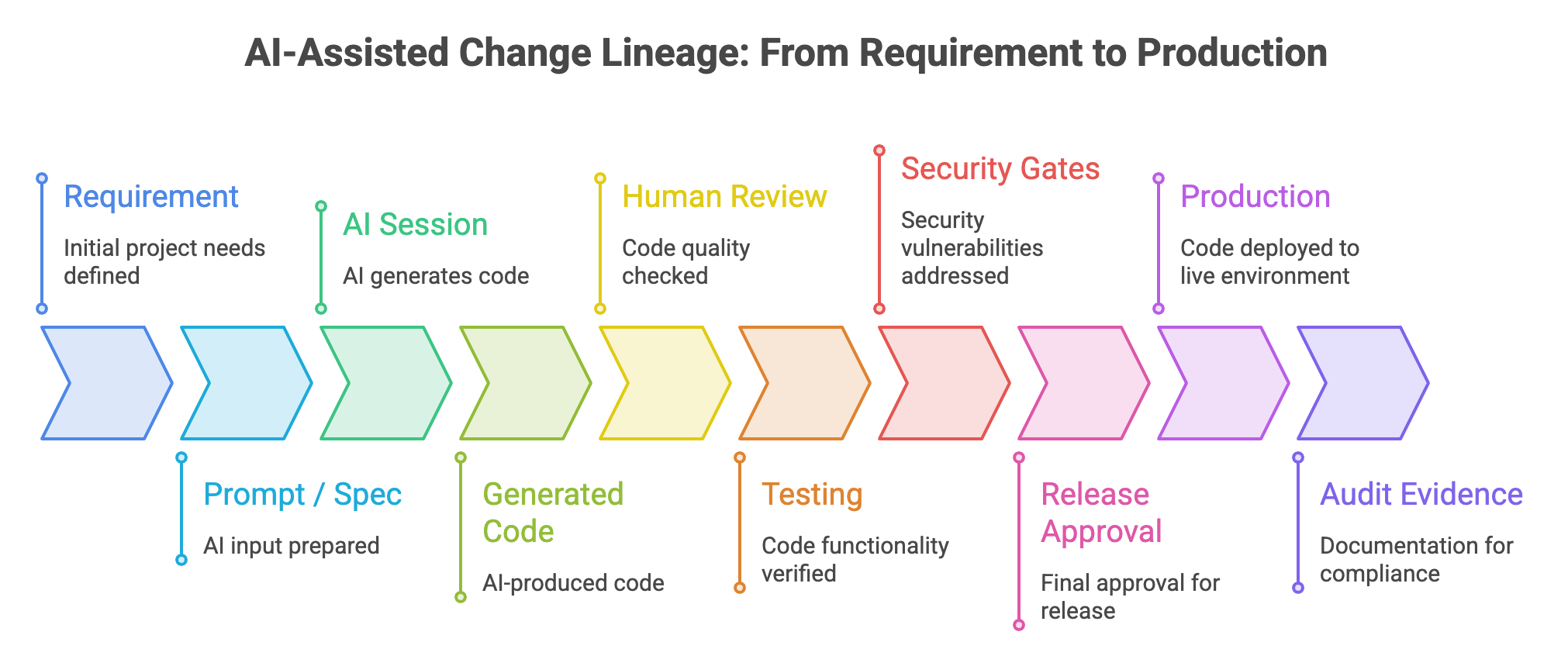
This changes audit preparation from a change-management record into a fuller AI-assisted change lineage.
| Area | Traditional SDLC | AI-first SDLC |
| Change history | Jira ticket, commit history, PR, release notes | Same evidence plus prompt/session history, AI task ID, agent session ID |
| Author accountability | Developer, reviewer, approver | Developer plus AI tool or agent identity and responsible human owner |
| Code origin | Human-written code, third-party libraries | Human-written, AI-generated, AI-modified, and AI-reviewed code |
| Version evidence | App version, commit hash, build artifact | App version plus model ID/version, prompt version, agent configuration, toolchain version |
| Review evidence | Peer review, security review | Human review of AI output, reviewer notes on AI-generated logic, evidence that reviewer understood the code |
| Testing evidence | Unit, integration, regression, SAST, DAST | Same testing plus AI-specific validation for hallucinated logic, insecure patterns, missing edge cases, prompt injection where relevant |
| Data protection | Test data rules, PII masking, access logs | Evidence that prompts did not contain customer data, secrets, production logs, card data, or source code sent to unapproved tools |
| Tool governance | IDEs, CI/CD, repos, artifact registry | Approved AI tools, model providers, enterprise accounts, retention settings, DLP, audit logging |
| Deployment approval | Release manager or CAB approval | Same approval plus confirmation that AI-generated code passed required gates |
| Production traceability | Source → build → artifact → deploy | Prompt/spec → AI session → generated diff → human review → tests → signed build → deploy |
Several new artifacts become critical in AI-first development: AI tool inventory, prompt or session history, model and tool version evidence, generated code traceability, human review notes, and AI-specific testing evidence. For high-risk banking changes, the audit pack should show what AI saw, what it generated, what a human accepted, which controls ran, and who remains accountable.
In a traditional banking SDLC audit, the evidence trail runs from ticket to approval, code change, test result, release, and rollback plan. In an AI-first SDLC, the trail starts earlier: prompt or spec, AI session, model version, generated diff, human review, testing evidence, signed build, and deployment record. The bank must prove that AI did not leak sensitive data, bypass SDLC gates, or make autonomous production changes.
AI Governance Readiness Checklist for Banking Engineering Teams
Technology leaders evaluating AI adoption should be able to answer a practical question: can the organization scale AI-assisted development without losing control over data, code, approvals, and audit evidence?
The checklist below summarizes the capabilities mature teams usually build first.
Governance
- Do we have an approved AI policy for engineering use cases?
- Does every AI tool, model, agent, and vendor have a named business and technical owner?
- Are AI-assisted engineering activities classified by risk level?
Data and security
- Do we know which data, repositories, logs, and environments AI tools can access?
- Are customer information, credentials, production secrets, and restricted source code protected from unapproved AI tools?
- Are enterprise AI platforms governed by retention, residency, access, and vendor controls?
Engineering controls
- Does AI-generated code pass through the same SDLC as developer-written code?
- Are peer review, automated testing, SAST, dependency scanning, secrets detection, and release approval mandatory?
- Do high-risk components such as payments, authorization, AML, fraud, KYC, cryptography, and data retention receive additional review?
Operational resilience
- Do we have fallback procedures when AI tools are unavailable or behave unexpectedly?
- Can autonomous agents be limited, paused, or disabled?
- Are unauthorized actions, prompt injection attempts, and policy violations monitored?
Auditability
- Can we show which AI tool, model version, prompt, context, and user contributed to a change?
- Are AI-generated artifacts linked to tickets, pull requests, approvals, test results, and release records?
- Is there a named human accountable for every AI-assisted production change?
Organizations rarely implement every capability on day one. Most begin with lower-risk engineering activities such as documentation, testing, and maintenance support before expanding AI into more sensitive workflows. That phased approach allows governance practices to mature alongside adoption.
Conclusion
AI-assisted development in banking can scale only when every generated artifact stays visible, reviewable, testable, and auditable. Each production release still needs evidence that security controls worked, regulatory obligations were met, and business-critical systems remain reliable.
For engineering leaders, the task is to bring AI into the SDLC with approved tools, controlled data access, risk-based permissions, human accountability, CI/CD gates, fallback procedures, and audit evidence that connects the original instruction to the final production release.
Banks that build this discipline early can expand AI adoption while preserving the controls that protect customers, financial operations, and regulatory trust.
If you’re evaluating AI adoption in banking software development, contact Itexus. We help banks and fintech companies design governed AI development workflows, strengthen SDLC controls, and prepare engineering processes for secure AI-assisted delivery.