
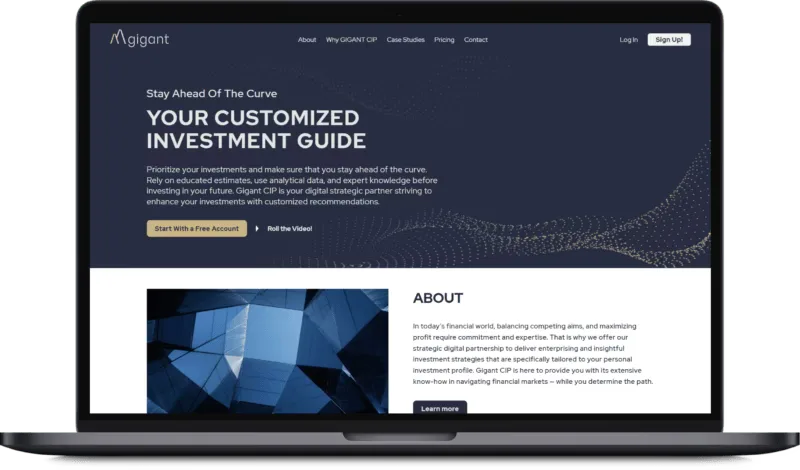
Wealth management platform connecting investors with a professional wealth-advisory company, allowing investors to answer a questionnaire and receive either a recommended model portfolio or a custom-tailored individual portfolio, that is further monitored, rebalanced and adjusted by a professional wealth-adviser based on the changing market conditions and client’s goals.
Multi-family offices (MFOs) are having a moment. As wealth concentrates and passes between generations, more ultra-high-net-worth families are turning to MFOs for a single, trusted view of capital spread across dozens of banks, custodians, asset classes and jurisdictions. Yet the technology underneath many of these firms has not kept pace. According to the Campden Wealth / RBC North America Family Office Report 2025, roughly two-thirds of family offices still rely on manual, spreadsheet-driven processes for reporting and wealth aggregation — a striking gap for organizations entrusted with billions.
That gap is where wealthtech now competes. Whether a firm builds its own platform, buys an off-the-shelf product, or blends the two, the same hard problems appear. This article looks at what an MFO platform actually has to do, the leading products on the market, how teams decide between building and buying, and the technical trends — led by AI-assisted reporting — reshaping the category.
Where MFO Operations Break Down
The technology problem usually becomes visible when the operating model stops scaling. An MFO may already have portfolio systems, accounting tools, custodian portals, a CRM and document storage, yet its teams still move data manually between them.
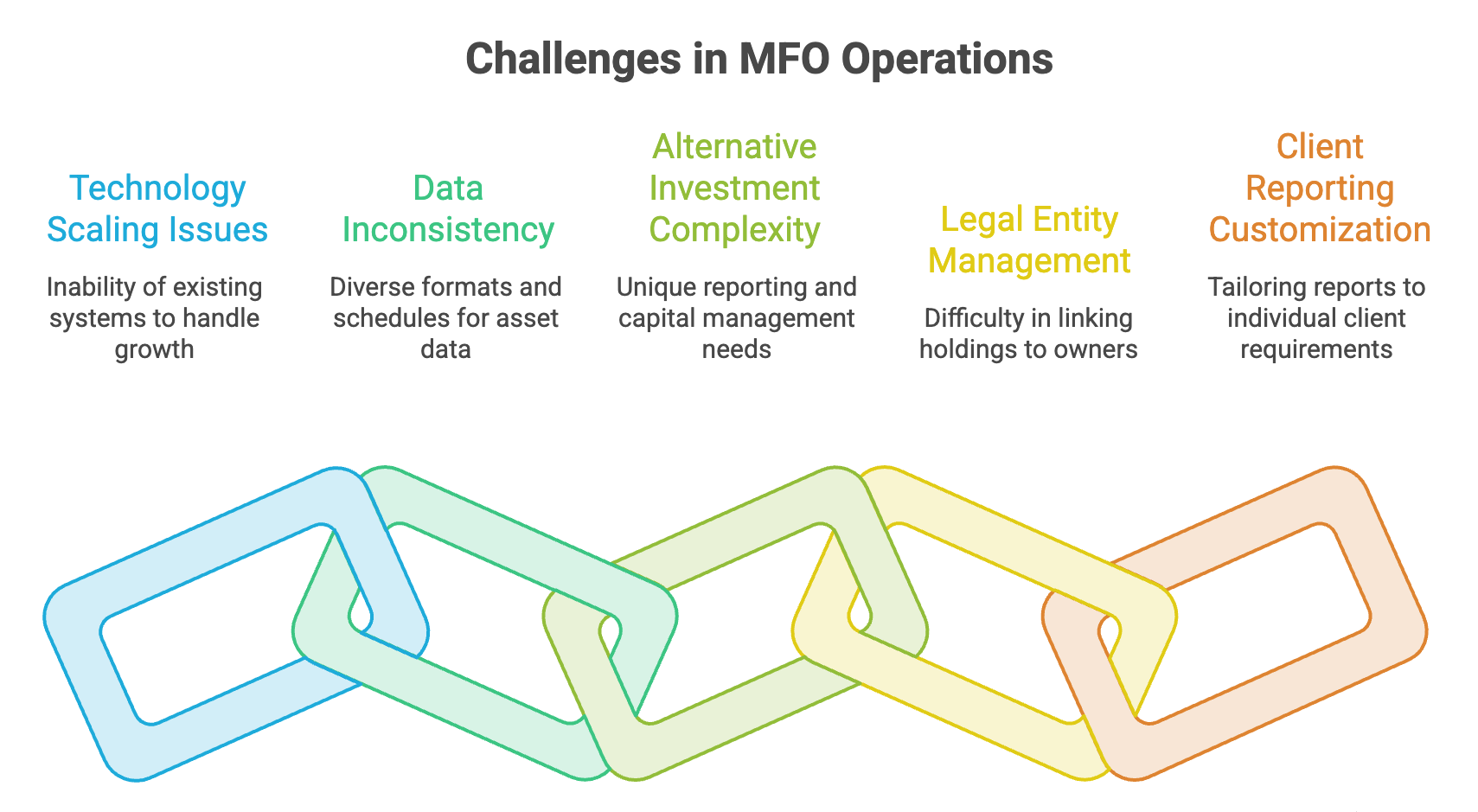
The pressure is especially acute in five areas. Asset data arrives from banks, custodians, fund administrators and private-market portals in different formats and on different schedules. Alternative investments add capital calls, distributions, unfunded commitments, delayed valuations, K-1s and PDF-based reporting. Legal entities, trusts, partnerships and family branches make it difficult to connect each holding to the correct owner, beneficiary and reporting view.
Client reporting creates another bottleneck. Every family may require different benchmarks, entity structures, access rights, tax views and levels of detail. Without a standardized production workflow, each new client increases the workload for operations, analysts and reporting teams.
The result is a familiar pattern: Excel becomes the integration layer, reconciliation consumes skilled time, and critical processes depend on a few employees who know where the correct data lives. These are the problems an MFO platform has to solve before dashboards, analytics or AI can create meaningful value.
What an MFO platform actually has to do
The temptation is to picture an MFO platform as a polished dashboard. In practice, the dashboard is the easy part; the difficulty lives underneath, in the data. A useful way to reason about the system is as a stack of layers, with information flowing from the bottom up.
It starts with aggregation. A wealthy family’s assets are scattered across many custodians, often in multiple countries and currencies, and increasingly tied up in private markets. Pulling that together means connecting directly to custodian banks — via APIs, secure file transfers, or SWIFT messages — and, for alternative investments where no clean feed exists, ingesting data from PDF statements, capital-call notices and fund reports. That last part has traditionally been manual and error-prone, which is one reason it is now a prime target for automation.
Raw data is rarely clean, so the next layer is normalization. Disparate formats are mapped to a common model; a security master ensures the same instrument from three different banks is recognized as one holding; and reconciliation produces a single, trusted “golden source.” This layer also has to model the messy reality of UHNW wealth — multiple currencies, jurisdictions, legal entities and trusts that together form an ownership graph. It is unglamorous work, but everything above it depends on getting it right.
On top of clean data sits portfolio accounting and performance. Even “what was the return?” is subtle: time-weighted return (TWR) measures the manager’s skill, while money-weighted return (IRR) reflects what the family actually earned given the timing of its cash flows — a distinction that matters enormously for private markets with capital calls. Look-through analysis then peers inside funds to reveal true exposure by sector and geography.
The analytical layer turns this into insight — concentration risk, liquidity mismatches, and misalignment with a family’s risk profile. Reporting renders it into consolidated, audit-ready statements, by entity and at the family level, on a schedule or on demand. A client or family portal exposes a curated view, with the multi-generational access controls and governance features the segment expects. And running through all of it is security: encryption, granular access control, audit logging and data-residency controls that, for UHNW data, are not a feature but the basis of the firm’s license to be trusted.
These security capabilities are increasingly shaped not only by client expectations but also by the regulatory environment. Depending on its structure and jurisdiction, an MFO may be subject to GDPR, investment-adviser rules, AML requirements, Regulation S-P in the United States, or operational-resilience obligations under frameworks such as DORA. While DORA and NIS2 do not apply to every family office, they increasingly influence the security standards expected by regulated owners, clients, and technology partners. Across these frameworks, the architectural priorities are remarkably consistent: granular access control, encryption, audit-ready data lineage, incident response, business continuity, and effective oversight of third-party providers (European Parliament and Council of the European Union, 2016; 2022a; 2022b; Securities and Exchange Commission, 2024).
The growing use of AI introduces another dimension. Most current MFO use cases, such as document extraction, reporting assistance, or natural-language portfolio search, are unlikely to fall into the EU AI Act’s high-risk category. Even so, firms increasingly need human oversight, permission-aware access to data, traceable AI outputs, and clear governance over how AI-generated information is produced and reviewed (European Parliament and Council of the European Union, 2024).
The off-the-shelf landscape
For firms that would rather buy than build, a mature market of wealthtech platforms exists. They overlap heavily but differ in emphasis — some lean toward investment analytics, others toward total-wealth operations, governance, or privacy.
| Criteria | Addepar | Masttro | Aleta | FundCount |
| Primary role | Investment data aggregation, analytics and reporting platform | Full family-office and total-wealth platform | Total-wealth and client experience platform | Portfolio, partnership and general-ledger accounting platform |
| Best fit | Large RIAs, MFOs, wealth managers and institutions | SFOs, MFOs and UHNW advisory firms | Family offices, wealth managers and advisors seeking a modern digital experience | Family offices, fund administrators, private equity and hedge funds |
| Investment types supported | Public markets, private markets, hedge funds, private equity, venture capital, real estate and direct investments | Public and private investments, real assets, collectibles and digital assets | Public markets, private markets, real estate and alternative investments | ublic securities, private equity, hedge funds, private debt and fund investments |
| Accounting capabilities | Strong portfolio analytics; not positioned primarily as a general-ledger system | Wealth aggregation and reporting rather than accounting-led | Portfolio tracking and reporting focused | Integrated general ledger, portfolio and partnership accounting |
| Reporting and analytics | Advanced performance, exposure, look-through and customizable reporting | Total-net-worth reporting, dashboards and family-level views | Consolidated reporting, portfolio analytics and AI-ready insights | Accounting-led financial, portfolio and partnership reporting |
| Client portal | Branded reporting and digital client access | Strong secure portal and family communication experience | Mobile-native, white-label client experience | Available, but secondary to accounting and reporting |
| Alternative investments | Strong support for private-market data and analytics | Broad coverage of illiquid and alternative assets | AI-assisted processing and consolidated alternative-asset views | Strong accounting support for partnerships, private funds and complex structures |
| Integration model | Open APIs and enterprise integration ecosystem | APIs and integrations with external systems | Open architecture designed for external integrations and AI agents | Integrations with accounting, banking and portfolio systems |
| Typical role in the stack | Core investment data and analytics platform | Core family-office operating platform | Wealth portal and total-wealth platform | Accounting system of record |
| Pricing | Small offices: $50,000 – $65,000 (simple structures).Mid-sized offices: $75,000 – $300,000 (complex alternative assets).Large institutional offices: $400,000 – $500,000+ (assets over $5B). | Entry Point: Base enterprise contracts typically start around $50,000 per year.Per-User Reference: Baseline retail licensing scales from roughly $325 per user, per month. | Starter Plan: Entry-level configurations begin at $1,000 per month ($12,000 billed annually).MFO Enterprise Tier: Custom multi-family configurations scale up from $40,000+ per year. | MFO Plan: Base configurations start at $26,950 per year.Asset Management Plan: Starts at $35,899 per year.Private Equity / Fund Admin: Ranges from $26,950 to $38,389+ per year. |
| Public user rating | 4.1/5 on G2, 5 reviews | 5.0/5 on Capterra | No sufficiently representative public rating found | 4.7/5 on Capterra |
A few patterns are worth noting. Most of these products converge on the same three pillars: consolidation across all asset classes and custodians, AI-assisted handling of private-markets data, and open architecture so the platform integrates with the rest of a firm’s stack. They vary most on the parts that are hardest to demo — breadth of direct custodian connectivity, handling of complex ownership structures, and depth of private-markets workflows. Much of the comparison content online is published by the vendors themselves, so capabilities are best validated in a live demo against a firm’s actual custodians and asset types, not taken at face value.
Build vs. buy
The build-vs-buy question rarely has a universal answer; it depends on what a firm is optimizing for.
Buying usually wins on speed, predictability and cost. A proven platform brings years of accumulated edge cases, custodian integrations and reporting logic that a firm cannot reasonably reproduce quickly. For most MFOs whose differentiation is advice and relationships rather than software, this is the sensible default.
Building becomes compelling when the platform itself is part of the strategy. Common reasons include data ownership and residency (keeping sensitive UHNW data inside controlled infrastructure); bank-agnostic independence (aggregating across any institution rather than being tied to one provider’s ecosystem); bespoke workflows that encode a firm’s particular process; deep integration with a parent group’s core systems; and a branded client experience off-the-shelf products cannot deliver. For a bank-owned or enterprise initiative, these factors often dominate.
In reality, most firms land on a hybrid: buy a capable core, such as portfolio accounting, and build around it the aggregation connectors, analytics, portal and AI layer that differentiate the offering. Industry surveys reflect this: the hardest problem in 2025–2026 has shifted from choosing a tool to integrating several systems and trusting the data flowing between them.
In this model, custom development creates the most value in the operating layer around the commercial platform. It can connect portfolio, accounting, tax, legal and CRM systems; automate alternative-investment workflows; model complex ownership and entity structures; enforce firm- and family-specific approval rules; and support reporting or client experiences that standard products cannot accommodate. It also gives the MFO more control over data access, AI governance and the way information moves between systems, without requiring the firm to rebuild mature portfolio-management capabilities from scratch.
One honest caveat for anyone tempted to build the whole thing: an institutional, “Addepar-style” platform represents many years of engineering. Addepar itself serves more than 1,400 firms across roughly $9 trillion in assets and raised $230 million in 2025 at a $3.25 billion valuation, a useful gauge of the bar. The right way to de-risk a build of that ambition is not a single grand contract but a sequence: a short feasibility study that produces a reference architecture and a costed, phased roadmap; a proof of concept on the riskiest layer, almost always multi-custodian aggregation, including decades of historical data; and only then a phased build. That turns a leap of faith into a series of grounded decisions.
| Ready-made platform: strengths | Ready-made platform: limitations |
| Faster implementation | Workflows may not match the MFO operating model |
| Proven portfolio and reporting logic | Limited support for complex entity and ownership structures |
| Existing custodian integrations | Integration depth varies by institution |
| Lower initial engineering risk | Custom reporting and workflows can be expensive |
| Vendor-managed security and updates | Less control over data, roadmap and AI architecture |
| Predictable starting cost | Pricing can rise with AUM, entities, users and modules |
| Established wealth-management functionality | Alternatives and tax workflows may remain partly manual |
| Internal support and maintenance | Risk of vendor lock-in and another fragmented system |
Ready-made platforms reduce the cost and risk of implementing standard wealth-management capabilities. Their limitations become visible where an MFO differentiates itself: complex ownership structures, alternative-investment workflows, client-specific reporting, data control and the operating processes behind high-touch service. In these areas, custom development can extend the commercial core rather than replace it, giving the firm greater control over workflows, integrations and the client experience.
Where AI Creates Value in Multi-Family Office Operations
The most visible trend is AI, and the clearest near-term value is in reporting and content. In UBS’s 2025 Global Family Office Report, roughly 69% of family offices said they expect to use AI for financial reporting and data visualization within five years. The appeal is straightforward: report preparation and the handling of unstructured documents consume enormous amounts of skilled time, and that is precisely where automation pays off.
Three applications stand out:
- Document intelligence — using AI to read messy private-markets PDFs, extract the key figures and flag anomalies for review, replacing a tedious manual workflow.
- Report and content generation — drafting client-ready commentary and statements directly from consolidated data.
- Conversational access — letting a banker or principal query the portfolio in natural language, typically implemented as retrieval-augmented generation (RAG) over the firm’s own verified data.
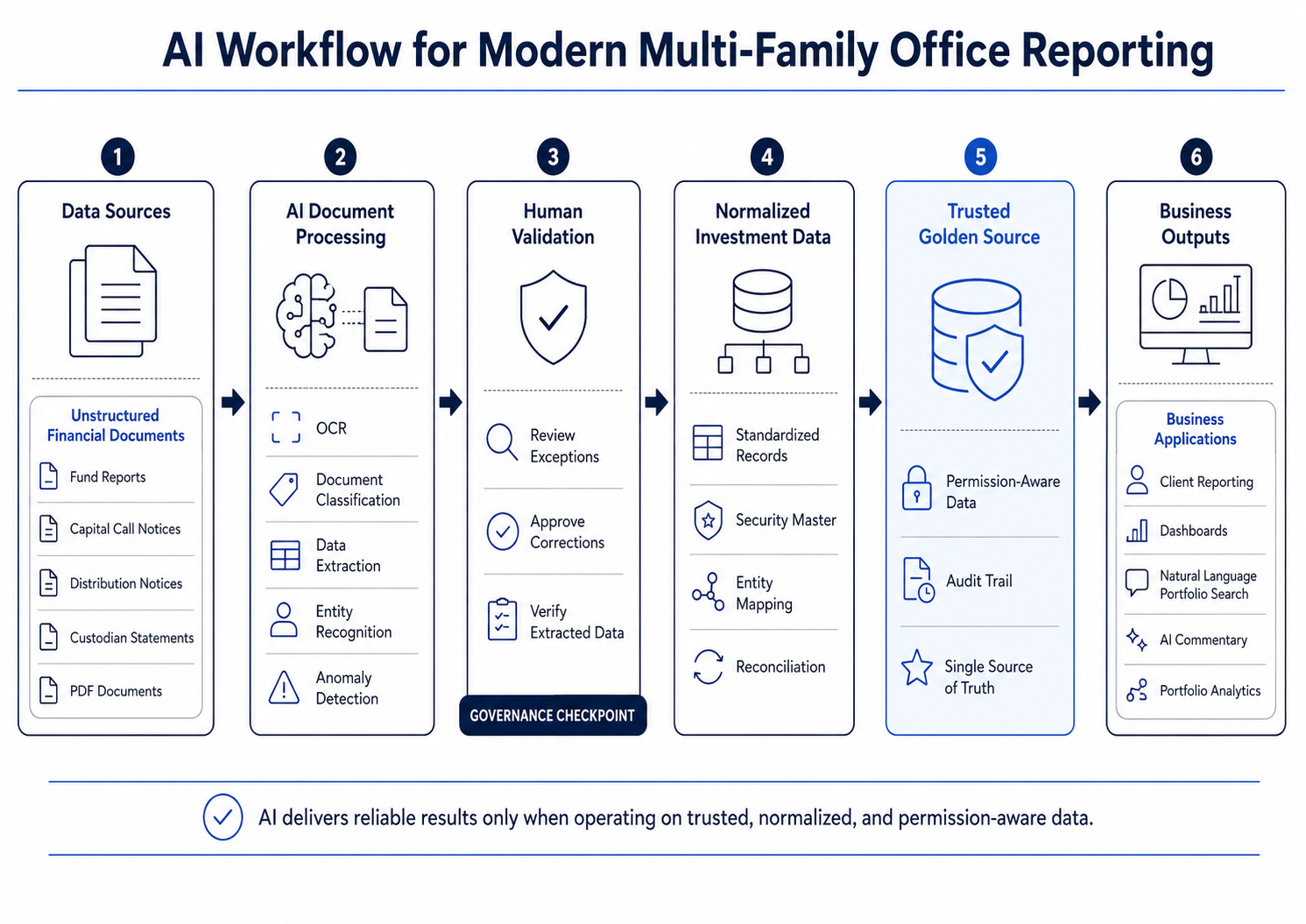
AI is particularly effective where work revolves around documents, repetitive reporting and information retrieval. It can extract data from capital-call notices and fund reports, classify unstructured documents, draft client-ready commentary, answer questions over trusted internal knowledge, and flag anomalies for human review. These capabilities reduce manual effort and accelerate workflows, particularly in private-markets operations.
Its limitations are equally important. AI cannot reliably resolve conflicting valuations across custodians, determine how a transaction should be attributed across trusts, partnerships or family entities, infer firm-specific governance rules, or approve investment decisions without structured workflows and human oversight. In practice, AI does not replace the operating model. It accelerates the parts of the operating model that have already been standardized and built on trusted, permission-aware data.
The crucial point, easy to miss in the excitement, is that all of this depends on the unglamorous lower layers. An AI assistant is only as good as the consolidated, reconciled, permission-aware data beneath it; bolted onto fragmented data, it produces confident nonsense. This is why the mature platforms emphasize a clean, open data foundation and increasingly expose it through open APIs — and, more recently, protocols such as MCP — so AI agents can operate over trustworthy data rather than static reports.
Beyond AI, a few architectural themes recur: multi-tenancy and isolation decisions that must be made early and are expensive to change; cloud architectures that allow region-specific data residency; and security treated as a foundation rather than an afterthought. None are glamorous, but for a firm handling UHNW data they are decisive.
A Practical Roadmap to Building a Family Office Platform
Successful implementations usually follow the same sequence. The order matters because each stage reduces risk before larger investments are made.
1. Separate standard capabilities from differentiation
Portfolio accounting, performance measurement, standard reporting and basic custodian connectivity are often better purchased. Custom development creates more value in firm-specific workflows, complex ownership structures, alternative-investment operations, proprietary reporting and client experience.
2. Design the data foundation first
Before building portals or AI features, define how data will be aggregated, normalized, reconciled and governed. The platform needs a permission-aware golden source that can support reporting, analytics and automation.
3. Test the riskiest integrations early
Multi-custodian aggregation, historical migration, private-market documents and entity mapping often drive project complexity. Validate them through a feasibility study or proof of concept before committing to a full build.
4. Build the operating layer
Connect the core platform with accounting, tax, legal and CRM systems. Add workflow orchestration, approvals, client-specific reporting, entity management and other processes that reflect how the firm actually operates.
5. Add AI after governance
AI can improve document processing, reporting and portfolio search, but only when the underlying data is trusted, permission-aware and auditable. Human review and clear approval workflows should be in place before wider deployment.
A pragmatic way forward
Whether a firm buys, builds or blends, the lesson is consistent: the value and the difficulty both live in the data layer, not the dashboard. Get aggregation, normalization and a trustworthy golden source right, decide the tenancy and security model early, and the analytics, reporting, portal and AI features become tractable. Get them wrong, and no amount of polish will save the platform.
For firms weighing an ambitious build, the most useful first step is rarely to start coding. It is to map requirements honestly, prove out the hardest layer, and sequence the work so each phase delivers value and reduces risk. That is the difference between a wealth platform that scales with a growing book of families and one that quietly becomes the next legacy system.
Itexus is a fintech-focused software development company that designs, builds and modernizes wealth-management and family-office platforms. We scope and de-risk build-vs-buy decisions through feasibility-led discovery and phased delivery.