
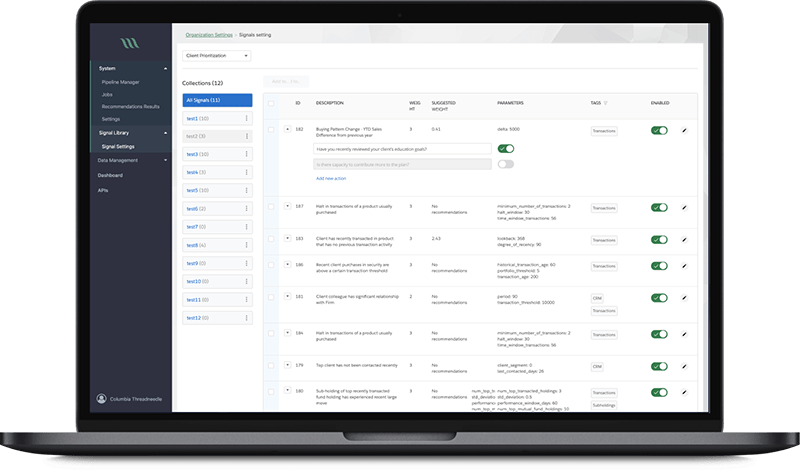
The system uses machine learning techniques to process various content feeds in realtime and boost the productivity of financial analysts and client relationship managers in domains such as wealth management, commercial banking, and fund distribution.
Fintech products are starting to work outside their own interfaces.
This week’s stories point to one direction from different angles: AI agents can initiate financial actions, payment and data platforms are moving closer to real-time decisioning, shopping journeys are entering AI interfaces, and wealth systems are turning into controlled execution layers.
Fintech teams need products that can safely expose data, permissions, risk logic, and actions to AI-driven workflows, with clear controls and evidence for every execution step.
AI agents move closer to financial execution
Robinhood launched new agentic features that let users give AI agents controlled access to trading and card-based purchases. Users can set limits, use separate balances or virtual cards, and require manual approval for selected actions.
Source: www.americanbanker.com
Why it matters
AI agents are becoming a new participant in financial workflows. They can do more than explain data; they can initiate actions within rules set by the user. This changes the requirements for fintech software. Products need granular permissions, spending and transaction limits, approval rules, audit trails, real-time risk checks, and a clear way to disable agent access.
Competition is moving from the app interface to the ability to serve as a trusted execution layer for external AI systems. Fintech teams that do not prepare their APIs, data, compliance logs, and dispute flows for agent-initiated actions risk losing direct contact with users and becoming backend infrastructure for someone else’s AI interface.
What teams should watch
If your product already uses AI agents, or your team is considering agent-initiated actions, start by defining safety boundaries. For any workflow that could affect trading, payments, purchases, transfers, limits, applications, or account updates, specify what the agent can access, what it can execute, when approval is required, how risk is checked before execution, and what evidence is stored after completion.
What to assess first:
- Agent access layer
AI agents should interact with the product through controlled APIs, tool endpoints, or protocol-ready layers, not through screen scraping or full user access. The system should define what an agent can read, what it can do, and which actions are blocked by default.
- Delegated permissions
Agent permissions should be narrower than user permissions. The product needs scopes by action type, amount, time window, asset class, merchant, balance, card, or use case. Separate balances, virtual cards, and spending caps should be used for higher-risk actions.
- Pre-action risk checks
Risk logic should run before execution, not only after a trade, payment, transfer, purchase, or limit change is complete. The system should be able to pause, decline, or escalate actions based on policy, velocity, anomaly signals, user limits, and transaction context.
- Audit trail and explainability
Every agent action should leave a full record: who granted access, which agent acted, what instruction it followed, what data it used, which checks ran, and why the action was approved, blocked, or escalated.
- Kill switch
Users, support, risk, and compliance teams need a fast way to revoke agent access, freeze suspicious activity, move workflows to manual review, and investigate disputes with the full instruction and approval history.
Plaid moves deeper into real-time financial decisioning
Plaid launched new AI data tools and Guaranteed Payments, a service that lets fintech apps approve ACH transfers instantly and credit users before settlement. If an approved payment later fails, Plaid covers the loss and handles recovery.
The update expands Plaid’s role from financial data connectivity to risk, fraud, payment certainty, and AI-powered transaction intelligence.
Source: www.thisweekinfintech.com
Why it matters
ACH has always created a gap between user expectations and payment reality. Users want funds to move instantly, while settlement risk, returns, insufficient funds, and fraud can remain unresolved for days. Plaid’s move shows how fintech infrastructure is trying to close that gap without replacing ACH itself: by adding real-time risk scoring, payment guarantees, and clearer ownership of failed transfers.
For fintech teams, the key issue is risk ownership between authorization and settlement. ACH products need pre-transfer decisioning, fraud signals, return-risk models, recovery workflows, and audit trails. Speed depends on the product’s ability to decide when funds can be advanced, when they should be held, and who carries liability if the payment fails.
What teams should watch
Map the decisions around every payment, transfer, funding flow, withdrawal, limit change, and verification step. Then define which data, fraud signals, consent state, and risk rules determine whether the system approves, delays, accelerates, or escalates the action.
What your team should do:
- Review payment flows
Where does the user wait for ACH, funding, repayment, or withdrawal? These points need to be reconsidered. Can you deliver a faster experience through risk scoring, payment guarantees, RTP, FedNow, smarter routing, or risk-based holds?
- Move risk decisioning closer to the product
Fraud, return risk, income verification, account behavior, and limits should not live only in the back office. They should become part of the core flow: approve, decline, delay, request more data, or escalate.
- Improve data quality
Your product needs a stronger understanding of transactions: income, loan payments, recurring payments, cash flow, anomalies, and balance patterns. Without this, AI features, scoring, payment acceleration, and personalization will remain weak.
- Prepare the product for AI interfaces
If financial data, recommendations, or actions are exposed through AI interfaces, permissions, consent state, revocation, and data scopes need to be explicit. External AI systems should not receive unclear data or trigger workflows without controlled access.
- Add governance from the start, not after launch
Every AI or risk decision should make clear which data was used, why the decision was made, who is responsible, how the user can dispute the outcome, and where the audit trail is stored.
AI shopping moves closer to the payment layer
Klarna connected its merchant network to ChatGPT, allowing users to search and compare products from Klarna’s retail partners directly inside the AI interface. The feature uses live product data, prices, availability, and merchant listings, while the final purchase still happens on the merchant’s website.
Source: www.finextra.com
Why it matters
AI interfaces are becoming a new entry point for product discovery and shopping intent before checkout. Users can compare products, merchants, prices, and availability before they reach a merchant site, checkout page, or fintech app. Payment methods, financing terms, and application flows may be the next layer to move into the same AI-driven journey.
For fintech teams, the product needs to be readable and usable outside its own interface. Product data, offers, pricing, eligibility rules, fees, restrictions, and availability should be available to external AI systems in a structured and verifiable form. The advantage comes from showing up in an AI-assisted journey, preserving context through checkout, and safely supporting the user’s next action.
What teams should watch
Do not focus only on the shopping feature. The key question is whether your product can participate in an AI-driven journey before the user reaches checkout.
What to check in your product:
- Can your product operate outside its own interface?
Your pricing, offers, eligibility rules, limits, fees, merchant data, customer data, and product logic should be available through clean APIs, tool endpoints, or protocol-ready layers. The product should not depend only on screens that a human user opens manually.
- Can AI correctly understand your product?
You need structured data that explains what is available, who it is available to, under which conditions, what restrictions apply, what fees or risks exist, and when authorization is required. If this logic lives across code, internal documents, Slack threads, and product managers’ heads, the AI channel will not be able to represent it reliably.
- Can you preserve context through checkout?
If discovery happens inside an AI interface but checkout happens on the merchant’s website, the product still needs a clean handoff. Basket data, selected product, merchant, price, availability, financing option, user eligibility, and attribution should survive the transition instead of being lost between systems.
- Do you control actions, not just data?
The next step after “show me an option” is “select it, apply for it, finance it, pay for it, open the account, or submit the request.” That requires permissions, consent logs, step-up authentication, spending and action limits, human approval for higher-risk actions, and audit trails.
- Can you explain every decision?
If AI recommends an offer, payment method, financing option, or risk outcome, the team should be able to show which data was used, which rules were triggered, why the option was available or declined, and what the user agreed to before the next action happened.
Wealth management moves toward AI operating systems
Moment raised $78 million in Series C funding led by Index Ventures, with participation from Andreessen Horowitz, Avra, and existing investors. The company will use the capital to expand its AI operating system for investment management, which helps wealth firms manage trading, portfolio workflows, compliance, and execution in one platform.
Source: www.fintechfutures.com
Why it matters
Wealth management depends on fragmented operational context: client profiles, portfolios, restrictions, research, trade history, approvals, compliance notes, and advisor decisions. Moment’s funding points to demand for systems that can connect this context and use it inside daily investment workflows.
The main issue is workflow control. If AI supports portfolio reviews, rebalancing, trade preparation, client reporting, or compliance checks, the product has to show which data shaped the recommendation, which restrictions applied, who approved the action, and what changed in the portfolio or client record. In wealth management, AI value depends less on generating advice and more on making regulated investment work traceable, reviewable, and operationally usable.
What teams should watch
Check whether your product is ready to become a controlled execution platform. The system should not only make suggestions; it should safely perform actions inside a regulated workflow.
What to focus on:
- Data layer
Check how cleanly your product collects and connects data: customer profiles, accounts, transactions, portfolio data, documents, restrictions, approvals, and historical decisions. If the data is fragmented, AI will not be able to act reliably.
- Permission model
Define in advance what an AI agent can see, suggest, and execute. Separate what requires user consent, what requires internal approval, and what is fully prohibited.
- Audit trail
Every AI-driven action should be reproducible: which data was used, which logic was applied, who approved it, what changed, and why the system suggested that specific action.
- Compliance inside the workflow
Compliance should not be a post-action check. Rules, restrictions, suitability, risk checks, escalation logic, and exception handling should be built into the product flow itself.
- Human in the loop
Define where AI can act on its own and where it can only prepare a recommendation. For financial decisions, approve, reject, and escalate scenarios are especially important.
- Explainability for users and internal teams
The product should show not only the outcome, but also the rationale: sources, constraints, confidence, risks, and the reasons behind the recommendation.
Closing insight
The common thread across these stories is not AI adoption itself. It is the shift of financial products toward controlled execution.
The next generation of fintech systems will need to decide what an AI agent, partner platform, internal team, or user can see, request, approve, and execute. That requires more than a model or chatbot. It requires clean data, scoped permissions, consent records, real-time risk checks, audit trails, exception handling, and clear ownership of every automated action.
For fintech teams, the priority is to build products that can participate safely in AI-driven workflows. That means connected data, precise permissions, early risk checks, explainable decisions, and enough operational evidence to show how each automated action was reviewed, approved, or escalated.