
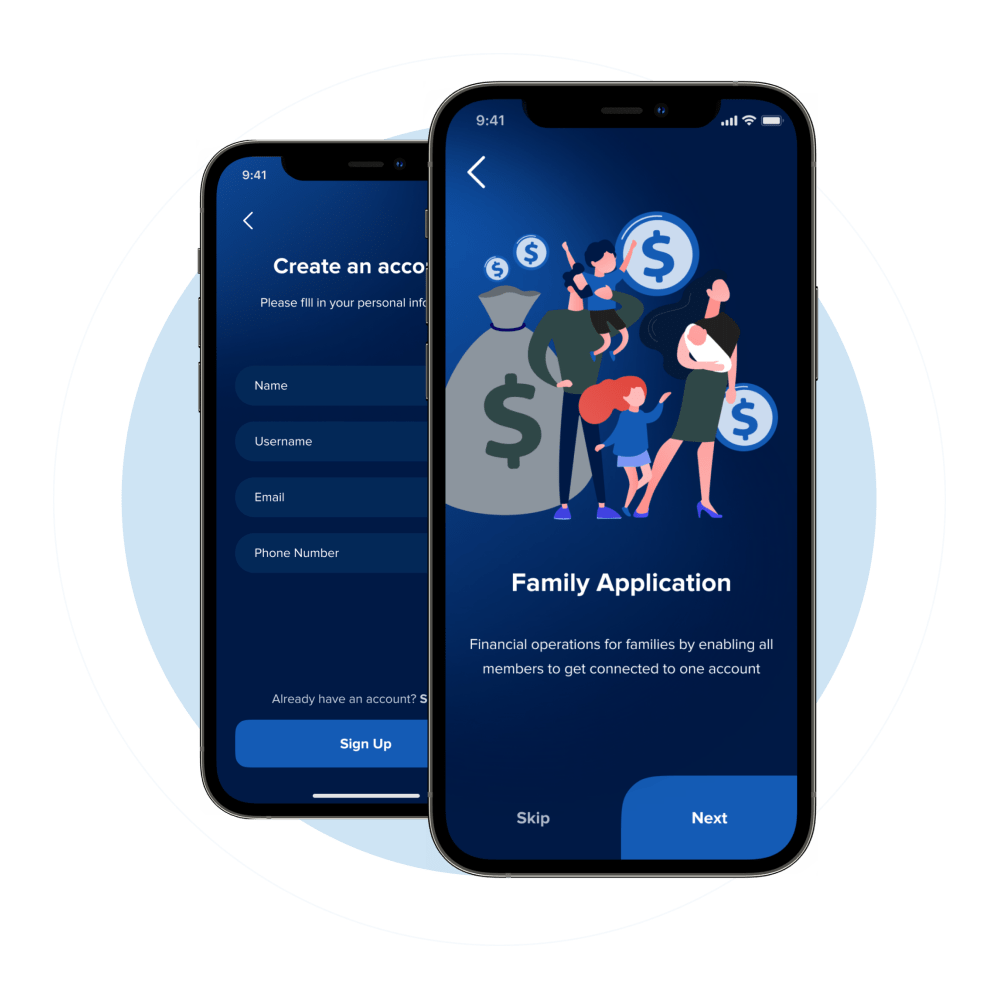
A fintech startup headquartered in Northern Europe approached us to hire mobile developers to reinforce their in-house development team working on an e-wallet for families. After a few interviews with our specialists, the client selected two candidates who were the best fit: a senior iOS developer and a mid-level Android developer. They started working on the client’s project shortly after signing the NDA.
In the middle of the process, the client decided to redesign the application’s interface. He was looking for a skilled designer with hands-on experience in creating interfaces for fintech solutions. At Itexus, we offer turnkey fintech software development, so we have UI/UX specialists on board who have extensive track record in the fintech domain. Thus, we offered the client to review the CVs and portfolios of our designers and they chose one for their project. In this way, three Itexus specialists were added to the client’s internal team – two mobile developers and one UI/UX designer.
How Digital Wallet Apps Work in 2026?
Digital wallet apps are reshaping the way we pay, send money, and manage daily finances—and in 2026 they’re no longer just “card storage.” Today’s e-wallets apps as all-in-one financial hubs: you can pay in-store and online, transfer money instantly, store loyalty cards and IDs, track spending, and in many cases access investing tools or crypto features (where available by region).
A digital wallet app is a mobile app that lets you store payment cards and pay online or in-store, often with contactless NFC while also supporting transfers, budgeting tools, and other finance features depending on your region.
This shift is powered by what people expect from modern payments: speed, convenience, and security. Whether you’re tapping your phone with NFC, scanning a QR code, or paying in an app, the best digital wallet apps aim to make transactions seamless while protecting your data with encryption, tokenization, and biometric login.
With dozens of options across the US, UK, Europe, and other markets and different support for banks, cards, and local payment networks. Choosing the right wallet can feel confusing. That’s why we created this guide: below you’ll find the top 10 digital wallet apps for 2026, selected for their usability, security, reliability, and standout features.
How to Choose the Right Digital Wallet App in 2026: Key Criteria
Not all digital wallet apps offer the same experience—features, fees, and availability can vary widely by country, bank partner, and device ecosystem (iOS vs Android). Use the criteria below to quickly compare options and pick the wallet that matches your daily needs.
- Compatibility and availability (country + device): Start with the basics: does the app work in your region and support your phone and OS? Some wallets are limited to specific countries, while others depend on local banking integrations or payment networks. Also check whether it supports NFC contactless payments, QR payments, or both—since usage differs across markets.
- Supported payment methods: When choosing a digital wallet, the first thing to confirm is whether it supports the payment methods you actually rely on day to day. The best apps make it easy to link credit and debit cards (Visa, Mastercard, and sometimes AmEx depending on the country), connect a bank account for instant transfers, or keep a prepaid balance for quick payments. This matters even more if you split expenses between cards and bank transfers, or regularly top up your wallet to control spending.
- Everyday usability (speed + interface):
- The best mobile wallet isn’t always the one with the longest feature list—it’s the one you’ll actually use because it feels effortless. Smooth checkout flows (tap-to-pay with NFC, one-click online payments), clean navigation, and fast access to recent transactions all make a difference when you’re paying in real life, not just testing features.
- Security and privacy features:
- A secure digital wallet should protect both your money and your personal data without making payments feel slow or complicated. Strong options typically include biometric login (Face ID or fingerprint), secure device authentication, and encryption for sensitive information. For card-based payments, tokenization is a major advantage because it reduces exposure of your real card number during transactions
- Integration with your ecosystem:
- A wallet can look perfect on paper and still feel inconvenient if it doesn’t fit your device ecosystem. Check how well it works with iOS or Android, whether it supports wearables (Apple Watch / Wear OS), and how smoothly it handles everyday flows like in-app checkout, browser payments, or tapping to pay in stores. The best experience usually comes from wallets that are deeply integrated into the system you already use.
- Integration also matters outside the phone. If you manage finances across multiple services, it’s useful when a wallet connects cleanly with banking apps, e-commerce platforms, or even accounting tools (especially for business users). For teams building or scaling a wallet experience, partnering with a fintech product development company can also help ensure smooth integrations with payment providers, banks, and third-party platforms. In practice, strong ecosystem support reduces friction: fewer failed payment prompts, faster confirmations, and clearer transaction records—exactly the small details that make a wallet feel reliable in daily use.
Top 10 digital wallet apps
In the ranking below, we picked the top 10 digital wallet apps for 2026 based on real-world usefulness: security and privacy features, everyday reliability, supported payment methods, and regional reach. To make this guide easier to scan, each option includes a quick “Best for” recommendation so you can find the right wallet in seconds—whether you’re in the US, UK, Europe, China, or shopping globally.
1. Apple Pay
Best for: iPhone / Apple Watch users who want fast, private contactless payments.
Apple Pay is a leading digital wallet app for the Apple ecosystem, built for frictionless tap-to-pay (NFC) in stores and fast checkout online and in apps. It’s especially convenient if you already use an iPhone, Apple Watch, or Mac and want a wallet that “just works” across devices.
For security, Apple Pay relies on device authentication (Face ID / Touch ID / passcode) and is designed to protect card details during transactions. Apple also notes it doesn’t store your original card numbers on the device or its servers, and some features (like Apple Cash) are region-specific.
2. Google Wallet
Best for: Android users who want one app for payments + passes + cards.
Google Wallet is a top mobile wallet for Android that combines everyday payments with storage for items like loyalty cards, gift cards, and supported passes helpful if you want everything in one place.
On the security side, Google highlights privacy protections for tap-to-pay, including not sharing the real card number with merchants during transactions (availability depends on country, bank, and card issuer).
3. Samsung Pay / Samsung Wallet
Best for: Samsung device owners especially where Samsung Wallet features are supported.
Samsung’s wallet experience (often referred to as Samsung Pay, now inside Samsung Wallet in many markets) supports contactless payments and can also include MST on supported devices, which helps with compatibility at older terminals. Samsung notes NFC + MST may be available depending on device model and region.
MST support is largely tied to older hardware, while newer Samsung flagships are typically NFC-first—so it’s worth checking your exact device before treating MST as a guaranteed advantage.
4. PayPal
Best for: online checkout + cross-border payments + keeping a wallet balance.
PayPal remains one of the most recognizable digital wallet apps for paying online and sending money. It allows you to link a bank account and cards, store a balance, and manage transactions in one place-making it a strong “all-around” choice for everyday digital payments.
Because PayPal is widely supported by merchants, it’s often the easiest pick for people who shop internationally or want a familiar checkout option across many websites and apps.
5. Venmo
Best for: peer-to-peer payments in the U.S. with a social-first experience.
Venmo (owned by PayPal) is best known for fast P2P transfers splitting bills, paying friends, and casual everyday payments. It also adds a social layer with a feed-style experience, which is exactly why it’s become a cultural default for many U.S. users.
Venmo is primarily U.S.-focused, so for it’s smart to position it as a “best for the United States” wallet rather than a global solution.
6. Cash App
Best for: U.S./UK users who want payments + simple investing in one app.
Cash App stands out because it blends a modern money app with optional investing tools. Beyond instant transfers, it’s known for a streamlined experience for buying stocks/ETFs and Bitcoin (features and eligibility can vary).
Cash App states it’s available in the U.S. and UK, while card transactions may work internationally in many countries so it’s a strong pick if your audience is US/UK-centric. That flexibility matters even more once you start moving money out of the app, which is why knowing how to withdraw money from Cash App helps users turn balances, payouts, or investment returns into usable funds without friction.
7. Zelle
Best for: instant bank-to-bank transfers inside the U.S.
Zelle is built around speed and simplicity: it typically runs through participating U.S. bank apps and sends money directly between bank accounts using an email address or U.S. mobile number. That direct bank integration is the main reason it feels faster and more “native” than many standalone wallets.
Zelle has also reduced emphasis on its standalone experience major coverage notes that money transfers via the standalone Zelle app were shut down (the service continues through bank and credit union apps).
8. Amazon Pay
Best for: e-commerce checkout for people who already use Amazon regularly.
Amazon Pay is designed for shoppers: it lets you use the payment methods already saved in your Amazon account to pay on third-party sites that support Amazon Pay.
It’s best positioned less as a “send money to friends” wallet and more as a fast, recognizable online checkout wallet especially for retail-heavy audiences.
9. Alipay
Best for: payments in China + travelers/merchants working with Chinese consumers.
Alipay evolved from a major Chinese e-wallet into an all-in-one “super app” style payment ecosystem used for daily transactions and lifestyle services (feature sets vary by market).
Alipay is most relevant when your readers are in China or interacting with Chinese commerce and travelers so it’s great to frame it as a top pick for that specific region and use case.
10. Skrill
Best for: international money transfers + multi-currency usage.
Skrill is often chosen for cross-border needs: it positions itself around international transfers and global payments, which makes it appealing for freelancers, travelers, and users who deal with multiple currencies.
Skrill is useful to highlight as a wallet that’s oriented toward global movement of money rather than purely local tap-to-pay.
FAQs
What is a digital wallet app?
A digital wallet app (e-wallet) lets you store payment methods on your phone and pay online or in-store—often with NFC tap-to-pay—and may also support transfers, passes, rewards, and budgeting depending on the provider and region.
Which digital wallet is best for contactless payments?
For everyday contactless payments, the top choices are usually Apple Pay (iPhone), Google Wallet (Android), and Samsung Wallet (Samsung devices) because they’re designed for fast NFC checkout and strong device-level security.
Which digital wallet is best for sending money to friends?
If you’re in the U.S., Zelle is great for bank-to-bank transfers (through participating banks), while Venmo is popular for friend payments and splitting bills. For broader international reach, PayPal is often the most universal option
Which wallet is best for international payments or travel?
Look for wallets that support multi-currency and transparent conversion rules. Skrill is commonly positioned for international use, and PayPal is widely accepted for online checkout across countries (fees and FX rates vary by route).
Are digital wallet apps safe?
Top digital wallet apps use layered security such as biometric login (Face ID / fingerprint), device authentication, and transaction protections. Still, safety depends on your habits too—use a strong passcode, enable biometrics, and turn on transaction alerts.
Do all wallets work in every country?
No. Digital wallets can be limited by region, bank integrations, local payment rails, and regulation. Always check availability in your country and whether your bank/card issuer supports the wallet before switching.
What should I prioritize: features or reliability?
For most people, reliability wins. A wallet you can count on for daily checkout (fast, stable, supported by merchants) is usually better than one with extra features you rarely use.
Glossary (2026): key digital wallet terms explained
NFC (Near Field Communication)
NFS is a short-range technology that enables contactless “tap-to-pay” in stores. If a wallet supports NFC payments, you can usually pay by holding your phone or smartwatch near a compatible terminal.
Tokenization
Tokenization is a security method where your real card number is replaced with a unique token during transactions. This helps reduce exposure of sensitive card details and is one of the reasons modern digital wallet apps are considered safer than typing card numbers manually.
P2P payments (peer-to-peer transfers)
P2P – sending money directly to another person, typically using a phone number, email, or username. P2P is common for splitting bills, paying friends, or quick personal transfers.
Multi-currency wallet
Multi-currency wallet is a wallet that lets you hold, spend, or convert multiple currencies (sometimes with local account details, depending on the provider). This is especially useful for international shopping, travel, and cross-border transfers, but exchange rates and fees can vary between apps.
Local payment rails
The underlying domestic payment networks that move money between banks in a specific country. Wallets integrated with local rails can offer faster transfers and lower fees, but support varies by region and bank partners.
Conclusion: choosing the best digital wallet app for 2026
Digital wallet apps have moved far beyond “storing cards.” In 2026, the best e-wallet for you is the one that fits your device ecosystem (iPhone/Android/Samsung), works reliably in your country, and matches how you pay—whether that’s contactless NFC tap-to-pay, peer-to-peer transfers, online checkout, or multi-currency spending.
Before you commit, do a quick reality check on the essentials: supported cards/banks, security (biometrics + tokenization), fees (especially FX and transfers), and day-to-day usability. If two wallets feel similar, choose the one with better local support and cleaner integrations—those small details usually matter most over time.
Final takeaway: the “best digital wallet app in 2026” isn’t a single winner – it’s the wallet that’s secure, available where you live, and frictionless for your most common payments.