
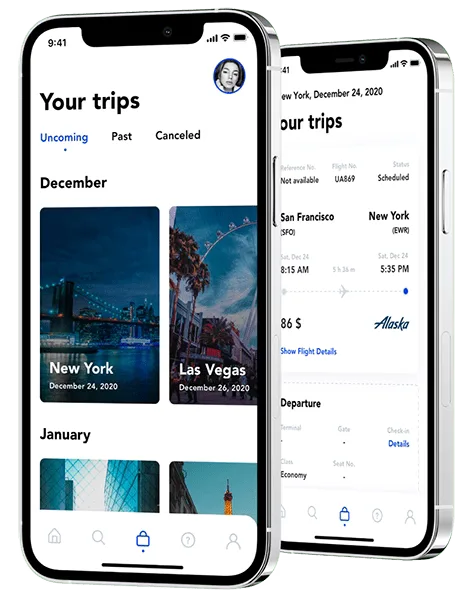
It is clear that correct automation enables businesses to eliminate errors, reduce processes time and costs, increase performance, and prevent overstaffing. But beyond the regular automation, there are some unobvious processes driven by people that actually do not require a dedicated staff member. In particular, it is corporate travel management or CTM.
How many people in your company are involved in organizing business trips for employees? How long does it take to book, change, or cancel tickets and hotels and address other travel-related issues? How many working hours do your employees spend on writing business trip reports instead of the work itself?
The solution is a corporate travel management software. Read on to learn how Itexus participated in building an iOS app that can help dozens of companies – from small businesses to enterprises – save money and time where others waste resources and overstaff.
Travel is mobile-first. From booking flights and hotels to planning routes and finding local activities — it all happens in apps.
But the big question is: how much does it cost to build a travel app?
In this guide, we’ll break down costs, factors that influence pricing, competitor practices, and what the “best version” of a travel app looks like in terms of ROI.
Key Factors Influencing Travel App Development Cost
| Factor | Why it matters | Example impact |
|---|---|---|
| Features & complexity | More features = more time, higher cost | Basic booking app vs. AI-driven recommendation engine |
| Platforms | iOS only, Android only, or both | Two platforms nearly double the cost |
| Tech stack | Native apps cost more, cross-platform may save | Swift/Kotlin vs. Flutter/React Native |
| Team location & rates | Developer rates vary widely | US devs: $80–150/hr, Eastern Europe: $35–60/hr |
| Integrations & APIs | Travel apps need external services | Amadeus, Skyscanner, Google Maps |
| UI/UX design | A polished, intuitive design requires extra effort | Custom animations, microinteractions |
| Maintenance & updates | Ongoing costs post-launch | 15–25% of initial budget per year |
Cost benchmarks (2026):
- Simple MVP: $10,000–30,000
- Mid-level app: $30,000–70,000
- Advanced product: $100,000+
Competitor Insights
Leading travel apps show what works:
- Hopper — predicts flight prices using AI.
- Booking.com, Expedia, Airbnb — full-cycle booking platforms.
- City guide apps — offline maps + curated local experiences.
Key takeaways:
- Personalization is critical.
- Strong API integrations (hotels, flights, activities).
- Offline support boosts user experience.
Best Practices for Travel App Development
- Start with MVP — focus on core features: search, booking, payment, user profile.
- Use cross-platform frameworks — Flutter/React Native = faster, cheaper, same codebase for iOS & Android.
- Adopt modular architecture — easier scaling and maintenance.
- Integrate ready APIs — payments, maps, booking systems.
- Offline functionality — must-have for travelers with weak internet.
- Ensure scalability — cloud-based backend that handles seasonal spikes.
- Run usability testing — launch early, gather feedback, iterate fast.
- Security & compliance — protect personal data, follow GDPR and PCI DSS.
- Agile process — build in sprints, adjust priorities.
- Plan for post-launch support — ongoing bug fixes and updates.
The “Best Version” of a Travel App
Core must-have features:
- Hotel/flight search & booking
- Secure payments
- User profiles + trip history
- Push notifications
- Maps & navigation
- Offline access
Advanced features (added later):
- AI-powered recommendations
- Chat support
- Loyalty programs
- Expense tracking
- AR/VR guides
Monetization options:
- Commission from bookings
- Premium features (subscription model)
- Advertising / local offers
- Partnerships with travel providers
How much does it cost to develop a travel app?
| Scenario | Estimated cost (USD) | What you get |
|---|---|---|
| Basic MVP | 10,000–30,000 | Booking, payments, simple UI |
| Mid-level app | 30,000–70,000 | iOS + Android, APIs, offline mode, push notifications |
| Advanced solution | 100,000+ | AI, AR, personalization, high-load backend |
Conclusion
The cost of building a travel app ranges from $10K to $100K+, depending on complexity, platforms, and integrations.
The smartest approach? Start lean with MVP, validate your idea, and scale gradually with features like personalization, offline mode, and loyalty programs.
At Itexus, we help startups and enterprises build scalable, cost-effective travel apps with the right tech stack and design expertise.