
Quick Summary: A forward deployed engineer (FDE) is a hybrid technical role that embeds directly inside a customer’s environment to solve real operational problems with the vendor’s product, rather than building features from behind a company’s own walls. FDEs combine software engineering, systems configuration, and client-facing consulting to close the gap between a platform’s raw capabilities and a customer’s actual workflows. The role has become especially relevant in fintech, defense, and enterprise software, where generic products rarely fit a client’s environment out of the box.
The job title sounds almost military, and that’s not an accident. “Forward deployed” borrows straight from defense language, where forces move closer to the front line instead of waiting in reserve. Apply that idea to software, and a forward deployed engineer is someone who moves toward the customer’s problem instead of waiting for a ticket to land in a backlog.
It’s a role that’s grown fast over the last decade, largely thanks to companies like Palantir that built entire delivery models around it. But the pattern now shows up across fintech, healthcare tech, defense contracting, and any industry where software has to bend around messy, high-stakes, real-world operations.
What Is a Forward Deployed Engineer, Exactly?
A forward deployed engineer sits at the intersection of software engineering, solutions consulting, and product management. Instead of working purely inside a vendor’s headquarters on a roadmap, the FDE physically or virtually embeds within a client’s team — sometimes for weeks, sometimes for years — to configure, extend, and sometimes rebuild parts of a product so it actually works for that specific customer.
This isn’t the same as traditional customer support or a solutions architect who shows up for a kickoff call and disappears. Forward deployed engineers stay close to the problem long enough to write real code, ship real prototypes, and watch how the client actually uses the tool day to day. That proximity is the whole point.
Where the Concept Came From
The term gained mainstream attention through Palantir, whose forward deployed software engineers (sometimes nicknamed internally) embed with government agencies and large enterprises to configure Palantir’s platforms around each client’s operational reality. Because Palantir’s customers range from intelligence agencies to hospital networks, a one-size-fits-all product simply wouldn’t hold up — every environment has different data, different rules, and different failure modes.
That model proved so effective that other companies building complex, mission-critical software — from defense tech startups to enterprise fintech vendors — started copying the playbook. The underlying insight is simple: some products are too complicated, too regulated, or too tightly coupled to a client’s existing systems to succeed with a purely remote, ticket-based support model.
Core Responsibilities of a Forward Deployed Engineer
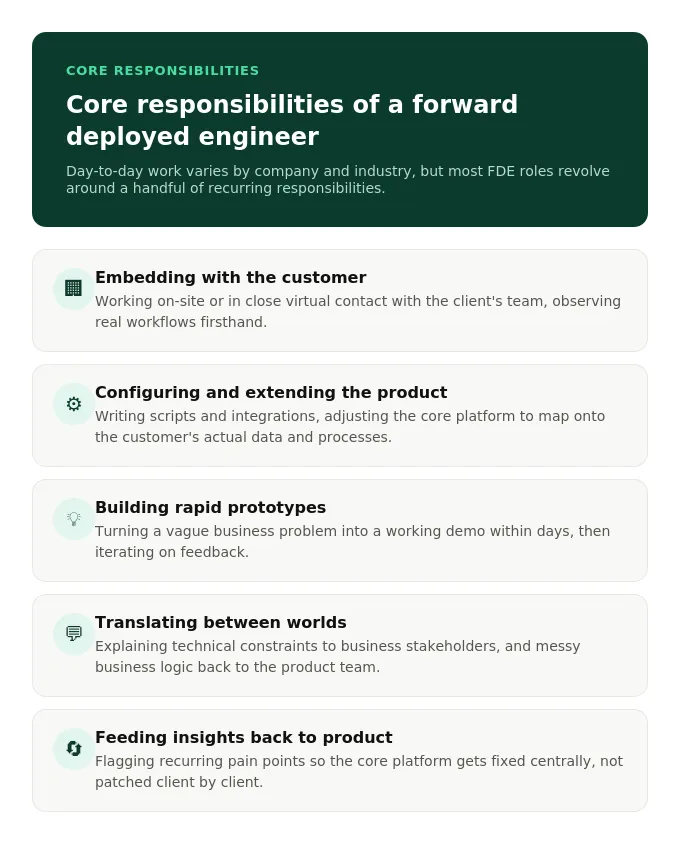
Day-to-day work varies by company and industry, but most FDE roles revolve around a handful of recurring responsibilities.
- Embedding with the customer: working on-site or in close virtual contact with the client’s team, often sitting alongside analysts, traders, or operations staff to observe real workflows firsthand.
- Configuring and extending the product: writing scripts, building integrations, and adjusting the core platform so it maps onto the customer’s actual data and processes.
- Building rapid prototypes: turning a vague business problem into a working demo within days, then iterating based on immediate feedback.
- Translating between worlds: explaining technical constraints to business stakeholders and, just as often, explaining messy business logic back to the core product team.
- Feeding insights back to product: flagging recurring customer pain points so the central engineering org can eventually bake fixes into the core platform instead of patching them client by client.
Configuration Over Custom Coding — Usually
A common misconception is that FDEs are just contractors writing custom software for one client. Most forward deployed roles actually favor configuration and low-code extension of an existing platform over building things from scratch. That keeps the client on a supported product rather than a bespoke fork that nobody outside the engagement can maintain. That said, when the platform genuinely can’t do something the client needs, a good FDE will write the missing piece — then push to get it generalized.
Living Inside the Client’s Constraints
Regulated industries add another layer. In banking or trading, an FDE might have to work within strict data-residency rules, legacy core banking systems, or compliance sign-offs that a typical SaaS deployment never touches. Anyone building embedded technical teams for regulated fintech clients ends up dealing with the same friction points that show up in fintech software development more broadly — data governance, audit trails, and integration with systems that were never designed to talk to each other.

Turn Business Requirements Into Working Fintech Software With Itexus
Itexus supports financial software projects from early discovery through development, integrations, testing, and production support.
Need Engineers Who Can Work Across Technical and Business Requirements?
Itexus can help with:
- fintech consulting and product discovery
- custom financial software development
- API and legacy system integrations
- cloud and DevOps engineering
- testing and software maintenance
 Contact Itexus to discuss your product and technical requirements.
Forward Deployed Engineer vs. Traditional Software Engineer
It helps to see the two roles side by side, since the differences explain why FDE hiring pools skew toward a specific kind of person.
| Dimension | Traditional Software Engineer | Forward Deployed Engineer |
|---|---|---|
| Primary location | Company office or remote, working on internal roadmap | Embedded with a customer, often on-site |
| Scope of work | Features defined by product management | Whatever the client actually needs to succeed, defined jointly |
| Feedback loop | Sprint cycles, backlog grooming | Immediate, often same-day, from the client using the tool |
| Success metric | Shipped features, code quality, velocity | Customer outcomes and adoption of the product |
| Required soft skills | Collaboration with internal teams | Client relationship management, communication under pressure |
| Travel | Rare | Frequent, sometimes constant |
Skills That Make a Strong Forward Deployed Engineer
Technical skill alone doesn’t cut it in this role. Companies hiring for FDE positions tend to look for a specific blend of traits.
- Strong generalist engineering ability — comfortable across the stack, since there’s rarely a specialist team on-site to hand off to.
- Comfort with ambiguity — client requirements often arrive half-formed, contradictory, or verbally, not as a neat spec document.
- Client-facing communication — explaining a technical limitation to a non-technical stakeholder without sounding condescending or evasive.
- Fast prototyping instincts — knowing when a rough demo beats a polished but slow-to-build solution.
- Domain curiosity — genuine interest in how the client’s business actually operates, whether that’s trading desks, hospital logistics, or lending operations.
- Resilience — travel fatigue and constant context-switching between clients are real, common complaints in this career path.
A Day in the Life
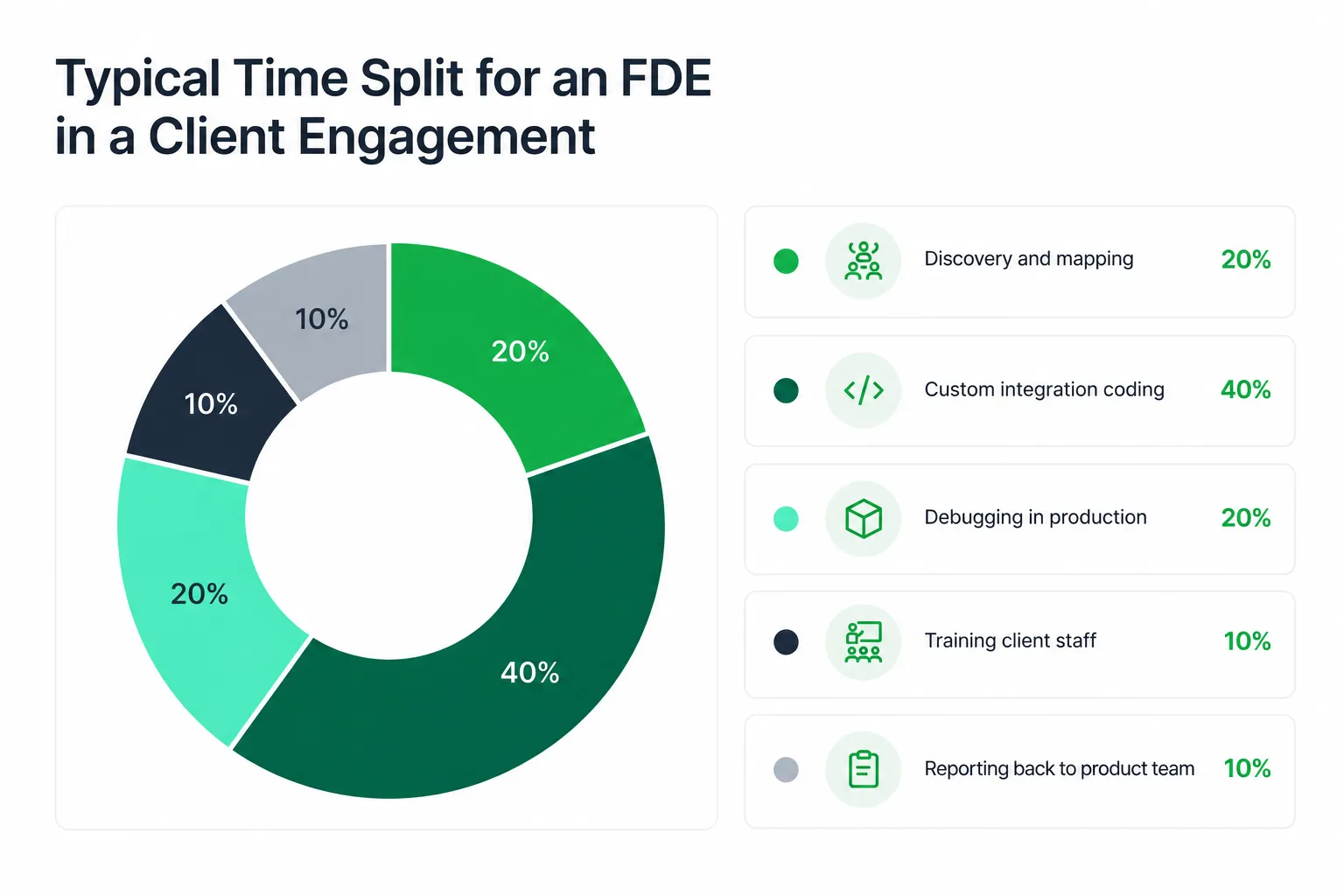
Mornings often start with a stand-up alongside the client’s own team, not the FDE’s home company. From there, the day might involve pulling sample data to test an integration, sitting in on a trading desk’s workflow to see where a tool breaks down, or demoing a small fix built the night before. Evenings sometimes get eaten up writing internal reports back to the core product org, since one of the quieter parts of the job is making sure lessons learned with one client don’t stay siloed with that one client.
Here’s the thing though — no two days look alike, and that’s precisely why the role appeals to engineers who get bored doing the same sprint ritual every two weeks.
Why Companies Are Adopting the Forward Deployed Model
The model earns its keep in industries where the gap between “product as sold” and “product as needed” is wide and expensive to ignore. Fintech is a textbook example. A digital lending platform might work beautifully in a demo environment, then run into a wall the moment it meets a client’s decade-old core banking system or a jurisdiction-specific compliance rule.
Companies building digital lending systems or trading platforms for enterprise clients often end up doing informal forward deployed work whether they call it that or not — sending engineers to sit with a bank’s IT team, trace an integration failure, and patch it in near real time. The same logic applies to Banking-as-a-Service rollouts, where every partner bank has slightly different rails, and to white-label banking platforms that need heavy customization per client brand.
Pros and Cons of the Forward Deployed Engineer Path
| Pros | Cons |
|---|---|
| Direct visibility into how customers actually use the product | Heavy travel and unpredictable schedules |
| Fast, tangible feedback loops compared to backlog-driven work | Emotional toll of constant relationship management |
| Broad skill development across engineering, sales, and consulting | Risk of building one-off fixes that never scale |
| Often higher compensation than equivalent internal engineering roles | Less time for deep, focused technical craftsmanship |
| Strong career pipeline into sales engineering, product, or founding roles | Success metrics can feel vague or client-dependent |
Is Forward Deployed Engineering a Good Career Move?
For engineers who like variety and don’t mind travel, it can be a genuinely rewarding path — one that builds business fluency most pure engineering roles never touch. It also tends to open doors into product management, sales engineering, or even founding a startup later, since FDEs accumulate a rare mix of technical depth and firsthand market insight.
It’s not for everyone, though. Engineers who prefer deep, uninterrupted focus on a single codebase, or who dislike client interaction, often find the constant context-switching draining rather than energizing. The honest answer is that fit matters more than talent here — plenty of excellent engineers would be miserable in this role, and that’s fine.
Wrapping Up
A forward deployed engineer is, at its core, a bridge — between a product’s theoretical capabilities and the messy reality of how a specific customer actually operates. That bridge role has become increasingly valuable as software eats industries that were never designed around clean APIs and predictable data, banking and lending included.
Companies weighing whether to build this kind of embedded delivery capability in-house, or to bring in a partner who already runs this playbook, might find it useful to look at how experienced teams structure that engagement. Reviewing a development process built around close client collaboration or browsing a portfolio of completed fintech projects can offer a clearer picture of what “close to the customer” delivery actually looks like in practice.